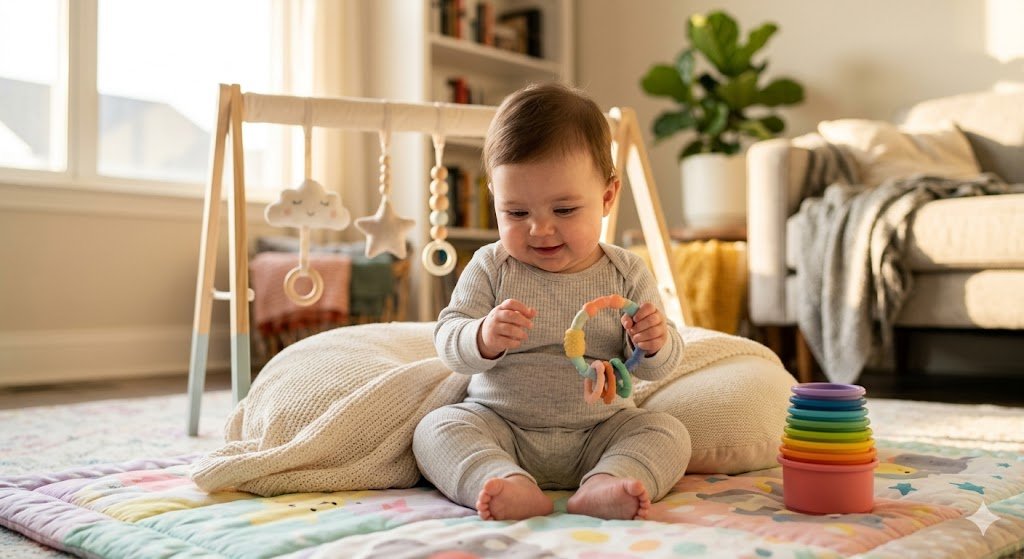
Looking for the best toys for 3-6 month old babies? Between three and six months, your baby is hitting exciting milestones — steadier head control, intentional reaching, early grasping, and lots of mouthing. The best toys 3-6 months are simple, easy to grab, and give instant feedback.
I tested many toys during this stage with my daughter and kept only the ones she actually used more than twice. Here are the six categories worth buying, with specific product picks for every budget.
What’s Happening at 3-6 Months
- Steadier head and neck; longer tummy time sessions
- Intentional reaching and hand-to-mouth exploration
- Early grasp-and-release, beginning two-hand transfers
- Cause-and-effect discovery (shake = sound!)
- Loves faces, mirrors, bold colors, and gentle sounds
Every baby develops on their own timeline. These milestones are general guidelines, not a checklist — if you have concerns about your baby’s development, talk to your pediatrician.
The right toys at this stage match these emerging skills — so your baby succeeds, stays engaged, and you buy less.
Best Toys 3-6 Months: Floor Mirror
If there’s one toy that transformed tummy time for us, it’s a floor mirror. Babies this age are fascinated by faces, and seeing their own reflection gives them a reason to lift their head and hold it longer.
Prop the mirror at baby’s chest level during tummy time. Narrate what they see: “Who’s that? That’s you!” Even 3 minutes of mirror play counts as a win.
Our picks:
- Sassy Tummy Time Floor Mirror Top Pick — $12. Lightweight, shatter-proof, stands on its own. The black-and-white frame adds extra visual stimulation. This single toy doubled my daughter’s tummy time tolerance.
- Skip Hop Silver Lining Cloud Mirror — $15. Slightly larger, softer look. Good if you also want it as a car seat toy later.
Best Toys 3-6 Months: Easy-Grip Rattles
At 3-6 months, your baby is learning to reach and grab intentionally. The right rattle rewards their effort with instant feedback — a sound, a texture, a sense of “I did that!”
Offer the rattle during floor play or reclined time. Try hand-to-hand transfers: place it in one hand, see if baby passes it to the other. Shake-pause-shake games build anticipation.
Our picks:
- Manhattan Toy Winkel Rattle & Teether Top Pick — $15. Still the champion. If you didn’t buy it at 0-3 months, get it now. The loops are perfect for this stage’s developing grip, and it becomes a teether when gums get sore.
- HABA Clutching Toy Rainbow Ball — $12. Beautiful wooden beads with elastic — easy to grab from any angle. A step up in complexity from the Oball.
- Bright Starts Oball Shaker Budget — $6. The holes make it nearly impossible to drop. Great for car seats and strollers too.
Soft Sensory Ball
Rolling a ball toward your baby encourages reaching, bilateral hand use, and early body awareness. Different textures add tactile exploration to every grab.
Roll the ball slowly toward baby during floor time. Let their hands meet it naturally. Try two-hand holds. As they get steadier, increase the distance.
Our picks:
- Infantino Textured Multi Ball Set (6-pack) Top Pick — $10. Six different textures at under $2 each. My daughter had clear favorites — the bumpy one and the ridged one got the most attention.
- Bright Starts Oball Original Budget — $6. The classic. Flexible, easy to grab through the holes, lightweight enough for small hands. Also great in the bath.
Cloth & Crinkle Books
This is the sweet spot for introducing “reading” — not for the words, but for the sensory experience. Crinkle sounds, different textures, and simple high-contrast images all capture attention.
“Read” by pointing and naming pictures. Let baby mouth the pages (they will). Crinkle pages during tummy time for extra motivation.
Our picks:
- Melissa & Doug K’s Kids Flip Fish Top Pick — $13. Not a book exactly — it’s a plush fish where each “scale” flips to reveal different textures, crinkles, and a mirror. More interactive than a flat book, and it holds attention longer.
- Jellycat Soft Tails Book (Farm or Jungle) — $18. Beautiful design with fabric tails to pull. Higher price but exceptional quality and a popular baby shower gift.
Play Mat & Tummy Time Props
By now your baby can handle longer tummy time sessions. A good play mat with a few strategic props turns tummy time from a chore into a game.
3-5 sessions per day, short is fine. Place a mirror or toy just out of reach to spark movement. Avoid overhead gym toys if they distract from tummy time practice.
If you already have a play mat/gym from 0-3 months, you don’t need a new one. Just rotate the toys you place on it.
Teether (Optional, 4-6 Months)
Many babies start teething in this window. You’ll know — everything goes in the mouth, drool production doubles, and gums look swollen. A simple silicone teether provides relief.
Our picks:
- Itzy Ritzy Teething Tube Top Pick — $8. Hollow tube design is easy for small hands. Food-grade silicone, can be chilled for extra relief. Tested #1 across multiple review sites.
- Frida Baby Not-Too-Cold-to-Hold Teether — $10. Clever design with a built-in handle that stays warm while the teething part chills. Baby can hold it comfortably without freezing their fingers.
Want the full vetted list? Both picks above are solid choices for this age. For a deeper roundup — including a CPSC recall check, four expert panel cross-references, and five teether categories to skip entirely — see my complete best teething toys 2026 guide. If you’re also wondering when each tooth actually shows up, the baby teething timeline covers all 20.
Play & Rotation Tips for 3-6 Months
- Short and frequent beats long and rare — think 5-10 minutes, many times a day.
- Off-center placement: Place toys slightly off-center to encourage rolling and weight shifting.
- Two-hand holds: Invite ball or rattle play to build midline skills.
- Narrate actions (“You reached!”) to connect movement with language.
- Rotate 2-3 toys at a time. Too many choices = overwhelm.
Your voice is still the best toy. Short, calm narration builds language foundations at every stage.
How Many Toys Does a 3-6 Month Old Need?
Not many. Your baby is happy with 3-4 items within reach at any time. Here’s a realistic starter set:
- 1 floor mirror ($12-15)
- 1 rattle/teether ($6-15)
- 1 set of sensory balls ($6-10)
- 1 crinkle book or fish ($13-18)
- 1 teether — if teething has started ($8-10)
Budget path: ~$37 — Sassy mirror + Oball shaker + Oball ball + Flip Fish
Premium path: ~$70 — Sassy mirror + Winkel + Infantino balls + Jellycat book + Itzy Ritzy teether
Both paths work great — babies care about interaction, not price tags.
Prices are approximate and may vary — check current listings before purchasing.
Safety & Cleaning
- Everything goes in the mouth at this age. Check weekly for cracks, loose parts, and worn seams.
- Fabric toys: machine wash. Plastic/silicone: hot soapy water.
- Floor mirror and toys: supervised floor use only, never in the crib.
- No strings, cords, or small detachable parts.
For detailed safety guidance, see the AAP toy safety guidelines and CDC 4-month milestones.
The Bottom Line
The 3-6 month stage is when play starts to get really fun. Your baby is discovering they can make things happen — grab, shake, reach, roll. A handful of well-chosen best toys 3-6 months lets them practice these new skills without overwhelm.
Coming from the earlier stage? See our Best Toys for 0-3 Month Babies.
Ready for what’s next? Check out Best Toys for 6-9 Month Babies.
This article is for informational purposes only and isn’t a substitute for personalized medical advice from your pediatrician.
Browse Best Toys by Age