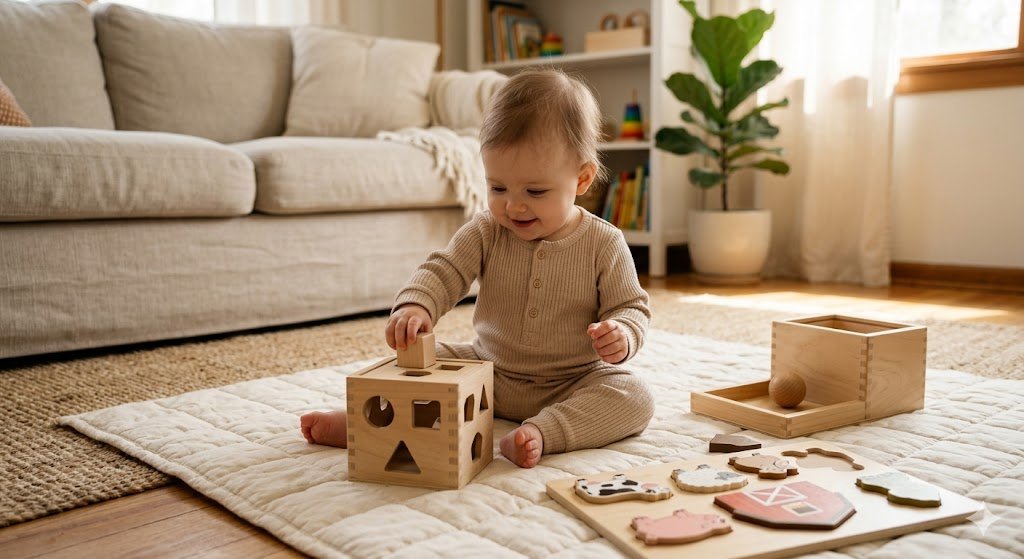
The best toys 9-12 months support a huge leap in problem-solving, movement, and communication. Your baby is cruising along furniture, pointing at things, maybe taking first steps, and starting to understand that objects exist even when hidden. The toys that work best now are the ones that challenge their brain just enough to keep them coming back.
I watched my daughter go from “everything in the mouth” to “actually figuring things out” during these three months. Here are the four categories that kept her engaged the longest, with specific product picks.
What’s Happening at 9-12 Months
- Cruising along furniture, possibly first steps
- Pincer grasp refined – picking up Cheerios, turning pages
- Object permanence developing – knows hidden things still exist
- Early problem-solving – fitting shapes, opening lids
- First words emerging (mama, dada, ball, more)
- Pointing, waving, clapping – social communication exploding
Every baby develops on their own timeline. These milestones are general guidelines, not a checklist‚ if you have concerns about your baby’s development, talk to your pediatrician.
The best toys 9-12 months give your baby problems they can actually solve – with just enough challenge to feel proud.
Best Toys 9-12 Months: Shape Sorters
Shape sorters are the ultimate problem-solving toy at this age. Your baby is learning that specific shapes fit specific holes – and the satisfaction of getting it right is written all over their face.
Our picks:
- Melissa & Doug Shape Sorting Cube Top Pick – $15. Wooden cube with 12 shapes and swap-out lids. The genius is that you can start with the easiest lid (circles only) and gradually increase difficulty. We used this for a solid 8 months.
- Hape First Sort & Stack – $18. Beautiful wooden design with shapes that double as stacking toys. Slightly more premium feel, and the colors are gorgeous.
Best Toys 9-12 Months: Object Permanence Box
When your baby drops a ball into a hole and it “disappears” then reappears in the drawer below – that’s a mind-blowing moment. Object permanence boxes teach the concept that things don’t vanish just because you can’t see them. This is genuinely one of the most important cognitive milestones of the first year.
Our picks:
- Lovevery Object Permanence Box Top Pick – $36. Beautifully made, smooth drawer action, perfect ball size. This was the toy my daughter played with more than any other single item between 9-12 months. Worth every penny.
- Adena Montessori Ball Drop Box Budget – $18. Same concept at half the price. Slightly rougher finish but functionally identical. Great if you’re trying the Montessori approach on a budget.
Pounding Bench
Babies this age LOVE to bang things. A pounding bench channels that energy into something productive – hand-eye coordination, cause-and-effect, and the deeply satisfying thunk of a peg going through.
Our picks:
- Hape Pound & Tap Bench with Xylophone Top Pick – $25. Pounding bench on top + pull-out xylophone underneath. Two toys in one. The xylophone slides out for standalone music play. Hape’s wood quality is excellent.
- Melissa & Doug Deluxe Pounding Bench Budget – $15. Classic design, bright non-toxic colors. No xylophone but the pegs are satisfyingly chunky. Simpler = less distraction for some babies.
Chunky Puzzles
First puzzles are a gateway to spatial reasoning. At 9-12 months, baby is ready for puzzles with big, chunky knobs and 3-5 pieces maximum. The knobs are key – they let developing fingers actually lift and place pieces.
Our picks:
- Melissa & Doug Farm Chunky Puzzle (8-piece) Top Pick – $10. Thick wooden pieces that stand up on their own – so they double as animal figures for pretend play. The farm theme is universally loved. Start with 3-4 animals, add more as baby improves.
- Hape Geometric Shapes Knob Puzzle – $10. Simple circles, squares, and triangles. Less exciting than farm animals but actually better for shape recognition. Good companion to the shape sorter.
Play Tips for 9-12 Months
- Frustration is part of learning – but only in small doses. If baby gets upset, simplify the task (fewer shapes, fewer pieces) rather than doing it for them.
- Celebrate the process, not just success. “You’re trying!” matters as much as “You did it!”
- Follow pointing. When baby points at something, name it. This builds vocabulary fast.
- Containers are free toys. Putting things in boxes, taking them out, dumping, refilling – this IS learning.
- Books with flaps (like “Where’s Spot?”) are perfect for object permanence practice.
Language tip: Narrate with short phrases. “Ball IN. Ball OUT. Where did it go? THERE it is!” Repetition + emotion = faster word learning.
How Many Toys Does a 9-12 Month Old Need?
3-4 items out at a time. Here’s a realistic set:
- 1 shape sorter ($15-18)
- 1 object permanence box ($18-36)
- 1 pounding bench ($15-25)
- 1 chunky puzzle ($10)
Budget path: ~$58 – M&D Shape Cube + Adena Ball Drop + M&D Pounding Bench + M&D Farm Puzzle
Prices are approximate and may vary‚ check current listings before purchasing.
Premium path: ~$90 – M&D Shape Cube + Lovevery Box + Hape Pound & Tap + M&D Farm Puzzle + Hape Geometric Puzzle
Plus stacking cups and Dimpl from 6-9 months still get heavy daily use.
Safety at 9-12 Months
- Cruising baby = bumps and falls. Pad sharp furniture edges, anchor bookshelves.
- Check puzzle pieces for splintering or chipped paint weekly.
- Pounding bench hammers are safe-sized but still supervise – babies swing wildly.
- Small object test: if it fits through a toilet paper roll, it’s a choking hazard.
For detailed safety guidance, see the AAP toy safety guidelines and CDC 12-month milestones.
The Bottom Line
The 9-12 month stage is when your baby becomes a little problem-solver. They’re fitting, sorting, dropping, and figuring things out – and the pride on their face when they succeed is priceless. The best toys 9-12 months give them just-right challenges that grow with them.
Coming from the earlier stage? See our Best Toys for 6-9 Month Babies.
Ready for toddlerhood? Check out Best Toys for 1-2 Year Olds.
This article is for informational purposes only and isn’t a substitute for personalized medical advice from your pediatrician.
Browse Best Toys by Age