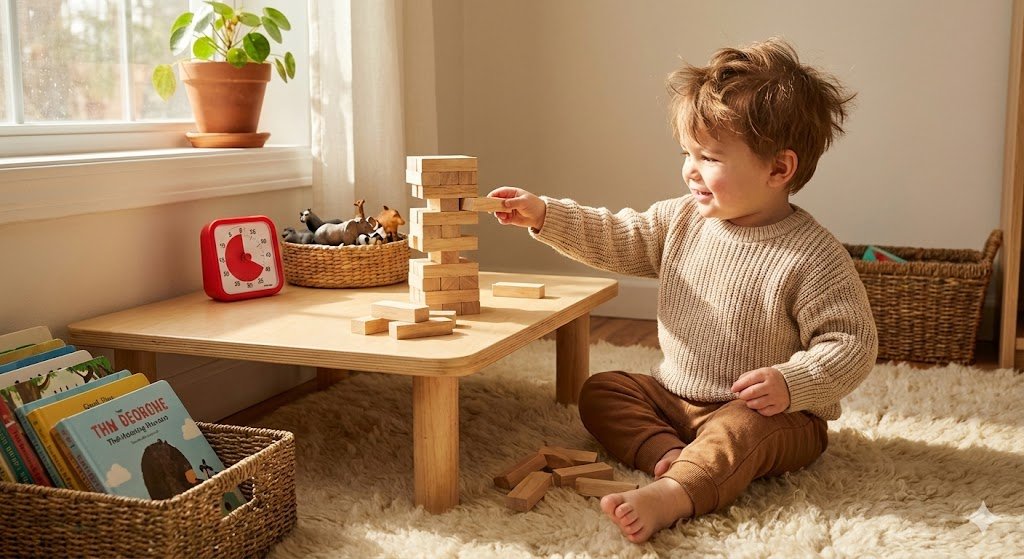
The 30-Second Overview
- The Biology: A 4-year-old’s focus maxes out at roughly 16 minutes.
- The “Sensory Diet”: Why “Heavy Work” (pushing/pulling) must happen before seated work.
- The “Body Double”: Why sitting quietly next to them changes everything.
- The Hidden Killers: How background noise and visual clutter drain attention.
- The Checklist: Is it a focus issue? Or is it hunger, sleep, or over-scheduling?
Understanding toddler focus can feel like a mystery when your child acts like their chair is made of lava. Is it just me, or does your child also slide off their chair the second you sit down for dinner? Last week, I watched my 4-year-old try to eat his pasta while upside down. It’s easy to think, “Why can’t he just sit still? Why doesn’t he listen?”
But here’s the truth I learned after diving into child development research: Behavior is communication.
When our kids are squirming, wandering off, or ignoring us, their brains aren’t trying to be difficult. They are working overtime to develop a massive skill called Self-Regulation. And frankly? It’s exhausted work.
If you are tired of the constant reminders to “pay attention,” this deep-dive guide is for you. Let’s look at what is really going on, and the practical tools to fix it.
1. The Reality Check: Adjusting Your Expectations
Before we fix the behavior, we have to fix our expectations. The prefrontal cortex (the brain’s CEO responsible for focus) is under heavy construction until age 25.
The “Focus Formula”: A general rule of thumb is 2–5 minutes of focus per year of age.
| Age | Realistic Focus Time | What Success Looks Like |
|---|---|---|
| 3 Years | 6 – 12 Minutes | Building a tower, washing toy cars. |
| 4 Years | 8 – 16 Minutes | Sorting Lego colors, drawing a “map.” |
| 5 Years | 10 – 20 Minutes | Stringing beads, listening to a full story. |
| 6 Years | 12 – 30 Minutes | Working on a complex puzzle or Lego set. |
Note: If your child is tired, hungry, or over-stimulated, cut these numbers in half.
2. The Missing Link: The “Sensory Diet” & Heavy Work
This is the #1 thing most parents miss. We cannot expect stillness from a body that is screaming for movement.
Occupational Therapists use a concept called “Heavy Work” (proprioceptive input). Activities that involve pushing, pulling, or lifting release calming chemicals in the brain.
Try this “Focus Prep” routine (5 mins before a seated task):
- The Burrito Roll: Wrap your child tight in a blanket and pretend they are a burrito. The deep pressure is instantly calming.
- Wall Pushes: “Can you push this wall down? Push harder!”
- Animal Walks: Bear crawl to the table (hands and feet on floor).
- The Helper: Have them carry a heavy laundry basket or grocery bag.
The Strategy: Get the wiggles out purposefully so the brain has space to settle.
3. The “Body Double” Technique
Have you ever noticed your child plays beautifully when you are sitting right there, but chaos erupts the moment you walk away to do dishes?
This isn’t manipulation; it’s a need for Co-Regulation. In the ADHD community, this is called “Body Doubling.” Your calm presence acts like an external battery for their focus.
- How to do it: You don’t need to play with them. Just sit nearby. Read a book or fold laundry next to them while they play.
- The phrasing: “I’m going to sit right here and drink my coffee while you build that tower.”
4. Audit Your Environment: The Hidden Distractions
A toddler’s brain is like a sponge—it soaks up everything. It cannot filter out background noise like an adult brain can.
Focus Killers:
- The TV in the background: Even if they aren’t watching it, the flickering light and sound drain their processing power. (Read more about managing screen time here).
- Visual Clutter: A toy bin with 50 mixed-up pieces is overwhelming. It screams “mess,” not “play.”
The Fix: Toy Rotation & Invitations
- Rotate: Pack 50% of toys away. Rotate them every 2 weeks.
- Invite: Set up a simple scene. Put 3 cars in a line. Place a piece of paper with one crayon on the table. Make it easy for them to say “Yes!” to the activity.
5. Tools of the Trade: Visuals Over Vocals
Our voices turn into “white noise” after a while. Use visual tools to save your breath.
- Visual Timer (The Red Clock): Use a Time Timer so they can see time passing. “When the red is gone, it’s bath time.”
- Visual Schedules: Instead of nagging “Brush teeth! Shoes on!”, make a simple chart with pictures. Let them check it off. It shifts control from you to the routine.
6. The “Salami Slice” Method for Tasks
“Clean your room” is a terrifying command to a 3-year-old. They don’t know where to start, so they give up (or melt down).
Slice the task into tiny, thin slices:
- “Pick up the blue trucks.” (Done? High five!)
- “Now, put the books in the basket.”
- “Last one: put the stuffed animals on the bed.”
Micro-wins build momentum.
💬 Final Thoughts
Building focus isn’t a sprint; it’s a marathon. Some days will be magical, and some days you will find your child licking the window instead of putting on their shoes.
And that is okay. You are planting seeds. Every time you help them regulate, every time you offer a “heavy work” break, you are wiring their brain for future success.
Question for you:
What is the one time of day your child struggles to focus the most? Morning rush or dinner time? Let me know in the comments below! 👇