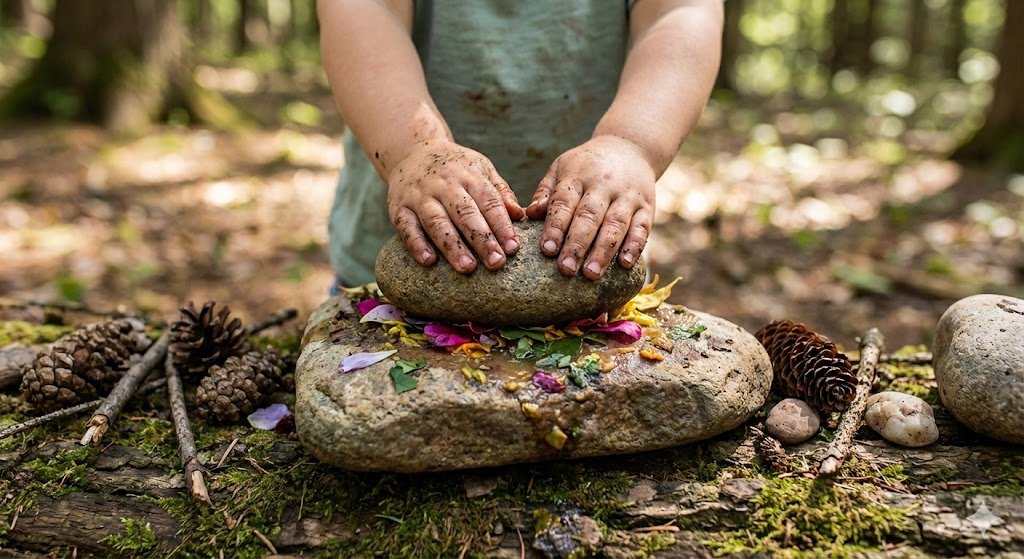
The exhaustion isn’t just about the mess; it’s about the feeling that we are constantly “performing” creativity—following a manual to produce a result that looks exactly like everyone else’s. But for a toddler, real art isn’t about the result. It’s about the exploration of Transient Art: creations that are made to be used, moved, and eventually, to disappear.
1. Why “Impermanence” is a Brain Booster
When we remove the glue, we remove the “fear of doing it wrong.” This shifts the brain from compliance to active experimentation.
Executive Function (EF)
In a “no-stakes” environment, toddlers are free to experiment with trial and error. According to the Harvard Center on the Developing Child, these experiences are foundational for building cognitive flexibility.
Loose Parts Theory
A plastic toy has one fixed function. Nature provides what architects call “Loose Parts.” As originally defined by Simon Nicholson, environments rich in movable variables invite much higher levels of creative interaction.
2. The “Raw” Experiments (Ages 1–3)
The American Academy of Pediatrics (AAP) emphasizes that play is essential because it contributes to cognitive and emotional well-being.
A. The Pigment Lab
Find two rough stones and some wilted petals. Show your child how to grind and pound them. Watching the color “bleed” out is a foundational lesson in cause and effect.
B. Shadow Tracing
On a sunny balcony, place a branch on the ground. Use pebbles to trace the edge of the shadow. This helps toddlers process abstract spatial relationships as they see the “art” move with the sun.
C. Gravity Mandalas
Draw a circle in the dirt. Provide sticks and stones. No adhesives allowed. They must stack and balance to keep the pattern alive. When it falls, the play begins again.
3. The Urban Survival List
Nature isn’t just in the forest; it’s in your grocery bag. These “scraps” are world-class Loose Parts:
| Supermarket Scrap | Developmental Value | The Activity |
|---|---|---|
| Celery Base | Pattern Recognition | The cross-section looks like a rose. Use water to “stamp” on dry pavement. |
| Corn Husks/Silk | Tactile Contrast | Comparing the papery, dry husk vs. the soft silk is a sensory goldmine. |
| Red Cabbage | Chemical Curiosity | Grind it to see deep purple bleed; watch it change if it touches lemon juice. |
| Dried Pulses | Fine Motor Precision | Pinc-gripping small lentils to arrange patterns builds hand-eye coordination. |
| Old Rosemary | Olfactory Art | Crushing herbs releases scents that activate the brain’s limbic system. |
Ready to let go of the glue?
This weekend, leave the craft kit in the drawer. Grab an empty basket, head outside, and look for the beauty that isn’t meant to last.
Join the conversation: What “useless” thing did your child find today that turned into an hour of focus?