3 Play-Based Ways to Support Development at Home
I remember the first time I sat down with a milestone checklist for my two-year-old.
Can he group shapes yet? Does she understand two-step instructions? Why is the toddler next door already identifying hexagons while mine is still trying to eat the crayon?
If you’ve ever gone down that mental spiral, you’re not alone. As parents, we want the best for our children.
But somewhere along the way, cognitive development quietly turns into a series of mini-exams. We start checking instead of observing. Lately, I’ve had a shift in perspective. I stopped treating milestones like a to-do list and started seeing them as a window—a way to understand how my child’s brain is growing, at their own pace.
✓ A Gentle Snapshot: Common Abilities at Age Two
Before we talk about activities, here’s a calm, no-pressure snapshot of what cognitive abilities many two-year-olds begin to show:
- Follows simple two-step directions occasionally
- Sorts objects by one feature (color, size, or shape)
- Looks for hidden objects (object permanence)
- Uses one object to represent another in play
- Begins matching familiar colors or shapes in real-life settings
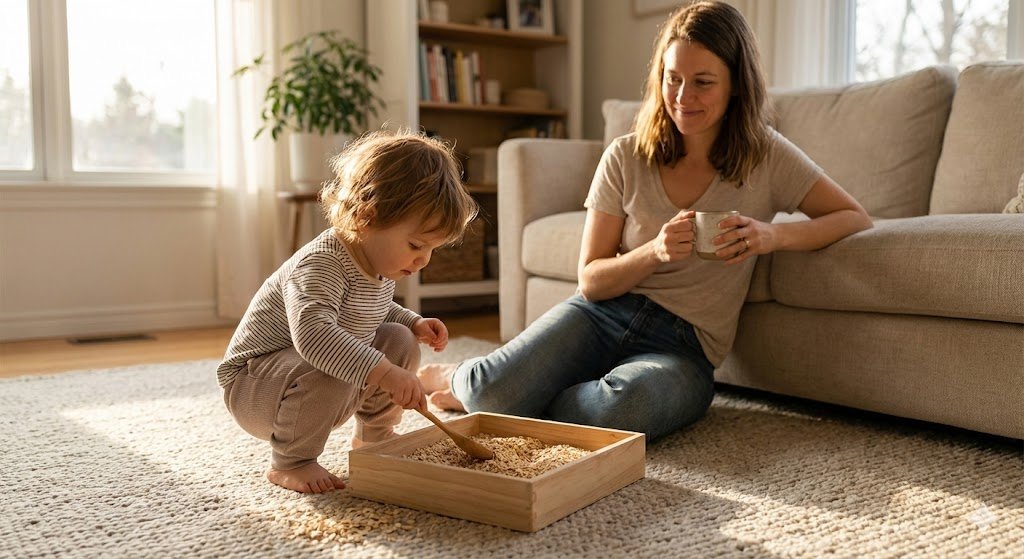
1. Sensory Bins
Problem Solving Through “Messy” Logic
What You Need
- • A shallow container
- • Rolled oats, crushed cereal, or pasta
- • A few small toys or scoops
What It Supports
- • Spatial awareness
- • Cause-and-effect reasoning
- • Object permanence
Sensory play is one of the best ways to support cognitive development at this age. For ready-made options that encourage exploration and focus, check out our guide to the best toys for 1-2 year olds.
2. Pretend Play
Building Symbolic Thought
When your toddler hands you a block and says “Hello?” like it’s a phone, that’s a major cognitive leap. This is symbolic thought.
“Oh! Who’s calling?”
3. Color Scavenger Hunt
Executive Function in Action
This supports Executive Function: Holding a goal in mind, filtering distractions, and categorizing.
“Can you find something blue and bring it to the sofa?”
🍼 Tracking Milestones & Development
Want to see how your child’s cognitive, physical, and emotional skills grow by age?
Explore Baby & Toddler Development (0-3) Hub →