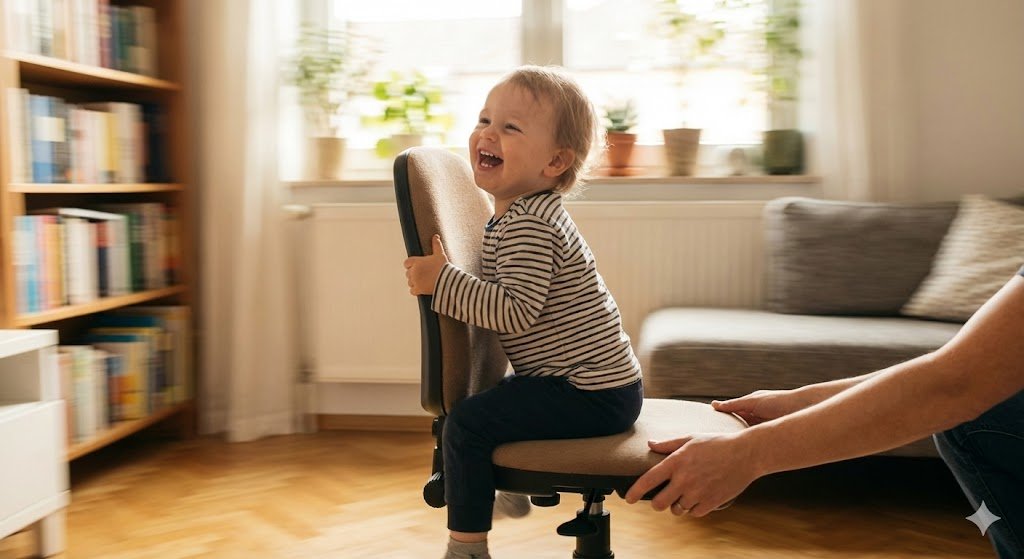
A Familiar Scene
More Than a Game: The Quiet Link to Reading
Spinning may seem worlds away from reading—but the vestibular system is closely connected to eye movement control.
When this system is well-organized, it helps support smooth eye tracking—an important skill for later reading, such as moving the eyes steadily from left to right across a page. Research highlighted by the National Institutes of Health (NIH) suggests that vestibular function is intrinsically tied to the stability of our visual field during movement.
This doesn’t mean spinning “teaches” a child to read. But for some children, well-regulated vestibular input supports the underlying body awareness and attention skills that reading will later depend on.
Long before a child ever holds a book, this quiet foundation is already being built.
Simple, Intentional Movements at Home
In our home, we lean toward sensory experiences that don’t require special equipment. The most effective tools are often already in your living room.
1. The Swivel Chair (Office Chair)
A slow, intentional spin is a classic for a reason. Try five slow rotations in one direction, then pause, then five in the other direction. This keeps the nervous system balanced, rather than overstimulated.
2. The Floor Roll (Log Roll)
Rolling slowly across a rug offers a different plane of movement. It’s grounding, calming, and supportive of core stability.
3. The “Bear Hug” (Deep Pressure Reset)
If your child seems overly “high” or dysregulated after spinning, a firm, full-body hug can act as a natural reset button. Deep pressure helps the nervous system re-organize and settle.
How Much Is Too Much? A Gentle Boundary
Every child’s sensory threshold is different—and it can change from day to day.
Spinning is usually okay when:
- The child can stop on their own
- They recover quickly
- They remain playful and regulated afterward
It’s a sign to pause when:
- It leads to frequent falls or injuries
- Nausea, paleness, or distress occurs
- Dysregulation lasts a long time afterward
- It interferes with daily life or sleep
This isn’t about restriction—it’s about supporting regulation, not overwhelm.
A Note on Observation
The goal isn’t to make children spin. It’s to offer opportunities—and observe how their body responds.
Most of the time, a child’s nervous system is incredibly wise. And when it needs help, gentle structure and co-regulation make all the difference.
🍼 Tracking Milestones & Development
Want to see how your toddler’s sensory and physical skills grow by age?
Explore Baby & Toddler Development (0-3) Hub →