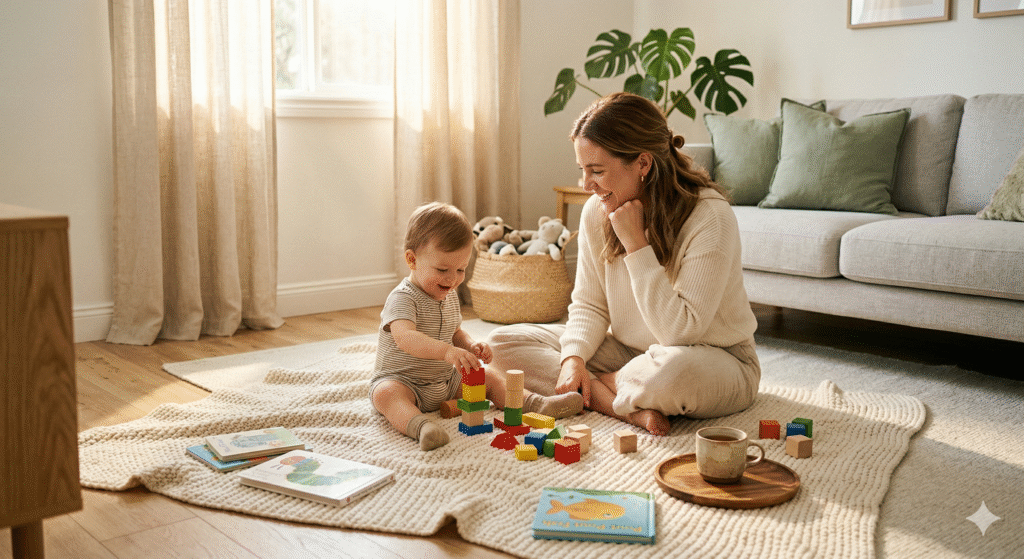
Last Saturday morning, I was trying to get my kids out the door to the park. One was looking for a missing shoe. Another was asking me something about clouds. And the littlest one had plopped down on the hallway floor to watch an ant crawl along the baseboard.
“Come on, guys, let’s GO.” I heard myself say it in that voice — the one that means I need everyone moving right now. And then I caught myself. Why? We were going to the park. On a Saturday. Nobody was waiting for us. There was literally no reason to rush.
So I sat down on the floor. We watched the ant together. Maybe three minutes passed. And in those three minutes, something shifted — a little laugh, a tiny hand pointing at the ant’s path, and I realized this was the most connected I’d felt with my kid all morning.
I keep seeing this phrase everywhere lately — slow motherhood. It’s all over Pinterest (apparently searches are up like 300% this year?), and honestly, I think I know why. We’re all just… tired. Tired of rushing. Tired of optimizing every snack and every activity. Tired of feeling like we’re failing at something that’s supposed to come naturally.
So What Is Slow Motherhood?
Slow motherhood is not about doing less. It’s about being more present in the things you’re already doing.
The idea grew out of the broader Slow Movement — the same one that gave us slow food, slow fashion, slow travel. Applied to parenting, it basically means: stop trying to optimize every moment of your child’s life, and instead move at a pace that actually lets you connect with them.
The way I think about it: it’s the difference between rushing through bedtime so you can finally have “your” time, and actually lingering over that last story because your child’s sleepy voice reading along is something you’ll never get back.
One thing I want to say up front, though — slow motherhood is not the same as gentle parenting. Gentle parenting is more about how you respond to your child’s emotions. Slow motherhood is about the pace of your entire family life.
And it’s definitely not lazy parenting. You’re not checking out. You’re choosing where to check in.
I started thinking about all this because I noticed a pattern in my own life: I was always in a hurry, and I couldn’t really explain why. So I started paying attention. And once I did, the signs were kind of everywhere.
5 Signs You Might Need Slow Motherhood
Slow motherhood isn’t a personality type or a parenting philosophy you have to commit to fully. It’s more like a compass. If you recognize yourself in any of these, it might be pointing you somewhere worth going:
1. You say “hurry up” more than “I love you.” I caught myself doing this the other day. One of my kids was carefully putting on shoes — a skill they’d just mastered — and I was rushing them because we were two minutes behind some schedule I’d made up in my own head.
2. You’re physically present but mentally somewhere else. Your body is at the playground, but your brain is drafting emails, planning dinner, or scrolling through your phone. Your kids can feel the difference. They always can.
3. Weekends feel more exhausting than weekdays. If your Saturdays are a relay race of swim class → birthday party → grocery run → homework, and Sunday is the day you collapse, that’s not a weekend. That’s a second shift.
4. Your child’s first response to boredom is “Can I watch something?” This one stung when I noticed it. It told me something about the environment I’d been creating — one where stillness felt uncomfortable for all of us.
5. You can’t remember the last time you had an unplanned moment with your kids. No destination. No agenda. No activity. Just… being together.
If you’re nodding at more than one of these — yeah, me too. That’s kind of the whole reason I started paying attention to this.
7 Simple Ways to Practice Slow Motherhood — Even on Your Busiest Days
I know what you might be thinking — this all sounds lovely, but I can barely get through a Tuesday. Slow motherhood doesn’t require you to quit your job, move to a farm, or homeschool your children. It’s about finding the cracks in your existing life where slowness can seep in. These are the practices that have made the biggest difference for our family:
1. Start with one slow morning per week
Pick one morning — maybe Saturday — where there’s no alarm, no schedule, and no rushing. Let your kids wake up naturally. Let them decide what happens next. The first time I tried this, one of mine spent 45 minutes building a “restaurant” out of couch cushions and served us pretend pancakes. It was the happiest I’d seen them all week. The second time I tried it, everyone fought for an hour and I ended up hiding in the bathroom wondering why I thought this was a good idea. That’s part of it too. It doesn’t work every time — but the times it does work make up for the times it doesn’t.
2. Create a “wonder walk” ritual
Take a walk where your child leads. They set the pace. They choose when to stop. You follow. For us, this means a lot of squatting down to examine rocks, pointing at every dog we pass, and answering an endless stream of “why” questions. It’s slow and sometimes a little boring — and it’s wonderful.
3. Swap one scheduled activity for free play
I’m not saying cancel everything. But if your child has activities five days a week, try dropping to four and leaving that afternoon completely open. Unstructured play — where kids have to invent their own fun — is where creativity, problem-solving, and independence actually grow.
4. Practice the 10-minute rule
Every day, give your child 10 minutes of completely undivided attention. Phone in another room. No multitasking. Just follow their lead. I’ve noticed that on the days I do this, my kids are actually more willing to play independently afterward — almost like they just needed to fill up their “attention tank” first.
5. Simplify your toy rotation
Fewer toys lead to deeper play. When kids have too many options, they flit from one to the next without really engaging. Try putting most toys away and leaving out just a few open-ended ones — blocks, art supplies, a basket of fabric scraps. Rotate every few weeks. We started doing this and the difference in how long my kids actually stick with something was night and day.
6. Say “yes” to boredom
When your child says “I’m bored,” resist the urge to fix it. Boredom is not a problem to solve — it’s the doorway to imagination. The first five minutes might be whiny. But what comes after — the elaborate games, the invented stories, the weird and wonderful projects — is where the magic lives. Every time I’ve let my kids sit with boredom instead of handing them a screen, they’ve surprised me with what they came up with.
7. Let meals be slow
Stop rushing your kids through dinner. Put away your phone. Don’t clear plates while someone is still eating. Meals are one of the few built-in daily rituals where your whole family is in the same place at the same time. Use them. Ask silly questions. Tell stories about your day. Let your toddler take twenty minutes to eat three bites of pasta. That’s connection, not wasted time.
What Slow Motherhood Is NOT
OK, I need to talk about the elephant in the room. Because whenever someone writes about slowing down, the comment section fills up with: “Must be nice to have the time.”
And honestly? Fair point.
A lot of the “rushing” in modern motherhood isn’t a mindset problem — it’s a system problem. Childcare is absurdly expensive. Parental leave is a joke in most places. Many of us are parenting without a village, without nearby grandparents, without a safety net. When you’re paying overtime fees if you’re late to daycare pickup, “let your child lead the walk home” isn’t advice — it’s fantasy.
I’m not going to pretend I have that figured out. I don’t.
What I will say is this: slow motherhood is not about having more time. It’s about being more intentional with whatever slivers of time you do have. Maybe that’s three minutes watching an ant. Maybe it’s putting your phone on the charger during dinner. It doesn’t have to be big.
And here’s the other thing no one says: slow motherhood also means giving yourself permission to step away. It’s not just about being more present with your kids — it’s about recognizing when you need the slowness. A cup of coffee alone. Five minutes of silence after bedtime before you start the dishes. Slow motherhood includes you, not just them.
It’s not about judging busy moms. It’s not about rejecting modern life. And it’s definitely not about being perfect at being slow (the irony of that would be unbearable).
It’s just about asking yourself, once a day: can I slow down right here, just for a moment?
The Bigger Picture: Why This Matters for Our Kids
Something I keep thinking about: so much of the parenting world tells us our kids need more — more activities, more educational apps, more enrichment, more stimulation. But the child development experts I trust keep saying the same thing in different ways — that what matters most is having a caregiver who’s genuinely present. Not perfect. Just… there.
When we slow down, we give our children the message that they are worth our full attention. We show them that stillness is not the same as laziness. That life doesn’t have to be a race.
I’ve noticed one of my kids is already picking up the rushing habit. Inhaling breakfast to get to the next thing. Asking “what are we doing after this?” before the current activity is even finished. I see myself in that — and it motivates me to model something different.
Slow motherhood isn’t just good for us. It’s the kind of childhood our kids will actually remember.
Not the scheduled stuff. Not the enrichment classes. The ant on the hallway floor. The twenty-minute pasta dinner. The afternoon nobody planned.
That’s the stuff that sticks.
Want Screen-Free Activity Ideas for Your Slow Days?
Once you start building slow moments into your week, the hardest part is figuring out what to actually do with that unstructured time. That’s exactly why I made these — grab our free Screen-Free Activity Cards: 30 simple, mess-rated activities sorted by age (0–6) that need zero prep and zero screens.