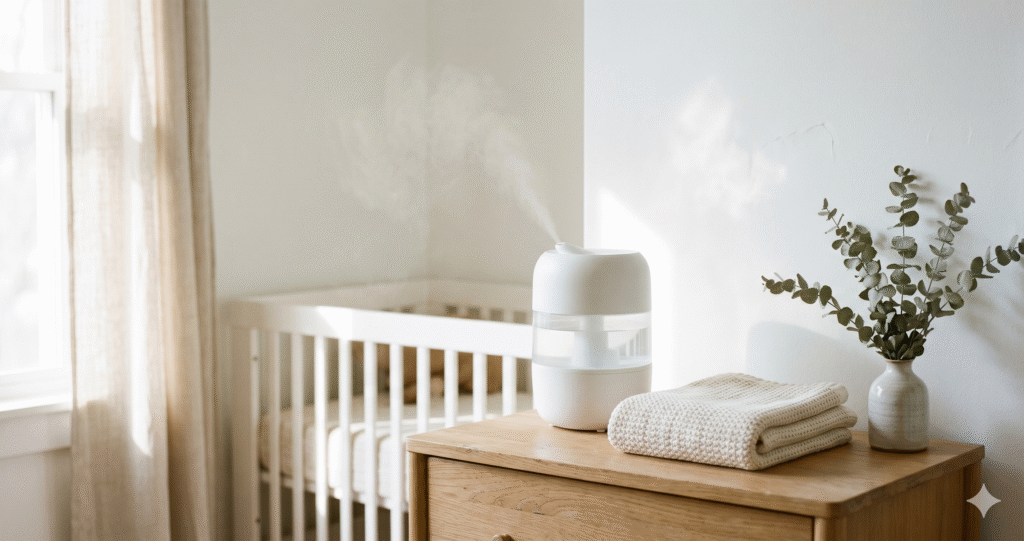
Most baby humidifier articles won’t tell you this: the American Academy of Pediatrics doesn’t actually say your baby needs one.
Their official position? If you use one, it has to be cool mist. That’s basically it. No “every nursery should have one,” no “essential for newborns.” The AAP recommendation is a safety guideline, not a shopping order.
So why does every other article act like you’re failing your baby if you don’t buy one?
I’ve cycled through humidifier after humidifier across three kids. One of them I eventually had to throw out. What I’d assumed was harmless mineral buildup inside the tank turned out to be something darker and slimier when I finally got a close look, and that was the one my oldest had slept next to for an entire winter.
This guide compares what humidifiers can and cannot do, the maintenance details that matter, and five cool-mist options using current product information and safety guidance.
Does Your Baby Actually Need a Humidifier?
Short answer: not for health reasons, most of the time.
The AAP’s position, as shared by spokesperson Dr. Natasha Burgert with The Bump, is that a humidifier is nice to have, not a must-have. It can help when your baby is sick, has eczema, or when indoor heating turns your house into the Sahara. But a healthy baby in a normally-humid home doesn’t need one running year-round.
The EPA advises keeping indoor relative humidity around 30% to 50% and not exceeding 50%. Reduce output or stop the unit if condensation or dampness appears.
Use a hygrometer to decide whether added moisture is needed. Run a humidifier only when the room is dry, and keep relative humidity within the EPA range.
A humidifier may make dry indoor air feel more comfortable when heating is running or during congestion, but it does not treat a cold, eczema, or another illness. Use it only when humidity is low and follow medical advice for symptoms.
Cool Mist Only. This Part Isn’t Negotiable.
Warm-mist humidifiers (also called vaporizers) work by boiling water and releasing steam. That heating element? It’s a scald risk.
The Consumer Product Safety Commission has cataloged thousands of burn injuries from steam vaporizers over the years, often involving children who pulled the cord or tipped the unit over. Children’s Hospital of Philadelphia puts it bluntly: “Vaporizers can cause burns if your child gets too close to the steam or accidentally knocks over a device filled with hot water.” A 2023 Consumer Reports piece made the same call: skip warm mist entirely when there’s a mobile child in the house.
Cool-mist units do not create the hot water or steam scald hazard of vaporizers. They still require stable placement, cord control, humidity monitoring, and the cleaning and water routine in the exact manual.
Ultrasonic vs. Evaporative: The Decision Most Articles Skip
I’ll spare you my first-humidifier mistake by getting straight to it.
Ultrasonic humidifiers can disperse minerals from tap water as settled white dust. Use the water type and cleaning schedule specified in the current manual for the exact unit.
The EPA notes that ultrasonic humidifiers can disperse minerals from tank water into indoor air and recommends following the manufacturer’s water and care instructions.
The real difference between the two:
Ultrasonic humidifiers use vibration to create a cool mist. Because material in the tank may be dispersed with that mist, water choice, emptying, drying, and cleaning should follow the exact manual.
Evaporative humidifiers pull water through a wick and use a fan to move moisture into the room. They generally reduce the mineral dust associated with ultrasonic mist, but the wick and reservoir still require the exact cleaning and replacement routine; the design does not guarantee that microorganisms cannot be dispersed.
Ultrasonic and evaporative models have different maintenance needs. Choose only after reading the exact manual and deciding whether its water, cleaning, and filter routine is realistic for your household.
The comparison below includes both ultrasonic and evaporative designs so their different water, filter, noise, and cleaning requirements can be compared.
What to Compare in a Nursery Humidifier
The comparison criteria below prioritize scald avoidance, cleanable water-contact surfaces, humidity control, exact-model instructions, and fit for the room.
- Cool mist only. Already covered. Moving on.
- Reachable water-contact surfaces. Check the current cleaning instructions and make sure the reservoir and base can be cleaned, rinsed, and dried as directed.
- Automatic shutoff. Confirm how the exact model behaves when the tank empties and follow its operating instructions.
- Check published noise information in context. Perceived sound depends on setting, distance, room acoustics, and the sleeper; a single decibel cutoff does not guarantee sleep.
- Do not add oils or medication to the water tank by assumption. Use only an exact appliance feature and additive that the current manual and product label explicitly permit for that age.
- Right size for the room. A big humidifier in a small nursery will over-humidify and grow mold on your walls. A small one in a big room won’t do anything. Check square-foot coverage before you buy.
Optional features include top-fill access, a night light, an automatic humidity mode, app control, or a carrying handle. Cleaning access, exact-model instructions, and humidity control matter more than convenience features.
The 5 Best Baby Humidifiers for Nursery 2026
These five options are compared from current product information, exact-model instructions where available, and the safety sources cited in this guide. Each has trade-offs to check against your room and maintenance routine.
Crane Drop Ultrasonic Cool Mist Humidifier
The Crane Drop is a simple ultrasonic option to compare on tank access, current cleaning instructions, water guidance, and replacement-part availability.
Key specs: Ultrasonic cool mist · 1-gallon tank · rated up to 24 hours under stated conditions · filter-free · auto shut-off · around $50. Crane’s current product page and the exact EE-5301 manual list different room coverage, so verify the current model and manual instead of relying on one coverage number.
Current features
- The 1-gallon tank is rated for up to 24 hours; actual runtime varies with output and room conditions. Direct mist away from the crib and nearby surfaces.
- A filter-free design avoids replacement wicks, but cleaning method and any approved descaling agent must come from the current manual.
- Colors and housing variants change; verify the exact model and package.
Watch-outs
- Because this is an ultrasonic model, check the current Crane Drop manual for the permitted water type and any compatible demineralization accessory; do not assume an accessory fits every version.
- Review the current manual’s reservoir-access and cleaning steps before buying. If every wet surface cannot be reached, cleaned, rinsed, and dried as directed, choose a model with easier access.
Check Latest Price on Amazon
Prices fluctuate, so verify on Amazon.
Pure Enrichment PureBaby Cloud Ultrasonic Cool Mist Humidifier
The PureBaby Cloud is an ultrasonic model with a cloud-shaped housing and integrated night light. Compare its exact warranty, tank access, runtime conditions, and room-size guidance on the current product page and manual.
Key specs: Ultrasonic cool mist · 1.8-liter tank · rated up to 24 hours on low or 15 hours on high · up to 250 sq ft · auto shut-off · independent color night light · optional PECLDDCAL decalcification cartridge · 5-year limited warranty · around $55.
Current features
- The current product page lists a 5-year limited warranty; check its terms and proof-of-purchase requirements.
- The color night light can operate independently of humidification; follow the current controls instructions.
- The child-themed housing does not make the appliance a toy. Follow the manual’s supervision rules and keep the appliance and cord out of young children’s reach.
Watch-outs
- The manual directs cleaning the mist tube with fresh water and a bottle-cleaning brush and gives vinegar steps for scale; follow the exact frequency for use and water conditions.
- Hard-water mineral dust is possible with ultrasonic mist. Use the water type and any compatible cartridge specified by the exact manual.
- No humidity sensor or auto mode. It’s a knob, and that’s it.
Check Latest Price on Amazon
Prices fluctuate, so verify on Amazon.
Canopy Nursery Humidifier 2.0
Canopy emphasizes evaporative mist, an auto-dry cycle, and components intended for regular cleaning. Confirm the current model, compatible filter, and care instructions before buying.
Key specs: Evaporative cool mist · 2.5-liter tank · rated 18–36 hours · up to 500 sq ft · replaceable wood-pulp wicking filter with pre-filter · specified top-rack dishwasher-safe parts · red and warm-white light · white noise · separate aroma system · USB-C · 12-month limited warranty · around $150.
Current features
- Canopy describes an auto-dry airflow cycle. This feature does not replace emptying, cleaning, filter replacement, and drying under the current instructions.
- Check the current manual to confirm which parts are dishwasher-safe and which must be cleaned by hand.
- Use only the water type and compatible filter specified for the current Canopy model; a wick does not remove the need for regular cleaning and replacement.
- Canopy lists a separate aroma system. Use only the compatible accessory and additive as the current manual and label direct; do not add oil to the water tank.
Watch-outs
- Premium price and ongoing filter cost; compare the current total cost before buying.
- Canopy currently directs replacement every 45 days, or sooner if the filter hardens or discolors; verify the current filter and price.
- The auto-dry cycle may continue running after the tank empties. Check the current manual and consider whether residual fan noise suits the room.
- No smart app or humidity sensor. For the price, some people expect those.
Check Latest Price on Amazon
Prices fluctuate, so verify on Amazon.
Levoit Classic 300S Smart Ultrasonic Humidifier
Levoit lists a 6-liter tank, app control, and a maximum runtime under stated test conditions. Actual runtime varies with output, room conditions, and humidity target.
Key specs: Ultrasonic cool mist · 6-liter top-fill tank · rated up to 60 hours on low under stated conditions · 215–505 sq ft · VeSync app with Alexa and Google controls · built-in humidity sensor and Auto Mode · separate aroma pad · night light · around $80.
Current features
- Auto Mode uses the built-in sensor to adjust mist around a 40%–50% range or a target selected in VeSync. Use a separate hygrometer if exact room humidity matters.
- The reservoir uses a top-fill design; follow the carrying, filling, and cleaning instructions for the exact model.
- The Levoit 300S has a separate aroma-pad compartment. Use it only as the exact current manual and compatible product label direct; never pour oil into the water tank by assumption.
- The current product page lists a 6-liter tank and a maximum runtime under stated conditions; actual runtime varies by output, room conditions, and humidity target.
Watch-outs
- The current package or product page may display a California Proposition 65 warning. Read the exact warning and current manufacturer documentation before buying.
- The current manual recommends purified or distilled water, daily water changes, and no water-treatment liquids or third-party filters.
- Some customer reports mention a high-frequency sound. Perceived noise varies by setting, distance, room acoustics, and listener.
Check Latest Price on Amazon
Prices fluctuate, so verify on Amazon.
Honeywell HCM-350 Evaporative Cool Mist Humidifier
The Honeywell HCM-350 is an evaporative cool-mist unit with a UV component and replaceable wick. A humidifier can add moisture to dry air, but it does not prevent or treat RSV, fever, or another infection.
Key specs: Evaporative cool mist with UV water treatment · 1.1-gallon tank · rated up to 24 hours on low · medium-room guidance · 3 speeds · HAC-504 / Filter A wick · specified dishwasher-safe removable parts · 3-year limited warranty · around $80.
Current features
- The unit routes reservoir water past a UV component before evaporation. This does not sterilize room air or replace the cleaning and filter schedule in the current manual.
- Its evaporative design and wick reduce the mineral dust associated with ultrasonic mist; performance still depends on water, maintenance, and filter condition.
- Confirm dishwasher-safe parts and placement in the current HCM-350 manual before cleaning.
- 3-year warranty is generous for the price point.
Watch-outs
- Replace the exact compatible wick when the current manual or its condition calls for it; interval and cost vary with use and water quality.
- An evaporative fan produces audible airflow. Compare published noise information and return terms for the exact model if sound sensitivity matters.
- The unit is listed at 8.36 lb before adding up to 1.1 gallons of water; consider the filled weight before moving it.
- It has no night light or app controls.
Manufacturer status note: Honeywell Store lists HCM-350B as discontinued; Amazon had the exact HCM-350B in stock when checked on October 5, 2026. Confirm current availability and Filter A support before buying.
Prices fluctuate, so verify on Amazon.
Quick Comparison
| Product | Type | Tank | Runtime | White Dust? | Price |
|---|---|---|---|---|---|
| Crane Drop | Ultrasonic | 1 gal | Up to 24h | Possible | around $50 |
| PureBaby Cloud | Ultrasonic | 1.8L | Up to 15–24h by setting | Possible | around $55 |
| Canopy 2.0 | Evaporative | 2.5L | 18–36h | Lower mineral-dust risk; maintain filter | around $150 |
| Levoit 300S | Ultrasonic | 6L | Up to 60h on low | Possible | around $80 |
| Honeywell HCM-350 | Evaporative + UV component | 1.1 gal | Up to 24h on low | Lower mineral-dust risk; maintain wick | around $80 |
The Cleaning Truth Most Articles Skip
Here’s what every consumer-facing humidifier article seems to bury in a footnote, but the EPA has been quietly clear about for years.
From the EPA’s official guidance on home humidifiers: “Microorganisms often grow in humidifiers which are equipped with tanks containing standing water,” and breathing this contaminated mist “has been implicated as causing a certain type of inflammation of the lungs.”
The EPA advises emptying and drying portable humidifier tanks every day and cleaning them every third day, together with the exact manufacturer instructions. Do not substitute one universal cleaner or method for the exact manual.
A humidifier is not a set-and-forget appliance. Compare how easily the exact reservoir, base, outlet, and filter can be accessed and maintained as directed before buying.
Use the EPA’s general precautions together with the exact manufacturer instructions; cleaning agents, dishwasher-safe parts, and filter schedules differ by model.
- After use: Empty and dry the reservoir as directed, and refill with fresh water.
- For scale or residue: Use only the cleaner, dilution, contact time, rinsing steps, and dishwasher guidance listed for the exact model.
- For filtered models: Inspect and replace the exact compatible filter according to the manual and its observed condition.
- Before storage: Clean, dry, and store every component according to the manufacturer’s instructions.
How to Actually Use a Humidifier Safely in a Nursery
Beyond the cleaning, there are placement rules that matter:
- Use the exact model’s placement and clearance instructions. Keep the appliance, mist outlet, cord, and water out of the child’s reach and never direct mist at the sleep space.
- Use a stable, water-resistant surface with the airflow and clearance required by the exact manual. Protect surfaces from condensation and spills.
- Monitor relative humidity. Keep it around 30% to 50% and never above 50%, per EPA guidance; reduce output or stop the unit if condensation or dampness appears.
- Use the water type specified for the exact unit. The EPA notes that lower-mineral water can reduce mineral scale and dispersal; a filter does not make every tap-water source interchangeable.
- Do not add oils or medication to the water chamber unless the exact current manual permits it. If a separate aroma tray exists, follow both the appliance instructions and the additive label.
- Don’t run it 24/7 if you don’t need to. Over-humidifying breeds mold on your walls, ceiling, and inside the humidifier itself. Run it when the air is dry, not as a default.
Frequently Asked Questions
At what age can I use a humidifier for my baby?
The reviewed manuals do not set a minimum age for a child to be in a room with a cool-mist humidifier. They do require adult setup, exact-model placement and cleaning, and keeping the appliance and cord out of children’s reach. Any additive has its own separate age label.
Should a humidifier run all night?
Run the unit only while added moisture is needed. Keep relative humidity around 30% to 50% and never above 50%; turn it down or off if condensation or dampness appears, and follow the exact operating instructions.
Distilled water, filtered, or tap?
Follow the exact unit’s manual. Lower-mineral water can reduce white dust in ultrasonic models, while evaporative models still require the specified water, wick, cleaning, and replacement routine.
Can I add essential oils or Vicks VapoRub to a humidifier?
Do not put essential oils, chest rub, or other additives in a humidifier unless both the appliance manual and the product label explicitly allow that exact use and age. A separate aroma tray is not permission to treat cough or congestion, and an additive should never be poured into the water tank by assumption.
How do I know if my humidifier has mold?
Odor, visible film, slime, or residue is a reason to stop using the unit. Disassemble and clean it only as the current manual directs; replace parts or the unit if they cannot be fully cleaned and dried.