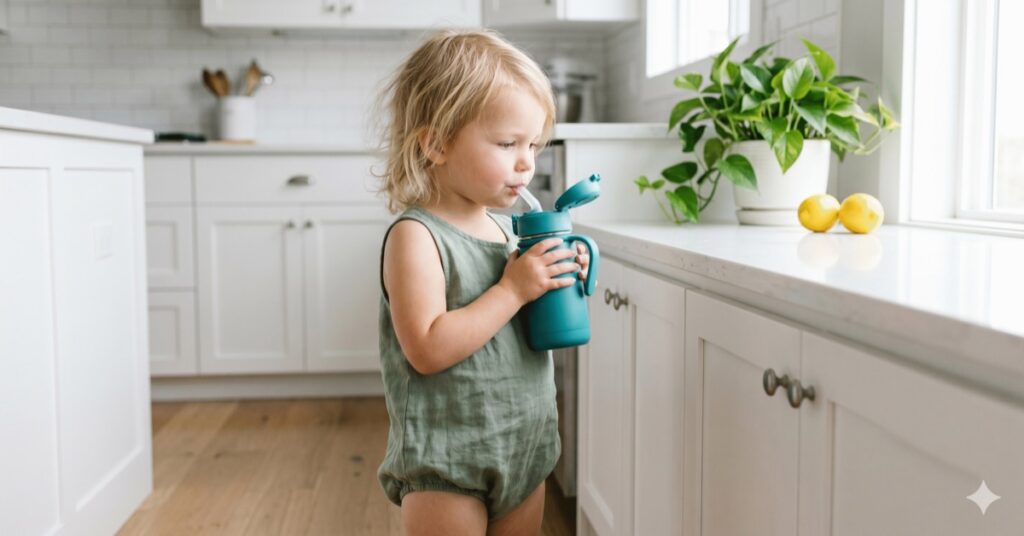
Toddler standing in a bright white kitchen holding a teal stainless steel water bottle with a flip-top straw lid, best toddler water bottles 2026

7 Best Toddler Water Bottles 2026 (Tested by a Mom of Three)

This post contains affiliate links. As an Amazon Associate, I earn from qualifying purchases. If you buy through our links, we may earn a small commission at no extra cost to you. All products are independently researched and recommended based on real parent needs — never sponsored.

There’s a specific kind of heartbreak that happens the first time your daycare sends you home with a note that says “please send a labeled water bottle tomorrow.” Because now you have to figure out which water bottle. And the market is… a lot.

I have three kids, ages 5, 3, and 1. We’ve been through the sippy cup chaos, the daycare-approved bottle saga, and the “why is my toddler chewing the straw off a $30 bottle” stage twice. My younger two have worked with feeding and speech therapists along the way, so I’ve gotten the inside scoop on which bottles actually support good oral-motor development and which ones look cute but aren’t ideal for little ones still learning to sip.

This is my honest 2026 shortlist. Seven bottles, sorted by age. With the real pros and cons, including the stuff most roundup posts skip over (like “this one can actually pop open in a backpack” and “this one technically isn’t leak-proof, even though everyone acts like it is”).

Quick Age Bridge: Where Toddler Water Bottles Fit

If you’re just walking into this stage, here’s the feeding-vessel progression aligned with AAP guidance and common SLP recommendations:

  • 0–12 months: Baby bottle (breastmilk or formula). See my guide to the best baby bottles for newborn-through-infancy picks.
  • 6–24 months: Sippy or straw cup as a bridge. The American Academy of Pediatrics suggests introducing a cup around 6 months and transitioning away from the bottle in the months that follow, because “it’s healthiest for kids to drink from an open cup by about 2 years of age” (AAP guidance). For picks here, see the best sippy cups for your toddler’s stage.
  • 18 months+: A proper toddler water bottle. This is the workhorse: daycare drop-off, stroller strolls, tantrum-defusing on a hot afternoon in the backyard. It needs to be leak-tolerant, easy for little hands, and ideally easy for a parent to clean at 10pm.

Toddlers ages 1 to 3 need roughly 4 cups (about 32 ounces) of total fluid each day, counting water and milk per AAP hydration guidance. The right bottle genuinely makes that number easier to hit. Especially on the days your kiddo would rather lick the couch than drink from a cup.

What I Actually Look For in a Toddler Water Bottle

Things I care about

  • Straw type. Soft silicone straws are safer if your toddler falls mid-sip (hard spouts can cut gums and lips). And for 18-month-olds still learning, a valveless straw is much easier than a bite-to-open valve.
  • Closed leak performance vs. packable. These are two different things. “Leak-proof when closed” means it won’t drip standing upright. “Packable” means it can survive being tossed in a shaken backpack without opening. A few premium bottles (YETI, Hydro Flask’s wide-mouth straw cap) are surprisingly not packable, and the brands themselves say so.
  • Dishwasher-friendly construction. If I have to hand-scrub three water bottles at 9pm every night, I will lose my mind.
  • Weight vs. capacity. A 14 oz stainless bottle is heavy for a 20-pound kid to haul. Smaller capacity is sometimes the feature, not the bug.
  • Daycare details. Can I label it? Does it fit the cubby? Will it be upright most of the day (forgiving the not-packable bottles)?

Things I try not to overthink

  • Cute characters. Honestly — if a Bluey sticker gets my kid to drink water, I’m buying the Bluey bottle.
  • Exact insulation hours. Most modern stainless bottles keep water cold long enough for a daycare day. I don’t need a 40-hour flask for a toddler.
  • Every single minor feature. Pick 2–3 things that matter for your family and optimize for those.
Quick heads-up on sippy vs. toddler bottles: These two categories overlap in ways marketing doesn’t always clarify. A lot of “toddler water bottles” are really advanced sippy cups, and some “sippy cups” are fine to keep using at age 2. Read the age labels and check the straw type before you buy.

Best Toddler Water Bottles for Younger Toddlers (18 Months to About 3 Years)

Smaller hands, softer straws, lighter bottles. These are my picks for the kids who are just graduating from sippy cups and still figuring out how to drink without dribbling the whole thing down their chin.

1. Thermos Baby 10 oz Vacuum Insulated Stainless Steel Straw Bottle — Best for the Sippy-to-Water-Bottle Transition

Best for ages 18 months+ · 10 oz · 18/8 stainless steel · ~$15–18

If your youngest is right in the sippy-to-bottle handoff, this is the one I’d buy first. The 10 oz capacity is perfect for tiny hands, the contoured body is actually shaped for a toddler grip (not just a smaller adult bottle), and the pop-up silicone straw has no valve, which matters more than most product pages bother to mention.

Thermos explicitly markets this one for 18+ months transitioning off the bottle. Cold retention runs up to 12 hours. Dishwasher safe on the top rack (though they recommend hand-washing, and honestly so does every dishwasher veteran I know once the silicone starts looking funky).

What I love: The small size means my youngest can actually lift it without using two hands. The thin straw limits how much water comes up in one pull, which helps new straw-drinkers not choke. Interchangeable lid system if you outgrow the straw style.

Watch-outs: 10 oz is on the small side if you need one bottle to last a full daycare day. Consider sending two, or refilling at drop-off. Not for hot liquids.

Check price on Amazon →

2. Thermos FUNtainer 12 oz Kids Stainless Steel Straw Bottle — Best Overall

Best for ~18 months through preschool (brand doesn’t state a minimum age) · 12 oz · 18/8 stainless steel · ~$16–20

This is the bottle I go back to most. The FUNtainer is what my older son has used almost daily since he was two, and the straw design is the reason I keep coming back to it.

It uses a thin silicone pop-up straw with no bite valve. For kids still learning straw mechanics, that’s gold. They don’t have to figure out that they’re supposed to chomp down on something to trigger flow. They just sip. Push the button, straw pops up, drink. Push it back down, it stays reasonably dry in a backpack.

Cold for up to 12 hours, BPA-free, dishwasher safe on the top rack. The licensed-pattern library is almost obscene in a good way: Bluey, Spider-Man, Paw Patrol, Minnie, Disney Princesses, Gabby’s Dollhouse. If character buy-in is what gets your kid drinking water, you have options.

What I love: SLP-friendly valveless straw. Integrated soft-grip handle. Slim profile fits most cup holders and backpack side pockets. Replacement straws and lids are actually sold separately (rare these days).

Watch-outs: The straw can leak through the opening if the button gets pressed inside a bag. We’ve had this happen. Solution: I flip it upside down in a side pocket rather than lay flat in the main compartment. Chewers (you know who you are) will wear through silicone straws every few months, so buy a replacement pack.

Check price on Amazon →

Best Toddler Water Bottles for Preschoolers (Ages 3 and Up)

Once a kid is a confident straw drinker with enough coordination to open and close a lid on their own, the playing field opens up. These are my picks for ages 3+, which is when most daycare and preschool programs start expecting real water-bottle independence anyway.

3. Simple Modern Kids Summit Water Bottle with Straw Lid, 14 oz — Best Value & Biggest Pattern Library

Officially rated for ages 3+ · 14 oz (also 18 oz, 20 oz) · 18/8 stainless · ~$20–28

Simple Modern is the brand I most often point friends toward when they ask “what do you actually use?” The kids’ Summit in 14 oz hits the sweet spot: big enough to last a preschool morning, small enough to fit a backpack side pocket, and the pattern catalog rivals Thermos.

The flip-up silicone straw lid is leak-proof when the nozzle is closed (US patent pending, per the brand). It’s genuinely dishwasher safe on the top rack, and Simple Modern backs it with a limited lifetime warranty on manufacturer defects.

What I love: Bluey, Marvel, Disney Princess, Minecraft, Toy Story, farm animals, unicorn rainbows — you name it. Price-to-quality ratio is hard to beat. Pairs with matching backpacks and lunch boxes from the same brand if you’re the kind of parent who color-codes kid gear (no judgment, I am).

Watch-outs: Simple Modern explicitly says “Not for children under 3 years old” on the product page, so don’t hand this to an 18-month-old. The cup itself is officially hand-wash only for longevity (lid is dishwasher safe).

Check price on Amazon →

4. Hydro Flask Kids 12 oz Wide Mouth with Straw Cap — Best for Daycare Labeling & Serious Insulation

Ages 3+ · 12 oz · 18/8 pro-grade stainless, TempShield insulation · ~$28–35

This is the bottle I’d buy if daycare requires a name on everything and your kiddo drinks in 90°F summers. Hydro Flask rates the 12 oz kids’ Wide Mouth at 24 hours of cold retention, which is genuinely class-leading, and the removable Flex Boot bumper on the bottom has a tiny built-in spot for writing your child’s name. Translation: no more painter’s tape flaking off after one dishwasher cycle.

It ships with two silicone straws (so you have a backup when the first one inevitably goes missing or gets chewed) and a carabiner-style loop for clipping to a backpack. Dishwasher safe. Slim new design fits cup holders. The whole thing feels like it will outlast elementary school. One important caveat to flag clearly: Hydro Flask itself states this Wide Mouth Straw Lid is not leak-proof. A lot of parents (myself included, before I read the manufacturer’s fine print) assume it is. So this one is great for a cubby or stroller cup holder, less great for jamming into a tipped-over backpack. Price is also at the premium end of the list.

Check price on Amazon →

5. YETI Rambler Jr. 12 oz Kids Bottle with Straw Cap — Most Rugged for Active Kids

Ages 3+ · 12 oz · Kitchen-grade 18/8 stainless, DuraCoat finish · ~$22–30

My oldest is rough on gear. Throws it, drops it, kicks it across the driveway. The Rambler Jr. is the only bottle we own that looks exactly the way it did the day we unboxed it after two solid years of abuse.

It’s built the way you’d expect a YETI to be built: heavy-gauge stainless, DuraCoat finish that doesn’t crack or peel, included Straw Cap that’s shatter-resistant. Dishwasher safe. 5-year YETI warranty. Fits most car seat cup holders. The 12 oz capacity with a tight Straw Cap seal keeps water cold without feeling oversized for a 4-year-old. The No-Sweat exterior is also a small but real win. It doesn’t soak through a backpack like some non-insulated bottles do.

One important warning, straight from YETI’s own FAQ: the Straw Cap is leak resistant when closed, but not packable — meaning the cap can pop open if the pack gets shaken or jostled. So this is a bottle that wants to ride upright in a cubby or cup holder, not get tossed sideways into a squirmy pre-K backpack. It’s also notably heavier than every other bottle on this list, so it might be too much for younger toddlers to lug around all day.

Check price on Amazon →

6. CamelBak Eddy+ Kids Tritan Renew 14 oz — Best Lightweight & Budget Option

Ages 3+ · 14 oz · Tritan Renew plastic (50% recycled), BPA/BPS/BPF-free · ~$13–16

If weight is your issue, either because your kid is on the smaller side or because you’re filling a whole backpack for school, the Tritan version of CamelBak’s Eddy+ is genuinely feather-light compared to any stainless option. It’s also the most affordable pick on this list.

The Big Bite Valve is the CamelBak signature: spill-proof when open, leak-proof when closed. The Tritan Renew material is made from 50% recycled plastic, which is a small but real win if reducing new plastic matters to you. Dishwasher safe.

What I love: Price. Weight. Fun graphics. The fact that it’s truly spill-proof even with the straw up (a rarity), so I can hand it to my 3-year-old in the car without visualizing the cleanup.

Real SLP watch-out: This is a bite-valve bottle. The child has to bite gently on the silicone valve to break the seal and release water. Speech-language pathologists specifically caution against bite valves for toddlers who are still learning straw drinking, because it can reinforce a biting-to-drink pattern they’ll have to unlearn. If your 3-year-old already drinks confidently from a valveless straw (like the Thermos FUNtainer above), the CamelBak is fine. If they’re brand new to straw bottles, start with a valveless one first.

Check price on Amazon →

7. Owala Kids Flip 14 oz — Best One-Handed Flip-Top for Independent Toddlers

Best for confident straw drinkers 18 months+ through preschool · 14 oz · Stainless, double-wall insulated · ~$20–24

Owala went viral on adult TikTok, and the kids’ version is quietly one of the best-designed bottles on the market if you want a confidence-builder. The flip-straw is hidden and locked when closed (actually locked — not just “clicked”), and opens with a one-handed push-button that a motivated 3-year-old can absolutely operate solo.

Double-wall insulated stainless steel, 24 hours cold, BPA/lead/phthalate-free. Comes with a limited lifetime warranty.

What I love: The “I can do it myself” factor is real. The locking mechanism means no surprise backpack leaks even when my kid throws the bag. Hideaway straw stays clean inside the closed lid. Beautiful color palette.

Watch-outs: The locking straw has more flow resistance than a Thermos-style valveless silicone straw, so younger or less-experienced straw drinkers may get frustrated trying to pull water through. The cup itself is hand-wash only (lid is dishwasher safe).

Check price on Amazon →

Straws, Spouts, and 360 Cups: What Pediatric Experts Actually Recommend

This is the section I wish someone had handed me three years ago. The tl;dr:

Soft silicone straws win. Pediatric dentists and speech-language pathologists generally prefer soft straw cups over hard spouts for toddlers. Our pediatrician mentioned the same thing at our last well-child visit. Two reasons: toddlers walk around drinking (and fall, a lot), and a hard plastic spout in the mouth during a fall can cause injury. A soft silicone straw gives way. Separately, straw drinking promotes better lip closure and tongue positioning, which feeds into early speech development.

360-degree spout cups get side-eye from SLPs. The “spoutless” 360-style cups (the ones that look like a normal cup but don’t spill because of a valve ring around the rim) are sometimes flagged by speech-language pathologists for potentially reinforcing atypical drinking patterns if used as the primary cup long-term. I haven’t included any on this list for that reason.

Traditional hard-spout sippy cups are a bridge, not a destination. Per AAP: sippy cups are for the learning phase. By about age 2, kids should be moving toward open cups at the table and a dedicated straw bottle on the go.

One more bottle-geek note: If your toddler is just starting on straws, start with a valveless straw (Thermos Baby, Thermos FUNtainer). Add a valve-style bottle (CamelBak, Owala) only once they’re sipping confidently. This isn’t fancy therapy advice — it’s what the speech therapists our family has worked with have told us, and it tracks with what published feeding therapists recommend.

The Daycare Reality Check No One Writes About

Stuff the marketing copy doesn’t tell you, based on three years of drop-offs:

Name labeling is non-negotiable. Most daycares require your kid’s name on every single item, full name, visible. Painter’s tape doesn’t survive the dishwasher. The built-in name spot on the Hydro Flask Flex Boot is an actual feature, not marketing fluff. Otherwise, permanent-marker it directly on the bottom (brands’ warranties don’t cover Sharpie ink, but honestly, the bottle will die before the ink fades).

“Leak-proof” and “packable” are different words for a reason. If your kid’s bottle is going to spend the day in a cubby standing upright, Hydro Flask and YETI are great. If it’s going to be tossed around in a backpack, pick the Simple Modern or Owala, which lock shut, or the CamelBak whose valve physically won’t release water unless bitten.

Stainless steel is usually fine. Glass is usually not. Most daycares allow stainless; many prohibit glass for obvious reasons. Double-check your specific center’s list.

Weight matters over a full day. A fully loaded 14 oz stainless bottle plus a lunch box plus a change of clothes is a lot to ask a 2-year-old to carry. When in doubt, smaller is friendlier.

How to Clean a Toddler Water Bottle (Without Losing Your Mind)

My husband and I have a “all bottle parts on the drying rack by 9pm” rule that works maybe half the time, but here’s the honest daily routine that’s saved us from pink mold so far:

  1. Disassemble after every use. Pop off the lid. Remove the straw. Yes, every day. This is the single biggest thing that prevents pink mold.
  2. Use a straw brush. Not optional. Every kid’s bottle on this list has a narrow straw that a dish sponge will not reach. Get a small-diameter straw brush — the OXO one is $5 and will outlive the bottle.
  3. Top-rack dishwasher for the parts that allow it, hand-wash for the cup. Most brands recommend hand-washing the stainless body to preserve the powder coat finish and insulation integrity.
  4. Air-dry fully overnight. Stand the parts upright on a drying rack, don’t twist the lid back on a damp bottle. Water trapped in threads is how that funky smell starts.
  5. Replace silicone straws every 2–6 months. They wear out. Chewers kill them fast. Thermos and CamelBak both sell replacement packs; Hydro Flask’s kids bottle ships with a spare.

When Is It Time to Transition From a Sippy Cup to a Toddler Water Bottle?

The short answer: somewhere between 18 months and 2 years for most kids, but it’s less about a calendar date and more about whether your little one can do a few key things.

Signs they’re ready:

  • They can drink from a straw without needing a squeeze-assist
  • They can hold a bottle with two hands and lift it to their mouth
  • They’re getting curious about your water bottle (the ultimate “I’m ready” signal)
  • Daycare or preschool is asking for a bottle — this is often what forces the decision

For most families, moving to a dedicated toddler straw water bottle around 18 months overlaps with still-occasionally-using-a-sippy-cup for a few more months. Both can coexist. If your kiddo isn’t quite there yet, head back to my guide to the best sippy cups for the learning phase, and you can pick this up when they’ve leveled up.

Toddler Water Bottle FAQ

How many ounces of water should a toddler drink per day?

Toddlers ages 1–3 need around 4 cups (about 32 ounces) of total fluid per day, including water and milk. The exact split depends on their size, activity, and how hot it is outside. The AAP’s hydration guide has the full breakdown by age, and the CDC’s infant and toddler nutrition page backs up the same numbers from a different angle.

Is stainless steel or plastic better for a toddler water bottle?

Both work if they’re BPA-free. Stainless steel (18/8) keeps water colder longer and is more durable over time. Modern Tritan plastic (like CamelBak Renew) is BPA/BPS/BPF-free, lighter, and cheaper — great for younger toddlers whose grip strength is still developing or for families who don’t need insulation. If your kid is a chronic bottle-dropper, stainless lasts longer.

Are straws better than spouts for toddler water bottles?

Generally, yes. Soft silicone straws are safer if your kid falls mid-sip (hard spouts can injure gums and lips) and they support better tongue and lip development — which feeds into early speech skills. Pediatric dentists and speech-language pathologists tend to prefer straw cups over spout cups for this reason.

When should my toddler stop using a sippy cup?

The AAP recommends moving toward an open cup by about age 2. A dedicated straw water bottle can absolutely live alongside open-cup practice — the water bottle covers the on-the-go hours, and the open cup covers meals at the table. Keep building both skills.

Can I put milk in a toddler water bottle?

Check the manufacturer’s guidance. Most insulated stainless bottles can handle cold milk just fine, but the straws need to be disassembled and washed same-day to prevent souring. None of the bottles on this list are rated for hot liquids.

How do I clean the straw on a toddler water bottle?

Use a small-diameter straw brush — the $5 kind you find in the dish brush aisle. Push it through the straw daily, then rinse. Top-rack dishwasher for the straw itself once a week. Air-dry everything overnight with the lid off.

Still piecing together the toddler drinkware collection?

Browse the full cluster: Best Sippy Cups · Best Baby Bottles · Best High Chairs

Want 30 screen-free activities on printable cards?

Grab the free Screen-Free Activity Cards PDF — sorted by mess level, setup time, and age. Print, cut, and grab one whenever you need an idea.