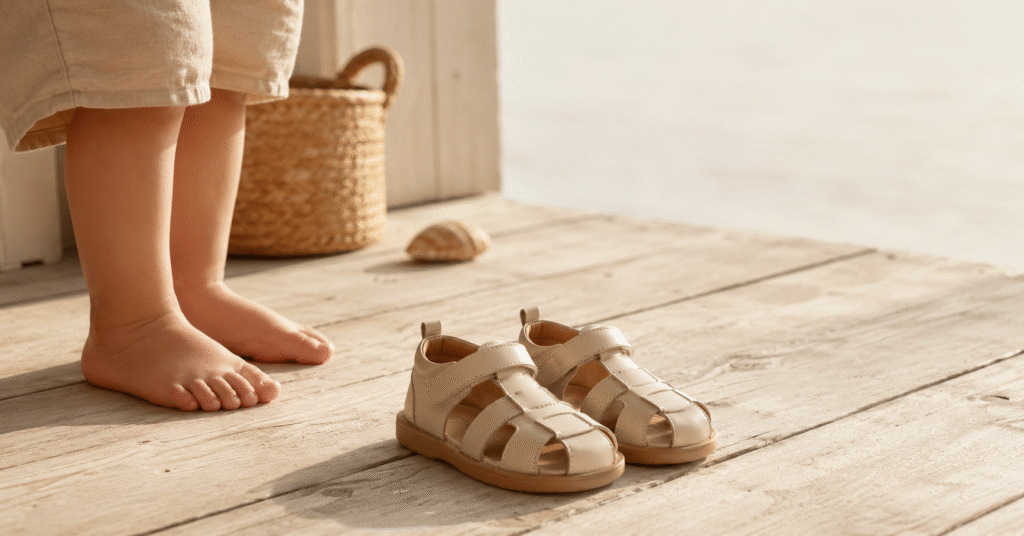
The first time you shop for toddler sandals, it’s easy to make a classic rookie mistake: buying the cutest open-toe pair you can find. A week later, the typical fallout looks like a stubbed pinky toe, a strap that rubs an ankle raw, and a meltdown every time you try to put them on. Most of us have done some version of this. I’ve watched two of my three go through different stages of summer-sandal trial and error, and the pattern repeats.
Three kids and a lot of trial and error later, I’ve learned that the words that actually matter for toddler sandals are not cute or cheap. They are wide toe box and adjustable. Toddlers’ feet are still soft, fan-shaped, and growing by the month, and the closure system is the difference between a sandal that stays on through the splash pad and one that comes flying off at the playground.
This guide walks through the seven toddler sandals I’d actually recommend in 2026, all with wide-foot-friendly shapes and adjustable straps. Every pick was cross-checked against current Amazon listings, brand sources, and physical-therapist and podiatrist round-ups, plus a CPSC recall check before publishing.
Why “wide toe + adjustable” isn’t marketing talk
I used to roll my eyes at this language too. Then I started paying attention to what was actually happening on new walkers’ feet around 18 months: a pair of hand-me-down sandals or a cute Target find that looks fine on the rack, but in motion the toes are curled like little fists inside the front of the shoe, and a non-adjustable strap is riding too high on the ankle and sending the kid sideways like a crab. Once you start noticing it, it’s everywhere at the playground.
The American Academy of Pediatrics is pretty direct about this. In its guidance on baby and toddler shoes on HealthyChildren.org, the AAP recommends shoes that are flexible, lightweight, and roomy enough for the toes to spread out, with non-skid soles for traction. The American Podiatric Medical Association (APMA) Seal of Acceptance, which you’ll see referenced for some of the picks below, looks for similar things: a wide forefoot, flexible sole, and supportive fit that doesn’t squeeze the natural shape of a child’s foot.
In plain English, that means looking for:
- Wide toe box. Your kid’s toes should be able to splay out like a tiny starfish, not pile up on top of each other. Most adult-style sandals taper too narrowly at the front. Look for a rounded, almost square-ish toe.
- Adjustable closure. Hook-and-loop (velcro) straps at the instep, ankle, or both, ideally with an oversized opening so you can actually get the shoe on a kicking foot. A single non-adjustable elastic band won’t fit a wide foot and a narrow foot the same way.
- Closed or protected toe. Toddlers stub their toes constantly. A closed-toe or rubber bumper saves you a lot of crying at the park.
- Flexible, low-profile sole. Bend the sandal in your hands at the ball of the foot. It should fold easily, not feel like a stiff plank. Chunky platform soles change a toddler’s gait.
- Heel strap or closed heel. Open-back slides slip off when toddlers run. For a true outdoor sandal, a back strap is non-negotiable.
The 7 best toddler sandals at a glance
Quick comparison before I get into the details — full reviews below.
| Pick | Best for | Closure | Price range | APMA seal |
|---|---|---|---|---|
| KEEN Newport H2 Kids | Best overall & adventure | Bungee + hook-and-loop | $$ | No |
| KEEN Seacamp II CNX | Best hot-weather lightweight | Bungee + hook-and-loop | $$ | No |
| Stride Rite SRT Archie 2.0 | Best for wide / extra-wide feet | Hook-and-loop | $$$ | Yes |
| Stride Rite SRT Reggie Fisherman | Best closed-toe casual | Hook-and-loop | $$ | No |
| Merrell Kids’ Bare Steps Sandals | Best barefoot-style / new walkers | Dual buckle + heel velcro | $$ | No |
| See Kai Run Jude IV Leather | Best dress-up / APMA-approved leather | Hook-and-loop | $$$ | Yes |
| HOBIBEAR Closed-Toe Sport Sandal | Best budget wide-toe | Hook-and-loop heel strap | $ | No |
1. KEEN Newport H2 Kids — Best Overall & Adventure
KEEN Newport H2 Kids
Why it’s here: If you only buy one pair of toddler sandals this summer, this is the safest bet. The Newport H2 has been KEEN’s flagship kids’ water sandal for years, and it’s the rare shoe that hikes, runs through sprinklers, and goes to dinner without missing a beat.
The piece of the Newport that earns its reputation is the toe cap. It’s a thick rubber bumper that wraps from the outsole up and over the toes, which is exactly the feature outdoor-mom blogs and gear reviewers consistently single out as the reason their kids can charge through rocky tide pools, gravel trails, and playground bark mulch without losing a toenail. The webbing upper is made from recycled plastic bottles, dries reasonably fast, and is machine washable, which matters when sand and lake mud are involved.
The closure is the other reason it stays on. A bungee lace runs through the upper and ties off at a lace-lock toggle, and there’s an adjustable hook-and-loop strap across the top. Once you set the bungee for your kid’s foot shape, you only need to undo the velcro for getting in and out. The snug fit stays put. The wide, anatomical last gives toes real room to splay.
The honest weaknesses: the interior volume runs a little high, so if your toddler has a narrow or low-volume foot, you may need to cinch the bungee tight and circle it through the tongue loop a second time to keep the strap from flapping. The nylon webbing also holds water longer than the synthetic-only sandals later in this list, which means a faint wet-shoe smell if you don’t air them out between water days. A small number of reviewers have reported heel stitching wearing through after a few months of hard wear, though most reports describe one to three full summers of life.
Skip if: your kid has a narrow foot, or you mostly need a dress sandal for indoor wear.
2. KEEN Seacamp II CNX — Best Hot-Weather Lightweight
KEEN Seacamp II CNX
Why it’s here: The Newport’s lighter, more breathable cousin. If your summers run brutally hot and your toddler spends most of them at the splash pad or in grass, the Seacamp ventilates better and weighs noticeably less while keeping the iconic KEEN toe protection.
KEEN bills the Seacamp as their most lightweight, flexible kids’ water sandal sole, and reviewers consistently confirm the difference from the Newport: more open mesh on the upper, a thinner and flexier midsole, and a feel that’s closer to a barefoot-style design while still keeping that protective rubber toe bumper. For hot, humid summers it’s a real upgrade in breathability.
The closure is the same bungee-plus-velcro system as the Newport, which means the same single-handed on/off once you’ve set the fit. Like the Newport, it’s machine washable and PFAS-free, and the webbing uses recycled plastic.
The honest weaknesses: the trade-off for all that ventilation is that sand and small pebbles get in more easily than on the Newport. The thinner midsole means less cushioning if your kid is going to do a lot of pavement walking. And if you’re choosing between the two KEENs, you really only need one. Pick the Seacamp if heat and weight matter more to you than trail-ready cushion.
Skip if: you want a single all-purpose sandal. The Newport H2 covers more ground.
3. Stride Rite SRT Archie 2.0 — Best for Wide / Extra-Wide Feet
Stride Rite SRT Archie 2.0
Why it’s here: This is the sandal I’d send a friend with a genuinely wide-footed toddler. Stride Rite offers the Archie 2.0 in medium, wide, extra-wide, and extra-extra-wide widths. Almost no other brand goes that deep on width options for toddler sandals.
The Archie 2.0 carries the APMA Seal of Acceptance, which means a panel of podiatrists has reviewed and accepted it as supportive of healthy foot development. In practice, it’s a fisherman-style closed-toe sandal with a hook-and-loop strap and an oversized opening, which makes it one of the easiest sandals on this list to actually get on a squirming toddler. The footbed uses Ortholite memory foam, the soles have Stride Rite’s sensory pod pattern for traction, and the rounded sole edges help prevent the classic toddler face-plant.
A reviewer on Zappos described their 16-month-old, 99th-percentile wide-foot son finally being able to run comfortably in the XW version. That lines up with what the team at fittingchildrenshoes.com (a U.S. children’s shoe fitting service) has noted about Stride Rite’s wide options being a rare true fit for chunky toddler feet.
The honest weaknesses: this is a newer 2.0 release, so the long-term durability story isn’t fully written yet. The pinky toe sits close to the open side of the fisherman cutout, so a small number of reviewers have noticed a tiny toe poking through. The price runs higher than most picks on this list, especially in the wider widths.
Skip if: your kid has a narrow or even average-width foot. You’ll be paying for width you don’t need.
4. Stride Rite SRT Reggie Fisherman — Best Closed-Toe Casual
Stride Rite SRT Reggie Fisherman Sandal
Why it’s here: The Archie’s slightly more dressed-up older sibling. Premium leather upper, hook-and-loop closure, oversized opening, and Stride Rite’s memory foam footbed in a classic fisherman shape that works for daycare drop-off, a family lunch, or running around the backyard.
This is the sandal I think of as the “photos with grandparents” option. The all-leather upper looks polished enough for occasions but still has the toddler-friendly engineering Stride Rite is known for: an easy-on hook-and-loop strap, sensory pod traction underneath, and flexible rounded soles for natural movement. The closed toe and seamless interior cradle the foot without rubbing.
The honest weaknesses: the Reggie’s Amazon rating sits a notch below the Archie (around 4.3 stars), and reviewers flag two things consistently. First, the ankle area can rub if your kid has prominent ankle bones. If you have a sensitive one, try them on with socks first. Second, the leather fades quickly if you let it get wet at a splash pad. This is a casual sandal, not a water sandal. Treat it accordingly and it lasts; submerge it weekly and the color goes patchy fast.
5. Merrell Kids’ Bare Steps Sandals — Best Barefoot-Style / New Walkers
Merrell Kids’ Bare Steps Sandals
Why it’s here: If you’ve read our first walking shoes guide and you’re sold on the barefoot-style approach for your new walker, the Bare Steps Sandal is the most accessible mainstream option. Wide toe shape, near-zero drop, flexible grooves on the sole, and a soft leather upper that molds to small feet over the first week.
Merrell built the Bare Steps line specifically to mimic the feel of barefoot walking while still protecting little feet. The outsole has multi-directional flex grooves so the foot bends naturally with each step, and Merrell’s M Select Grip rubber outsole gives non-marking traction on the slippery floors of every museum and library you’ll ever visit. The closure is dual adjustable buckles up top plus a hook-and-loop heel strap, which sounds fussy but gives you genuine width adjustability once you’ve set it for your kid.
The wide toe shape on the Bare Steps really does match how toddler toes naturally splay (something the physical-therapist blogs covering this category point out repeatedly). The leather softens after a few wears so it doesn’t dig into pudgy ankles. The Bare Steps line also comes in wide widths, which is rare in this barefoot category.
The honest weaknesses: the leather is not machine washable, spot clean only, so this is not your splash-pad sandal. The buckle closures take a little longer than pure velcro, which can be a headache with a wiggly under-2-year-old. Sizing tends to run small; most parents recommend going up half a size.
Skip if: you need a water-friendly daily sandal, or you have very limited patience for fiddly straps in the morning.
6. See Kai Run Jude IV Leather — Best Dress-Up / APMA-Approved
See Kai Run Jude IV Leather Fisherman
Why it’s here: The genuine dress sandal of the bunch, and the only all-leather pick on this list that also carries the APMA Seal of Acceptance. Classic fisherman silhouette, soft leather lining, wide-foot-friendly last, and a TPR rubber outsole with a triangle lug pattern for actual traction.
See Kai Run is one of the few American kids’ shoe brands that builds wide toe boxes into its standard sizing rather than treating “wide” as a separate fit. The Jude IV is the boys’ fisherman in their line and comes in Navy Leather, Brown, and Gray Canvas. The leather upper is genuine, the lining and footbed are also leather (so the inside breathes the way a leather shoe should), and the strap is a single hook-and-loop closure with a long enough travel to fit a chunky foot.
If you’ve ever wondered what the APMA Seal of Acceptance actually means, this is one of the cleanest examples. APMA-accepted children’s shoes need to demonstrate features that promote healthy foot development: flexible soles, room for natural toe splay, supportive but not constricting fit. See Kai Run’s entire line is built around those criteria, and the Jude IV is their most popular sandal.
The honest weaknesses: price. This is the most expensive sandal on the list. The leather upper is not water-friendly — treat it like dress shoes and keep it out of the kiddie pool. And because See Kai Run’s Amazon presence is smaller than the giant brands, you’ll occasionally see sizes go in and out of stock through the season.
Skip if: your budget is tight or you need a single water-friendly daily wearer.
7. HOBIBEAR Closed-Toe Sport Sandal — Best Budget Wide-Toe
HOBIBEAR Closed-Toe Sport Water Sandal
Why it’s here: The budget pick that the pediatric physical therapist behind Eat Play Say has recommended after two summers of testing it with her own kids. About a quarter of the price of the KEEN, with a genuinely wide toe shape, a rubber toe bumper, breathable mesh upper, and a single back hook-and-loop strap.
HOBIBEAR is a value-driven brand, not a heritage one. But for a closed-toe water sandal at this price, the fundamentals are right. The mesh and synthetic upper dries quickly, the EVA foam midsole gives reasonable cushion, the TPR outsole has decent multi-surface grip, and the rubber toe bumper protects against the standard playground toe stubs. The single heel-strap velcro closure is simple enough that even a two-year-old can sort of help.
The honest summary from reviewers and the pediatric PT blog that originally surfaced this brand is that HOBIBEAR holds up well for one full summer of hard wear on a fast-growing foot. Visible wear at the toe shows up by month two, but functionality stays intact. For one season on a kid who’s about to size up anyway, the cost-per-wear math is hard to argue with.
The honest weaknesses: HOBIBEAR is a third-party Amazon brand, so quality control varies more from batch to batch than name-brand shoes. Color choices come and go quickly. Sizing tends to run small, so size up half a size, especially if your kid has wide feet. There’s no APMA or formal medical endorsement, and the construction won’t survive multiple kids the way a KEEN sometimes does.
How I picked these seven
A few words about the process, since I think it matters more than the picks themselves.
I started with a long list pulled from current physical-therapist and podiatrist round-ups (Eat Play Say, SheKnows’ pediatrician-vetted guide, fittingchildrenshoes.com, the barefoot kids’ shoe community), then verified every candidate against current Amazon listings, brand product pages, and CPSC’s recall database. Anything with a current safety issue was cut. Anything with fewer than several hundred verified reviews on Amazon was treated with extra caution, since small-sample ratings can be noisy.
I deliberately did not stack the list with one brand. KEEN gets two picks because the Newport and Seacamp serve genuinely different use cases (rugged vs. lightweight). Stride Rite gets two because the Archie 2.0 owns the wide-width niche and the Reggie owns the dressed-up niche, and they barely overlap. The rest of the list is one pick per brand.
The popular Crocs Classic Clog didn’t make the cut because the narrow toe shape and lack of real adjustability undermine both criteria in the title. Native Jeffersons (the EVA slip-ons) are everywhere, but they’re a slip-on clog, not a sandal: no real adjustability for a growing foot. Salt Water Sandals and the various Birkenstock Kids styles have devoted fans, but the toe boxes are narrower than I want for a daily toddler shoe.
Specialty brands worth knowing about (beyond Amazon)
One brand that didn’t make the main list deserves a mention here: Ten Little Splash Sandals and Everyday Sandals, sold direct-to-consumer at tenlittle.com. They’re APMA-approved, genuinely zero-drop, anatomically foot-shaped with extra-wide toe boxes, and built specifically around the barefoot-style developmental approach. If everything in this guide about wide toe boxes and natural toe splay resonates with you, Ten Little’s sandals are probably the best-thought-out option I’ve come across. The reason they’re not in the numbered list is simply that they’re not sold on Amazon, so I can’t link them through the same affiliate system. If you’re shopping with the wide-toe philosophy front and center, they’re worth a look.
Sizing toddler sandals: a few things I wish I’d known earlier
Two things I learned the hard way with my first:
- Toddler feet grow in spurts. From around 12 months to 3 years, expect a new shoe size roughly every three to four months. By the time you’ve broken a pair of sandals in, they may be too small. This is the main reason I’m more comfortable mixing one premium pick with a budget backup than buying two premium pairs.
- Sandal sizing usually runs whole sizes only. Half sizes are rare. Most pediatric foot specialists recommend sizing up when in between. A slightly roomy sandal with an adjustable strap fits fine, while a too-small sandal will pinch toes and cause issues you won’t see until socks come off later.
- Measure feet in the late afternoon. Kids’ feet swell a bit through the day, just like adults’. A morning measurement can leave you with a sandal that’s tight by dinner.
If your toddler is a true new walker (anywhere from around 10 to 18 months for most kids), our first walking shoes guide covers why barefoot time still beats almost any shoe at that stage, and what to do when you do need protection. For daily non-sandal recommendations, our best toddler sneakers 2026 guide is the companion piece to this one.
Frequently asked questions
What age can a toddler wear sandals?
Once your child is walking independently outdoors, usually somewhere between 12 and 18 months, closed-toe sandals are reasonable for short, supervised outings. For brand-new walkers, the AAP’s position is that barefoot or socks-only is better indoors, with simple flexible shoes only when needed for protection.
Open-toe or closed-toe sandals for toddlers?
For most parents, closed-toe wins. Toddlers stub their toes constantly, climbing, running, kicking. A rubber toe bumper or a fisherman-style covered toe prevents a lot of crying. Open-toe sandals are fine for older toddlers who have better balance and body awareness, but for a fresh walker, closed-toe is the safer default.
How do I clean toddler sandals after a splash pad or beach?
For synthetic and webbing sandals like the KEEN Newport and Seacamp, a quick hose rinse and air-dry out of direct sun is the daily routine. KEEN’s kids’ sandals are also machine washable on a cold, gentle cycle in a mesh laundry bag. For other synthetic sandals (HOBIBEAR and similar), I stick to hose rinse and air-dry to be safe. For leather sandals (Stride Rite, See Kai Run, Merrell Bare Steps), spot-clean with a damp cloth and a tiny amount of mild soap, then air-dry. Never put leather sandals in the washing machine.
Are barefoot-style sandals OK for toddlers?
For most toddlers, yes. Pediatric physical therapists and podiatrists generally support barefoot or minimalist footwear for healthy foot development. The exceptions are kids with diagnosed foot conditions (severe pronation, flat feet with pain, certain orthopedic concerns), where a pediatrician or pediatric podiatrist may recommend more supportive sandals. If you’re unsure, ask at your toddler’s next well visit.
What about sandals for kids with wide feet?
The Stride Rite SRT Archie 2.0 in wide or extra-wide is my top recommendation for true wide-footed toddlers. Merrell Bare Steps Sandals also come in a wide width. KEEN Newport H2 has a naturally roomy last that fits many wide feet well even in standard width. Salt Water and most Crocs styles run narrow at the toe, so they’re not my first pick for genuinely wide feet, but their devoted fan base means plenty of parents make them work.
Get the toddler sandal sizing & fit cheat sheet
The exact thumb-width fit test, brand-by-brand sizing notes (which run small, which run wide, when to size up), plus my one-page printable measuring guide. Free download. Drop your email below and I’ll send it over.
The honest bottom line
If I had to pick one pair right now for a typical toddler heading into a typical American summer, it’d be the KEEN Newport H2. It does the most things competently, the toe protection saves a lot of tears, and KEEN’s reputation for build quality that survives passing down to younger siblings is well-earned in the parent communities I trust. If your kid has wide feet, swap in the Stride Rite SRT Archie 2.0 in your width of choice. If your budget is tight or you’re buying for a fast-growing 2-year-old, the HOBIBEAR at a quarter of the price is a real option, not a downgrade.
Whatever you choose, ignore the marketing and check the basics with your own hands: bend the sole, look at the toe shape, work the strap. Toddler feet are doing a huge amount of developmental work in these years, and the right sandal just gets out of the way and lets them.