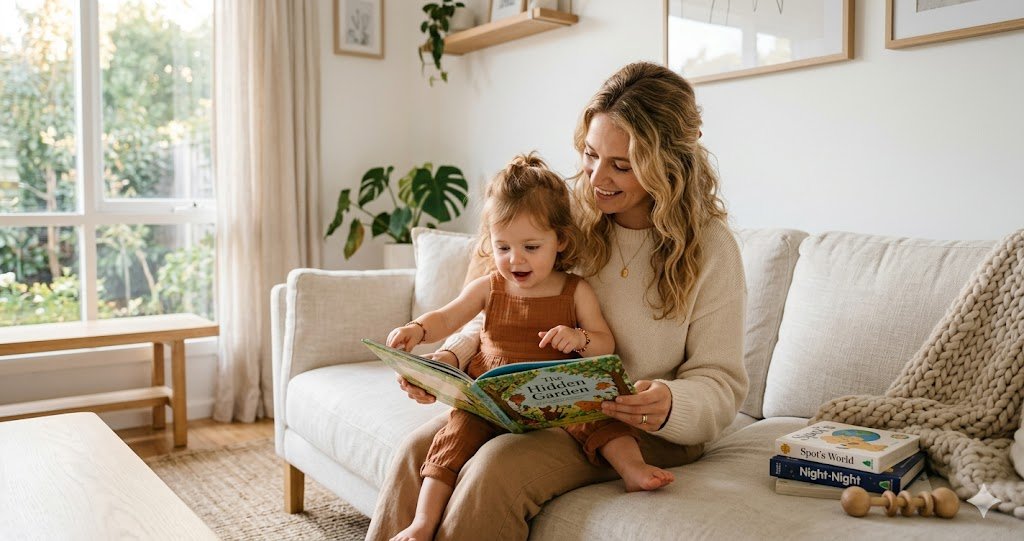
There is a very specific kind of quiet that falls over a toddler right before everything falls apart. If you have a one-, two-, or three-year-old, you know the one. My middle son went through a stretch where the trigger could be anything: the wrong colored cup, a banana that broke in half, the unforgivable crime of me opening his yogurt for him. By the time my husband got home, I usually just pointed at the kid on the kitchen floor and said “big day.”
The good news, straight from the pediatricians: this is normal. The American Academy of Pediatrics notes that temper tantrums usually begin around 12 to 18 months, peak between two and three, and ease off once kids have the words to tell you what they actually want. The whole problem, really, is the gap between enormous feelings and a tiny vocabulary. Your toddler is furious or heartbroken or overwhelmed, and they have maybe forty words, none of which are “frustrated.” (If you want the bigger picture of what is developmentally normal at each age, our guide to emotional development from ages 0–6 walks through it stage by stage.)
That is exactly where a good feelings book earns its keep. Books give little kids the language before the meltdown shows up, in a calm moment, snuggled on the couch, instead of in the middle of the storm. After ten years and three kids cycling through this stage, I have gotten picky about which ones are actually worth the shelf space. Here are the ten I would hand a friend with a toddler, no hesitation.
The 10 best feelings books for toddlers, at a glance
| Book | Best for | Format | Ages |
|---|---|---|---|
| The Color Monster | A first “what is this feeling?” | Board | 1–4 |
| In My Heart | Feelings in the body | Board / hardcover | 1–6 |
| The Feelings Book | Keeping it light & silly | Board | 2–5 |
| The Way I Feel | Building a feelings vocabulary | Board / hardcover | 2–5 |
| Happy Hippo, Angry Duck | A quick daily mood check-in | Board | 1–5 |
| Grumpy Monkey | Bad-mood days | Board / hardcover | 2–5 |
| When Sophie Gets Angry | Anger & calming down | Paperback / hardcover | 3+ |
| Ravi’s Roar | The youngest sibling’s frustration | Paperback / hardcover | 3+ |
| The Rabbit Listened | Sadness & comforting others | Hardcover | 3–6 |
| Glad Monster, Sad Monster | Hands-on learners | Hardcover | 3+ |
What makes a feelings book worth buying for this age
Toddlers and young preschoolers do not need a lecture. They need short text, faces they can read, and a clear “feelings are okay” message they can absorb in the ninety seconds before they wander off. So when I am sizing up a feelings book for the 1–4 crowd, I look for three things: it names emotions in plain words, it shows what those feelings look like (in a body, a face, a color), and it never shames the kid for having them. The titles below all clear that bar. A few are sturdy board books for the littlest hands; the rest are picture books that work better once your kiddo can sit for a slightly longer story. They pair well with a gentle, connection-first approach at home — the same one behind our positive discipline guide.
Board books for the littlest big feelings (ages 1–3)
1. The Color Monster: A Story About Emotions — Anna Llenas
If you only buy one book on this list, this is the one I would start with. A fuzzy little monster wakes up with all his emotions tangled together and, with a child’s help, sorts each one into a jar and gives it a color — happy is yellow, sad is blue, calm is green. Llenas is an art therapist, and it shows: the genius move is turning invisible feelings into something a two-year-old can literally see and point to. It is an international bestseller for a reason, and it comes in a chunky board version that survives toddler hands. Pediatric counselors lean on it so often it is practically standard equipment.
2. In My Heart: A Book of Feelings — Jo Witek
A New York Times bestseller with a die-cut heart that shrinks page by page, and honestly the design alone keeps little fingers turning. What I love about it is the angle: it does not just name happiness or sadness, it describes how they feel inside — happiness as light as a balloon, sadness as heavy as an elephant. That mind-body link is exactly the kind of thing toddlers cannot articulate on their own, and it is the seed of real self-awareness later. Grab the smaller board edition if your child is still in the “everything goes in the mouth” phase.
3. The Feelings Book — Todd Parr
Todd Parr’s whole thing is bold colors, goofy stick-figure scenes, and zero pretension, and it works shockingly well on a wiggly two-year-old. “Sometimes I feel silly. Sometimes I feel like standing on my head. Sometimes I feel like kissing a sea lion.” It is less about teaching and more about gently normalizing the fact that feelings come and go and all of them are allowed. The book ends on “share them with someone you love,” which is a sweet little nudge toward exactly the conversations you want to be having. Be warned: kids ask for this one on repeat.
4. The Way I Feel — Janan Cain
A long-running classic that has stayed in print for a reason. Each spread pairs one big expressive illustration with one feeling word (frustrated, jealous, proud, scared) in simple rhyme. It is basically a vocabulary builder disguised as a storybook, which is precisely what a kid who melts down because they cannot name “frustrated” needs. The publisher’s edition even tucks in conversation questions at the end, which is a nice prompt if you (like me) sometimes blank on what to actually ask. Worth noting: a couple of feelings got trimmed from the board version, so the hardcover is the fuller experience.
5. Happy Hippo, Angry Duck — Sandra Boynton
Leave it to Sandra Boynton to make moods this fun. The book runs through a parade of cranky-as-a-moose, worried-as-a-rabbit animals and then turns it around on your kid: “Are you HAPPY AS A HIPPO? Or ANGRY AS A DUCK?” It is interactive, it is genuinely funny (the sad chicken’s “cluck cluck” is the kind of bit that reliably cracks toddlers up), and it lands on a warm note: whatever mood you are in, your people still like you a lot. A perfect grab-and-go for the under-three set.
6. Grumpy Monkey — Suzanne Lang
Jim the chimpanzee is grumpy for absolutely no good reason, and every animal in the jungle has unsolicited advice for how to fix it. (Relatable.) The lesson sneaks up on you: sometimes you just need to be grumpy for a day, and that is allowed. This is a #1 New York Times bestseller, and the humor is the trick — it gives you and your toddler a shared, low-stakes way to talk about bad moods without anybody feeling lectured. There is a sturdy board edition for younger toddlers and a full picture book once they can sit longer.
Picture books for bigger feelings (ages 2–4)
7. When Sophie Gets Angry — Really, Really Angry… — Molly Bang
A Caldecott Honor book, and a staple in preschool and counselor circles for good reason. Sophie’s sister grabs her toy, Sophie explodes (the colors on the page literally go red and jagged), she runs outside, climbs a tree, watches the world for a bit, and comes home calmer. Toddlers see their own meltdowns in Sophie, which is the whole point. One honest heads-up: Sophie’s strategy is running off on her own, so for a younger or two-year-old reader you will want to add a line like “and when you feel that big, you can come find me.” Otherwise it is a gorgeous, true-feeling portrait of anger.
8. Ravi’s Roar — Tom Percival
This one hits close to home if you have got a littlest in the family. Ravi is the smallest, always the last in line, always missing out — and when the ice cream runs out, he turns into an actual tiger and roars his way through a full-blown tantrum, bullying his way to what he wants until he ends up alone. It is a clever, honest take on frustration boiling over, and it is part of Tom Percival’s well-loved Big Bright Feelings series that teachers reach for constantly. Fair warning: the “and then he calmed down” ending wraps up a touch fast, so it is a great launchpad for your own follow-up chat rather than the last word.
9. The Rabbit Listened — Cori Doerrfeld
When something Taylor built comes crashing down, all the animals show up with opinions (talk about it! get angry! laugh it off!) and none of it helps. Then the rabbit just sits quietly and listens, which turns out to be the only thing that does. This New York Times bestseller landed on more “best of the year” lists than I can count, and it is doing double duty: it helps a sad kid feel seen, and it quietly teaches the harder skill of how to be there for someone else. The spare, gentle text makes it an easy jump from the toddler years into preschool.
10. Glad Monster, Sad Monster — Ed Emberley
Ed Emberley’s monsters each explain what makes them glad, sad, loving, silly, or angry — and the book comes with pop-out monster masks your child can actually wear while you read. For a kid who cannot sit still for a quiet story (so, most of them), that physical, try-on-a-feeling element is gold. It turns “what does angry look like?” into a game instead of a quiz. The masks take a little abuse over time, but the trade-off in engagement is more than worth it.
How to actually use these books at home
Buying the book is the easy part. Here is what makes them work, and most of it comes down to timing and your own calm.
Read them when everyone is regulated. A feelings book is a teaching tool, not a rescue. The skills land during cozy, ordinary moments — bedtime, after lunch, on the daycare-pickup couch decompress — not when your toddler is already mid-roar.
Name it as you read. Point at the faces. “Ooh, he looks frustrated. His banana broke! You felt that yesterday, remember?” Connecting a book feeling to a real moment from your kid’s day is what turns a story into a usable word.
Lend your calm. When the real meltdown does come, the books pay off only if you stay steady. As both the AAP and Mayo Clinic put it, a child in a tantrum cannot access reason — your job is to be the calm anchor they borrow until the wave passes. The book gave them the word; you give them the safety to use it. (My husband and I trade off on the hard ones. No shame in tapping out.)
One last thing: you do not need all ten. Pick two board books for the little years and one or two picture books to grow into, and you have got a feelings library that will carry you straight through the tantrum era. Honestly, borrow a few from the library first to see which ones click with your kid, then buy the keepers. And if your child is dealing with something bigger, like a new sibling, a big move, or anything heavy, books on that specific topic are worth adding too.