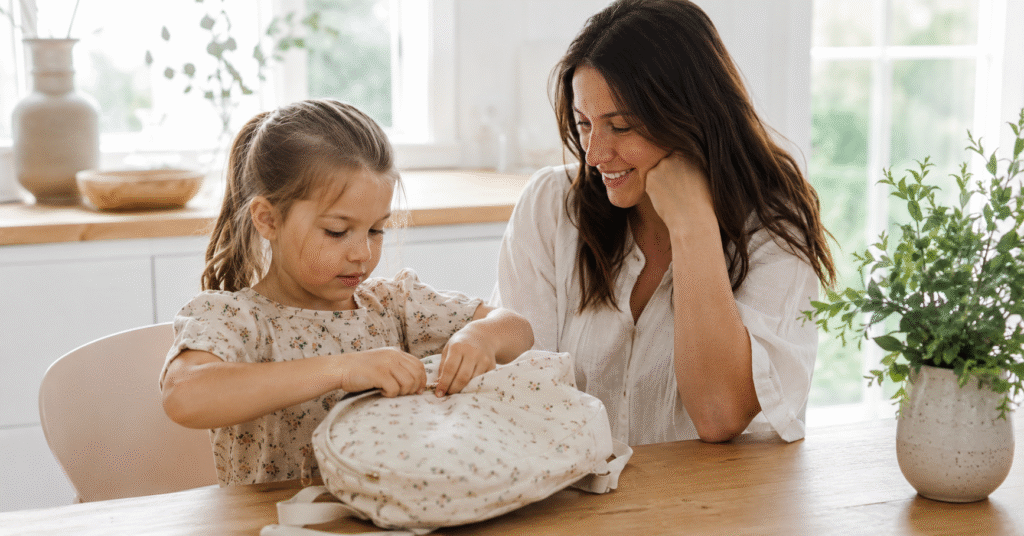
The week before my daughter started kindergarten, I was quietly panicking about the wrong things. I had her practicing letter sounds at the kitchen table, drilling her on counting past twenty, second-guessing whether she should be reading simple words by now. What I had not practiced even once: opening her own lunchbox.
You can guess how the first week went. She knew her alphabet cold. She also sat in front of a sealed yogurt tube for ten minutes because she was too shy to ask for help, and came home starving. Her teacher mentioned it kindly at pickup, and I remember thinking, nobody told me that was the part that mattered.
Here is what I have learned since, both from her teacher and from digging into what early childhood researchers actually say: the skills that make kindergarten go smoothly are mostly not the academic ones parents stress about. They are quieter, more boring, and a lot more buildable in a summer than you would think. Let’s get into what they are and how to practice them without turning your home into a worksheet factory.
What Parents Prep For vs. What Teachers Actually Want
If you ask a room full of parents what “kindergarten ready” means, you’ll hear letters, numbers, maybe writing their name. If you ask kindergarten teachers, you get a strikingly different list. In a long-running national survey of public school kindergarten teachers, the qualities they rated most essential weren’t academic at all.
That bottom bar is the one that stops parents short. Knowing the alphabet lands near the bottom of the teacher wish list, while being able to say “I need help opening this” sits near the top.
One honest caveat: that survey is a classic, but it’s not new, and kindergarten has gotten more academic since. Studies tracking teacher expectations have found the share who call knowing the alphabet “very important” roughly doubled over a decade, and many teachers now expect children to leave kindergarten reading, something closer to what first grade used to ask. So the academic bar has genuinely risen. What hasn’t changed is the foundation underneath it. The American Academy of Pediatrics still flags that too many children arrive without the social-emotional and self-regulation skills school success rests on, and recent parent-and-teacher surveys keep landing in the same place: self-help and emotional skills outrank early academics when teachers describe a ready child. The letters matter more than they used to. They still aren’t the foundation.
So think of those academic skills as the part of the iceberg above the water. The five skill areas below are what’s holding everything else up.
The 5 Skills That Actually Matter (and How to Build Them)
1. Self-Help and Independence
This is the lunchbox lesson, and it’s the one I wish I’d taken seriously sooner. A kindergarten teacher has somewhere around 20 kids and cannot personally open every yogurt, zip every jacket, or wipe every nose. The children who can manage their own bodies and belongings spend their energy on learning. The ones who can’t spend it on getting stuck.
The list teachers quietly hope for is unglamorous: opening lunch containers and food packaging, putting on and zipping a jacket, managing the bathroom independently (including the part where they wash hands and blow their own nose), hanging up a backpack, and putting on shoes. Education experts make the same point. As one professor put it, having kids do simple self-care tasks at home builds self-reliance and a real sense of pride.
The fix is almost too simple: stop doing these things for them. Buy the lunchbox you’ll actually use in September and let your kiddo practice opening every container now, at the kitchen table, with no bus waiting. Let them struggle with the zipper for the extra ninety seconds. It feels slower in the moment and saves a hungry, frustrated afternoon later.
2. Emotional Regulation
Kindergarten is a six-hour marathon of small frustrations: losing a game, waiting for a turn, not sitting next to a best friend, being told it’s cleanup time mid-craft. A child doesn’t need to be calm all the time. They need a few ways to handle a big feeling that don’t involve melting onto the floor or hitting a classmate.
This is the skill teachers consistently say they see missing, and it’s also the one with the longest payoff. Kids who can name a feeling, take a breath, and recover are kids who can stay in the room and keep learning. Decades of research on school readiness point to emotional regulation and getting along with others as stronger predictors of how the year goes than any letter chart.
You build this in the ordinary friction of home, not in a special lesson. When my older son loses at a board game, that meltdown is the practice, not the problem. Naming feelings out loud (“you’re really disappointed the tower fell, that’s so frustrating”), modeling your own (“I’m annoyed I burned dinner, I’m going to take a breath”), and letting kids sit with small disappointments instead of fixing everything fast all add up. If your child already separates from you for a few hours without falling apart, that’s a huge piece of this one already done.
3. Listening and Following Directions
“Attending kindergarten involves a lot of listening,” is how one group of teachers put it, and it’s easy to underrate. A surprising amount of a kindergarten morning is multi-step instructions delivered to the whole group at once: “put your folder in your cubby, hang up your coat, and come sit on the carpet.” A child who can hold two or three steps and act on them is set. A child who needs each step repeated one-on-one is swimming upstream all day.
The good news is this is genuinely fun to practice and needs zero materials. Give two-step directions during normal life and gradually stretch to three: “please grab your shoes and put them by the door.” Cooking together is a stealth workout for this, full of “first we pour, then we stir.” So are classic games like Simon Says and Red Light, Green Light, which are basically listening drills disguised as fun. Reading aloud daily helps here too, because following a story is its own kind of sustained listening.
4. Fine Motor Skills
Here’s where a little bit of gear genuinely helps, so this is the one section where I’ll point you at specific things. Fine motor strength is what lets a child hold a crayon without their hand cramping, cut along a line, manage buttons and zippers, and eventually form letters. Teachers notice when it’s underdeveloped, because so much of the school day runs on small hands doing small precise things.
You do not need a curriculum. You need playdough, crayons, scissors, and a kid who’s allowed to use them. Squishing dough, threading beads, peeling stickers, and tearing paper all build the same hand muscles. When you do add tools, a few well-chosen ones earn their keep. These are the categories I’d actually spend money on, with the specific products my own kids cycled through across three rounds of preschool-aged hands.
Triangular crayons are the easiest upgrade. The three-sided shape nudges little fingers into the tripod grip they’ll eventually need for a pencil, and they don’t roll off the table, which spares you the under-the-couch crayon hunt.
Melissa & Doug Jumbo Triangular Crayons (10-Pack)
Chunky three-sided crayons made of plastic rather than wax, so they hold up to drops and stomps better than a standard box. The flip-top case keeps them corralled, and the triangular shape is designed to encourage the grip kids carry into early writing. A solid first set for around the price of a coffee.
If your child is already holding a regular pencil or crayon in a fist grip, slip-on pencil grips are a cheap way to retrain it without nagging. They won’t fix everything, and some kids ignore them, but at a few dollars they’re worth a try before you worry.
Mr. Pen Pencil Grips for Kids (4-Pack with Clips)
Soft silicone grips that slide onto a standard pencil, crayon, or pen and gently position the fingers. They work for righties and lefties, and the four-pack means you can leave one on the pencil that lives in your bag. From a teacher-founded brand, which is a nice touch even if your kid mostly cares that they come in colors.
Cutting deserves its own mention, because scissor skills are a classic kindergarten checklist item and a lot of kids arrive having never been handed a pair. You want safety scissors with rounded tips and plastic-covered or plastic blades. I’d actually suggest two stages here.
Crayola My First Safety Scissors (3-Pack)
All-plastic blades and rounded tips, rated for ages three and up. The set includes straight, wavy, and zigzag edges, which keeps cutting practice interesting. Worth setting expectations: these only cut single sheets of thin paper, so think of them as a true beginner’s pair for a child who’s never held scissors, not a do-everything tool. For a first introduction, that limitation is a feature.
Fiskars Training Scissors for Preschoolers (Ages 3+)
These have a spring-loaded training lever that pops the blades back open after each cut, so a beginner can focus on just the closing motion. Once that clicks, you flip the lever up and they become regular open-and-close scissors, so the same pair grows from “learning to cut” to “actually cutting.” Blunt tips and plastic-covered metal blades. A genuinely useful bridge to big-kid scissors.
For lots more low-cost, no-tool ideas to build hand strength, our guide to fine motor activities for little hands has a whole list you can start today.
5. Early Literacy and Math, in the Right Dose
So where do letters and numbers fit? They matter, but the bar is lower than anxious parents assume. Kindergarten teachers are not expecting a reader. The realistic targets look more like: recognizing most letters and knowing some of their sounds, counting to around 20, identifying basic shapes and colors, and recognizing numbers up to 10. Notably, the single most repeated piece of advice from teachers about early reading is almost embarrassingly low-tech: read aloud to your child every day. That’s the whole strategy. Talking with your child, pointing out letters on signs, and counting things in real life do more than any drill.
If your child enjoys a more structured activity, a workbook can be a fine addition, with one caveat: it should feel like a game your kid asks for, not a chore you enforce. A frustrated five-year-old at a worksheet is learning to dislike school, which is the opposite of the goal. Used in small, cheerful doses, these two are the ones I’d reach for.
School Zone Big Preschool Workbook (320 pages)
A long-running, comprehensive Pre-K workbook covering colors, shapes, numbers, early math, the alphabet, pre-writing, phonics, and following directions. The “following directions” pages are a sneaky bonus, since that’s skill number three on this list. At 320 pages it’s a buy-once book that lasts most of a year, and the price-per-page is tiny. Tear out a page at a time so it never feels like a mountain.
My First Learn-to-Write Workbook (Crystal Radke)
A gentle introduction to pen control and line tracing that builds toward letters, written by a former kindergarten teacher. It starts with the pre-writing strokes (lines, curves, zigzags) that have to come before actual letters, which is exactly the right place for a not-yet-writer to begin. One heads-up when you shop: there are many books with nearly identical titles, so check that you’re getting the Crystal Radke edition.
If you’d like to see how these two compare against other popular options, we rounded up the preschool workbooks actually worth the shelf space in a separate guide.
A reasonable worry here is screens, since so much “learning” content is now an app. If you’re weighing tablets and learning apps against paper and crayons, our take on kids’ learning tablets and screen time walks through where the research actually lands. For hands-on letter and number play that doesn’t involve a screen at all, the Montessori letters and numbers at home approach is a lovely low-pressure option.
How to Build All of This in One Summer
If that felt like a lot, here’s the reassuring part: you don’t need a schedule or a curriculum. You need ordinary days with a slightly different lens. A rough way to fold it into normal life:
- At meals: let them open their own packaging and use real utensils. This quietly covers self-help and fine motor at once.
- In transitions: give two- and three-step directions (“shoes on, then grab your water”). This is your listening practice, free of charge.
- During play: playdough, crayons, scissors, and stickers, with you nearby but not hovering. Independent play also builds focus.
- At bedtime: read aloud, every day, no exceptions. This is the single highest-return ten minutes you’ll spend.
- In meltdowns: treat them as the lesson. Name the feeling, model the recovery, and let small disappointments stand.
Notice how little of that involves “teaching.” Most of kindergarten readiness is just letting your child do more for themselves while you resist the urge to smooth every bump.
What If You’re Worried Your Child Isn’t Ready?
First, a deep breath. Most kindergarten teachers themselves believe readiness comes with growth and maturity and can’t be rushed, and that a wide range of starting points is completely normal. Children develop on very different timelines, and a child who’s behind on one skill in June often closes the gap fast once they’re surrounded by peers in the fall.
That said, it’s worth paying attention if you notice your child is missing several age-expected milestones, or seems to have lost skills they previously had, particularly around communication, social interaction, or motor skills. Those are signals to check in, not to panic. The CDC’s developmental milestone checklists are a free, plain-language way to see roughly where things stand, and your pediatrician is the right next stop if something feels off. Early support is far more effective than waiting, and asking is never an overreaction.
It’s also fair to remember that “ready” isn’t a single finish line. Some families consider an extra year before starting, and there’s no universally right answer. What there is: a child who can manage their body, handle a feeling, follow a couple of directions, and walk in curious. The letters will come.
The Realistic Kindergarten Readiness Checklist
If you want one honest, no-pressure list to keep on the fridge, here’s the short version of everything above. Your child is in good shape for kindergarten if they can mostly:
- Open their own lunch and manage the bathroom on their own
- Separate from you for a few hours without falling apart
- Recover from a small disappointment without a full meltdown
- Follow a two- or three-step direction
- Hold a crayon and make a few cuts with safety scissors
- Recognize most letters and count to around 20
- Walk in curious and willing to try
Notice that only one of seven is academic. That’s not an accident, and it’s the whole point.
The summer before kindergarten can feel heavy with expectation. But the most useful thing I did for my daughter that year wasn’t a flashcard. It was handing her the yogurt tube and waiting. Start there.