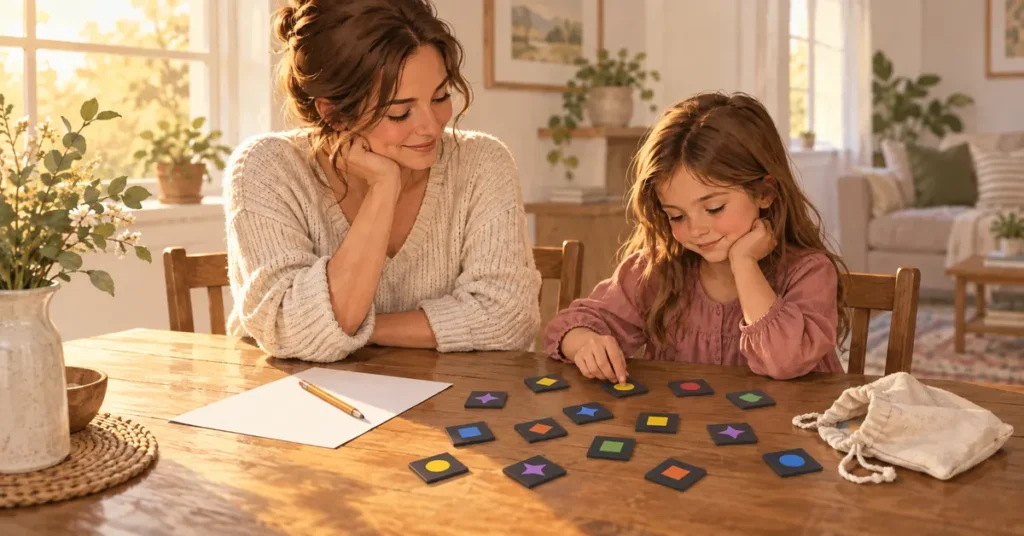
Picture your child sliding a red tile toward a row of other red tiles. It looks like a match. Then you notice the blue tile underneath the empty space, and there is another rule to explain before the move can count.
I’d consider Qwirkle for a six-year-old when an adult wants to sit down and learn alongside her. You will still have rules to explain and scores to keep, even though there are no words on the tiles. The current classic set also has quality complaints that make me cautious about buying it as a gift.
MindWare recommends Qwirkle for ages six and up, with two to four players. Its official rules put a full game at 30–60 minutes and ask you to supply a pencil and paper. Leave time for a proper game; I would not squeeze the first attempt between setting the table and serving dinner.
The version discussed here is the US classic Qwirkle set, model 32016: 108 wooden tiles and a drawstring bag, without tile racks or a score pad. Keep that distinction in mind when shopping, because an accessory pictured with another set may not be in this box.
Who I would buy it for
The appealing part is easy to see: a child who is still learning to read can look for a useful color or shape without having to decipher a card. Adults have decisions to make, too. Where you place a tile changes what you score and what opportunities you leave for the next player. You can be interested in your own turn while your child is interested in hers.
Before buying, think about games you already play. Does your child enjoy searching the table for a move? Can she wait while someone else thinks, then try a different spot when a tile does not fit? She need not get everything right. What matters is whether you both want to keep playing while she learns.
| Your family wants… | My take |
|---|---|
| A game to learn together, with an adult helping with scores | Consider it if your child enjoys choosing moves and taking turns. |
| A quick game before dinner or something to play alone | Skip it for this purpose. |
| A cooperative game without individual winners | Choose a different kind of game. |
| A game for someone who struggles to distinguish the tile colors | Try it in person first; shapes do not remove the color requirement. |
| A wooden gift chosen mainly for durability | I would pass on this classic set. |
If you need something different, our screen-free gift ideas offer other starting points.
A matching color is only the start
The basic matching rule is manageable: each straight line shares one color or one shape. In a line of red tiles, the shapes must be different. In a line of squares, the colors must be different. You cannot repeat the same color-and-shape tile within that line.
The extra check comes when your tile touches another line. Every horizontal and vertical line it joins must work. Matching the row in front of you is only part of the move.
In the example below, a red star fits the empty spot beside the red row and above the blue star. A red diamond fits the red row, but it fails next to the blue star below: those tiles share neither color nor shape.
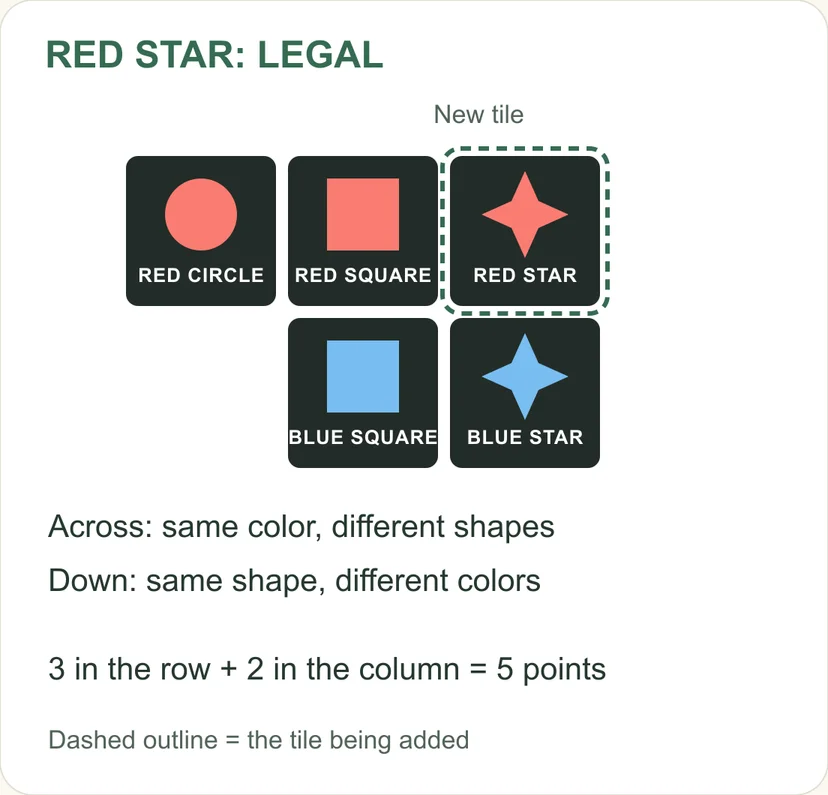
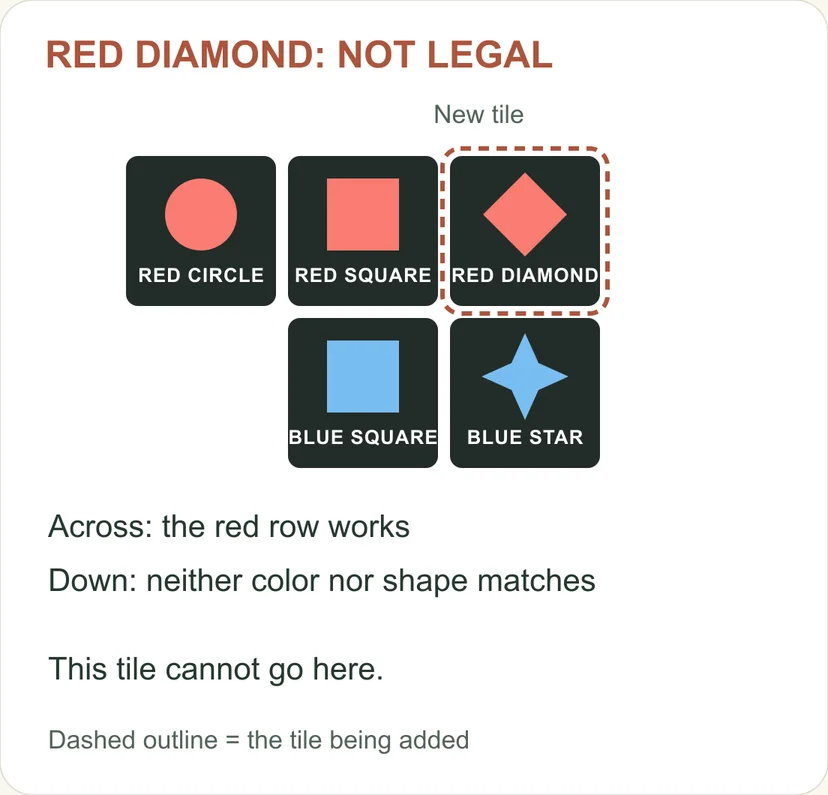
The red star scores five points: three for the row and two for the column. That is the part you may need to explain with a finger moving along each line. One new tile does not necessarily mean one point.
Matthew Smail describes this learning curve in his Big Boss Battle review. His six- and eight-year-old daughters grasped the game, but the family initially missed some illegal duplicate placements. It shows a family learning together; your child’s pace may differ.
Color recognition matters throughout play. The shapes do not remove the need to distinguish the colors. If someone in your family has trouble telling these colors apart, try a set in person before buying. Do not assume familiarity with the rules will solve that problem.
Keep the pencil beside you
I would expect to stay at the table for those first games. Keep the score sheet beside you so your child can focus on finding a move. Once she has placed a tile, look along each line it touches, count the points together, and write the new total. You can hand over more of the counting when she wants to take it on.
Keeping score for her will not remove every pause. Other players still need time to look at their tiles and choose a move. A child can understand the matching rule and still dislike waiting through everyone else’s turn. Before promising family game night, consider whether that wait already causes frustration with games you own.
Clear a stretch of table before opening the bag. There is no fixed board containing the growing layout. I would move the dinner things before starting, so you are not shifting rows of tiles just as your child spots a move.
The classic tiles give me pause
I would be cautious about giving this classic set as a gift. Buyers have reported thin or uneven tiles, pieces that tip over, and paint that wears or fades. Those reports do not tell us how often a problem occurs or what will arrive in your box. They do mean I would not promise years of trouble-free use.
A tile that tips over can show the hand you are trying to keep hidden. Fading colors or shapes can make it harder to judge a move. A small surface mark is one thing; having to stop and work out what is printed on a tile is another.
Tile racks are not included in this classic version, so their absence is not a packing error. I would not order extra accessories to compensate for a set that might have unstable tiles. If the pieces will not sit properly or the printing is hard to distinguish, ask the seller about a return or replacement.
On arrival, count the tiles, check for the bag, and look at the colors, flatness, and edges. A November 2023 owner review also describes splintering edges. Stop using damaged or splintering pieces, or tiles with paint loss that affects play, and seek a return or replacement. I would not sand or repaint them for a child.
Start with a few practice turns
For a first try, I’d start with one adult and the child. Put a few tiles where you can both see them, practice a valid line, then try a move that needs checking in both directions. Keep any scores yourself and point out where the points come from.
Showing your tiles and setting aside the competition are teaching adjustments. This is a practice session, not an official short version of Qwirkle. You can stop after a few turns; once the placements make sense, return to the full rules, including hidden hands and scoring.
Notice whether your child wants another turn. That tells you more about this purchase than one correct match. If you can borrow a set or try a friend’s, start there. Turning six does not mean you need another game when you already have one you enjoy together.
Keep the tiles and bag out of reach of younger siblings who put things in their mouths. Follow the six-and-up age recommendation; sitting beside a younger child does not change it. A separate place to play can help if you share a room with little ones; our mixed-age playroom guide has ideas for keeping their toys apart.
Buying it for your family
I’d buy Qwirkle for afternoons when I wanted to stay at the table, help with a tricky placement, and keep playing. A child who enjoys that shared game may find plenty to like. The quality concerns still matter: inspect the pieces when they arrive, and choose something else if you want a gift you can hand over without checking.
A complete set in good condition, paper, and a pencil are enough to begin. Let your child’s interest decide whether you play again before buying any extras.
Check Qwirkle Classic on Amazon
Classic set without tile racks. Keep the tile-quality concerns above in mind before ordering.