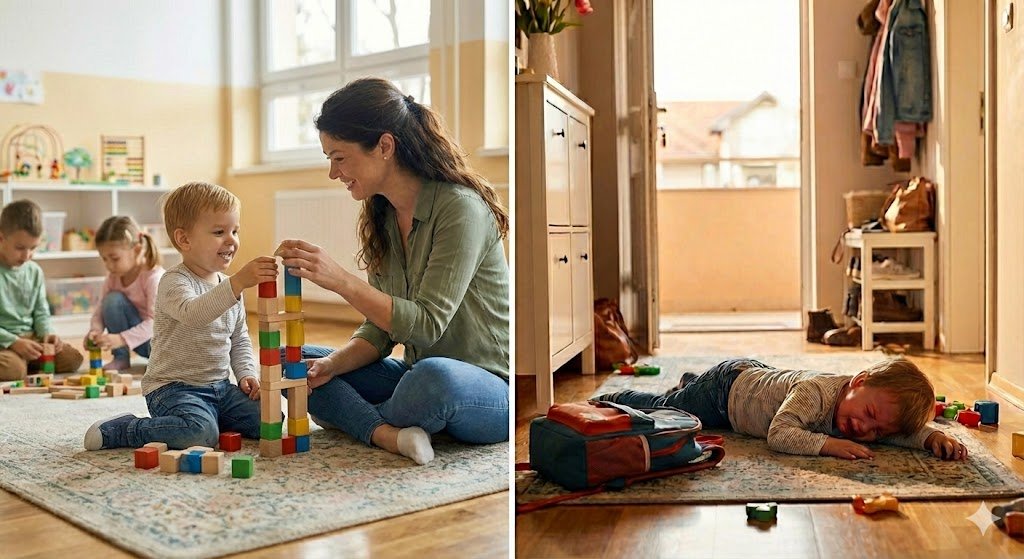
The “Angel” at the Gate, the “Storm” in the Car
It’s a scene played out at daycare gates everywhere. You pick up your child, and the teacher beams: “They were a total joy today!” You feel a surge of pride—until you get to the car.
The moment the door shuts, the “joyous” child vanishes. According to experts at the Child Mind Institute, this abrupt transition occurs when a child’s coping resources are fully depleted.
You wonder: “Why do they save their worst for me?” The answer is a biological phenomenon known as After-School Restraint Collapse.
1. The Science: Why the “Filter” Fails at Home
Imagine your child has a “Willpower Battery.” In their brain, the Prefrontal Cortex (PFC) is the CEO in charge of following rules. Harvard Health notes that emotional regulation is a skill that matures over many years.
At school, they spend 7 hours holding themselves together. By 4 PM, their battery is at 0%. Their logical brain is literally “offline,” and the Amygdala (the emotional center) takes over.
2. You Are the Safe Space to Fall Apart
They finally feel safe enough with you to stop performing. They know your love is unconditional. The American Psychological Association emphasizes that secure attachment allows children to express complex emotions safely.
It is not a manipulation; it is a profound sign of ultimate trust.
3. Holding the Line: Safe Feelings, Safe Bodies
Holding space for a meltdown doesn’t mean becoming a doormat. When a child is acting out, they need short, firm, and warm guidance.
- If they hit: “I won’t let you hit me. Hand down. I’m going to give you some space. I’m right here.”
- If they throw things: “I’m taking the toys away so no one gets hurt. You can throw these pillows instead.”
4. The 4 PM Survival Protocol
At 4 PM, regulation is physical before it’s emotional, and emotional before it’s verbal.
Phase 1: Physical (The Reset)
- No Questions: Skip the interrogation. Let them process in silence.
- The Crunchy Snack: Offer apples or pretzels. Chewing is biologically grounding.
Phase 2: Emotional (The Connection)
- Zero Decisions: Don’t ask what they want for dinner. Just lead with calm routines.
- The Long Hug: A 20-second hug lowers stress hormones instantly.
Phase 3: Verbal (The Recap)
- Wait for the Calm: Only when they are regulated, say: “Your brain worked so hard today. It’s okay that it all came out.”
Conclusion
“If your child saves their most difficult moments for you, take a deep breath. It means your home is the one place on earth where they don’t have to be ‘perfect’ to be loved. That meltdown is not a failure; it is a sign of ultimate trust.”
💗 Looking for the full framework on toddler emotions and meltdowns? Read the complete guide here → Toddler Tantrums & Emotional Regulation Hub
FREE: 10 Calm-Down Phrases
3 pages of what to say during meltdowns, hitting, screaming, and when nothing works.
Print them. Stick them on your fridge.