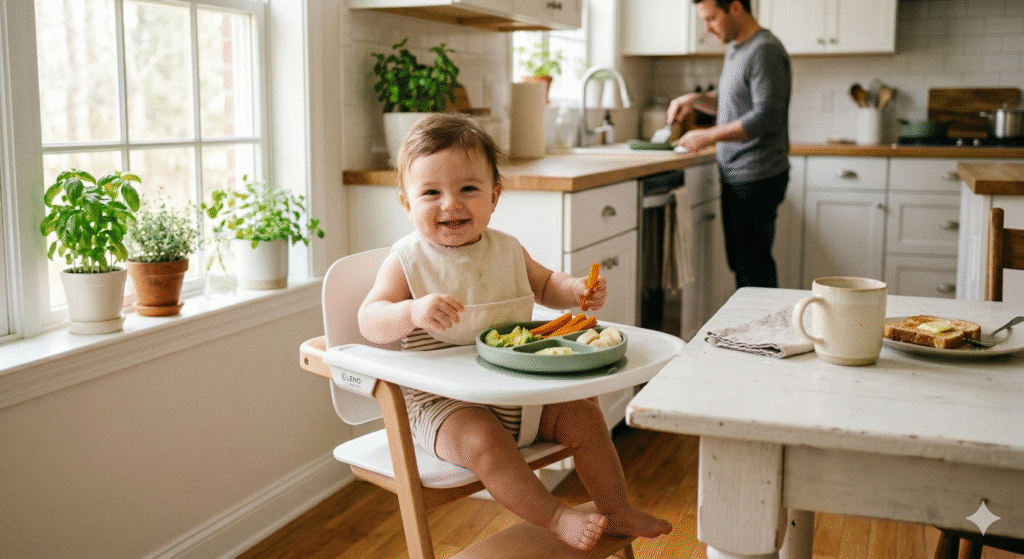
When my youngest was six months old and ready to try his first taste of avocado, I sat him in a high chair that looked great in photos but was completely wrong for baby-led weaning. His feet dangled. The tray was too far from his chest. And cleaning pureed sweet potato out of fabric straps at 7 a.m.? I was done.
Three kids, four high chairs, and one memorably ruined white shirt later, I finally know what actually matters when you’re picking a seat for those messy, magical first meals. (Spoiler: it’s not the Instagram aesthetic. It’s whether you can wipe spaghetti sauce off the straps in under ten seconds.)
We used the IKEA Antilop with my oldest, upgraded to a Tripp Trapp for my middle kid, and finally landed on the Mockingbird for my youngest — and each time I learned something new about what works and what drives you quietly insane. This guide covers the six best high chairs I’d recommend to any parent starting solids in 2026, plus exactly what to look for so your baby is safe, comfortable, and actually ready to eat.
What Makes a High Chair Safe for Baby-Led Weaning?
Before we get into specific chairs, here’s what feeding therapists and pediatric dietitians actually care about. (Hint: it’s not the color options.)
The 90-90-90 rule. Your baby’s hips, knees, and ankles should each be at roughly 90-degree angles when seated. This position gives their core muscles a stable foundation, which helps them focus on chewing and swallowing rather than fighting to stay upright. Research shows that proper positioning can reduce choking risk and increase the length of time a child is willing to sit for a meal.
A footrest that actually reaches their feet. This is the single most overlooked feature in high chairs. When a baby’s feet dangle with nothing to push against, they tend to squirm, slouch, and lose interest in eating. Think about it — have you ever tried to eat comfortably on a barstool with no footrest? An adjustable footrest lets you keep that 90-degree angle at the knees as your baby grows.
A five-point harness. A five-point harness (two shoulder straps, two waist straps, one crotch strap) keeps your baby safely contained and prevents them from standing up or climbing out. Some chairs offer a three-point harness, which works fine for older toddlers but isn’t ideal for babies just starting solids.
An upright seat — never reclined for solids. This one surprises a lot of parents. Many high chairs come with a recline feature, and it seems logical for smaller babies. But feeding therapists are very clear: babies should always eat solid food in a fully upright position. A reclined position allows gravity to pull food toward the back of the throat before the baby is ready to swallow, increasing choking risk. Recline is fine for bottle feeding, but never for solids or purees.
If you’re just getting started with baby’s first foods, the seating is step one.
How We Picked These High Chairs
I’ve personally used four high chairs across three kids, researched a dozen more, and asked every feeding therapist and pediatric dietitian I could corner at the playground. Here’s what I actually looked at — not just what sounds good in a product listing.
Safety first. Every chair on this list has a secure harness system, a stable base, and no active CPSC recalls. I checked each one against the Consumer Product Safety Commission database. One popular premium chair got cut from this list after being recalled in 2025 for a structural defect that caused collapses and injuries — more on that in the FAQ section.
Ease of cleaning. If you’ve ever discovered a dried pea wedged in a harness buckle three days later — yeah, me too. You’ll clean this chair multiple times every single day, so I weighted this one hard.
Ergonomics for BLW. Does it have an adjustable footrest? Can the baby sit upright? Can you remove the tray and pull the chair up to the family table? These features aren’t nice-to-haves — they’re essential for baby-led weaning.
Growth potential. Some chairs last six months. Others last until your child is in elementary school — or longer. I considered how much use you’ll actually get out of each chair before it ends up in the garage.
Real-world value. A $20 chair and a $250 chair can both be excellent depending on your situation. I included options at every budget because the best high chair is the one that works for your family, not the one with the best marketing.
I also cut several popular chairs from this list — one for a safety recall, two for impossible-to-clean designs with fabric everywhere, and one that looked gorgeous but had zero foot support. Pretty only gets you so far when there’s oatmeal involved.
6 Best High Chairs for Baby-Led Weaning in 2026
1. Best Overall — Mockingbird High Chair
This is the chair we use daily with my youngest, and honestly? It’s the chair I wish existed when my oldest was a baby. Its standout feature is something no other high chair offers: silicone-coated harness straps with a magnetic buckle. If you’ve never experienced the joy of wiping food off silicone versus scrubbing it out of nylon webbing — trust me, this alone is worth it.
The seat is designed with smooth, curved surfaces and virtually no crevices where food can hide. The removable tray liner pops off and goes straight into the dishwasher, so you can swap in the clean tray underneath and actually finish your own meal while your baby plays with toys. The footrest adjusts to four positions without tools, which matters when you’re doing it one-handed with a fussy toddler on your hip.
The chair converts from a high chair to a child chair (up to 150 lbs) by simply lifting off the baby seat — no tools required. The Y-shaped beechwood frame tucks neatly under the table when the tray is removed, and the overall footprint is smaller than most — about 16.5 inches wide by 24 inches deep.
The main downside? It doesn’t fold. If you live in a very small space where you need to store the high chair between meals, consider the Munchkin Float instead.
Best for: Families who are done scrubbing straps and want a chair that’s actually designed for how babies eat.
2. Best Classic — Stokke Tripp Trapp
The Tripp Trapp has been around since 1972, and there’s a reason it’s still the most recommended high chair in baby-led weaning communities. Designed by Peter Opsvik — and reportedly part of MoMA’s design collection — this chair was built around one simple idea: a child should sit at the family table, at the right height, with proper foot support.
Both the seat plate and footplate adjust to multiple positions, which means you can dial in the perfect ergonomic setup as your child grows from a six-month-old just starting solids to an elementary schooler doing homework. The solid European beechwood construction holds up to 242 lbs — yes, most adults could sit in it comfortably.
The honest downsides: you’ll spend a lot more than $249 once you add the Baby Set with harness (required for babies), the tray, and a cushion. The total bundle runs $350–400+. My husband jokes that the Tripp Trapp cost more than his desk chair — but to be fair, it’s lasted longer too. The wood grooves collect food. And the fabric straps are notoriously difficult to keep clean — a stark contrast to the Mockingbird’s silicone approach. Footrest adjustment requires a tool (an Allen key), which makes it less convenient than chairs with tool-free systems.
Despite these quirks, the Tripp Trapp earns its spot because nothing else lasts this long. I know families using their Tripp Trapp with teenagers. Hard to argue with a chair that outlasts your kid’s interest in Paw Patrol.
Best for: Families who want a single chair that lasts from first solids through childhood (and don’t mind paying for accessories).
3. Best Budget — IKEA Antilop
The IKEA Antilop is the high chair that feeding therapists recommend without hesitation — not despite its low price, but because its simple design does exactly what a high chair needs to do. No fabric. No crevices. No padding to absorb yesterday’s dinner. You can literally hose it down or throw the tray in the dishwasher. There’s a reason it has a cult following in every BLW Facebook group.
The big catch for BLW is that the Antilop doesn’t come with a footrest, and it only has a basic lap belt rather than a full harness. Both are fixable. A third-party adjustable footrest from Amazon (search for “IKEA Antilop footrest”) runs about $15–30 and transforms the chair from adequate to excellent for baby-led weaning. You can also find third-party five-point harnesses if you want more security.
💡 Antilop footrest hack: For the DIY route, some parents use a pool noodle or tissue box secured with strong Velcro strips or duct tape as a temporary footrest. It works surprisingly well while you wait for a proper one to arrive. The key is getting your baby’s feet flat on a surface so their knees bend at 90 degrees.
The Antilop won’t grow with your child past toddlerhood, and it won’t win any design awards. But at $20 plus a $20 footrest, you get a feeding setup that rivals chairs ten times the price — and if it gets destroyed by your toddler’s creative interpretation of mealtime, replacing it doesn’t sting.
Best for: Budget-conscious families, second chairs for grandparents’ houses, or anyone who values the easiest possible cleanup.
4. Best Wooden Chair — Abiie Beyond Junior Y
Abiie’s original Beyond Junior was BabyGearLab’s top-rated high chair, and the new Y model builds on that foundation with a redesigned frame. It offers the same grow-with-your-child promise as the Stokke Tripp Trapp — from first solids all the way to a 250 lb adult chair — at a lower price point and with several practical improvements.
The standout is Abiie’s EZ-Seat technology: you click, slide, and lock the seat and footrest into place in under 20 seconds, no tools needed. Compare that to the Tripp Trapp’s Allen-key situation and you’ll appreciate it — especially when you’re adjusting one-handed with a squirming toddler. The dual-depth tray adjusts as your baby grows, keeping food within easy reach for little hands. And the waterproof cushion simply wipes clean — no removing, no machine washing, no waiting for it to dry.
A nice bonus: the wood is heat-sterilized at 248°F before it ships, which Abiie says makes the surface anti-microbial. The chair also meets ASTM F404 safety standards and is free of BPA, phthalates, and PVC — all the things you want to see when your baby is literally chewing on the tray.
The one catch: BabyGearLab flagged that the new Y-model tray requires two hands to operate and has a slightly stiff tray cover mechanism with potential for pinching. Worth being aware of, though not a dealbreaker.
Best for: Families who love the Tripp Trapp concept but want tool-free adjustments, a waterproof cushion, and a lower price.
5. Best Portable — Inglesina Fast Table Chair
The Inglesina Fast isn’t a replacement for a full-sized high chair — it’s the one you toss in the trunk. At just 4.2 lbs with an integrated carry bag hidden under the seat, it goes everywhere: restaurants, grandparents’ houses, vacations, picnics. We’ve taken ours to Thanksgiving dinner, beach trips, and at least a dozen restaurants.
The twist-tight couplings clamp securely to most tables without scratching, and the padded seat with high backrest keeps babies surprisingly comfortable. Inglesina is an Italian brand that’s been designing baby gear since 1963, and the Fast is one of their most refined products — there’s very little left to improve for what it does.
The limitations are inherent to the hook-on format: no footrest (your baby’s feet will dangle), only a three-point harness, and the fabric seat needs machine washing on a delicate cycle — you can’t just wipe it down after a BLW session with spaghetti. The optional dining tray (about $30 extra) is worth getting if you’ll use this as a primary feeding seat while traveling.
It’s also free of BPA, BPS, PFAs, lead, flame retardants, and phthalates — that’s a lot of safety checkboxes for a $70 chair.
Best for: Families who eat out frequently, travel, or need a compact chair for grandparents’ houses.
6. Best for Small Spaces — Munchkin Float
If you need a full-featured high chair that actually disappears when mealtime is over, the Munchkin Float is your answer. Press two buttons on the sides and the legs fold inward, leaving a profile just 8 inches deep that leans against any wall or slides between the fridge and the counter. For apartment dwellers or anyone with a small kitchen, it’s kind of a revelation.
Despite the folding mechanism, the Float doesn’t feel flimsy. The wooden legs and thick plastic seat have a mid-century modern look that genuinely fits into home decor rather than screaming “baby gear.” My neighbor has one in her galley kitchen — I was actually surprised how nice it looked next to her dining table. BabyGearLab praised its build quality too, noting that the materials felt more expensive than the price suggests.
The footrest flips between two height positions — about 6 inches and 9 inches from the seat — which isn’t as adjustable as the Mockingbird’s four positions but still provides real foot support. The five-point harness keeps babies secure, and the smooth surfaces are easy to wipe clean. One caveat: the tray is not dishwasher safe and requires hand washing.
The chair doesn’t convert to a toddler or child chair, so its useful life ends around age 3. But if folding capability is high on your priority list, nothing else on this list competes.
Best for: Small kitchens, apartments, or any family that needs to store the high chair between meals.
Quick Comparison Table
| Chair | Price | Footrest | Harness | Folds | Grows to | Clean |
|---|---|---|---|---|---|---|
| Mockingbird | $249 | 4-pos | 5-pt silicone | No | 150 lbs | ⭐⭐⭐⭐⭐ |
| Stokke Tripp Trapp | $249+ | Multi (tool) | 5-pt fabric | No | 242 lbs | ⭐⭐⭐ |
| IKEA Antilop | ~$20 | Add-on | Lap belt | Legs detach | 33 lbs | ⭐⭐⭐⭐⭐ |
| Abiie Beyond | ~$200 | EZ-Seat | 5/3-pt switch | No | 250 lbs | ⭐⭐⭐⭐ |
| Inglesina Fast | ~$70 | None | 3-pt | Yes + bag | 37 lbs | ⭐⭐⭐ |
| Munchkin Float | ~$180 | 2-pos flip | 5-pt | Yes (8″ flat) | 33 lbs | ⭐⭐⭐⭐ |
How to Set Up Your High Chair for Safe BLW
Even the best high chair needs proper setup. Here’s how to get it right from day one.
Adjust the footrest first. Before your baby even sits down, set the footrest so their feet will rest flat with knees bent at approximately 90 degrees. If your chair doesn’t have a footrest (like the IKEA Antilop out of the box), add one. A pool noodle secured with Velcro strips to the front legs works as a quick DIY solution, or invest in a proper third-party footrest for $15–30.
Check the tray height. The tray or table surface should be at your baby’s chest level or slightly below. If their arms can’t comfortably reach the food, they’ll struggle with self-feeding and get frustrated. Some chairs (like the Mockingbird and Abiie) offer adjustable tray depth to accommodate this as your baby grows.
Support smaller babies. If your baby has just started sitting independently and feels a bit lost in the chair, a small rolled towel behind their back provides extra support — similar to adding a pillow behind your back when a chair is too deep. This is especially helpful in the first few weeks of solids.
Get the harness right. The straps should be snug enough that your baby can’t stand up or slide down, but loose enough that they can move their arms freely to self-feed. Unlike a car seat harness, high chair straps don’t need to be super tight. And never put a bib over the harness straps — if you ever need to unbuckle quickly, you don’t want extra fabric in the way.
A comfortable, well-positioned baby is a baby who’s willing to explore food. And honestly? That willingness is one of the best things you can build early — it’s a big part of why some toddlers try everything and others turn into picky eaters. The chair setup is doing more work than you think.
Frequently Asked Questions
When is my baby ready for a high chair?
Most babies are ready around 6 months, when they can sit upright independently with steady head control. If your baby still slumps forward or can’t keep their torso upright on the floor, wait a little longer. A quick test: sit your baby on the floor between your legs for a minute — if they can stay upright and turn their head smoothly, they’re likely ready.
Do I need a high chair with a recline feature?
For solid food feeding, no. Babies should eat solids in a fully upright position. A recline feature is only useful if you plan to bottle-feed in the chair. If you’re buying primarily for BLW or starting solids, a recline is unnecessary and could be a safety risk if accidentally left in the reclined position during solid feeding.
Is the IKEA Antilop safe for baby-led weaning?
Yes, with modifications. Add a third-party footrest (essential for proper positioning) and consider upgrading to a five-point harness. With those additions, the Antilop becomes one of the best BLW chairs available — feeding therapists recommend it regularly.
How long will my baby use a high chair?
Most children transition out of a traditional high chair between 18 months and 3 years. If you’re still in the newborn stage and building your gear list, check out our newborn must-haves checklist — but know that a high chair will be one of your most-used items once solids start. Many kids need a booster or elevated seat at the family table well into elementary school, since their feet may not reach the floor from an adult chair until age 8 or 9. Convertible chairs like the Stokke Tripp Trapp, Abiie Beyond, and Mockingbird address this by transforming into child or youth chairs.
What about the Bugaboo Giraffe? I’ve seen it recommended elsewhere.
The Bugaboo Giraffe was recalled by the U.S. Consumer Product Safety Commission in June 2025 after 22 reports of the chair’s legs detaching during use, resulting in 13 injuries to children including bruising, abrasions, and temporary loss of consciousness. Bugaboo offers a free repair kit with replacement screws, and chairs purchased after May 2025 include the fix. However, given the severity of the reported incidents, I can’t recommend it right now. You can check the full recall details at cpsc.gov.
Can I check if any high chair has been recalled?
Yes. Visit cpsc.gov/Recalls and search by product name or brand. I also recommend registering your high chair with the manufacturer so you receive direct recall notifications. It takes two minutes and could prevent a serious injury.
The Bottom Line
There’s no single perfect high chair for every family. But there is a perfect high chair for your family — and it comes down to what you prioritize most.
If easy cleaning is everything, go with the Mockingbird. If you want a chair that lasts until college, choose the Stokke Tripp Trapp. If you’re on a tight budget, the IKEA Antilop with an aftermarket footrest is genuinely hard to beat. If you want the best wooden chair with modern conveniences, the Abiie Beyond delivers. If you need something for travel, grab the Inglesina Fast. And if your kitchen is small, the Munchkin Float folds down to nothing.
Whatever you choose, the setup matters more than which chair you pick. Seriously. Get that footrest right. Keep baby upright. Pull them up to the family table. And let the mess happen — that’s where the learning is.
Last updated: April 2026. All prices and specifications verified against manufacturer websites and Amazon listings at time of writing.