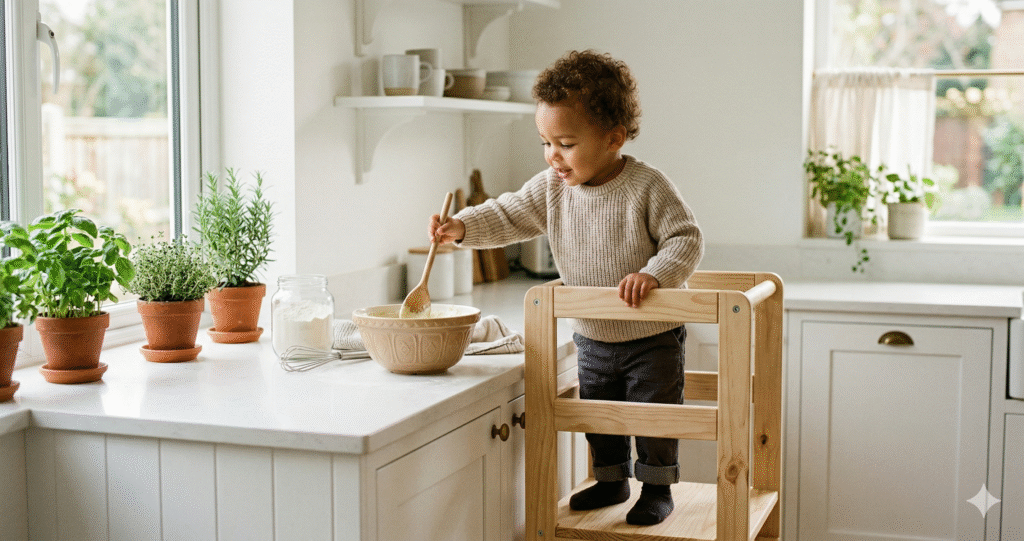
You’re chopping vegetables for dinner, and your toddler is wrapped around your leg, whining to be picked up because they want to see. You hoist them onto one hip and try to wield a knife with your other hand, which is roughly as safe as it sounds. My older son went through this phase around 20 months, and it drove my husband and me a little nuts — he wanted desperately to be part of the action, and I wanted desperately not to lose a finger.
That’s exactly the problem a learning tower solves. Unlike a regular step stool (which toddlers can — and will — fall right off), a learning tower has protective railings on all sides, giving your kiddo a safe, enclosed platform to stand on at counter height. They can watch you cook, “help” stir, wash their hands, do art projects — all while you keep both hands free and your blood pressure at a reasonable level.
After researching dozens of options, reading through hundreds of parent reviews, and figuring out what actually works in a kitchen with three kids underfoot, I’ve narrowed it down to the five best learning towers across every budget. Whether you want a premium foldable tower that passes Consumer Reports safety tests or a $40 DIY option, there’s something here for you.
Quick Comparison
| Tower | Price | Ages | Weight Limit | Foldable | Best For |
|---|---|---|---|---|---|
| Guidecraft Contemporary | ~$170–200 | 18 mo–5 yr | 125 lbs | Yes | Overall pick |
| Little Partners Explore ‘N Store | $159.99 | 2–6 yr | 150 lbs | Step folds | Montessori families |
| Simplay3 Toddler Tower | ~$89.99 | 18 mo–5 yr | 150 lbs | No | Easy cleaning |
| SDADI Step Stool | ~$50–70 | 18 mo–3 yr | 150 lbs | No | Budget pick |
| IKEA BEKVÄM DIY Hack | ~$40–50 | Custom | Varies | No | DIY parents |
What to Look for in a Learning Tower
Here’s what actually matters when you’re choosing a learning tower. I’ve used a few different towers over the past couple of years, and these are the factors that ended up making the biggest real-world difference:
Safety railings on all four sides. This is non-negotiable. The whole point of a learning tower over a step stool is that enclosed design that keeps your toddler from toppling sideways. Some budget options leave one side wide open, which honestly defeats the purpose.
Adjustable platform height. Your 18-month-old and your 4-year-old are wildly different heights. You want at least 2–3 height settings so the tower grows with your child. Some towers need a screwdriver to adjust; others are tool-free. After a few rounds of fumbling with screws while my son stood there saying “UP! UP!” — trust me, tool-free adjustment is worth paying for.
Footprint and storage. Learning towers are bulky. If you have a small kitchen (hello, apartment life), a foldable design or at least something that tucks under the counter is a big deal. Measure your space before you buy.
Weight capacity. Most towers support 125–150 lbs, which is plenty for a toddler. But if you have the kind of kid who convinces an older sibling to climb in too (asking for a friend), look for higher limits.
Ease of cleaning. Toddlers in the kitchen = flour explosions, smeared banana, mystery sticky spots. Plastic towers wipe clean in seconds. Wood towers are beautiful but need a little more care.
The 5 Best Learning Towers for Toddlers
Guidecraft Contemporary Kitchen Helper
Dimensions: 23″L × 23″W × 36″H | Material: Hardwood + birch plywood
Height Settings: 2 (15″ and 18″, Phillips screwdriver needed)
Foldable: Yes, folds flat | Certifications: GREENGUARD Gold
If I could only recommend one learning tower, it’s this one. The Guidecraft Contemporary Kitchen Helper was one of only two towers (out of 16 tested) to pass both the entrapment and stability safety tests from Consumer Reports — that’s a big deal in a product category with zero mandatory safety standards.
What really sets it apart is the combination of foldability and safety. The whole tower folds flat, so you can stash it behind a door or in a pantry when it’s not in use. The included mesh “Keeper” nets add an extra layer of protection on the open sides, and the anti-tip feet keep things planted during even the most enthusiastic toddler cooking sessions. My older son used to do this thing where he’d lean waaay forward to grab something on the counter — the anti-tip feet handled it without drama.
The slatted design looks genuinely nice in a modern kitchen, which I know shouldn’t matter but… it kind of does when this thing lives in your kitchen 24/7. It’s also GREENGUARD Gold certified for low chemical emissions, so you’re not parking your kid next to off-gassing furniture.
👍 What We Love
Consumer Reports safety tested
Folds flat for storage
Mesh Keeper nets included
GREENGUARD Gold certified
Sleek, modern aesthetic
👎 Worth Noting
Only 2 height settings
Needs screwdriver to adjust height
125 lb limit (lower than some)
Higher price point
Little Partners Explore ‘N Store Learning Tower
Dimensions: 22.28″L × 19.56″W × 33.50″H | Material: Birch, poplar & pine LVL
Height Settings: 4 (12.36″ / 14.33″ / 16.3″ / 18.27″, tool-free)
Foldable: Bottom step folds up | Certifications: ASTM F96-30, GREENGUARD Gold
Little Partners literally invented the learning tower concept back in 1992 — the company was founded by a Montessori-trained educator who made the first one for her own daughter. That heritage shows in the Explore ‘N Store, which is their current flagship model.
The standout feature here is four height settings that adjust without any tools. You just pop the platform out and slide it to the right level. With three kids at different heights, I cannot overstate how much I appreciate not needing to hunt for a Phillips head screwdriver every time someone different wants to use the tower.
The bottom step folds up and locks, so the tower can tuck under a kitchen island — a clever design for anyone who doesn’t want a big wooden box permanently camped in their kitchen. It’s also the only tower on this list that comes with a lifetime warranty, which tells you something about how confident they are in the build quality.
One heads-up: the age range starts at 2 years (not 18 months like some competitors). If you have a younger toddler who’s already climbing everything in sight, you may need to wait a bit or look at other options.
👍 What We Love
4 tool-free height adjustments
Lifetime warranty
The OG learning tower brand
GREENGUARD Gold + ASTM tested
Folding step saves space
👎 Worth Noting
Minimum age 2 (not 18 months)
150 lb limit vs. older Original’s 250 lb
Not fully foldable like Guidecraft
Simplay3 Toddler Tower
Dimensions: 20.5″D × 26″W × 34.5″H | Material: Double-wall plastic
Height Settings: 3 (12″ / 15″ / 18″)
Foldable: No (but fits under standard counters) | Certifications: CPSC approved
Here’s the thing about wooden learning towers: they look gorgeous on Instagram. And then your toddler smears an entire banana into every crevice and you spend 20 minutes scrubbing joints with a toothbrush. The Simplay3 solves that problem entirely — it’s made from durable double-wall plastic, so you can literally hose it down or wipe it with a Clorox wipe and you’re done.
It’s also the lightest tower on this list at about 13 lbs, which means your kiddo can’t drag it around the kitchen (a safety plus), but you can easily pick it up and move it from the counter to the bathroom sink when it’s teeth-brushing time. The fully enclosed design — no open sides at all — gives it an edge in the safety department for younger toddlers who are still wobbly.
A nice bonus: it’s proudly made in Ohio, USA, which matters to some families. At under $90, it sits in a sweet spot between the budget picks and the premium wooden towers. One thing to double-check before ordering: Simplay3 sells multiple versions, and the weight capacity varies. You want model #418070 with the 150 lb rating — some older or retailer-specific versions top out at only 60 lbs, which is a pretty significant difference.
👍 What We Love
Insanely easy to clean
Fully enclosed (no open sides)
Lightweight, 5-minute assembly
Made in USA (Ohio)
Stores under counter
👎 Worth Noting
Plastic aesthetic (not as “warm”)
Not foldable
Check model # for correct weight limit
SDADI Kids Kitchen Step Stool
Dimensions: 15.3″L × 18.1″W × 35.4″H (LT05) | Material: Solid wood, non-toxic finish
Height Settings: Adjustable (varies by model)
Foldable: No | Certifications: 4-sided railings, anti-slip strips included
If you’re not ready to drop $150+ on a piece of furniture your kid might use for two years, the SDADI is the one to grab. It’s been an Amazon bestseller for years, and for good reason — it’s a solid wood tower with four-sided railings at roughly a third of the price of premium options.
At 8.8 lbs (for the LT05 model), it’s impressively light for a wooden tower. It includes anti-slip strips for the legs, and the platform height adjusts to accommodate growing kids. The build quality is genuinely decent for the price — I’ve talked to plenty of parents who’ve used theirs daily for 2+ years without issues.
The trade-offs are what you’d expect at this price. Some parents report that the paint finish can be uneven (one side glossy, the other matte — a cosmetic issue, not a safety one). The LT02 model has a larger gap on one side that some parents find too open for small toddlers. If you’re going SDADI, I’d specifically recommend the LT05 model, which has better enclosure on all sides.
Real talk: is it as pretty as the Guidecraft sitting in your kitchen? No. Will your toddler care? Also no. Mine just wanted to smash bananas into things at counter height, and the SDADI delivered on that dream beautifully.
👍 What We Love
Hard to beat the price
Real solid wood construction
Lightweight and compact
Anti-slip strips included
Amazon bestseller with tons of reviews
👎 Worth Noting
Paint finish can be inconsistent
LT02 model has larger side gaps
No built-in step on some models
More basic design
IKEA BEKVÄM Learning Tower Hack
Ages: Custom (typically 14 months – 3 years) | Material: Solid rubberwood (BEKVÄM)
Height Settings: Fixed (custom cut to your counter height)
Foldable: No | Certifications: None (DIY)
If you’re handy — or even just handy-adjacent — the IKEA BEKVÄM + ODDVAR learning tower hack is a rite of passage in the parenting DIY world. It’s been shared thousands of times on Pinterest and parenting blogs, and the total cost is roughly $40-50 depending on what screws and paint you already have.
The basic concept: you assemble the BEKVÄM step stool normally, then flip a modified ODDVAR stool upside down and attach it on top to create the safety railing. The whole project takes about an hour (excluding paint drying time), and you can customize the height, color, and details however you want. Some parents add chalkboard panels, some paint them to match their kitchen cabinets — the creative possibilities are part of the fun.
👍 What We Love
Unbeatable price (~$40)
Fully customizable
Fun weekend project
Pinterest-famous for a reason
BEKVÄM is incredibly sturdy (rated 220 lbs)
👎 Worth Noting
No safety certification
Can tip if built incorrectly
Not height-adjustable
Requires tools and DIY skills
BEKVÄM stock varies by location
Learning Tower Safety Tips Every Parent Should Know
Learning towers occupy a weird regulatory gap — there’s currently no specific mandatory safety standard for them in the US. The Consumer Product Safety Commission (CPSC) has been looking into it, but for now, manufacturers largely self-certify. That makes it extra important for parents to be safety-savvy:
Always supervise. No learning tower replaces an adult’s watchful eye. Not even for a minute to grab your phone from the other room. My rule: if I leave the kitchen, the kid comes with me.
Push it flush against the counter. A gap between the tower and the counter creates a fall risk. The tower should sit snug against the counter edge.
Check stability before each use. Give it a gentle rock test. Tighten any loose screws periodically — wood expands and contracts with humidity changes.
One child at a time. I know, I know. But two toddlers jostling in a learning tower is asking for trouble, regardless of the weight limit.
Keep hazards out of reach. The whole point is giving kids counter access, but that also means knives, hot pans, and the food processor need to be moved back. Think about what’s within arm’s reach from the tower platform.
Check CPSC recalls before buying. Go to cpsc.gov/Recalls and search the brand name. As of 2026, Little Partners’ Grow ‘N Stow model was recalled for platform collapse — always verify your specific model.
The American Academy of Pediatrics recommends that children use step stools and elevated platforms only under direct adult supervision. While the AAP doesn’t have specific guidance on learning towers, their general fall prevention recommendations — supervision, stable surfaces, age-appropriate equipment — all apply here.
What Age Can a Toddler Start Using a Learning Tower?
Most learning towers are rated for 18 months and up, but the real answer depends on your kid. The two things I’d look for:
Can they stand independently and steadily? Not just pull-to-stand, but actually stand on their own for a minute without wobbling. My older son hit this around 16 months; my youngest is taking longer (he’s working on it — every kid’s timeline is different, and that’s completely fine).
Can they follow basic instructions? Things like “hold on to the railing” and “sit down if you feel wobbly.” They don’t need to be perfect at this, but some baseline comprehension helps a lot.
If your little one isn’t quite there yet, no rush. You can start with a regular step stool against a wall with you standing right there, and graduate to a learning tower when they’re ready. There’s no developmental prize for starting earlier.
Learning Tower vs. Step Stool: Which Do You Actually Need?
Honestly? It depends on your kid’s personality and your kitchen setup.
A learning tower is worth it if your child is between 18 months and 3 years, loves to be involved in everything you’re doing, and doesn’t have the coordination yet to safely stand on an open step stool. The enclosed railings are the entire selling point — they turn “supervise every second or disaster” into “supervise but with breathing room.”
A simple step stool might be enough if your child is 3+ with good balance, if you only need a boost for the bathroom sink, or if your kitchen genuinely can’t fit a tower’s footprint. Plenty of kids graduate from tower to stool around age 3-4.
What I did: learning tower from about 20 months to 3.5 years for my older son, then switched him to a regular stool. Worth every penny for those early years when he wanted to “help” with everything but couldn’t safely balance on his own. If you’re already working on kitchen life skills with your toddler, a learning tower makes the whole process dramatically easier and safer.
Frequently Asked Questions
Are learning towers safe?
When used correctly — always supervised, pushed flush against the counter, age-appropriate child — yes, they’re significantly safer than alternatives like chairs or regular stools. The enclosed design prevents the most common type of fall (sideways or backward off the platform). Look for towers that have been third-party safety tested, like the Guidecraft models that passed Consumer Reports testing.
Can I use a learning tower for twins or two kids?
Most manufacturers recommend one child at a time for safety reasons. If you have two kids who both want to help in the kitchen, the best solution is honestly two towers (the SDADI at ~$50 makes doubling up pretty affordable) or taking turns. Some towers like the Little Partners Original (now discontinued) had a 250 lb capacity that could technically handle two kids, but it’s still not recommended.
How long will my child use a learning tower?
Typically from around 18 months to 4-5 years, though many kids transition to a regular step stool by age 3-3.5 once their balance and height catch up. That’s 2-3 years of heavy daily use, which — when you divide the cost out — makes even the pricier towers a pretty good per-use value.
Do I need a foldable learning tower?
Small kitchen? Yes, get foldable — you’ll thank yourself. Big kitchen where the tower can just live permanently? Save the money and go non-foldable; they tend to be sturdier anyway.
Is the IKEA learning tower hack worth it?
If you enjoy DIY projects and understand the safety trade-offs, it can be a great budget option. The BEKVÄM stool itself is incredibly solid. But be honest with yourself about your building skills — an unstable DIY tower is more dangerous than no tower at all. If you’re not confident in your carpentry, the SDADI at ~$50-70 gives you certified safety at nearly the same price point.
🌿 More Kitchen Independence Ideas
A learning tower is just the beginning! For age-appropriate kitchen activities your toddler can actually do (spoiler: way more than you think), check out our full guide to Toddler Life Skills in the Kitchen.
Want 30 screen-free activities on printable cards?
Grab the free Screen-Free Activity Cards PDF — sorted by mess level, setup time, and age. Print, cut, and grab one whenever you need an idea.