Montessori at Home • Early Literacy
Montessori Letters & Numbers at Home: Why We Skip ABC Memorization
Building deep understanding through sounds and quantity, one tiny step at a time.
Why “Knowing the Song” Isn’t the Same as Recognizing Symbols
Reciting ABCs or counting high is a wonderful rhythmic achievement. But often, it's just a script. What helps a child transition to reading and math is connecting meaning to symbols.
Real-life note: If your child already knows the song, you haven't "messed up." You've just built the first floor; now we're adding the foundation underneath.
Letters: Start with Sounds
In Montessori, we prioritize the sound of the letter (/a/ as in apple) over its name (the letter "A"). According to the American Montessori Society (AMS), focusing on phonetics allows children to start blending sounds into words much more naturally.
Try this: “I Spy” (Initial Sounds)
- Say: “I spy something starting with /s/.”
- Let your child search: s-s-sock, s-s-spoon.
- Model the connection: “I was thinking of the s-s-sock.”
Keep it tiny: 60 seconds is plenty.
Writing: Let Fingers Lead First
Before a child can master a pencil, they can master the shape. Tactile memory is incredibly powerful at this age. If you're looking for ways to strengthen those tiny hand muscles first, check out our guide on essential fine motor activities for toddlers.
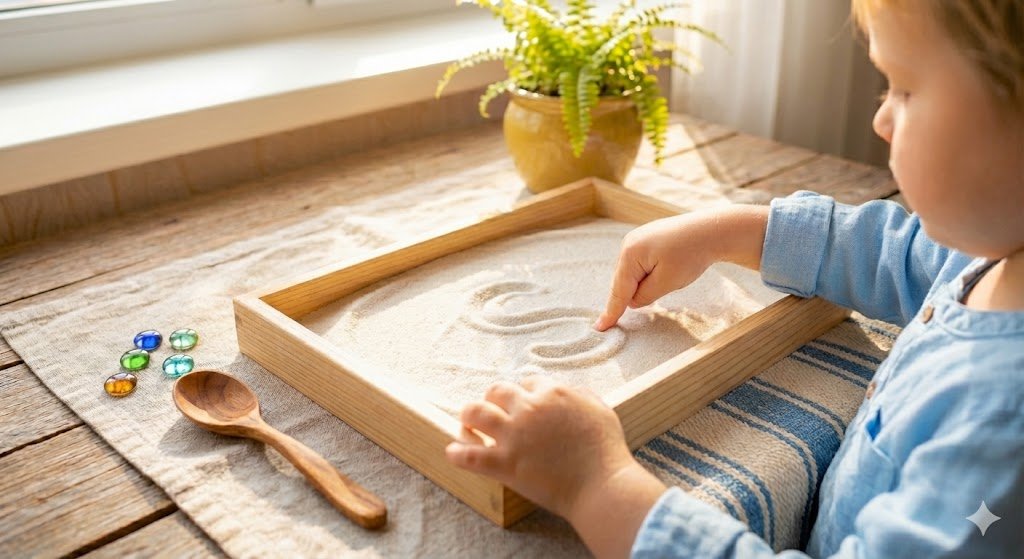
Use a shallow tray with sugar or salt. Draw a symbol (like "s" or "2") and invite your child to trace it with their index and middle fingers. This builds muscle memory without the frustration of grip.
Numbers: Quantity Before Numerals
A "3" is just a squiggle until it represents three physical things. Research curated by NAEYC (National Association for the Education of Young Children) highlights that "number sense" is built through concrete experiences with quantity long before abstract numerals make sense.
Use 10 identical items (coins or plain blocks). Showing "3" as three identical objects prevents the child from being distracted by the toys' colors or shapes.
A Simple 3-Step Teaching Flow
“This is /s/.”
“Show me /s/.” (Spend the most time here!)
“What is this?” (Only when Step 2 is easy.)
Only teach two new things at a time to keep it low-pressure.
A 7-Day Micro Plan
- Day 1-2: I Spy sounds (Focus on /s/ and /m/)
- Day 3-4: Sugar tray tracing (One letter or number)
- Day 5-6: Quantity matching (1, 2, and 3)
- Day 7: Light review of their favorites.
FAQ
What age should I start?
Between 2.5 and 4.5 is the "sweet spot." You can find more detail in our look at cognitive milestones for 2-year-olds to see if your child is ready.
Do I need expensive materials?
No. A tray of salt and some bottle caps are just as effective as official Montessori gear for home use.
The goal isn't to be "ahead." It's to ensure that when your child sees a letter or a number, they don't just see a mark—they see a tool they understand.
— Little Loving Life