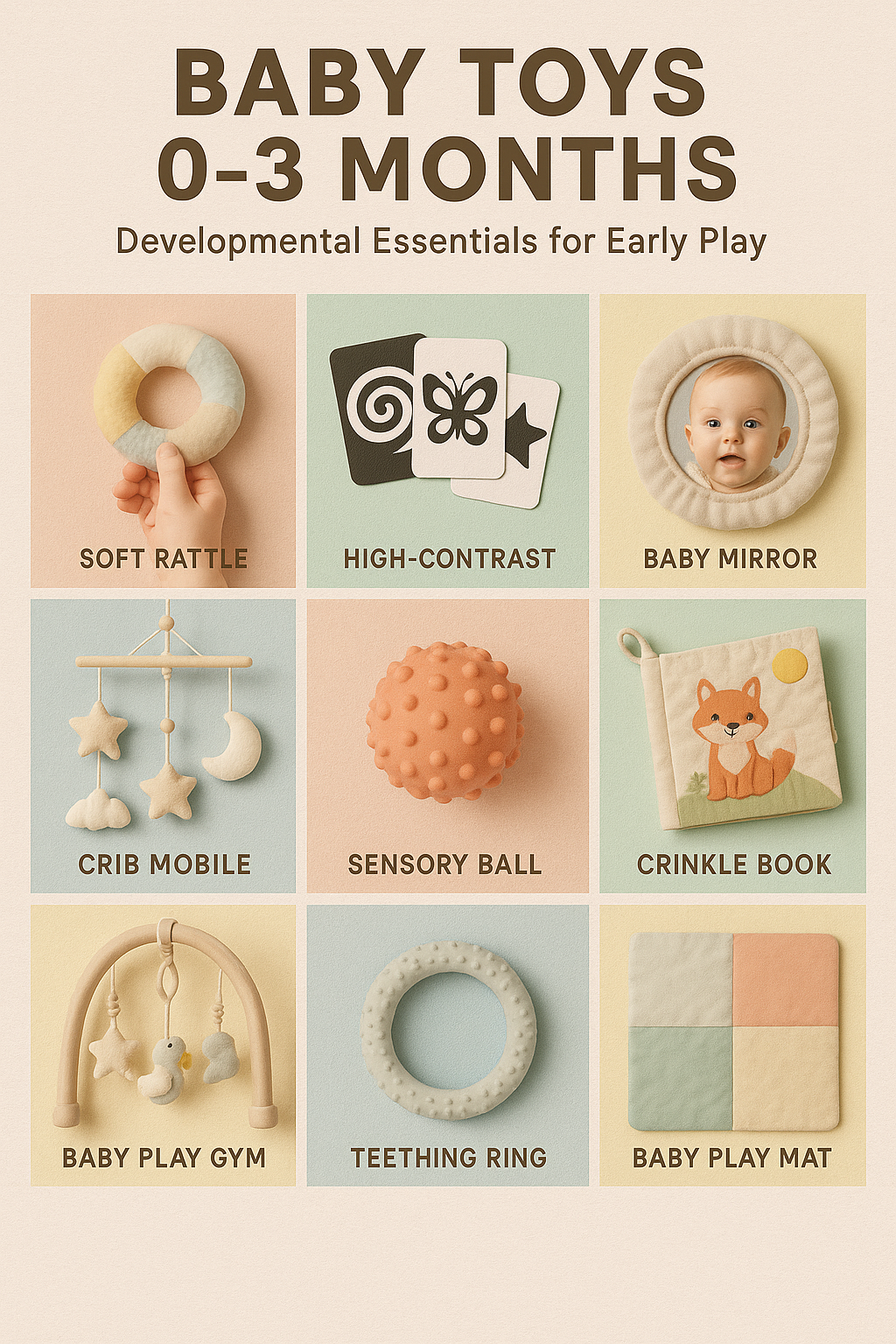
Choosing the best toys 0-3 months can feel overwhelming – there are hundreds of options, but newborns actually need very few. After trying dozens of toys with my own daughter and researching what pediatric experts recommend, I’ve narrowed it down to five simple categories that truly support early development.
In this guide, I’ll share exactly which products worked for us, which ones we skipped, and the specific brands worth buying. No fluff – just what your newborn will actually use.
What Your 0-3 Month Baby Actually Needs
Newborns see best at 8-12 inches and respond strongly to high-contrast patterns, gentle motion, and soft sounds. Their world is blurry and new – the right toys give them something to focus on without overwhelming them.
Here are the five types of toys that matter most at this stage:
Best Toys 0-3 Months: High-Contrast Cards
Newborn vision favors bold, simple shapes. Black-and-white patterns are the easiest for brand-new eyes to lock onto, helping strengthen focus and visual tracking.
Our picks:
- Banana Panda High Contrast Flash Cards Top Pick – $10. Bold, simple designs sized perfectly for newborn focus distance. The thick cardboard holds up to daily use.
- URMYWO Black & White Soft Book Budget – $7. Crinkle pages keep baby interested during tummy time. Machine-washable, which you’ll appreciate by week two.
- Wimmer-Ferguson Mind Shapes (Manhattan Toy) – $15. Higher quality with reversible designs that progress from simple to complex as baby grows.
You don’t need fancy cards – even a bold black circle drawn on white paper works. But if you want something ready-made, Banana Panda is the best value.
Best Toys 0-3 Months: Soft Rattles
A gentle rattle teaches your baby their first cause-and-effect lesson: I move my hand, and sound happens. At this age, baby won’t grip intentionally – but wrist rattles and lightweight loop designs make accidental discoveries easy.
Our picks:
- Manhattan Toy Winkel Rattle & Teether Top Pick – $15. The most recommended baby rattle across every major review site. The soft loops are incredibly easy for tiny fingers to grab, and it doubles as a teether later. My daughter held this before she could grip anything else.
- Bright Starts Oball Easy-Grasp Shaker Budget – $6. Same concept at 1/3 the price. The flexible holes let baby’s fingers slip through naturally. Only downside: a bit loud on hard floors.
- Sassy Spin Shine Rattle – $7. Colorful beads inside a clear handle. Good for visual tracking when you shake it slowly side to side.
Crib Mobile
A mobile gives your baby something calm and predictable to watch. Slow, gentle movement supports visual tracking and helps with the transition to sleep. Keep it simple – overly busy mobiles with flashing lights can overstimulate.
Our picks:
- Tiny Love Boho Chic Soothe ‘n Groove Mobile Top Pick – $45. 18 different melodies, adjustable volume, and the hanging toys detach for standalone play. We used this daily for 4 months.
- Manhattan Toy Wimmer-Ferguson Stim Mobile Budget – $25. Simple black-and-white graphics designed specifically for developing eyes. No batteries – just clips to the crib rail.
Safety: Always keep mobiles out of baby’s reach. Remove immediately once baby starts pushing up.
Baby Mirror (for Tummy Time)
Babies are fascinated by faces – especially their own. A tummy-time mirror gives them a reason to lift their head, building neck and core strength while sparking early social awareness.
Our picks:
- Sassy Tummy Time Floor Mirror Top Pick – $12. Lightweight, shatter-proof, stands on its own. The black-and-white frame doubles as visual stimulation. This was the one toy that made my daughter tolerate tummy time.
- Skip Hop Silver Lining Cloud Mirror – $15. Slightly larger with a softer look. Works well propped against a couch for floor play.
Baby Play Mat or Gym
A comfortable, padded surface makes tummy time less of a battle. Play gyms add dangling toys overhead for batting and reaching – your baby’s first workout.
Our picks:
- Lovevery The Play Gym Top Pick – $140. Expensive, but we used it every single day for 6 months. Five developmental zones, detachable toys, machine-washable mat. The high-contrast canopy is perfect for newborns.
- Fisher-Price Kick & Play Piano Gym Budget – $30. Amazon’s #1 bestseller in this category. The kick-activated piano keeps older babies engaged too, and converts to a sit-at piano later.
- Skip Hop Treetop Friends Activity Gym – $55. A solid middle ground – attractive design, good toy variety, and thick enough to use without extra padding.
Simple Play Ideas for 0-3 Months
- Tummy time: Start with 2-3 minutes, a few times daily. Use a mirror or card for motivation. Helpful tips on tummy time from the AAP.
- Sound play: Shake a soft rattle near one ear, then the other. Pause and let baby turn toward the sound.
- Mobile moments: 10-15 minutes before nap as a calming wind-down ritual.
- Texture time: Let baby feel a crinkle book page or a soft cloth. Narrate what they’re touching.
Your voice is the best toy. Short, calm narration of what baby sees or feels builds language foundations from day one.
How Many Toys Does a 0-3 Month Old Need?
About 5-7 items total. Newborns don’t need a full toy box – they need a handful of well-chosen pieces and lots of your time.
Here’s what a realistic starter kit looks like:
- 1 set of high-contrast cards ($7-10)
- 1 rattle/teether ($6-15)
- 1 tummy-time mirror ($12-15)
- 1 play mat or gym ($30-140)
- 1 mobile – optional ($25-45)
Budget path: ~$55 – Banana Panda cards + Oball rattle + Sassy mirror + Fisher-Price gym
Premium path: ~$225 – Wimmer-Ferguson cards + Winkel + Tiny Love mobile + Sassy mirror + Lovevery gym
The budget path works perfectly – babies don’t know the difference.
Safety Reminders
- No small detachable parts. Check seams regularly.
- Mobiles must stay out of reach. Remove once baby pushes up.
- Avoid overstimulation – dim lights, soften sounds, keep sessions short.
- Clean mouthable toys weekly with warm soapy water.
For age-appropriate toy safety guidance, see the AAP toy guidance and CDC milestones.
The Bottom Line
You don’t need to spend hundreds on newborn toys. A few thoughtful picks – one good rattle, some black-and-white cards, and a comfortable play space – are all the best toys 0-3 months your baby needs. Add your voice, your face, and your gentle touch, and you’ve got the perfect starter kit.
Ready for the next stage? Check out our Best Toys for 3-6 Month Babies.
This article is for informational purposes only and isn’t a substitute for personalized medical advice from your pediatrician.