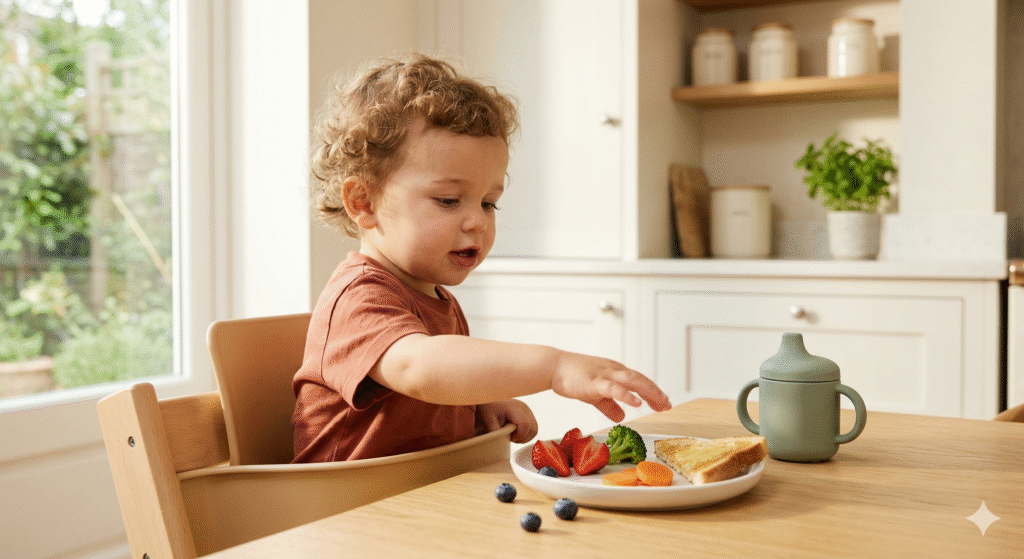
My youngest son pushed his plate away for the third time that morning. The sweet potato I’d spent twenty minutes roasting sat completely untouched. He looked at me, looked at the plate, and burst into tears — not because he was hungry, but because I’d dared to put something orange near his rice.
If this scene sounds painfully familiar, you’re not alone. Research suggests that roughly 25 to 35 percent of toddlers and preschoolers go through a picky eating phase, and it typically peaks around age 3 or 4. The good news? Most children naturally grow out of it by early school age. The even better news? There’s a lot you can do right now to make mealtimes calmer — without force, bribes, or tears.
Having navigated picky eating with all three of my kids — my daughter who once survived on crackers and yogurt, my older son who went through a “nothing green” phase, and my youngest son who is deep in the thick of it right now — I’ve learned that the strategies that actually work all share one thing in common: they take the pressure off.
Here are ten no-pressure strategies that have made a real difference at our table.
1. Drop the “Clean Plate” Rule
This one changed everything for me. I grew up hearing “finish everything on your plate,” and I carried that habit straight into motherhood. With my daughter, I used to negotiate — “two more bites and you can have a strawberry.” It never worked. She just fixated on the strawberry and learned that the food on her plate was something to suffer through, not enjoy.
The approach that finally clicked for me is called the Division of Responsibility, developed by feeding expert Ellyn Satter. The idea is simple: as the parent, you decide what food is offered, when meals happen, and where the family eats. Your child decides whether to eat and how much. That’s it.
This doesn’t mean you let your toddler skip meals and eat cookies at midnight. It means you provide healthy options at regular times, and then you genuinely let go of controlling what happens next. When children sense that nobody is going to pressure or trick them into eating, they feel less resistant and more willing to explore.
2. Serve Tiny Portions — Think One Bite, Not One Bowl
A heaping spoonful of something unfamiliar can feel like a mountain to a toddler. I learned this the hard way with my youngest son. One evening I put a full portion of steamed broccoli on his plate and he wouldn’t even sit down. The next day, I put a single tiny floret next to his rice. He poked it. He smelled it. He licked it. He didn’t eat it — but he engaged with it, and that’s a win.
Start with one or two tablespoons of a new food. Use child-sized plates and bowls so the portion looks normal rather than overwhelming. And here’s a trick that works beautifully: let your child ask for more. When my older son realized he could always get seconds, he stopped feeling anxious about what was on his plate.
3. Create a Mealtime Routine (and Stick to It)
For a while, my older son was a champion grazer. A cracker here, some goldfish there, half a banana in between — and by dinner, he had zero appetite. He’d refuse whatever I cooked, and I’d worry he wasn’t eating enough, which led me to offer more snacks, which made the next meal even worse. It was a cycle I couldn’t break.
The fix was establishing a predictable eating schedule: three meals and two planned snacks, spaced roughly two to four hours apart. Between those times, the kitchen is “closed.” Water is always available, but food waits for the next scheduled eating time. (If you’re looking for help building a broader daily structure, our Daily Routine Chart for Toddlers covers how to set up a rhythm that actually sticks.)
This sounds strict, but it actually reduces stress for everyone. Your toddler arrives at the table genuinely hungry, which makes them far more willing to try what’s offered. Keep meals short — about 15 to 20 minutes for toddlers is plenty. If they’re not eating, that’s okay. Calmly end the meal and wait for the next one.
4. Always Include One “Safe” Food
This strategy is the safety net that makes everything else possible. At every single meal, put at least one food on the plate that you know your child likes and will eat. For my youngest son, that’s bread — he’d eat a slice of toast at every meal if I let him. For my older son at age two, it was plain noodles. For my daughter, it was yogurt.
Why does this work? Because it takes care of two things at once: your child won’t go hungry (which calms your parental anxiety), and they have a home base from which to explore. When kids feel secure that there’s something familiar on the plate, they’re more likely to at least look at — or even touch — the unfamiliar items next to it.
The key is to resist the urge to make the safe food the entire meal. A slice of toast alongside some new vegetables and a protein is very different from a plate of nothing but toast because you’ve given up.
5. Make Friends Before Making Bites
Here’s something I wish I’d understood earlier: for a toddler, eating a brand-new food isn’t just one step. It’s a whole journey. Studies show it can take 10 to 20 exposures before a child decides a new food is okay — and “exposure” doesn’t even mean eating it. Feeding therapists describe a ladder of interaction that looks something like this: seeing the food on the table → tolerating it on the plate → touching it → smelling it → licking it → taking a tiny bite → chewing and swallowing.
Each step matters — even if it’s just a poke.
My older son refused mushrooms for months. One day during dinner, he poked a mushroom slice with his finger and said “squishy.” I resisted every urge to say “now try a bite!” and instead just said, “Yeah, it is kind of squishy, isn’t it?” Two weeks later, he put one in his mouth. Three weeks after that, he started eating them — but only if they were in soup. I’ll take it.
Let your child interact with food on their own terms. Comment without pressure: “That carrot is so crunchy” is much more effective than “just try one bite, please.”
6. Be the Chef, Not the Short-Order Cook
There was a period when I was cooking three different dinners every night — one for my daughter, one for my older son, and something for the adults. My husband finally looked at me one evening and said, “This is insane.” He was right. I was exhausted, resentful, and (I realized later) unintentionally teaching my kids that refusing dinner would always result in getting exactly what they wanted.
The healthier approach is to make one family meal that includes a mix of foods — ideally one protein, one starch, one fruit or vegetable, and at least one safe food your child accepts. Everyone eats from the same menu. If your toddler only eats the pasta and ignores the chicken and broccoli, that’s okay for tonight. But you’re not getting up to make a peanut butter sandwich as a replacement.
This takes real commitment and a thick skin for about a week. But once your child understands that this is what’s for dinner — no alternatives incoming — they become much more open to trying what’s actually on their plate.
7. Build Food Bridges
This one is sneaky-smart. The idea is to start with a food your child already accepts and gradually bridge to a similar food based on color, flavor, or texture.
Here’s how this played out with my daughter. She loved flavored yogurt but refused all fruit. So I started mixing tiny bits of mashed banana into her yogurt — so little she couldn’t taste it. Over a few weeks, I increased the amount. Eventually she was eating yogurt with real banana chunks. From there, we bridged to banana slices on their own. From banana slices to soft pear slices (similar texture). From pear to peach. It took about two months, and by the end, she had five fruits in her rotation instead of zero.
Some bridge ideas to try: if your child likes French fries, try roasted sweet potato wedges. If they like crackers, try thin toast strips. If they eat tomato sauce on pasta, try tomato soup. And on really tough days, smoothies are a brilliant bridge — blending a handful of spinach into a fruit smoothie lets your picky eater get nutrients without the texture battles. (We have a whole guide to Toddler Veggie Smoothies for Picky Eaters if you want to try this.)
8. Let Little Hands Help in the Kitchen
Research shows that children who help prepare food are significantly more likely to try it. And the tasks don’t need to be complicated — toddlers can tear lettuce leaves, stir batter, rinse vegetables under water, sprinkle cheese, or count out cherry tomatoes.
My older son had a breakthrough with bell peppers this way. He’d refused them for months, but one afternoon I let him help wash and “sort” pepper slices by color. He was so proud of his red-yellow-green arrangement that he popped one in his mouth without thinking. He made a face — but he tried it. And the next time we cooked together, he tried it again.
It’s not really about the cooking. It’s about the touching, the smelling, the “I did this.” Once they’ve gotten their hands on a food, it stops being scary.
9. Eat Together, Eat the Same
It sounds almost too simple, but sitting down and eating the same food as your child is one of the most powerful things you can do. Toddlers are copycats — and that’s actually a superpower at the dinner table. When they see you crunching on a carrot or spooning up soup, they file that information away: this food is safe, this food is normal, this food is something my family eats.
I see this play out between my sons constantly. If my older son tries something new at the table, my youngest son watches with intense curiosity — and about half the time, he’ll reach for the same food. Peer modeling is just as strong as parental modeling, which is another reason family meals matter so much.
One thing that helped me: I stopped eating different “adult food” at dinner and started eating exactly what I served the kids. When my youngest son saw me eating the same sweet potato he’d rejected, it shifted something. It went from “that weird thing Mom put on my plate” to “the thing everyone is eating.”
If there’s a food you personally don’t enjoy, try it in front of your child anyway. You can say something like, “I’m still learning to like this one. Maybe I’ll try a little more next time.” That’s exactly the attitude you’re trying to build — and they’ll pick up on it.
10. Remember: This Phase Has an End
On the hardest days — when your toddler has rejected every meal, when the floor is covered in thrown peas, when you’re questioning whether your child will ever eat a vegetable — it helps to zoom out.
My daughter was the pickiest of my three children. At age two, her entire diet seemed to consist of crackers, yogurt, banana, and plain noodles. I worried constantly. I Googled frantically. I called her pediatrician more than once. And now, at five, she eats salmon, broccoli, scrambled eggs, soup, and dozens of other foods she once refused to even look at. She didn’t need therapy or special intervention. She needed time, patience, and a calm table.
Pediatricians emphasize that what matters is your child’s nutritional intake over the course of a whole month — not a single meal or even a single day. Toddlers are remarkably good at self-regulating their calorie intake when given the opportunity. If your child is gaining weight appropriately, staying active, and meeting developmental milestones, they’re almost certainly getting what they need.
The Bottom Line
Picky eating is one of the most stressful parts of toddler parenting — but it doesn’t have to be a war. Every strategy in this guide circles back to one core principle: your job is to provide, their job is to decide. When you stop fighting over every bite, your child gets the breathing room they need to come around to food — in their own time, in their own way.
Some days will still be hard. Some meals will still end up on the floor. But if you stay consistent with a calm, no-pressure approach, you are giving your child exactly what they need to grow into an adventurous eater — even if that growth happens one tiny broccoli floret at a time.
Want more mealtime support?
Download our free printable guide with practical tips to make feeding your toddler easier — no battles required.