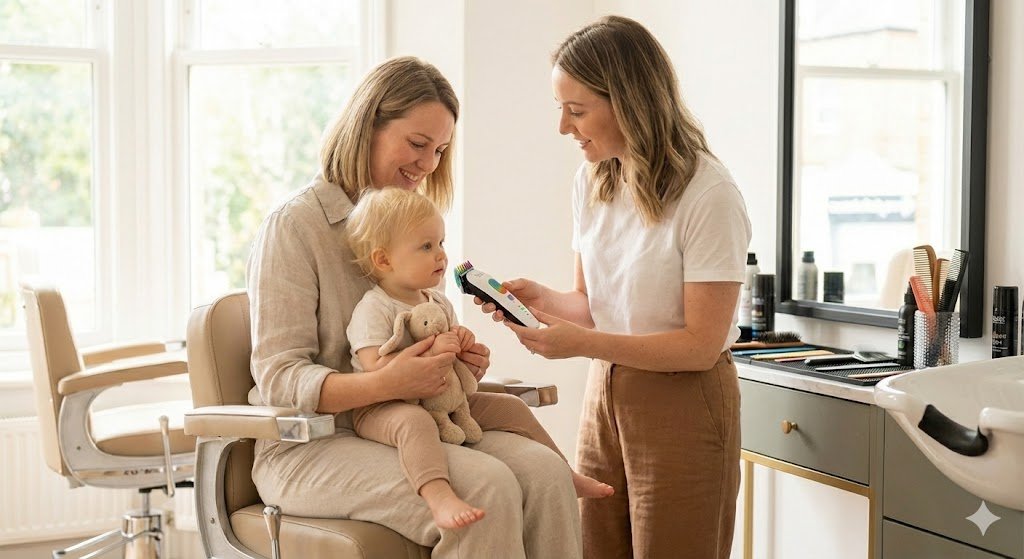
The Milestone We Fear
Let’s be honest: a toddler’s first haircut can feel like a bittersweet goodbye to the baby stage. Those soft, unruly curls are finally getting trimmed.
But for your child, this moment isn’t about looking neat. It’s about sensory overload: unfamiliar sounds, tools close to their face, a new environment, and often a sudden loss of control.
The goal of a first haircut isn’t a perfect result. It’s helping your child feel safe, respected, and heard. As the American Academy of Pediatrics notes, toddlers thrive on predictability and routine when facing new physical experiences.
Quick Take
- Use calmer words (avoid scary “cut”).
- Practice the buzzing sensation at home.
- Give your child a clear “stop” signal—and honor it.
- Skip the cape if it triggers panic.
- Validate fear instead of dismissing it.
1. Language Matters: Reframe the Experience
To a toddler, the word cut can sound scary—often linked to pain and injuries. Instead of “We’re going to cut your hair,” try:
- “We’re going to trim your hair.”
- “We’re going to style your hair.”
- “We’re doing a little hair tidy-up.”
Keep the explanation simple: “Your hair is just getting a little shorter—not going away.”
“We’re going to make your hair feel more comfortable.”
2. Sensory Practice: The “Tickle Test”
For many toddlers, the biggest trigger isn’t scissors—it’s the buzzing vibration of clippers near the ears. This is a common sensory processing challenge where everyday sounds can feel physically overwhelming.
A day or two before the appointment, practice at home:
- Let your child feel an electric toothbrush or a small massager on their arm.
- Offer control: “Do you want to try it on your hand first, or on mine?”
- Name it gently: “It feels like a little tickle.”
3. Honor Bodily Autonomy: The “Stop” Rule
One of the most practical ways to reduce fear is to give your child a clear way to pause. Building bodily autonomy early on helps kids feel in control of their environment.
Before you start, agree on a simple signal:
- “Raise your hand if you need a break.”
- “You can say stop any time.”
- “Let’s do 10 seconds, then pause.”
Then follow through. If your child asks to stop, stop. Trust—not perfection—is the long-term win.
4. Skip the Cape if It Triggers Anxiety
Many meltdowns start the moment the cape snaps around the neck. It can feel tight, noisy, and restrictive—especially if it traps the arms.
If your child resists the cape, don’t force it. Try:
- Bring an old t-shirt for them to wear during the cut.
- Change clothes afterward.
- Let them hold a small comfort object or fidget (if the stylist agrees).
5. Validate the Fear (Then Keep It Small)
Instead of saying “You’re fine” (when they clearly don’t feel fine), try validation. Research shows that validating a child’s feelings helps them regulate their emotions faster.
“I see you. This feels scary.”
Validation reduces escalation. Then make the next step tiny: one snip, then pause; one clipper touch, then a break.
The Keepsake Ritual
If you want a simple milestone moment, bring a small envelope for the first lock of hair. Not as proof you “got through it,” but as a marker of growth.
Final Note
A first haircut doesn’t need to go smoothly to be successful. The goal isn’t appearance—it’s safety and trust. Stopping early is sometimes the most effective choice.