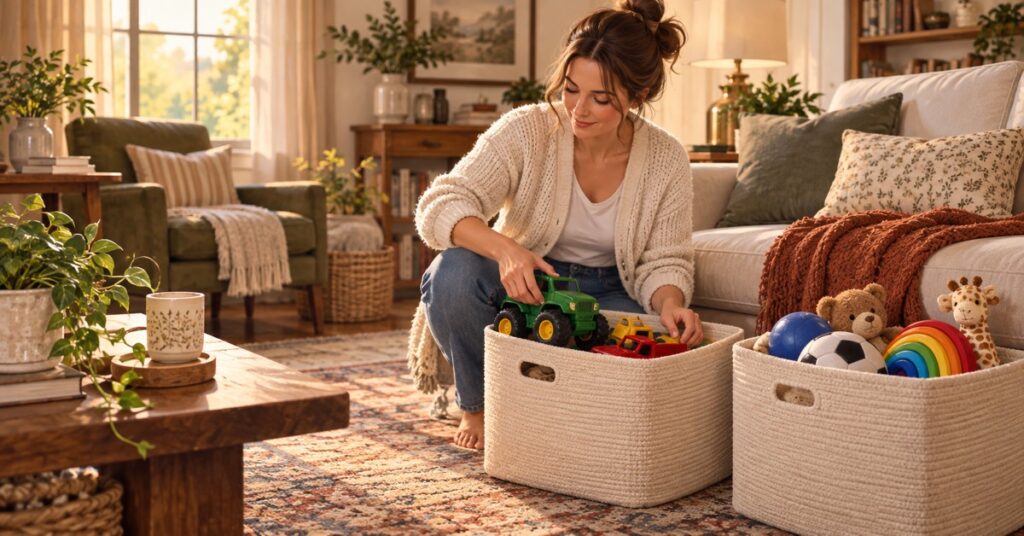
If you clear the sofa only to find the toys piled beside it, buying another basket can feel like the obvious next step. But a bigger basket won’t help much if your child has to empty it to find a favorite train.
I’d start with that search. Keep the toys your child uses together easy to find together, then decide what can leave the living room. You don’t need a room that looks untouched by children. You need somewhere to sit, a clear route through the room, and toys that can come out without everything else coming with them.
Leave favorite comfort toys alone for now, and don’t shop for replacement storage before you know what you’re keeping.
Start with one pile, not every cupboard
Start with one category that keeps landing underfoot: vehicles, puzzles, stuffed animals, or building pieces. Don’t empty every cupboard onto the floor. Keep children away while you check loose parts and damage; invite them to help with choices after that check.
Match loose pieces to their sets before deciding they are trash. A wheel may make a much-loved vehicle usable again. A missing puzzle piece is frustrating; a missing safety fastener is a reason to stop using the toy. Those are different problems.
Take cracked magnetic toys, toys with loose or missing magnets, and toys with damaged or unsecured battery compartments out of play immediately. Keep children away while you check the play area for loose pieces. Store damaged toys and loose parts out of children’s reach while you check the manufacturer’s instructions. Don’t patch a magnetic casing or battery cover with tape and return it to the toy box. CPSC magnet guidance and battery guidance explain these risks.
Decide what stays nearby, waits, or leaves
Now decide where the usable toys belong. The question is what happens when your child reaches for each one, not how much it cost or whether it matches the room.
A toy used regularly belongs within easy reach if it’s suitable for the children who can reach it. Keep enough pieces together to play the way your child actually plays. A basket of blocks is one activity; there is no reason to count every block toward a toy limit.
Something still enjoyed but rarely used in this room can go elsewhere. A large vehicle played with in the hallway doesn’t need to occupy the living-room shelf between turns. Choose a storage spot that doesn’t block a doorway, walkway, or exit.
For an ordinary missing piece, check whether the manufacturer offers the right replacement. Write down what is missing and choose a date to decide whether to repair it or let it go. Without that next step, a repair pile can become another permanent box. Don’t return a toy with a possible safety fault to play until the problem is properly resolved.
Toys in good condition that no one wants may be ready to pass on. First identify the brand and model, check for recalls, and confirm that necessary parts and instructions are included. Ask the recipient or donation organization what they accept, including the appropriate age range. A clean surface doesn’t make a damaged toy safe. If it’s recalled, follow the official remedy before considering passing it on. CPSC’s secondhand-product guidance applies to free giveaways too.
It’s also fine to be unsure. Put the safe toys you’re unsure about in a separate box where children can’t get into it, and agree on a time to look again. Label the contents so you can find a toy if your child asks for it. Don’t donate the box unopened just because a date has passed.
When a child wants to keep everything, make the first decision smaller: “Which of these would you like where you can reach them?” That’s a choice about today’s space, not a demand to give away a favorite. You can handle unsafe items yourself without asking a child to decide whether they are safe.
Price is a poor tie-breaker. An inexpensive plastic animal used in daily pretend play can stay. An expensive wooden activity that nobody chooses can wait elsewhere. A gift doesn’t have to remain on display to count as appreciated.
Try making toys easier to use before rotating them
Before you put toys into rotation, get the favorites ready to play with. Keep the train with its track, the doll with its clothes, and the puzzle with its picture. Too much mixing can look like too many toys when the immediate problem is that nothing is ready to play with.
Then watch what makes getting started difficult. Does your child need to empty several containers? Is a useful piece buried? Do you have to clear a surface every time? Fix that obstacle first. You may not need a rotation schedule at all.
If useful toys still can’t fit without being piled on top of each other, try rotating one complete activity out and another in. Leave current favorites available. When a child asks for something you’ve put away, bring it back rather than insisting that rotation day hasn’t arrived.
Repeatedly ignored toys are worth looking at more closely, but don’t assume they’re all outgrown. Try the toy with its necessary pieces, in a usable spot, and join your child if help is needed to get started. If it still holds little interest, decide whether to store it for later or pass it on.
If there’s nowhere to store a second set of toys, skip rotation. Keep what you can store safely and reach without unloading a stack. Give the toys you’re unsure about one small space that children can’t access; when it’s full, finish those decisions before setting aside more.
Put things back where they can be used safely
For everyday storage, use what you have first. A lightweight open container can be easier to return pieces to than a deep chest. Check for sharp edges and loose fittings. Avoid heavy or self-locking chests a child could become trapped in; CPSC warns about falling lids and entrapment. If an otherwise safe container needs an adult to open it, plan to help with that activity rather than expecting independent cleanup.
Clear bins aren’t a failure of taste, and woven baskets aren’t automatically better. Keep a see-through container if seeing the contents helps your child find things. With an opaque bin, a securely attached picture of the contents may make its purpose clearer. You don’t need a new matching set to try either approach.
Use broad categories that are easy to put back: vehicles together, pretend food together, one puzzle with its own pieces. Don’t separate everything by color if that means an adult has to sort it again every evening. Keep age labels, safety instructions, and model details when removing bulky packaging; the picture on a puzzle box is worth keeping too.
In a shared room, access matters more than matching labels. Keep small-part toys away from children under three, even when they belong to an older sibling. A closed lid on a box beside the sofa is not a childproof barrier. Use a separate play area the younger child cannot access, then check the floor and sofa gaps for escaped pieces before reopening the shared space. Follow each toy’s age and safety guidance. CPSC toy safety.
Anchor storage furniture according to its instructions, and don’t put tempting toys or finished models on top of a cabinet. A high perch may keep something away from a crawling baby while inviting an older child to climb. CPSC’s Anchor It guidance covers both furniture anchoring and removing those temptations.
Make room for unfinished projects and keepsakes
A half-built project doesn’t have to be dismantled every evening. Agree on a place it can stay without blocking the room or giving a younger child access to small pieces. An adult can move a suitable project on a stable tray to a separate storage space children can’t get into. A tray keeps pieces together; it doesn’t make them safe for a baby to reach.
Choose together when you’ll return to the project. If there isn’t space to keep it, offer a photograph before taking it apart. You don’t have to keep every build forever.
For stuffed animals, keep the frequently held favorites easy to reach and decide separately about the rest. They don’t all need a seat on the sofa. A toy you’re keeping for your own memories can go with keepsakes rather than back in the everyday basket. Decide whether you want the actual toy or whether a photograph would be enough, without applying that choice to a comfort toy your child still wants.
Give relatives a useful alternative to another large toy
Once the room is working better, be specific about incoming gifts. “We don’t have space for another large floor toy. Could we choose a book together, or plan an outing on a date that works?” gives someone a useful alternative without ranking their gift against everything your child owns. Our non-toy gift guide has more ideas; agree on dates, travel, and any extra costs before booking an experience.
Use the next cleanup to see what needs adjusting
At the next cleanup, notice where things stall. A bin that’s constantly dumped may need fewer mixed categories or a shallower place for the favorite pieces. A pile beside the shelf may mean the container is awkward to open or already full. Sit alongside your child and put away one familiar category together before adding more labels or rules.
Judge the change by what became easier: finding the missing train, returning a puzzle, or walking to the sofa without stepping over a pile. Some toys will still be on the floor while children play. That isn’t a failed toy detox.
For today, finish one category and stop. Put the favorites where your child can use them, secure the toys still awaiting an adult decision, and clear the path through the room. The rest can wait.