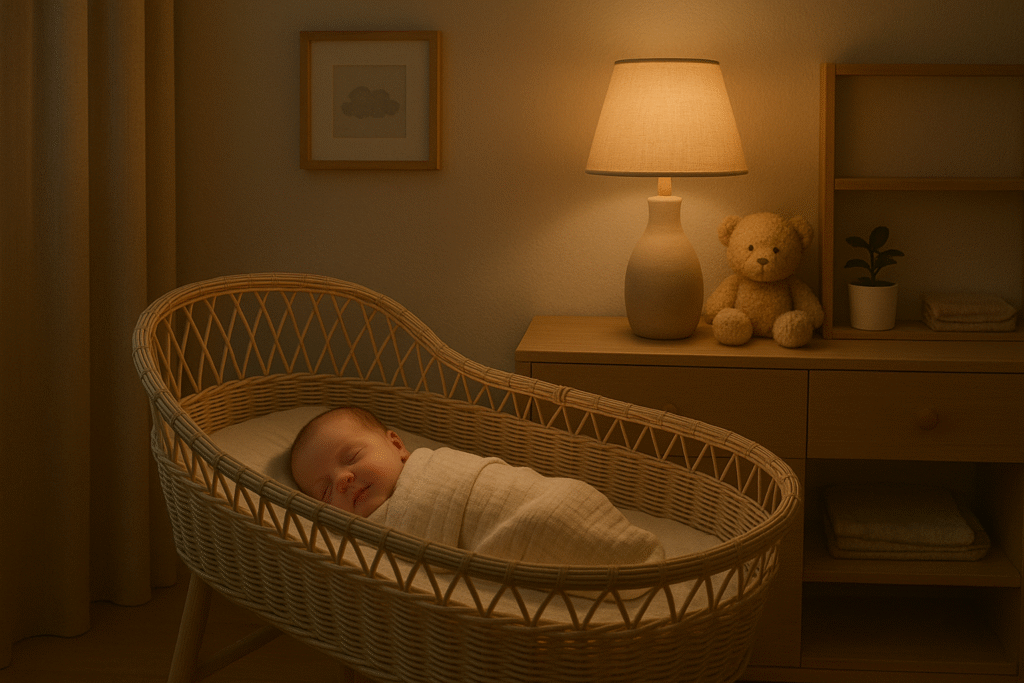
This baby sleep essentials guide gives you everything you need for safe, gentle newborn sleep – wake windows by age, a flexible daily rhythm, the exact products I used, and real solutions to the problems that keep new parents up at night (beyond the baby).
Let me be honest: there is no such thing as a newborn sleep “schedule.” Anyone who tells you their 2-week-old sleeps on a schedule is either lying or very lucky. What you can build is a rhythm – a loose pattern of eat, play, sleep that makes your days less chaotic and helps your baby distinguish day from night. My daughter did not sleep longer than 2 hours at a stretch until week 6. By month 3, she was doing a 5-hour stretch at night. That progression felt impossibly slow while living it, but looking back, it was completely normal.
Baby Sleep Essentials: Safe Sleep Setup
Before we talk about timing, let us talk about safety. This is non-negotiable and comes before everything else.
Always on their back on a firm, flat surface. Nothing else in the sleep space – no pillows, blankets, bumpers, loveys, or stuffed animals. Room temperature 68-72°F (20-22°C). Room-share but not bed-share for at least the first 6 months. Swaddle only until baby shows signs of rolling. For the full guidelines, see the AAP safe sleep guidelines.
Sleep gear essentials:
- Graco Dream Suite Bassinet Top Pick – $90. Compact, portable between rooms, converts to a changing station. We used this next to our bed for 4 months with my daughter.
- Halo SleepSack Swaddle Top Pick – $28. Three-way adjustable fasteners make 3 AM swaddling foolproof – arms in, one arm out, or both arms out. My daughter escaped every muslin wrap – this was the only swaddle that held.
- Yogasleep Dohm White Noise Machine – ~$45-55. The real mechanical fan sound is better than any phone app. We used it for all three kids. Still works after 5 years.
- Firm Crib Mattress + 2 Fitted Sheets – $50-70. Always have a backup sheet ready. At 2 AM after a diaper blowout, you do not want to be doing laundry.
- Blackout Curtains Budget – $20-30. Essential for naps and early morning wake-ups. Even cheap ones from Amazon work fine – just make sure they block light at the edges.
My biggest mistake: I bought a fancy bassinet with a rocking feature for my daughter. She hated it. The simple, flat Graco worked perfectly for all three kids. Do not overthink the sleep space – firm, flat, and boring is ideal.
Baby Sleep Essentials: Wake Windows by Age
Wake windows are the single most useful concept for newborn sleep. A wake window is how long your baby can comfortably stay awake between naps. Miss it, and they get overtired – which makes falling asleep harder, not easier.
| Age | Wake Window | Total Sleep | Night Stretches |
|---|---|---|---|
| 0-4 weeks | 45-60 min | 16-17 hours | 2-3 hours |
| 4-8 weeks | 60-75 min | 15-16 hours | 3-4 hours |
| 2-3 months | 75-90 min | 14-16 hours | 4-6 hours |
| 3-4 months | 90-120 min | 14-15 hours | 5-8 hours |
How to use this: Start timing from when your baby wakes up (not from when you put them down). When you hit the wake window limit, start your nap routine. Do not wait for yawning or eye rubbing – by then they are already overtired.
Baby Sleep Essentials: A Flexible Daily Rhythm
This is not a clock-based schedule. It is a pattern. Follow your baby’s cues and the wake windows above, and your day will naturally fall into something like this.
There is no “play” yet. Wake up, feed, burp, maybe 5-10 minutes of quiet eye contact, then back to sleep. Repeat every 2-3 hours. Daytime naps happen anywhere – the bassinet, the stroller, on you. Nighttime feeds should be dark, quiet, and boring. No talking, minimal eye contact, dim light only. This teaches your baby that nighttime is for sleeping.
Your baby starts having real awake time – 10-20 minutes of alert, curious looking around. Now you can build eat-play-sleep: feed when they wake, do a short activity (tummy time, talk to them, show a high-contrast card), then put them down when the wake window closes. My daughter started smiling at 6 weeks, and that changed everything – suddenly the “play” part felt real.
Naps consolidate to 3-4 per day. Night sleep lengthens. You might get a predictable bedtime between 7-8 PM. This is when a bedtime routine pays off: bath, feed, swaddle (or sleep sack if rolling), song, put down drowsy. Same order, same time, every night. My daughter’s longest stretch jumped from 4 hours to 6 hours almost overnight around week 12.
Baby Sleep Essentials: Bedtime Routine
A bedtime routine signals to your baby that sleep is coming. Keep it short (15-20 minutes), consistent, and calm. Here is what worked for us with all three kids:
- Warm bath (3-5 minutes, not every night – every other night is fine)
- Fresh diaper + pajamas in dim light
- Final feed (full feed, not a snack – this matters for longer stretches)
- Swaddle or sleep sack
- White noise on
- One song or 30 seconds of humming while rocking gently
- Put down drowsy but awake (this is the hardest part – it takes practice and does not work every time)
“Drowsy but awake” reality check: This worked maybe 30% of the time with my daughter in the early weeks. That is fine. The goal is practice, not perfection. If they cry, pick them up, calm them, try again. If it is not working tonight, hold them to sleep and try again tomorrow. No guilt.
Baby Sleep Essentials: Solving Common Problems
Day-Night Confusion (Week 1-3)
Your baby slept in a dark womb for 9 months. They have no idea when it is day or night. Fix this by keeping daytime bright (open curtains, normal noise, talk to them during feeds) and nighttime dark (dim light only, whisper, no stimulation during feeds). Most babies sort this out by week 3-4.
The Witching Hour (Week 2-8)
Almost every baby has a fussy period from 5-8 PM. My daughter cried for 2 hours straight every evening for weeks. What helped: tight swaddle, white noise on high, slow bouncing on an exercise ball, and skin-to-skin contact. What did not help: overthinking it. This phase passes by 8-12 weeks.
Only Sleeps on You
Contact naps are biologically normal. Your baby is not “spoiled” – they are a newborn who wants to be close to you. For the first 4-6 weeks, I let my daughter nap on me for most daytime naps. Around 6 weeks, I started putting her down for one nap a day in the bassinet. By 10 weeks, she did most naps independently. Gradual transfer, not cold turkey.
Short Naps (30-45 Minutes)
Short naps are developmentally normal until 5-6 months. One sleep cycle is about 30-45 minutes. If your baby wakes after one cycle, try waiting 5 minutes before going in – sometimes they resettle. If not, that is okay. You cannot force long naps. Focus on getting enough total sleep across the day rather than individual nap length.
Frequent Night Waking
Newborns need to eat at night. That is not a sleep problem – it is biology. Focus on making night feeds efficient: keep the room dark, do not change the diaper unless it is dirty, feed and put back down. Ensure full feeds during the day to reduce nighttime “snacking.” Night stretches gradually lengthen on their own without any training.
What NOT to Do
- Do not sleep train before 4 months – Newborns cannot self-soothe. Cry-it-out is not appropriate or safe at this age.
- Do not keep baby awake to “tire them out” – Overtiredness makes sleep worse, not better.
- Do not compare to other babies – Your friend’s baby sleeping 8 hours at 6 weeks is an outlier, not the norm.
- Do not stress about “bad habits” – Rocking, feeding, or holding to sleep in the newborn stage does not create lifelong problems. Do whatever works.
When to Talk to Your Pediatrician
Most newborn sleep issues are normal. But call your doctor if your baby is consistently sleeping less than 11 hours total in 24 hours, is extremely hard to wake for feeds, snores or has noisy breathing during sleep, or has not gained back birth weight by 2 weeks. The Mayo Clinic infant sleep guide has more detail on when sleep patterns warrant medical attention.
The Bottom Line
The most important baby sleep essentials are a safe sleep space, a white noise machine, a consistent bedtime routine, and patience. Everything else – the fancy bassinets, the sleep trackers, the online courses – is optional. Your baby will sleep longer stretches when their brain is ready. In the meantime, sleep when they sleep, accept help, and remember that this phase is temporary even when it does not feel like it.
My daughter went from waking every 2 hours to sleeping through the night by 5 months. Yours will get there too.
Looking for specific sleep products? See our Baby Sleep Essentials List: 10 Products That Saved Our Nights.
Need gear for the nursery? See our Newborn Must-Haves Checklist for specific products and prices.
First-time parent? Read our Newborn Care Guide (Week by Week).
Preparing for your recovery? Check our Postpartum Recovery Products: 12 Items I Actually Used.
Looking for first toys? See Best Toys for 0-3 Month Babies.
This article is for informational purposes only and is not a substitute for personalized medical advice from your pediatrician. Every baby is different – adjust these guidelines to what works for your family.