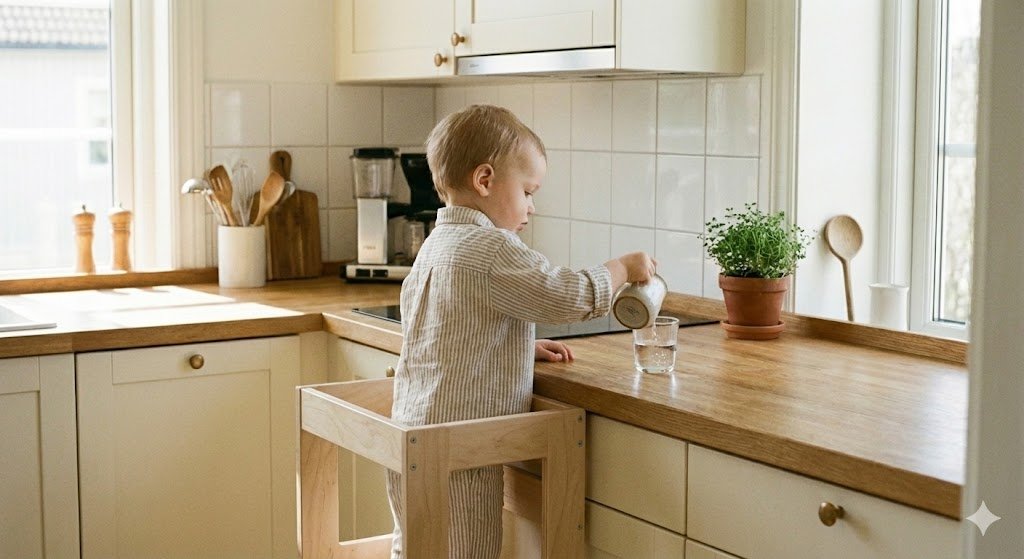
Practical Life Skills at Home: Shop Your Kitchen
At some point, most of us arrive at the same uncomfortable realization: our homes are full of toys—yet our children are still restless. Research has shown that fewer toys actually benefit a child’s focus and creativity.
Some of the most engaging Montessori activities don’t come from toy stores at all. They come from your kitchen. In Montessori philosophy, this is called Practical Life Work. According to the Association Montessori Internationale, these tasks are essential for developing a sense of order and independence.
1. Pouring Practice
What you need: Two small pitchers or cups, a tray, and water (or dry lentils for beginners).
Why it matters: Pouring is a foundational exercise for developing fine motor skills.
The Montessori insight: Use clear glass. If it breaks, it’s a lesson in care. This “control of error” is a central pillar of Montessori education.
2. Scooping & Transferring
This simple movement mirrors the action of eating and strengthens the same muscles needed later for writing.
3. Opening & Closing Containers
Twisting, snapping, and popping lids demand sequencing and strength. This is high-level problem-solving disguised as play.
4. Vegetable Scrubbing
In Montessori, we don’t “pretend” to cook. We offer real contributions. The American Academy of Pediatrics (AAP) notes that involving children in food prep encourages healthier eating habits.
5. Spice Sniffing
Open each jar together. Smell. Name. Compare. This builds sensory vocabulary far more effectively than flashcards ever could.
6. Sponge Squeezing
Squeezing strengthens the intrinsic muscles of the hand—one of the best “pre-writing” workouts.
7. Peeling (The Flow State)
Peeling requires sustained focus. This is where children often enter what psychologists call the “Flow State”—vital for cognitive development.
8. Water Pouring (Self-Regulation)
Learning to stop pouring just before the cup overflows is a powerful exercise in impulse control and spatial awareness.
9. Sorting Cutlery (Early Math)
Sorting by shape, size, and function builds visual discrimination—the foundation of mathematical thinking.
10. Caring for the Environment
Establishing consistent routines helps toddlers feel safe and teaches them that cleanup is an integral part of the “work” cycle.
Montessori activities don’t need to be impressive. They need to be meaningful. If things get messy, remember the Mayo Clinic’s advice: stay calm and prioritize the connection.