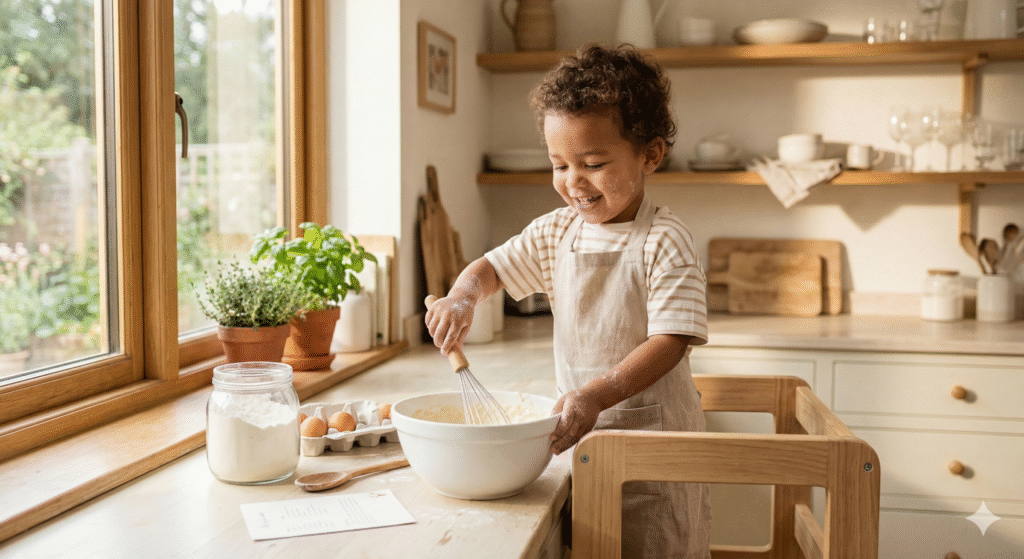
The other morning, my three-year-old climbed onto his learning tower, stretched up on his tiptoes to grab a banana from the counter, and started peeling it himself. The banana snapped in half. He looked at it, looked at me, then popped the broken piece into his mouth and announced to his little brother: “I did it. I made breakfast.”
His younger brother — thirteen months and already desperate to copy everything big brother does — was standing below the tower, arms up, yelling his version of “me too.” (It sounds more like “MEEEE.”) I handed him a piece of the broken banana and he squished it into his fist with this look of total satisfaction.
That whole scene took maybe ninety seconds. Nobody actually made breakfast. And yet both of them practiced something real — something no toy in our playroom could have taught them.
The most important toddler life skills aren’t learned from flashcards — they’re picked up in the kitchen. I keep coming back to this: the best classroom in our house isn’t the playroom with its carefully curated activity shelf. It’s the kitchen, with its sticky counters and its cereal crumbs. It’s where my boys are starting to figure out how to do things on their own. (If you want a bigger list of specific kitchen tasks by age, check out our Montessori kitchen activities guide.)
Here are five life skills your toddler picks up in the kitchen — even on the days when it feels like all they did was make a mess.
1. Independence & Confidence
Why this one comes first
You know that phase where your toddler says “I do it” about literally everything? That’s not stubbornness — it’s their way of figuring out what they’re capable of. (Sound familiar? We wrote a whole post about embracing the “I do it” phase through toddler chores.) And the kitchen is full of small, real tasks they can actually finish. Not pretend tasks. Not toy versions. Real ones.
When my older son spreads cream cheese on his own toast, it ends up in a big glob on one corner. I used to want to fix it. Now I just let it be his toast. He made it, and he’s ridiculously proud of it. That pride is the whole point.
Activities to try
- Peeling fruit. Bananas and clementines are perfect starters. Get the peel going for them, then let them finish. My younger son mostly just squishes the banana at this point, but he watches his big brother and wants to try everything — that’s how it starts.
- Spreading with a dull, child-safe knife. A butter knife or small silicone spatula works great. Cream cheese on toast, hummus on a cracker, mashed avocado on bread. (If your child has been cleared for nut exposure, peanut butter works too — but skip it if you haven’t introduced nuts yet or if there’s any allergy concern.)
- Pouring from a small pitcher. Fill a child-sized pitcher with just a little water or milk. They’ll spill some. Probably a lot. Put a towel underneath and let them practice.
2. Following Steps & Planning Ahead
What’s really going on
Cooking is one of the few things in a toddler’s day that has a natural order to it. You wash the fruit, then you tear it, then you put it in the bowl. You can’t frost a muffin before it’s baked. There’s a sequence, and it matters.
When your toddler follows even a simple two-step instruction — “first drop the strawberries in, now pour the yogurt” — they’re exercising the same mental muscles they’ll eventually use to follow directions at school, plan their own tasks, and work through problems step by step. Pediatricians call this executive function, and it starts developing right around this age.
Activities to try
- A two-ingredient smoothie. Let them drop strawberries into the blender, then pour in yogurt. Keep the blender unplugged and the lid off while they’re adding ingredients — plug it in and secure the lid yourself when it’s time to blend. (For more smoothie ideas that sneak in nutrition, see our toddler veggie smoothie guide.)
- Salad assembly. “Tear the lettuce into the bowl. Now add the cherry tomatoes.” (Quarter cherry tomatoes lengthwise first for safety — halves are still round enough to be a choking risk.) Tearing lettuce is a surprisingly satisfying toddler job — no tools needed, and they feel like a real helper.
- Pre-measured baking. Line up ingredients in small bowls before you start. Your toddler pours each one in, one at a time, in order. It looks like baking. It’s actually their first experience following a recipe.
3. Fine Motor Skills & Coordination
The kitchen gym
Of all the toddler life skills you can practice in the kitchen, this one shows results fastest.
I used to buy all sorts of fine motor toys — lacing beads, stacking rings, those little peg boards. They’re fine. But honestly? A whisk and a bowl of pancake batter work just as well, and my son is way more motivated to stir something he’s going to eat than to thread a bead he doesn’t care about.
Every time your toddler grips a spoon, scoops with a measuring cup, or kneads dough, they’re strengthening the small muscles in their hands and fingers. Those are the same muscles they’ll use later to hold a pencil and button a shirt.
Activities to try
- Stirring thick batter. Pancake mix, muffin batter, or just flour and water. The resistance is what builds hand strength — thin liquids are too easy.
- Kneading dough. Pizza dough, bread dough, or even homemade play dough. My older son will knead for twenty minutes straight. I think he finds it calming.
- Using a crinkle cutter. These wavy-edged cutters are designed for little hands and can slice soft foods like melon, strawberries, and cooked potatoes. Always supervise and show them where to keep their fingers.
- Scooping and transferring. Give them two bowls and a cup, and let them move dried pasta from one to the other. Use larger shapes like penne or rigatoni — tiny ones can be a choking risk if your toddler decides to taste-test. Simple, weirdly absorbing, great for hand-eye coordination. (For more tactile play ideas, try our sensory bins guide.)
4. Patience & Waiting
The hardest one (for all of us)
I’ll be honest — this is the skill I struggle with too, not just my kids. We’re all used to things being fast. Tap a screen, get what you want. The kitchen doesn’t work like that, and that’s exactly why it’s so good for toddlers.
When you put muffins in the oven, you wait. When you freeze popsicles, you wait. You can’t speed it up, and you can’t skip ahead. For a toddler who wants everything right now, this is genuinely hard — and that’s what makes it worthwhile.
You might have heard about the classic “marshmallow test” suggesting that kids who can wait end up more successful later. The reality is more complicated than that — newer research shows the picture is much messier, and a lot depends on a child’s circumstances, not just willpower. But most child development experts still agree that practicing patience in small, everyday ways helps young kids build the ability to manage their impulses and emotions. The kitchen just happens to be a natural place for that practice.
Activities to try
- Baking together. Put the muffins in (your toddler watches from a safe distance — never near the oven door). Set a timer. Talk about what’s happening: “The heat is making them puff up. We’ll hear the beep when they’re ready.” Then go do something else and come back.
- Freezing popsicles. Mix yogurt and fruit, pour into molds, put them in the freezer. Then the hard part: walking away. Unlike almost everything else in their day, they can’t speed this one up.
- Watching dough rise. If you bake bread or pizza dough, cover it with a towel and let your toddler check on it every fifteen minutes. “Is it bigger yet? Let’s wait and see.” It’s slow, it’s boring, and that’s the whole point — some things just take time.
5. Cleaning Up After Yourself
The part nobody wants to do
Yeah, I know. Cleanup with a toddler is slower than cleanup without one. Sometimes it creates more mess than it solves. But here’s why I keep at it: when my son wipes the table after we bake — even badly — he’s learning something I really want him to carry forward. You made it, you clean it up, you’re done. The whole loop.
I’m not aiming for a spotless kitchen. I’m aiming for a kid who doesn’t walk away from his own messes assuming someone else will handle it. (Honestly, some adults I know could use this lesson too.)
Activities to try
- Wiping the table. Hand them a damp cloth after cooking or eating. Their wiping will miss about 80% of the mess. Doesn’t matter. The habit is what you’re building.
- Putting dishes in the sink. Unbreakable plates, cups, and spoons go to the sink when they’re done. Make it part of the daily routine, not a special request.
- Tossing scraps. Banana peels, eggshells, paper towels — let them carry things to the trash or compost. If you sort recycling, bonus: they’re getting an early lesson in sorting and categories without even knowing it.
- Sweeping. Toddler-sized brooms exist and kids are surprisingly excited about them. The sweeping won’t actually clean the floor for at least another year. That’s not the point.
How to Start Building Toddler Life Skills in Your Kitchen
You don’t need to redesign your mornings or buy a bunch of new stuff. Just pick one thing that fits into what you already do. If you make toast every day, let them spread. If you do smoothies, let them drop in the fruit. One small invitation is plenty.
A few things that help me stay sane: a towel under the cutting board, an apron on the kid (or just clothes I don’t care about), and the constant reminder to myself that the mess is a ten-minute cleanup but the look on his face when he says “I made it” is something I actually want to remember.
Three easy starters if you want to try this week: peeling a banana, tearing lettuce for dinner, and wiping the table after a meal. That’s it. You’re already doing this. These toddler life skills start in the kitchen — the rest follows.
And if today isn’t the day — if you’re tired, the kitchen is already a disaster, or you just need to get dinner on the table without any “help” — that’s completely fine. The kitchen will be there tomorrow.
Want more screen-free ideas for busy days?
Grab our free Screen-Free Activity Cards — 30 simple activities sorted by mess level, so you can pick one that matches your energy. Subscribe for the instant PDF download.