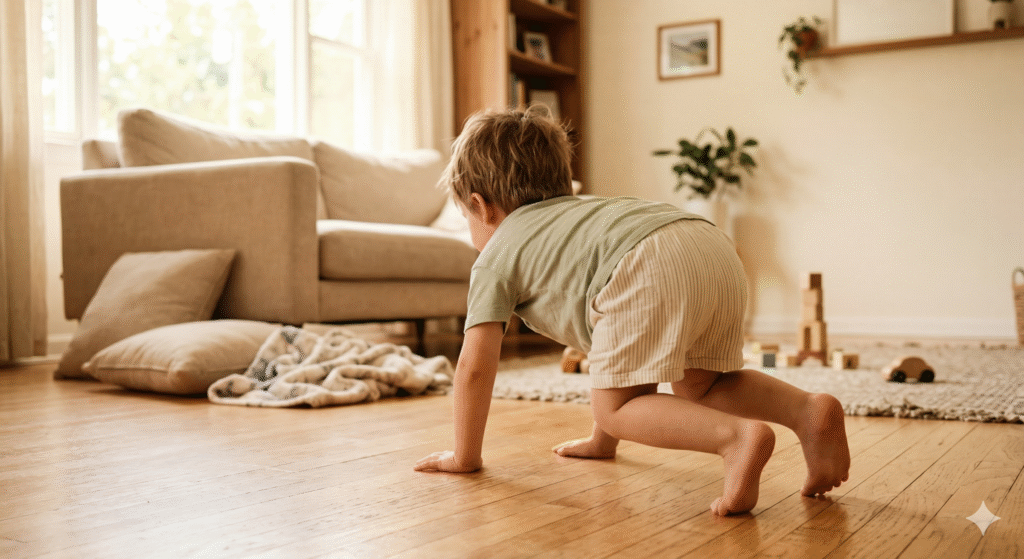
It’s 3 p.m. on a rainy Tuesday. Your toddler is climbing the couch for the fifth time. Your preschooler is doing laps around the kitchen table. And you’re wondering: how do I channel all this energy without a backyard full of equipment?
Here’s the thing — you don’t need to buy a single thing. Not a ball, not a mat, not a $200 climbing triangle. The American Academy of Pediatrics recommends that children ages 3 to 5 get at least three hours of physical activity every day. For toddlers, the CDC recommends at least 60 minutes of moderate-to-vigorous activity daily. And yet, research shows that many children under five aren’t meeting those benchmarks.
The good news? Everything on this list uses stuff you already have (your body, your floor, maybe some couch cushions) or nothing at all.
When my sons were bouncing off the walls one afternoon (literally — my older son had discovered he could push off the hallway wall and slide across the floor in his socks), I realized something. The best physical activities aren’t the ones that require fancy gear. They’re the ones that make kids laugh so hard they forget they’re exercising.
Here are 20+ tested, no-equipment activities organized by age — all you need is a little space and a willingness to get silly.
Why No-Equipment Play Matters
Take away the equipment and something clicks. There are no instructions to follow, no batteries to replace, no pieces to lose under the couch. Kids have to figure out what to do with their bodies — and that’s where the magic is.
Running, jumping, balancing, climbing — these build the gross motor skills that everything else depends on. Strong muscles, healthy bones, cardiovascular fitness, coordination. But honestly? The part I notice most is the confidence. When my older son figured out he could jump off a cushion and land without falling, he walked around like he’d won an Olympic medal for the rest of the day.
And for us parents: no prep, no cleanup, no Amazon order. You can start any of these in the next thirty seconds.
For Toddlers (Ages 2–3)
Toddlers are movement machines — but their coordination is still developing. These activities work with their natural energy while helping them build balance, body awareness, and basic motor patterns. Keep instructions simple (one step at a time), and expect short bursts of activity followed by rest.
1. Animal Walks
This is my older son’s absolute favorite right now. Call out an animal, and everyone moves like that animal across the room. Bear walks (hands and feet on the floor, bottom in the air), bunny hops (squat and jump forward), crab walks (on hands and feet with belly facing up), frog jumps, penguin waddles — we’ve done at least a dozen and he still asks “what else?”
The reason kids never get bored with this one: every animal is a totally different workout. Bear walks build arm and shoulder strength. Frog jumps are all legs. Crab walks quietly destroy your core. Your toddler won’t notice any of that — they just think waddling like a penguin is the funniest thing they’ve ever done.
2. Dance Party Freeze
Play music and dance like crazy. When the music stops — everyone freezes. Sounds simple, right? Stopping mid-dance is way harder than it sounds when you’re two. My sons treat the freeze moment like a competition — who can hold the most ridiculous pose without cracking up. They wobble, they giggle, they topple over. And then they beg to do it again.
Use whatever music you have. Upbeat kids’ songs work, but honestly, toddlers will dance to anything with a beat.
3. Follow the Leader
One person leads, everyone else copies. Jump, spin, stomp, crawl, tiptoe, march, wiggle — whatever the leader does, everyone follows. Then switch. When my older son leads, he intentionally makes it hard for his little brother. The little one can’t quite keep up, but he tries so hard his face turns red — and that determination is half the workout.
For a two-year-old, start with very simple movements: big steps, arm swings, clapping while walking. As they get comfortable, add more complex moves.
4. “Row Row Row Your Boat” Partner Game
Sit facing your toddler on the floor with your feet touching. Hold hands and lean back and forth — one person leans back while the other leans forward — while singing together. It’s gentle, it’s giggly, and it sneaks in some core work for both of you. (Yes, you’ll feel it too.)
5. Red Light, Green Light (Toddler Edition)
Shout “Green light!” and kids run. Shout “Red light!” and they stop. That’s it. Toddlers don’t need complicated rules — the thrill of running and the challenge of stopping is more than enough. You can add “Yellow light!” for slow motion walking once they’ve mastered the basic version.
This is perfect for a hallway, a backyard, or even a long living room. My older son takes about four red lights before he actually stops, but the practice is what matters.
6. Shadow Chasing
On a sunny day, take your toddler outside and show them their shadow. Then try to step on each other’s shadows. Run, jump, wave your arms — watch the shadows move with you. For a two-year-old, this is next-level mind-blowing. Wait, that dark thing FOLLOWS me?! My older son spent a full ten minutes trying to run away from his own shadow before he figured out that wasn’t going to work.
7. Cushion Mountain
Pull the couch cushions onto the floor and let your toddler climb, crawl over, roll across, and jump off them. Every parent has done this at least once — the difference is now you can call it a gross motor activity instead of “destroying the living room.” Climbing over uneven, soft surfaces is surprisingly great for balance and core stability.
For Preschoolers (Ages 3–5)
Around three, something shifts. They can follow multi-step instructions. They understand rules (even if they don’t always follow them). And suddenly the thing they care about most isn’t just the activity — it’s doing it with someone else.
8. Simon Says
“Simon says touch your toes.” “Simon says hop on one foot.” “Simon says spin around three times.” Then drop a command without “Simon says” and watch the chaos unfold. Half the fun is catching someone who moved when they shouldn’t have — the dramatic gasps alone are worth it.
Sneaky bonus: this game is basically a listening skills bootcamp in disguise. If your kid can learn to pause and actually process what they hear before reacting, you’ve won at parenting for the day.
Ramp it up with harder commands: “Simon says do five jumping jacks.” “Simon says crawl to the wall and back.” “Simon says stand on one foot and close your eyes.”
9. The Floor is Lava
Shout “The floor is lava!” and everyone has to get off the ground. Use couch cushions, rugs, towels, or designated “safe zones” as islands. Kids jump from island to island, balance, and figure out where to go next. I have never seen my kids move faster than when imaginary lava is involved. Nothing — not snacks, not screen time, not the promise of dessert — creates that level of urgency.
10. DIY Obstacle Course
Here’s my secret: let the kids help design it. When they pick the challenges, they’ll throw themselves into completing them with twice the energy. Crawl under a dining chair, hop over a line of tape on the floor, spin around a pillow three times, tiptoe along a tape “balance beam,” army-crawl under a blanket draped between two chairs — all stuff that’s already in your house. (Need ideas for setting up a play-friendly space? Check out our Montessori playroom guide for small spaces.)
Take it outside and nature does the work for you: run to the big tree, hop back, spin around the bush, touch the fence and sprint to the start.
11. Animal Races
Set a start and finish line. Everyone picks an animal and races using that animal’s movement. One child bear-crawls, another frog-jumps, another crab-walks. It’s chaotic, loud, and kids beg for “one more round” every single time. You can let the winner pick the next animal for everyone to use.
12. Freeze Dance (Level Up)
Your preschooler already knows Freeze Dance from the toddler days — so level it up. When the music stops, call out a pose everyone must freeze in. “Freeze like a tree!” “Freeze like a superhero!” “Freeze like a flamingo!” Going from full-speed dancing to a controlled pose in half a second? That takes real body awareness.
13. Duck Duck Goose
Everyone sits in a circle. One child walks around tapping heads saying “Duck… duck… duck…” then suddenly says “Goose!” The “goose” jumps up and chases the tapper around the circle. If the tapper makes it back to the empty spot and sits down, they’re safe.
Fair warning: we tried this with just the three of us once. With only three people, someone is always confused about which direction to run, someone falls over laughing, and no one actually completes a full circle. You really need at least four people for it to work — save it for playdates or when grandparents visit.
14. Treasure Hunt Sprint
Hide a “treasure” (a favorite stuffed animal, a small toy, a cracker) somewhere in the house or yard. Give verbal clues. Kids run to find it. When they find it, hide it again. They’ll sprint back and forth voluntarily — no convincing needed. I also use this one shamelessly when I need five minutes to prep dinner. Hide the treasure, give a clue, chop an onion in peace.
For Bigger Kids (Ages 4–6)
By four, five, and six, kids can handle real rules, longer games, and they actually want to win. The competitive streak kicks in hard. Use it.
15. Tag and Freeze Tag
Classic tag needs no introduction, but Freeze Tag adds a twist: when you’re tagged, you freeze with your legs apart. Another player can “unfreeze” you by crawling between your legs. Nobody ever stops moving — tagged kids are yelling for rescue, untagged kids are torn between running away and saving their frozen friends. It’s delightful chaos.
16. Hide and Seek
Does this one even need an explanation? One person counts, everyone else hides. But think about everything that’s actually happening when they play: sprinting to a hiding spot, squeezing into weird spaces, holding perfectly still, then the explosion of running when they’re found. It’s a full-body workout disguised as the oldest game in the world.
17. Hopscotch
Draw a hopscotch grid with sidewalk chalk outside, or use painter’s tape indoors on a hard floor. The classic pattern: single squares and double squares alternating, numbered 1 through 10. Kids hop on one foot through single squares, land on two feet for doubles. It looks like just hopping — but try watching a four-year-old balance on one foot mid-hop. It takes real leg strength and concentration.
For an extra challenge, have kids toss a small stone onto a numbered square and skip that square while hopping through.
18. Relay Races
Mark a start and a turn-around point. Kids sprint to the turn-around and back, then tag the next person in line. You can make it more interesting by changing the movement for each leg: sprint there, skip back. Bear-crawl there, hop back. Side-shuffle there, spin back. My daughter loved turning these into increasingly absurd challenges — “Walk backwards while flapping your arms like a chicken” was a personal highlight.
19. Yoga Pose Challenge
Call out yoga poses and see who can hold them longest. Tree pose (stand on one foot, place the other foot on your inner ankle or lower calf — not on the knee — and raise your arms up). Warrior pose. Downward dog. Airplane (stand on one foot, lean forward, arms out like wings). It sounds easy until you actually try holding tree pose for 15 seconds with a five-year-old staring you down. Spoiler: you will wobble first.
You don’t need to know formal yoga — just make up balance poses and give them fun names. “Stork,” “Rocket Ship,” “Wobbly Flamingo.”
20. Nature Scavenger Hunt + Sprint
Create a verbal list of things to find outdoors: something red, a smooth rock, a feather, three different leaves, something that makes noise. Here’s the twist — every time they find something, they have to sprint back to base to show you before searching for the next item. They think it’s a treasure hunt. You know it’s interval training. Everybody wins.
Bonus: Activities That Work for Every Age
If you have kids of different ages, you know the struggle of finding something they can ALL do without the older one getting bored or the younger one melting down. These three work every time in our house:
Dance Party — put on music and just dance. No rules, no structure, no winners. Everyone moves at their own level and in their own style. This is our go-to when energy is high and patience is low.
Paper Ball Keep-Up — crumple some newspaper or scrap paper into a ball and try to keep it from hitting the floor. Toddlers swat wildly, preschoolers develop strategy, older kids add rules like “only use your elbows!” A paper ball floats slowly enough to give little ones a fighting chance.
Chase — the simplest game in existence. One person runs, the other chases. Switch. Repeat until everyone collapses in a laughing heap on the grass. My sons could play this for an hour straight.
Quick Reference: Indoor vs. Outdoor
Here’s the quick rule of thumb: anything with chasing or sprinting (Tag, Relay Races, Duck Duck Goose) — do it outside or in a really big room. Anything where kids stay in one spot or move slowly (Animal Walks, Yoga Poses, Freeze Dance, Simon Says) works fine in a small living room. Obstacle courses and Hide and Seek? They work anywhere. Just shrink or expand the space.
Tips to Make Physical Play a Daily Habit
The easiest way to make movement stick? Attach it to something you already do. Dance party before breakfast. Animal walks right after naptime. Chase in the backyard before bath. We didn’t plan these — they just kind of happened, and now my kids expect them. (If you’re looking for more structure, our daily routine chart for toddlers has a free printable to help.)
Some days my older son will run for 45 minutes straight. Other days, ten minutes of animal walks and he’s done. Both are totally fine. I stopped tracking minutes a long time ago. If they moved and laughed, we’re good.
One thing that always helps: music. Fast music makes kids run faster without you asking. Slow music naturally brings the energy down. I don’t have a special playlist — I just hit shuffle on my phone and let whatever plays set the vibe.
And the biggest thing I’ve learned? They don’t want me to manage their play. They want me to play. When I actually get down on the floor and do the bear walk next to my kids, when I try to hold tree pose and dramatically lose balance, when I actually run during Tag instead of half-jogging — that’s when these activities stop being “exercise” and become the highlight of our day.
Last tip: quit while you’re ahead. End before the tears start. I’d rather do 10 great minutes than push for 30 and have it end in a meltdown. The goal is for them to finish thinking that was fun, let’s do it again tomorrow — not mom made me keep going when I was tired.