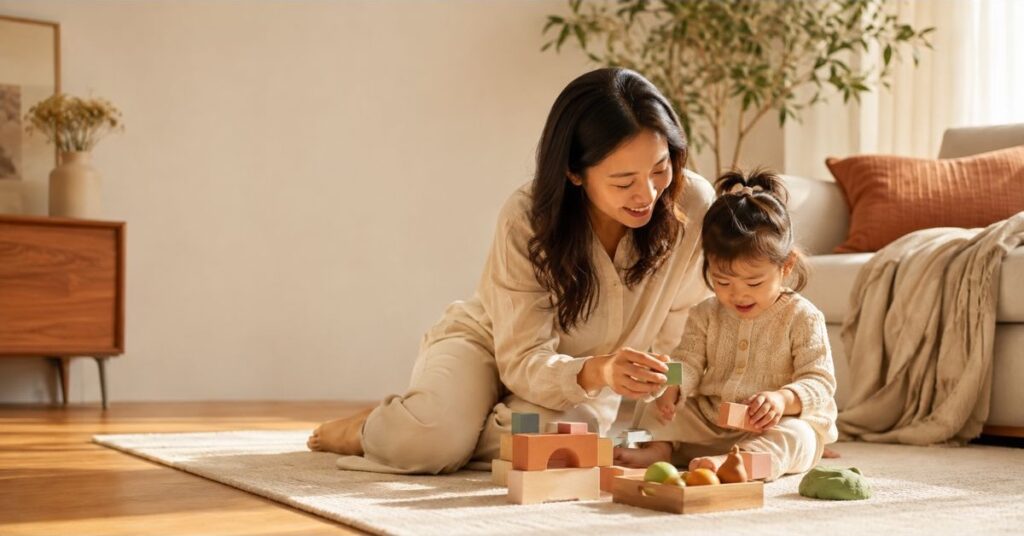
The best toy for a two-year-old is not necessarily the toy with the longest feature list. It is the one that matches what your child wants to do right now—stack and crash, squeeze and roll, point and repeat, or try the same little sequence fifteen times.
Watching my sons move through this age taught me to ask a more useful question than “Is this educational?” I want to know whether a toy gives a toddler something clear to do, leaves room to try it another way, and fits the amount of help an adult actually wants to give.
For this guide, I compared current age labels, product instructions, recurring low-review complaints, recall-search results, and the kind of play each toy genuinely supports. I also screened current Amazon listings at the exact item level. The result is a short list—not a toy-room shopping spree—with an honest reason to buy and an equally honest reason to skip each one.
Short answer: Choose LEGO DUPLO for open-ended building, Play-Doh for a low-cost creative activity, HABA First Orchard for a first turn-taking game, the LeapFrog 100 Words Book for a child who loves pointing and repeating, and the Hape Pound & Tap Bench for a younger two-year-old who still wants strong cause-and-effect play.
Quick comparison: which toy fits your child?
| Pick | Best for | Typical price | Adult involvement | Skip it if… |
|---|---|---|---|---|
| LEGO DUPLO Brick Box | Building, loading, knocking down, pretend play | $20–$30 | Low after setup | You want a detailed model or dislike floor pieces |
| Play-Doh 10-Pack | Squeezing, rolling, color play, a quick table activity | Under $10 | Medium for cleanup | Your child has a wheat allergy or still eats play materials |
| HABA First Orchard | A first game with turns and one shared goal | $25–$35 | High; play together | Your child cannot yet sit for one short round |
| LeapFrog 100 Words Book | Pointing, naming, sound imitation, quiet independent play | $15–$25 | Low to medium | You want a silent, battery-free toy |
| Hape Pound & Tap Bench | Hammering, dropping, repetition, cause and effect | $30–$40 | Medium; manage the mallet | Your almost-three-year-old has moved past simple posting toys |
Start with the play pattern, not the birthday
Two children with the same birthday can need completely different toys. One may be building little “houses” and narrating a story. Another may be happiest putting one object in, taking it out, and doing that again. The age label tells you whether a product was designed for the range; it does not tell you whether the play is a good match today.
Best open-ended building toy
1. LEGO DUPLO Classic Brick Box 10913
Best for: children who stack, load, connect, and knock down
This is the most flexible pick in the group because it does not demand one “right” result. A younger two-year-old can make a three-brick tower, take it apart, and feel finished. Later, the same pieces can become a car, a window, a tiny home, or whatever the child names that day.
The mix includes bricks, wheels, figures, a window, and a few familiar objects. That variety helps a child move from pure connecting to early pretend play without turning the set into a complicated building project. The box also gives the pieces a real home, which matters more than it sounds.
What play looks like
- Build two short towers and ask, “Which one is taller?”
- Put a figure in the wheeled base and make a simple delivery route.
- Sort a few pieces by color, then stop before sorting becomes a lesson.
- Take photos of favorite builds so cleanup does not feel like losing them.
Skip it if: loose pieces on the floor make you miserable, or your child currently wants a toy that performs a clear action without inventing a plan.
Check the current DUPLO price on Amazon
Exact item checked: LEGO set 10913, ASIN B07WJJF8PB.
Best budget creative toy
2. Play-Doh Modeling Compound 10-Pack
Best for: squeezing, rolling, pinching, and low-pressure creative play
Play-Doh earns a place here because it turns a small budget into many different invitations to play. You can put out only two colors and a cup, then change the activity another day with a spoon, a toy animal, or a cardboard tube. The material does most of the work; you do not need a themed kit.
For a two-year-old, the useful actions are simple: flatten, poke, pull, press, and roll. There is no need to make recognizable animals or letters. If a child combines every color into brown, that is exploration—not a ruined activity.
Make it easier to manage
- Offer one or two cans at a time rather than all ten.
- Use a tray or wipeable mat to create a clear boundary.
- Close each lid as soon as that color is finished.
- Let dried bits dry fully, then scrape and vacuum instead of rubbing them deeper into fabric.
Skip it if: your child has a wheat allergy, still routinely eats play materials, or you need a mess-free activity. Play-Doh is non-toxic when used as intended, but it is not food.
Check the current Play-Doh price on Amazon
Exact item checked: model 29413, ASIN B00JM5GW10.
Best first board game
3. HABA My Very First Games: First Orchard
Best for: a child who is beginning to wait, match colors, and finish one short round
Most games ask a young child to compete before losing makes sense. First Orchard takes a gentler route: everyone works together to collect the fruit before the raven reaches the orchard. A child still gets the pleasure of rolling a die and moving a piece, but one person does not have to defeat another.
The rule is concrete: roll a color, pick the matching fruit. That gives adults an easy script and gives toddlers a visible job on every turn. The large wooden fruit is also easier for small hands to handle than cards or tiny pawns.
How to introduce it
- On the first day, name the fruit and practice putting it in the basket without playing a full game.
- When you add the die, narrate only the current turn: “Blue. Let’s find a blue fruit.”
- If waiting is hard, let the child hand the die to the next player.
- Stop after one round while the experience still feels successful.
Skip it if: your child is not yet interested in a shared activity for several minutes, or an older preschooler already wants choices and strategy.
Check the current First Orchard price on Amazon
Exact item checked: HABA 3177, ASIN B004BW8TYC.
Best interactive word toy
4. LeapFrog Learning Friends 100 Words Book
Best for: children who point to pictures, copy sounds, and enjoy predictable repetition
Touch a picture and the book responds with a word, sound, or short fact. That immediate response is easy for a toddler to understand, and the themed pages make it simple to follow the child’s interest instead of moving through the book in order.
The English and Spanish switch adds exposure to a second label for the same picture. It does not make the toy a bilingual curriculum, and no electronic book can replace the back-and-forth of a real conversation. Its better role is to start one: “You found the turtle. Where have we seen a turtle before?”
Use it without turning it into a quiz
- Let your child choose the page and touch first.
- Repeat one word, then add a tiny real-life connection.
- Keep the volume low enough that your voice still belongs in the play.
- Put it away if repeated button pressing is making everyone edgy.
Skip it if: you want a battery-free home, your child is sensitive to repeated sounds, or you are hoping a device will independently teach expressive language.
Check the current LeapFrog book price on Amazon
Exact item checked: green 100 Words Book, ASIN B07B6ZN7P8.
Best for a younger two-year-old
5. Hape Pound & Tap Bench
Best for: hammering, dropping, and repeating one satisfying cause-and-effect sequence
A child taps a wooden ball through the bench and watches it roll over the xylophone below. The connection is immediate: my action made the ball move and made a sound. The xylophone also slides out, so the child can tap the keys directly.
This is the most age-sensitive recommendation here. It makes the most sense for a child at the younger end of two who still loves posting, pounding, and repetition. A child close to three may understand the mechanism in five minutes and want a more open-ended challenge.
What to expect
- Some children press the balls through before they learn to aim the mallet.
- The xylophone offers different sounds, but it is a toy component rather than a precisely tuned instrument.
- The mallet needs a simple family rule: it taps the bench, not people, pets, screens, or furniture.
- Clean the wood with a damp cloth; do not soak it.
Skip it if: your child already invents long pretend stories, gets bored with posting toys, or cannot yet use a lightweight mallet around siblings without close help.
Check the current Hape bench price on Amazon
Exact item checked: Hape E0305, ASIN B00712O2D6.
A practical safety check before play
- Follow the exact product’s age label. Similar-looking versions can have different pieces and different minimum ages.
- Check condition, not just age. Retire cracked plastic, splintered wood, loose hardware, leaking batteries, or pieces damaged by heavy chewing.
- Manage the environment. Keep game pieces at the table, bricks off walkways, and Play-Doh away from food-prep areas and fabric you cannot clean.
- Secure batteries. An adult should install them, tighten the battery-compartment screw, and remove batteries before long storage.
- Treat readiness as individual. If a child still mouths materials, throws hard objects, or cannot use a mallet safely, choose a different activity for now.
Recall status can change. Search the product name and model at the U.S. Consumer Product Safety Commission, especially when buying secondhand.
How many toys does a 2–3 year old need?
Probably fewer than a roundup makes it seem. These five products cover five different jobs; they are not a five-item shopping list. If you already own blocks, you do not need another building system to get the benefits of building. If your child paints, digs, and helps in the kitchen, you may not need Play-Doh either.
Choose the one missing play pattern, then rotate it with what you already have. A small shelf with visible choices is usually easier to use than a deep bin full of forgotten toys. Our toy rotation guide can help you start without reorganizing the whole house.
Frequently asked questions
Are “educational toys” better for toddlers?
Not automatically. A toy is useful when it gives a child an understandable action, enough challenge to stay interested, and room to repeat or vary the play. Flashing labels and developmental promises do not guarantee any of that.
What is the best gift for a two-year-old who already has too many toys?
Choose a consumable material, an experience, or one item that fills a clear gap. Play-Doh is easier to use up than another bulky toy. A zoo pass, water-play tools, or time with a favorite adult may be better still.
Should I buy for the child’s current age or “grow into” a toy?
Buy for current safe use. A toy that is too advanced often becomes adult work or sits unused, while a product labeled for older children may include parts or play assumptions that are not appropriate yet. “Grow with them” is only valuable if the first stage works now.
What if my three-year-old still likes very simple toys?
Simple is not the same as babyish. Repetition can be calming and satisfying. Look at how your child uses the toy and whether it remains safe, not whether the play impresses an adult.
The bottom line
If you want one broadly useful choice, start with DUPLO. For the lowest-cost activity, choose Play-Doh. Pick First Orchard when your child is ready to share one short game, the LeapFrog book for a pointer-and-repeater, and the Hape bench only when simple cause-and-effect play still has real pull.
The right toy does not need to teach five skills, entertain for an hour, or make a child look advanced. It needs to fit the child in front of you—and make the next ten minutes of play easier to begin.