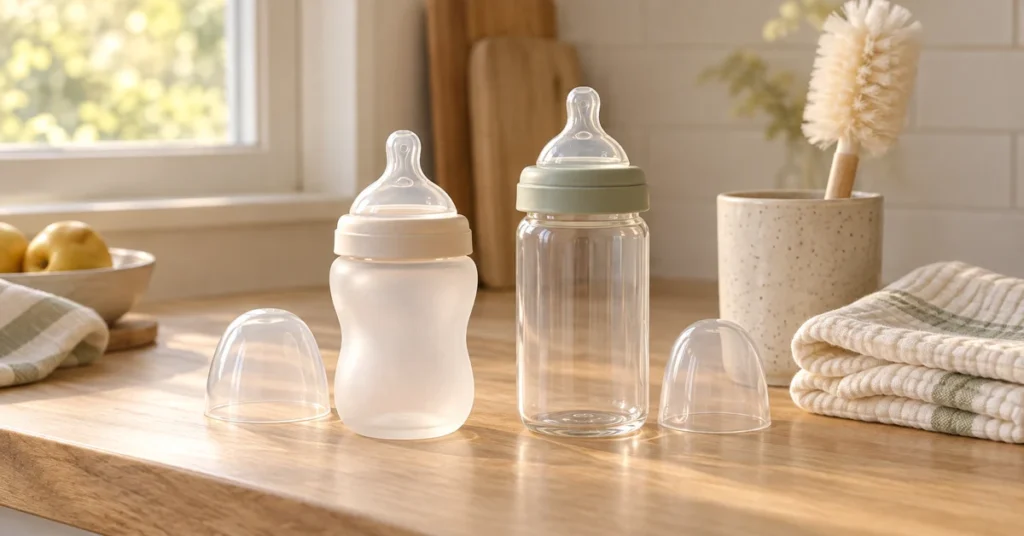
Cozy nursing station with baby bottles and warm natural light — the best baby bottles for new moms in 2026

10 Best Baby Bottles of 2026 (Tested by a Mom of Three)

When my daughter was about four weeks old, I decided it was time to introduce a bottle so my husband could take a night feed. What I didn’t expect was just how picky she’d be — the first bottle we tried? Total rejection. The second? She screamed louder. It took us three different brands before we finally found one she’d accept (spoiler: it was the Lansinoh, and yes, it’s on this list).

If you’re breastfeeding and need a bottle for pumped milk, combo feeding, or simply sharing the feeding load with your partner, choosing the right baby bottle matters more than you’d think. The wrong bottle can cause nipple confusion, lead to extra gas, or just end up collecting dust in the cabinet.

After testing multiple bottles with all three of my kids and spending hours researching what actually works, I’ve narrowed it down to the 10 best baby bottles for 2026.

In a hurry? The Comotomo is my #1 overall pick. For gassy babies, go with Dr. Brown’s. On a budget? The Evenflo Balance+ at ~$3/bottle is unbeatable.

How We Picked These Bottles

I spent way too many late nights comparing bottles, reading reviews, and consulting my lactation consultant friends. The five things I kept coming back to: nipple design (does it mimic the breast enough to avoid confusion?), anti-colic features (does it actually reduce gas, or is it just marketing?), material safety (BPA-free is just the starting point), ease of cleaning (3 a.m. bottle washing is nobody’s idea of fun), and value for money.

I also checked every single product claim directly on the manufacturer’s official website — because Amazon listings and product packaging don’t always tell the full story.

Quick Comparison

Bottle Best For Material Price/Bottle Anti-Colic
Comotomo Overall pick Silicone ~$12 Dual vents
Dr. Brown’s Options+ Anti-colic PP / Glass ~$5-6 Internal vent system
Philips Avent Natural Response Best value PP / Glass / PPSU ~$7-8 Nipple valve
MAM Easy Start Self-sterilizing PP ~$8 Bottom vent
Lansinoh NaturalWave Breastfed babies PP ~$6-7 AVS system
Chicco Duo Hybrid Glass + plastic Invinci-Glass / PP ~$10-12 Nipple valve
Evenflo Balance+ Nipple confusion PP / Glass ~$3-4 Integrated vent
Tommee Tippee Glass Best glass Borosilicate glass ~$9-10 Teat valve
Hegen PCTO Premium pick PPSU ~$23-28 Air bypass
NUK Simply Natural Temperature safety Tritan ~$7 1-piece vent

The 10 Best Baby Bottles of 2026

1. Comotomo Baby Bottle — Best Overall

If I could only recommend one bottle to a breastfeeding mom, it would be the Comotomo. The entire body is made of soft, squeezable medical-grade silicone that feels so much like real skin — which is exactly why so many breastfed babies accept it without a fight. The wide, rounded nipple mimics the natural breast shape, and the dual anti-colic vents prevent air intake without any extra parts to lose.

What I loved most was the ultra-wide neck. You can literally reach your hand inside to clean it — no bottle brush required. For a sleep-deprived mom doing dishes at midnight, that’s a game-changer.

The 5oz bottle comes with a slow flow nipple (0-3 months), and the 8oz comes with medium flow (3-6 months). Fast and variable flow nipples are available separately. All materials are BPA, PVC, and phthalate-free, and the bottles are made in South Korea.

Comotomo also released a Gen 2 version in 2026 based on parent feedback, which is worth checking out if you’re buying new.

Pros
• Breast-like silicone body reduces rejection
• Ultra-wide neck — no brush needed
• Dual anti-colic vents
• Dishwasher, microwave, and sterilizer safe
Cons
• ~$12/bottle is pricier than plastic options
• Silicone heats slower than plastic
• No preemie flow nipple available
• Silicone can stain if not cleaned thoroughly

Best for: Breastfed babies who reject other bottles, combo-feeding families.

2. Dr. Brown’s Natural Flow Anti-Colic Options+ — Best Anti-Colic

My younger son had the worst gas as a newborn — he’d scream after every feed, and nothing seemed to help. Dr. Brown’s was the bottle that finally made a difference. Their patented two-piece internal vent system creates positive-pressure, vacuum-free feeding that closely mimics breastfeeding. Air is channeled from the nipple collar through the vent system to the back of the bottle, so it never mixes with the milk. This also helps keep the good stuff in your breast milk — like vitamins C, A, and E — from breaking down.

There’s a reason this is the number one pediatrician-recommended baby bottle in the U.S. — hospitals use them, and the clinical backing is real. The Options+ design lets you use the bottle with or without the vent system, which is handy once your baby outgrows the gassy phase (mine did around 4 months, and I was happy to ditch the extra parts).

They offer the widest range of nipple sizes I’ve seen: Preemie, Level 1 through Level 4, and Y-Cut. Both narrow and wide-neck versions are available in plastic or borosilicate glass. The bottles are also compatible with most breast pumps.

Pros
• Clinically proven to reduce colic and gas
• 6 nipple flow levels including Preemie
• Options+ works with or without vent
• Budget-friendly at ~$5-6/bottle
Cons
• Vent system adds extra parts to clean
• Small vent pieces easy to lose
• Narrow neck version harder to fill/clean

Best for: Babies with colic, gas, reflux, or spit-up issues; preemie babies.

3. Philips Avent Natural Response — Best Value

The thing that sold me on the Philips Avent Natural Response is how the nipple actually works — it has a unique opening that only releases milk when your baby actively sucks. When baby pauses to swallow and breathe, the milk pauses too. It’s honestly the closest thing to breastfeeding I’ve seen in a bottle, and it helps prevent overfeeding.

The soft, wide breast-shaped nipple encourages a natural latch, and the built-in anti-colic valve keeps air away from baby’s tummy. I also love the no-drip design — no more milk puddles on the changing table.

Philips Avent offers the biggest range of options of any bottle brand: PP plastic, borosilicate glass, and PPSU versions in sizes from 4oz to 11oz. All nipples, caps, and parts are interchangeable across the Natural Response range and compatible with Avent breast pumps and toddler cups.

Note: The Natural Response nipple works differently than traditional free-flow nipples. It’s normal for your baby to need 2-3 tries to get milk flowing. If baby takes longer than 20 minutes to drink about 2 ounces, try switching to the First Flow (Flow 0) nipple first.
Pros
• Only flows when baby actively sucks
• No-drip design prevents milk loss
• Huge range of sizes, materials, and flows
• Works with Avent pump and cup system
Cons
• Some babies need adjustment period
• First Flow nipple may need to be purchased separately
• Works differently than regular bottles — slight learning curve

Best for: Budget-conscious families who want one bottle brand that does it all; combo-feeding.

4. MAM Easy Start Anti-Colic — Best Self-Sterilizing

The MAM Easy Start has a feature that no other bottle on this list can match: built-in self-sterilizing. Just add about 1.5 tablespoons of water to the disassembled bottle base, reassemble, and microwave for 3 minutes. Done — no separate sterilizer needed. For travel or visits to grandma’s house, this is incredibly convenient.

But it’s not just a party trick. The vented base design is clinically shown to reduce colic symptoms in 80% of babies by preventing air bubbles from forming in the milk. The SkinSoft silicone nipple has a unique flat shape that mimics the breast during feeding — and 94% of babies accept it, based on MAM’s testing with over 1,800 babies (that’s a lot of tiny critics).

MAM offers five nipple sizes (Size 0 through Size X), and all MAM nipples are interchangeable across every MAM bottle and trainer cup — so one system truly grows with your baby. The bottles are made in Europe and meet both American and European safety standards.

Pros
• Self-sterilizing in 3 minutes — no extra gear
• 94% baby acceptance rate
• 80% colic reduction (clinically tested)
• 5 nipple sizes, all interchangeable
Cons
• Measurements start at about 2oz (can’t see smaller amounts)
• 10+ minutes cooling time after self-sterilizing
• Flat nipple shape takes some babies an extra try or two

Best for: Families who travel frequently, parents who want minimal sterilizing equipment.

5. Lansinoh NaturalWave Anti-Colic — Best for Breastfed Babies

Founded by a breastfeeding mom over 30 years ago, Lansinoh designed this bottle specifically for babies who go back and forth between breast and bottle. A lactation consultant friend recommended these to me when my daughter kept refusing other bottles, and I can see why — the NaturalWave nipple is based on more than 50 years of research and is clinically proven to reduce nipple confusion.

The nipple has a triangular base with a textured, matte surface that helps baby keep a secure latch — it doesn’t slide around the way smoother nipples can. The flexible tip stretches with every suck, just like a real nipple, so baby controls the milk flow at their own pace. The built-in Air Ventilation System (AVS) is tested and shown to reduce colic, and it’s built right into the nipple — nothing extra to take apart or scrub.

The whole bottle is just three pieces (excluding the cap), which makes cleaning fast and simple. It’s also compatible with all Lansinoh breast pumps, so you can pump, store, and feed from the same bottle.

Pros
• Clinically proven to reduce nipple confusion
• Only 3 pieces — easiest to clean
• NaturalWave nipple supports baby-led feeding
• Compatible with Lansinoh pumps
Cons
• No self-sterilizing feature
• Nipple shouldn’t be soaked in sterilizing solution
• Narrower neck than some competitors

Best for: Exclusively breastfed babies who need occasional bottle feeds; pump-to-bottle routine.

6. Chicco Duo Hybrid — Best Glass-Plastic Hybrid

If you want the purity of glass but hate the weight and breakability, the Chicco Duo actually solves that problem. I was skeptical at first — how different can glass-lined plastic really be? But once I held one, I got it. It uses a patented medical glass technology called Invinci-Glass — a micro-thin layer of breakproof glass permanently bonded to the interior of a premium plastic bottle. Your milk touches only pure glass, but the bottle itself is lightweight, shatterproof, and won’t chip or crack.

Beyond the material, Duo bottles stay crystal clear and never stain, discolor, or retain odors — problems common with regular plastic bottles after months of use. The laser-etched measurement markings won’t fade or chip like printed ones do.

The Intui-Latch nipple has a skin-like texture that positions baby’s tongue and lips for a natural latch, with a 9 out of 10 acceptance rate. It includes an anti-colic valve and breast-like flow. Bottles are made in the USA and are BPA, BPS, PVC, and phthalate-free.

Sterilizing note: Chicco Duo bottles are safe for electric sterilizers and boiling (5 minutes), but do NOT use microwave sterilization or Instapot — it may damage the hybrid construction.
Pros
• Milk only touches pure glass — no plastic contact
• Breakproof, lightweight, won’t stain or smell
• 9/10 baby acceptance rate
• Laser-etched markings won’t fade
Cons
• Only 2 nipple flow stages (Slow and Medium)
• Can’t microwave-sterilize
• Higher price point (~$10-12/bottle)
• Nipple isn’t a gradual taper shape

Best for: Parents concerned about plastic chemicals and microplastics, families who want bottles that’ll last and stay clean.

7. Evenflo Balance+ Wide Neck — Best Budget Pick (and Best to Prevent Nipple Confusion)

At around $3-4 per bottle, the Evenflo Balance+ is the one I tell every new mom to try first. It’s the most affordable option on this list, and it’s the bottle our lactation consultant specifically recommended for preventing nipple confusion. Developed with pediatric feeding specialists, its naturally sloped nipple promotes a wide latch by providing a proper resting place for baby’s lips, reducing mouth fatigue during feeding.

The one-piece integrated Proflo vent prevents colic, gas, and fussiness — and since it’s all one piece, there’s nothing to disassemble or lose in the dishwasher. The included slow flow nipple has an intentionally slower flow rate to prevent chugging, allowing for a calm, paced feeding experience. And at this price, you won’t stress if one gets lost at daycare or grandma’s house — just toss another one in the diaper bag.

Available in both plastic (5oz and 9oz) and tempered glass (6oz) versions. The glass version is a particularly great value for eco-conscious families.

Pros
• Best price at ~$3-4/bottle
• Lactation consultant favorite for nipple confusion
• One-piece vent — nothing extra to clean
• Available in glass version too
Cons
• Measurement markings can be hard to read
• Nipple may compress during feeding (check periodically)
• Wide and Standard neck nipples not interchangeable
• Occasional stock availability issues

Best for: Budget-conscious families, breastfed babies transitioning to bottle, lactation consultant recommended.

8. Tommee Tippee Natural Start 3 Uses Glass — Best Glass Bottle

This is the smartest glass bottle design I’ve seen. The Tommee Tippee Natural Start 3 Uses set doesn’t just work as a baby bottle — it converts into a food storage jar (with included travel jar lids) and an open drinking cup (with included cup rings) as your baby grows. One purchase covers you from newborn feeding through toddler weaning.

The bottles are made from 100% medical-grade borosilicate glass that’s thermal shock resistant, scratch-proof, stain-resistant, and won’t absorb smells or flavors. Like the MAM, these bottles also self-sterilize — add a few tablespoons of water and microwave for 3 minutes.

The breast-like silicone nipple encourages a natural latch, and 92% of babies accept it within the first three tries. A built-in anti-colic valve in the teat reduces air intake. The set comes with 3 bottles, 3 jar lids, and 3 cup rings — basically everything you need from first feed to open cup.

Pros
• 3-in-1 design (bottle → jar → cup)
• Self-sterilizing in 3 minutes
• Glass = zero microplastics, no staining
• 92% acceptance rate; 100% leakproof
Cons
• Only available in 9oz (no smaller size)
• No silicone sleeve included
• Glass is heavier — baby can’t self-hold
• Limited nipple flow options

Best for: Eco-conscious families, parents who want one bottle system from birth to toddlerhood.

9. Hegen PCTO — Best Premium Pick

The Hegen is the most expensive bottle on this list — but also the most cleverly designed. Its patented PCTO (Press-to-Close, Twist-to-Open) closure is the world’s first no-screw-thread bottle lid. You press it on with one hand and twist it off. My husband loved this — he could prep a bottle one-handed while holding a fussy baby at 2 a.m. without fumbling with screw caps in the dark.

The bottles are made of PPSU (Polyphenylsulfone), an FDA-compliant material used in medical equipment. It gives you the safety of glass — no BPA, no leaching, no microplastics — without the weight or breakability. PPSU can handle anything from freezer to boiling water to sterilizer without cracking, so you can freeze and heat breast milk directly in the bottle.

The unique Sqround (square-round) shape is designed so it’s easy for both you and baby to hold, and it won’t roll off the counter. With interchangeable lids, the same bottle works as a pump bottle, storage container, feeding bottle, and eventually a drinking cup.

The elliptical, egg-shaped nipple closely mimics the breast shape with velvety-soft silicone, and the air venting system bypasses the milk to reduce colic and keep breast milk nutrients intact.

Pros
• One-hand PCTO closure — night feed hero
• PPSU = glass-level safety + plastic convenience
• Express-Store-Feed in one bottle (no transfers)
• Sqround shape: stackable, won’t roll
Cons
• Most expensive option (~$23-28/bottle)
• Only 3 nipple flow sizes
• Needs Hegen adapter for breast pump compatibility
• Less widely available in US stores

Best for: Parents who love smart design, pumping moms who want to pump, store, and feed from one bottle.

10. NUK Simply Natural with SafeTemp — Best with Temperature Indicator

The NUK Simply Natural has one feature I haven’t seen on any other bottle: SafeTemp technology. A blue thermometer indicator on the bottle fades and disappears when the milk is too hot, then reappears once it’s cooled to a safe temperature. No more doing the awkward wrist-test at 3 a.m. — especially helpful when dad or grandma is on feeding duty and less confident about getting the temperature right.

The nipple design is also unique — it’s the only bottle with up to 9 individual holes (slow flow has 3, medium has 6, fast has 9), mimicking how milk flows from multiple ducts during breastfeeding. The scoop-shaped nipple cavity provides space for baby’s tongue and jaw to move naturally, just like they do at the breast.

The bottles are made from Tritan — a premium, crystal-clear material that’s more durable and stain-resistant than regular polypropylene. It’s odor-resistant and stays looking new for longer. The one-piece anti-colic air vent helps reduce gas and spit-up.

Pros
• SafeTemp prevents feeding milk that’s too hot
• Multi-hole nipple mimics real breastfeeding
• Tritan material — clearer and more durable than PP
• NUK brand: 70+ years of trust
Cons
• Breast-shaped flat nipple takes some babies time to accept
• Can be harder to find in stores than Avent or Dr. Brown’s
• Fewer color and size options than some competitors

Best for: New parents and caregivers who want temperature safety built in, families with multiple caregivers.

Baby Bottle Buyer’s Guide: How to Choose

Material: Glass vs. Plastic vs. Silicone vs. PPSU

Plastic (PP/Tritan) is what most families start with — affordable, lightweight, and shatterproof. Modern baby bottle plastics are BPA-free and safe. The downside is that plastic can stain, retain odors, and get cloudy over time — and there are growing concerns about microplastics, especially when bottles are heated or sterilized repeatedly.

Glass (borosilicate) is the cleanest option — zero chemical leaching, no microplastics, and it stays crystal clear forever. The tradeoff is weight and breakability, though medical-grade borosilicate is thermal shock resistant. Great for home use; less ideal for daycare or travel.

Silicone (like Comotomo) offers a soft, squeezable feel that mimics skin. It’s lightweight, durable, and chemical-free. However, it heats more slowly and can be harder to get completely clean in crevices.

PPSU (like Hegen) is the upgrade pick if budget isn’t your main concern. It gives you the safety of glass — no BPA, no leaching, no microplastics — without the weight or breakability. It can handle anything from freezer to boiling water without cracking. The only downside is the price tag.

Nipple Shape and Flow Rate

For breastfed babies, look for a wide, breast-shaped nipple with a gradual slope — this encourages the same wide latch baby uses at the breast. Avoid narrow, elongated nipples that encourage a straw-like sucking motion.

Always start with the slowest flow nipple available. A flow that’s too fast can cause gulping, gas, and overfeeding — and may make baby prefer the bottle over the breast. Signs to move up a flow: baby takes longer than 20 minutes to finish, falls asleep during feeds, or tugs at the nipple in frustration.

Paced bottle feeding tip: When bottle-feeding a breastfed baby, hold the bottle horizontally (not tilted) and let baby pull the milk rather than gravity-feeding it. This mimics the effort of breastfeeding and prevents baby from developing a bottle preference. Take breaks every few minutes to let baby pace themselves.

When to Introduce a Bottle to a Breastfed Baby

Most lactation experts recommend introducing a bottle around 4 weeks postpartum. This window is considered the sweet spot: breastfeeding is usually established enough that a bottle won’t cause confusion, but baby is still young enough to be flexible about different feeding methods. Waiting too long (beyond 8-12 weeks) can lead to bottle refusal.

Safety reminders: Sterilize all bottles before first use by boiling for 5 minutes. For the first few months, sterilize regularly — newborn immune systems are still developing. Never microwave breast milk directly (it destroys nutrients and creates hot spots). Always check milk temperature before feeding, regardless of whether your bottle has a temperature indicator.

A Note About Daycare Bottles

If your baby is heading to daycare, keep it simple. Daycare staff handle dozens of bottles a day — they’ll appreciate bottles with fewer parts (skip the Dr. Brown’s vent system for daycare; the Options+ works fine without it). Go with something affordable enough that you won’t panic if a bottle disappears (Evenflo Balance+ at $3-4 each is perfect for this). And make sure every single piece is labeled with your baby’s name — nipples, caps, everything. Glass and PPSU bottles are beautiful at home, but plastic is more practical in a daycare setting where things get dropped, mixed up, and occasionally lost.

Frequently Asked Questions

How many bottles do I need?

For breastfeeding moms who occasionally bottle-feed, 3-4 bottles is usually enough. For formula-feeding or exclusive pumping, plan for 6-8 bottles so you always have clean ones ready while others are in the wash.

Can I use the same bottle for breast milk and formula?

Yes, all bottles on this list work with both breast milk and formula. Just clean thoroughly between uses to prevent buildup.

How often should I replace bottles and nipples?

Replace nipples every 2-3 months, or sooner if you notice tears, discoloration, thinning, or a sticky texture. Plastic bottles should be replaced if they become cloudy, scratched, or warped. Glass and PPSU bottles last much longer — usually years if well maintained.

Do I really need anti-colic bottles?

Not every baby needs them, but they don’t hurt. If your baby shows signs of gas, fussiness, colic, or excessive spit-up, anti-colic bottles can make a real difference. All 10 bottles on this list have some form of anti-colic technology.

Pro tip from experience: Don’t buy a full set of any one brand before testing. Buy one bottle from your top 2-3 choices and see which one your baby prefers. Every baby is different — what my daughter loved, my sons completely rejected.

Building your feeding station?

Check out my complete guide to 10 Breastfeeding Essentials Every New Mom Actually Needs — including the nursing pillow, breast pump, and Haakaa that made all the difference for me.