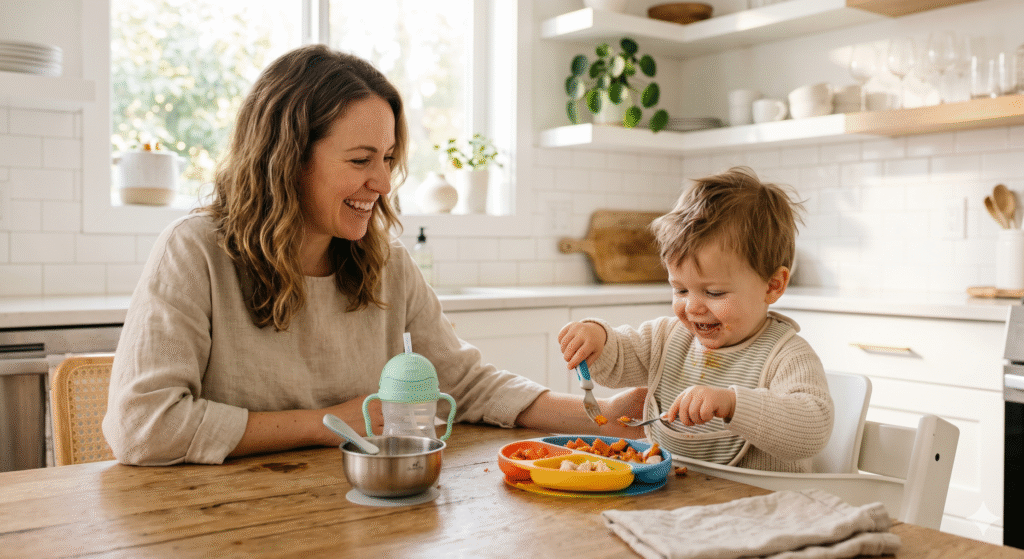
Quick — what color is your kitchen floor? If you have a toddler, I’m guessing the answer is “spaghetti sauce with a hint of yogurt.”
When my youngest son started solids around six months, I made the rookie mistake of thinking his high chair tray was all he needed. No plate, no bowl, just food directly on the tray. Efficient, right? Except that within about 30 seconds, every piece of banana was on the floor and he was licking the tray like it owed him something.
Three kids and an embarrassing number of Amazon returns later, my husband and I have figured out what actually works and what ends up shoved in the back of the cabinet after one use. The truth is, you don’t need 15 different plates and a drawer full of novelty spoons. You need a handful of things that actually stay on the table, are safe to chew on (because they will chew on them), and can survive the dishwasher 400 times.
Just when you feel like you’ve finally found the perfect bottle, it’s time to introduce solids. Here are the five pieces of toddler dinnerware that earned permanent spots in our daily rotation.
What to Look for in Toddler Dinnerware
Before we get into specific products, here’s the quick checklist I wish someone had given me before my first Target run. There are really only four things that matter.
Suction that actually works. “Strong suction” is on every box, but in reality, half of these plates pop off the high chair the second a determined toddler gets a fingernail under the edge. You want suction that sticks to both smooth trays and tables, and you want to test it on your specific high chair, because textured surfaces will defeat even the best suction base. A little water under the base before pressing down usually helps.
Material safety. This is a bigger conversation than it used to be. The main options you’ll see are silicone (flexible, microwave-safe, but can absorb dishwasher soap smells over time), stainless steel (completely non-porous, won’t leach anything, but can’t go in the microwave), and plastic (cheap and lightweight, but increasingly falling out of favor with parents who want to minimize plastic contact with food). Whatever you pick, look for BPA-free, phthalate-free, and PVC-free at minimum. Platinum-cured silicone and 304 18/8 stainless steel are considered the gold standards in their categories.
Walls that help, not hinder. You want high, slightly curved interior walls so your kiddo can push food against the side and actually get it onto a spoon. Flat plates are basically just food launch pads. Deep walls with a slight slope are the sweet spot.
Cleaning reality check. You’re going to wash this thing three times a day, minimum. It needs to be dishwasher-safe. Silicone pieces should go on the top rack. Stainless steel can handle anything. And if a product has hidden seams or crevices where mac and cheese can hide and fossilize, skip it.
Divided vs. undivided: the great debate
You’ll notice that divided plates are everywhere in the toddler aisle. And yes, they’re convenient for keeping applesauce away from the chicken. But here’s something worth knowing: pediatric dietitians generally recommend starting with undivided plates when possible. The reasoning is that divided plates can reinforce the idea that foods should never touch — which can feed into picky eating habits later. My older son went through a phase where he refused to eat if a single grain of rice touched his broccoli, and I’m pretty sure three months of divided plates didn’t help.
That said, every kid is different. If yours is already a selective eater and a divided plate gets them to actually eat dinner, that’s a win. I’ve included both options in this list so you can choose what works for your family.
The 5 Best Toddler Plates, Bowls & Utensils
1. Bumkins Silicone Grip Dish — Best Suction Plate Overall
If you buy one plate from this entire list, make it this one. The Bumkins Grip Dish has been in our house since my youngest was six months old, and it’s still going strong now that he’s a toddler who thinks he’s a food critic.
The suction on this plate is genuinely impressive. During testing by the team at Reviewed.com, toddlers couldn’t pry it off either smooth or textured surfaces — which is saying something, because toddlers are basically tiny engineers dedicated to destruction. My youngest son has tried everything short of a crowbar, and it stays put.
What I really appreciate is the design details that aren’t obvious from pictures. The interior walls are sloped, so when your kid drags a spoon along the side, food actually glides onto the utensil instead of getting pushed over the edge. There’s also a straight edge on one side so they can sit close to the plate without a curved rim poking their belly. My husband started tossing it in a wet bag and bringing it to restaurants too, which honestly made eating out with a toddler about 40% less stressful.
It’s made from 100% platinum-cured silicone — the highest quality silicone curing process, which means no by-products. It can go from the freezer (-40°F) to the oven (400°F), which I’ve used exactly once to reheat leftover pasta directly in the plate. Convenient? Yes. Life-changing? Also yes.
Specs: 8″ × 7″ × 1″ deep · 3 sections · 100% food-safe platinum-cured silicone · Oven, microwave, freezer, dishwasher safe · 3rd-party tested for BPA, lead, phthalates, cadmium · 12+ colors plus Disney and Nintendo character designs
Price: ~$11–13 on Amazon
Strongest suction I’ve tested — it actually stays put. Sloped interior walls make scooping easy. Goes from freezer to oven to dishwasher. Huge color and character selection. Price is very reasonable for the quality.
Silicone can absorb soapy smells over time — use unscented detergent or hand-wash occasionally with baking soda. Top rack dishwasher only. Tomato-based foods may temporarily stain (sunlight helps fade it).
2. OXO Tot Stick & Stay Suction Divided Plate — Best for Picky Eaters
If your toddler is the kind of kid who has a meltdown when a pea rolls into the mashed potatoes (hi, my older son), this plate was designed for you. It has four separate sections plus a small center circle that’s perfect for ranch dressing, hummus, or whatever magic dipping sauce convinces your kid to eat vegetables.
The OXO design takes a completely different approach from the Bumkins. Instead of a one-piece silicone plate, it’s a two-piece system — the plate sits on a separate silicone suction pad, and the two twist together. When mealtime is over, you twist them apart for cleaning. This actually solves one of my pet peeves with one-piece suction plates: food gets trapped under the suction area and you can never quite get it clean. With the OXO, you can wash every surface thoroughly.
There’s a clever “parent-friendly” release — easy for adult hands to detach, but the twisting motion is tricky enough that my youngest son hasn’t figured it out. OXO’s whole brand identity is built on thoughtful, ergonomic design, and that reputation is well-earned here. The curved walls encourage scooping, and the divided sections are deep enough that food stays in its lane.
Specs: 4 sections + center dip well · Plate body + silicone suction pad (twist-apart) · BPA-free, phthalate-free, PVC-free · Dishwasher safe (top rack) · Multiple colors including Teal, Navy, Blossom, Opal, Lilac · OXO Better Guarantee
Price: ~$11–14 on Amazon
Center dip section is genius — my kid will eat anything if he can dip it. Twist-apart design means genuinely thorough cleaning. OXO brand trust is well-earned. Multiple new color options for 2026.
Plate body is plastic (not silicone), so it’s not the pick for zero-plastic households. The manufacturer doesn’t list it as microwave-safe, so heat food separately and transfer. Suction isn’t quite as strong as the one-piece Bumkins, the trade-off for easier cleaning.
3. Elk and Friends Stainless Steel Bowl with Silicone Suction Sleeve — Best Non-Toxic Bowl
If the words “microplastics” keep you up at night (no judgment — I’ve read those studies too), Elk and Friends is the brand you want to know about. Their stainless steel bowls are what I reach for every morning for oatmeal and every evening for pasta, and I genuinely believe these will still be in our kitchen when my sons are in elementary school.
The concept is simple but smart: a 304 18/8 stainless steel bowl that slides into a removable food-grade silicone sleeve. The sleeve has a 3-point suction base (patent pending) that grips the table, and when you want to take the bowl on the go, you just pop it out of the sleeve, snap on the included lid, and toss it in your bag. The sleeve also has these cute textured woodland creature designs that my youngest son runs his fingers over while he eats — unexpected sensory bonus.
The non-porous stainless steel surface is the real star here. Unlike silicone, it doesn’t absorb soap flavors or food smells. Unlike plastic, there’s zero concern about chemicals leaching when food is warm. Tomato sauce, curry, beet puree — nothing stains it. After a year of daily use, our bowls look identical to the day they arrived.
The 4-pack with lids is a smart value play. We keep two at home and two packed for daycare, and the lids mean we can prep breakfast the night before and just grab from the fridge in the morning rush.
Specs: 4-pack: 4 stainless steel bowls + 4 silicone suction sleeves + 4 BPA-free lids · Bowl size: 4.7″ wide × 2″ tall · 304 18/8 stainless steel · 3rd-party tested (lead, BPA, phthalates, cadmium — not detected) · All parts dishwasher safe (top rack) · Brand est. 2015
Price: ~$33–35 on Amazon for the 4-pack (~$8.50 per bowl)
Zero staining, zero soap absorption — stays fresh forever. Removable sleeve = suction at home, bare bowl for travel. Lids included for meal prep and on-the-go. Will last years, not months. Consistently one of the best-selling stainless steel toddler bowls on Amazon.
Cannot microwave (stainless steel). Need to heat food separately and transfer. Price is higher than silicone bowls. A very determined toddler could eventually figure out how to pull off the silicone sleeve.
4. Bumkins Chewtensils — Best First BLW Utensils (6 months+)
Okay, I need to manage expectations here: these are not spoons and forks in the traditional sense. They’re more like training wheels for utensils. And if you’re doing baby-led weaning, they’re basically essential.
When my youngest son was around six months and starting solids, I handed him a regular baby spoon. He held it backward, chewed on the handle, and then used it to drum on the high chair tray. Not exactly self-feeding. The Chewtensils changed the game because they’re designed for exactly this stage — short enough that a baby can’t shove them too far into their mouth (there’s a ventilated choke barrier built in), textured enough that tiny hands can actually grip them, and soft enough that teething gums get some relief too.
The spoon has sensory bumps on the back that my son loved rubbing against his gums between bites. The “fork” has soft silicone tines — they won’t spear a piece of chicken, but they’ll pick up soft banana or avocado through friction. The idea is to introduce the concept of “utensil goes in food, food goes to mouth” without the frustration of trying to use a real fork at six months old.
Think of these as the crawling stage before walking. You’ll graduate to real metal utensils (see #5 below), but these make that transition so much smoother.
Specs: 1 spoon + 1 fork · 100% platinum-cured silicone · ~3″ long × 1.75″ wide · Ventilated choke barrier · Bendable heads · Weighted handles for stability · Dishwasher safe, can be boiled · 3rd-party safety tested (BPA, lead, phthalates, cadmium) · Ages 6 months+
Price: ~$10–13 on Amazon
Choke barrier gives real peace of mind during early BLW. Baby can chew on them for teething relief between bites. Weighted handles help babies learn to hold utensils correctly. Multiple colors plus Disney designs.
The fork cannot spear solid food — by design, it’s a learning tool, not a real fork. At 3 inches long, they won’t reach into a jar or deep bowl. Your baby will outgrow these — they’re a stepping stone to “real” utensils around 12 months.
5. WeeSprout Toddler Utensils — Best Utensils for Independent Eating (12 months+)
This is where real self-feeding begins. When my youngest son was around 12–13 months and had the hand coordination to actually aim food at his mouth (most of the time), we graduated from the Chewtensils to these WeeSprout utensils and never looked back.
The difference is night and day. The fork has real stainless steel tines that can actually pierce a piece of pasta or a chunk of steamed carrot. The spoon has a proper bowl deep enough to scoop oatmeal without it sliding off halfway to his mouth. But the handles are still thick, soft silicone — easy for little fingers to grip and short enough that the utensil can’t go too far back in their mouth.
There’s a reason these are consistently among the top-selling toddler utensils on Amazon. They hit the sweet spot between “kid-safe” and “actually functional.” My older son is three and still uses them daily — they bridge that awkward gap between baby spoons and full-size silverware perfectly. And the 6-piece set (3 forks + 3 spoons) means you always have a clean set ready even when the dishwasher hasn’t run yet.
If you’re only going to buy one set of utensils for the toddler years, this is the one.
Specs: 6-piece set: 3 forks + 3 spoons · Heads: 18/8 stainless steel · Handles: food-grade silicone (BPA, PVC, phthalate-free) · Dishwasher safe · 9 color combinations · Ages 12 months+
Price: $19.99 on Amazon
The fork actually spears food. The spoon actually holds food. That’s the bar, and you’d be surprised how many toddler utensils fail it. Thick silicone handles are easy to grip. 6 pieces means you can rotate through a full day without washing mid-meal. Stainless steel heads will last for years.
Stainless steel tips may feel firm for babies still teething heavily — if your child is under 12 months, start with the Chewtensils first and switch to these when ready. Some colors sell out frequently. At ~$3.30 per utensil, they’re pricier than plastic sets, but the durability makes up for it.
Quick Comparison
| Product | Type | Material | Price | Suction | Microwave |
|---|---|---|---|---|---|
| Bumkins Grip Dish | Plate (3-section) | Silicone | ~$12 | ✅ Built-in | ✅ |
| OXO Tot Divided Plate | Plate (4-section + dip) | Plastic + Silicone | ~$13 | ✅ Twist-apart | ❌ |
| Elk & Friends Bowl | Bowl (4-pack + lids) | Stainless Steel | ~$33/4pk | ✅ Sleeve | ❌ |
| Bumkins Chewtensils | First utensils | Silicone | ~$13 | — | — |
| WeeSprout Utensils | Toddler utensils (6-pk) | SS + Silicone | $20 | — | — |
When to Introduce What: An Age-by-Age Guide
One question I get asked a lot is “when should my baby start using plates and utensils?” Here’s the progression that worked for all three of my kids, and it lines up with what most pediatric feeding specialists recommend.
Around 6 months (starting solids): Your baby is mostly exploring textures and learning to bring food to their mouth. This is the Bumkins Grip Dish + Chewtensils stage. Put soft foods in the plate sections and let them practice. Most food will end up on the floor or in their hair. That’s completely normal — they’re learning.
Around 9–12 months: Hand-eye coordination is improving. Your baby might start scooping with the Chewtensils more intentionally. Introduce the Elk and Friends bowl for things like oatmeal or yogurt — the high walls help them push food onto the spoon. This is also when you might add the OXO divided plate if your child seems bothered by foods mixing.
Around 12–18 months: Time to graduate to real utensils. The WeeSprout set is perfect here — stainless steel tines can actually pick up food, which reduces frustration dramatically. Keep the Bumkins plate or OXO plate for serving, but let them practice with proper utensils at every meal.
18 months and beyond: Most toddlers are becoming fairly proficient at self-feeding by now. You might notice them getting frustrated with “baby” plates and wanting to use “real” dishes. This is totally fine! The Bumkins Grip Plate (undivided version) or the Elk and Friends bowl without the suction sleeve are great transition pieces.
Safety Tips for Toddler Mealtime
No matter which plates and utensils you choose, these basics apply across the board.
Always supervise mealtimes. This sounds obvious, but it’s especially important during the BLW phase when babies are learning to manage new textures. Sit with your child while they eat — not across the room scrolling your phone (I say this as someone who has absolutely done this).
Cut food to safe sizes. The American Academy of Pediatrics recommends cutting round foods like grapes and cherry tomatoes lengthwise (not into circles) and avoiding hard, round foods like whole nuts for children under four. Soft foods should be cut into pieces about the size of your pinky fingertip for beginners.
Check your utensils before each use. Silicone can tear, stainless steel can develop rough spots where handles meet heads, and suction bases can crack. A quick visual check takes two seconds and keeps mealtime safe.
Skip the cute but dangerous stuff. Those adorable ceramic plates with bunny ears? Save them for when your kid is five. Right now, you want unbreakable, non-toxic materials that can survive being hurled off a high chair at terminal velocity.
Frequently Asked Questions
Do suction plates work on wooden tables?
It depends on the finish. Suction works best on smooth, non-porous surfaces — so a lacquered or sealed wooden table usually works fine. Rough, unfinished wood or heavily textured surfaces won’t give you a good seal. If suction is a problem, try dampening the base with a little water before pressing down.
When should I stop using suction plates?
There’s no hard rule, but most kids are ready for regular plates somewhere between 2 and 3 years old. You’ll know it’s time when they can eat an entire meal without flipping the plate or using it as a frisbee. With my older son, the suction plate came off the rotation around 2.5 years. My youngest is still firmly in the “everything goes airborne” phase at one-and-a-half.
Is stainless steel better than silicone for toddler plates?
Neither is objectively “better.” They solve different problems. Silicone is flexible, microwave-safe, and lighter, which makes it great for everyday meals and travel. Stainless steel is more durable, won’t absorb odors or stains, and appeals to parents focused on reducing plastic and chemical exposure. We use both: silicone plates for meals we reheat, stainless bowls for everything else.
My toddler keeps pulling the suction plate off. What do I do?
First, make sure the surface is clean and smooth. Grease or crumbs will break the seal. Wet the suction base slightly before pressing down firmly. If your kiddo has figured out the “peel from the edge” technique, try plates with a lower profile (like the Bumkins Grip Dish, which sits closer to the tray). And honestly? Some kids just figure it out. If that’s yours, the Elk and Friends stainless steel bowl with its 3-point suction sleeve might be harder to defeat.
The Bottom Line
You don’t need to spend a fortune on toddler dinnerware, and you definitely don’t need every product in this article. If I had to narrow it down to the absolute essentials for a family just starting solids, I’d say: grab a Bumkins Grip Dish for everyday meals (about $12), a pair of Bumkins Chewtensils for BLW beginners ($13), and upgrade to WeeSprout utensils when your child is ready for real self-feeding around 12 months ($20). That’s everything you need for under $50.
If you want to go deeper — a divided plate for your picky eater, a stainless steel bowl for the microplastics-conscious parent — the OXO and Elk and Friends options round out a complete setup beautifully. But start with the basics and add as you need.
Your floor will still have food on it. That part never changes. But at least more food will make it into your child’s mouth first, and that’s the whole point.
Found this helpful?
Grab our free printable guide — packed with more practical tips for your little one’s stage. Drop your email below and it’s yours instantly!
