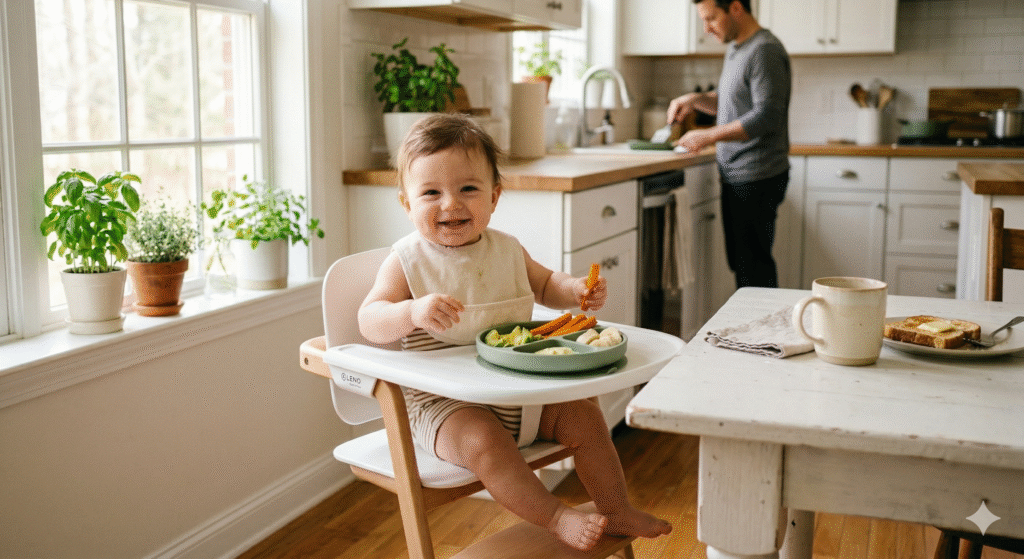
For baby-led weaning, look beyond the high chair photo: consider whether the seat fits your child, whether the tray is within comfortable reach, and how you will clean the straps after meals.
I have not personally used the high chairs in this guide. The comparison below discusses their published features and tradeoffs; it should not be read as a hands-on test or a report of use by my children.
What Makes a High Chair Safe for Baby-Led Weaning?
Before we get into specific chairs, here’s what feeding therapists and pediatric dietitians actually care about. (Hint: it’s not the color options.)
Upright, supported positioning. Choose a seat your child can use according to its sitting-readiness and fit instructions. Hip, knee and foot support can help with a comfortable setup, but a particular angle is not a guarantee against choking. Food texture, preparation and close supervision still matter.
A footrest that actually reaches their feet. This is the single most overlooked feature in high chairs. When a baby’s feet dangle with nothing to push against, they tend to squirm, slouch, and lose interest in eating. Think about it — have you ever tried to eat comfortably on a barstool with no footrest? An adjustable footrest lets you keep that 90-degree angle at the knees as your baby grows.
The supplied restraint, fitted correctly. Use the restraint system required by the exact chair, including the crotch strap, every time. A tray is not a substitute. Do not replace a three-point restraint with an unverified five-point harness or assume either design removes the need for supervision.
An upright position for eating solids. Seat your child upright and follow the chair’s readiness requirements. A recline function does not make a chair suitable for feeding a child who cannot maintain the required position. This guide does not recommend reclined high-chair bottle feeding.
If you’re just getting started with baby’s first foods, the seating is step one.
How We Picked These High Chairs
This is a research-based comparison, not a hands-on test. The criteria below explain the buying questions considered in the guide.
Safety checks. Match the exact chair, restraint and accessories to the current instructions and recall information. A feature list or the absence of a known recall is not proof that a chair fits every child. The Bugaboo Giraffe recall is discussed below with the official stop-use and repair instructions.
Ease of cleaning. Look at the tray, restraint, seat seams and removable parts separately. A washable tray does not establish that the whole chair can be cleaned the same way.
Fit and positioning. Check sitting readiness, seat fit and the available foot support. Follow each chair’s instructions for tray use and placement: removing the tray and pulling every high chair up to a table is not a universal option. The Munchkin Float, for example, must be kept away from tables and counters a child could push against.
Growth potential. Some chairs last six months. Others last until your child is in elementary school — or longer. I considered how much use you’ll actually get out of each chair before it ends up in the garage.
Real-world value. A $20 chair and a $250 chair can both be excellent depending on your situation. I included options at every budget because the best high chair is the one that works for your family, not the one with the best marketing.
I also cut several popular chairs from this list — one for a safety recall, two for impossible-to-clean designs with fabric everywhere, and one that looked gorgeous but had zero foot support. Pretty only gets you so far when there’s oatmeal involved.
6 Best High Chairs for Baby-Led Weaning in 2026
1. Best Overall — Mockingbird High Chair
The Mockingbird has silicone-coated harness straps with a magnetic buckle. That design is relevant to cleaning, but I have not tested how quickly food wipes off or how the straps hold up in daily use.
Mockingbird lists a removable dishwasher-safe tray liner and a four-position footrest. Finish adjustments and check that parts are secure before seating your child. Tool-free controls are a convenience, not a reason to adjust the chair while holding a squirming child or to leave a seated child unattended.
Mockingbird sets different limits for the two modes: the high-chair baby seat is for children who can sit upright without help, up to 35 lbs. Child-chair mode supports up to 150 lbs and is for children who can confidently climb in and out on their own; reaching a birthday alone does not establish readiness. To convert it, follow the manufacturer’s instructions: remove the baby seat using its two-button release, then move the footrest to the top position so it becomes the child-chair seat. The conversion requires no tools. The Y-shaped beechwood frame tucks neatly under the table when the tray is removed, and the overall footprint is smaller than most — about 16.5 inches wide by 24 inches deep.
The main downside? It doesn’t fold. If you live in a very small space where you need to store the high chair between meals, consider the Munchkin Float instead.
Best for: Families who are done scrubbing straps and want a chair that’s actually designed for how babies eat.
2. Best Classic — Stokke Tripp Trapp
The Tripp Trapp has been around since 1972, and there’s a reason it’s still the most recommended high chair in baby-led weaning communities. Designed by Peter Opsvik — and reportedly part of MoMA’s design collection — this chair was built around one simple idea: a child should sit at the family table, at the right height, with proper foot support.
Both the seat plate and footplate adjust to multiple positions, which means you can dial in the perfect ergonomic setup as your child grows from a six-month-old just starting solids to an elementary schooler doing homework. Adult-chair use is a separate configuration; its load rating is not permission to keep using the Baby Set beyond the limits in its instructions.
Before using it as a high chair: fit the matching Baby Set, its restraint system and the rear-leg Extended Gliders. Keep the seat plate in the top slot and follow the adjustment diagrams. The U.S. Baby Set² instructions specify independent upright sitting (approximately six months), with high-chair use ending at 36 months or when the child can safely get in and out independently. Check the manual for your exact version; a birthday alone does not establish readiness to start.
The honest downsides: you’ll spend a lot more than $249 once you add the Baby Set with harness (required for babies), the tray, and a cushion. The total bundle runs $350–400+. The wood grooves collect food. And the fabric straps are notoriously difficult to keep clean — a stark contrast to the Mockingbird’s silicone approach. Footrest adjustment requires a tool (an Allen key), which makes it less convenient than chairs with tool-free systems.
Despite these quirks, the Tripp Trapp earns its spot because nothing else lasts this long.
Best for: Families who want a single chair that lasts from first solids through childhood (and don’t mind paying for accessories).
3. Best Budget — IKEA Antilop
ANTILOP has a simple plastic seat and removable legs. For the current U.S. chair, IKEA specifies wiping the seat, tray and legs with mild soapy water and drying them with a clean cloth. This guide does not treat the tray as dishwasher-safe.
The Antilop does not include a footrest and comes with its own safety belt. Use the supplied restraint according to the instructions. Compatibility of aftermarket footrests and replacement five-point harnesses has not been verified for this guide; do not assume they make the chair safer. Check with IKEA before changing the restraint or adding an accessory to your exact chair.
Antilop fit and accessories: This guide does not recommend a pool noodle or tissue box attached with Velcro or duct tape as a footrest. That improvised setup has not been verified for this chair. Follow the manufacturer’s assembly and accessory instructions; ask IKEA about compatibility before modifying the chair.
The Antilop won’t grow with your child past toddlerhood, and it won’t win any design awards. IKEA specifies independent sitting and use up to age 3 or 33 lb. Check those limits and your child’s fit in the original setup before choosing it; the low price does not establish the safety of an added footrest or replacement restraint.
Checking a secondhand ANTILOP? The 2012 CPSC recall covers specified red, blue and white chairs from supplier 17389 with manufacture codes 0607–0911 (YYMM), marked under the seat. Their restraint buckle can open unexpectedly. If a chair matches and the recall remedy has not been completed, stop using it and contact IKEA about the replacement restraint. This historical recall does not identify today’s ANTILOP by name alone.
Best for: Budget-conscious families, second chairs for grandparents’ houses, or anyone who values the easiest possible cleanup.
4. Best Wooden Chair — Abiie Beyond Junior Y
Abiie’s original Beyond Junior was BabyGearLab’s top-rated high chair, and the new Y model builds on that foundation with a redesigned frame. It offers the same grow-with-your-child promise as the Stokke Tripp Trapp — from first solids all the way to a 250 lb adult chair — at a lower price point and with several practical improvements.
Abiie’s EZ-Seat system allows adjustment of the seat and footrest without tools. Make adjustments with the child out of the chair, follow the manual’s permitted positions, and confirm the parts are locked before use. Check the instructions for cleaning the cushion and tray rather than assuming every part can be washed the same way.
Abiie describes heat treatment during manufacturing. That process does not replace cleaning after meals or establish continuing protection from germs. Follow the current manual for care, assembly and restraint use.
The one catch: BabyGearLab flagged that the new Y-model tray requires two hands to operate and has a slightly stiff tray cover mechanism with potential for pinching. Worth being aware of, though not a dealbreaker.
Best for: Families who love the Tripp Trapp concept but want tool-free adjustments, a waterproof cushion, and a lower price.
5. Best Portable — Inglesina Fast Table Chair
The Inglesina Fast isn’t a replacement for a full-sized high chair — it’s the one you toss in the trunk. At just 4.2 lbs with an integrated carry bag hidden under the seat, it goes everywhere: restaurants, grandparents’ houses, vacations, picnics.
When to stop: the current U.S. Fast manual says to stop using the chair once a child can stand on their own, or if the seated child can shift the chair’s support arms on the tabletop. Do not treat the age range or 37 lb limit as permission to ignore these earlier limits.
The Fast must be used only on a compatible table. Inglesina specifies a tabletop 0.8–3.5 inches thick, with any apron at least 3.25 inches back from the edge and full contact for the upper arms and lower clamps. Do not use it on glass, a loose tabletop, a table leaf, a card table, or a single-pedestal table, or with a tablecloth or placemat. Read the manufacturer’s table-compatibility instructions before each setup. Never put an ordinary chair underneath or position the seat where the child can reach table legs or an island beneath the counter to push off. Check table stability before and after seating the child, secure every clamp, and zip the lower arm covers as the manual shows. The padded seat with high backrest keeps babies surprisingly comfortable. Inglesina is an Italian brand that’s been designing baby gear since 1963, and the Fast is one of their most refined products — there’s very little left to improve for what it does.
The limitations are inherent to the hook-on format: no footrest (your baby’s feet will dangle), only a three-point harness, and the fabric seat needs machine washing on a delicate cycle — you can’t just wipe it down after a BLW session with spaghetti. The optional dining tray (about $30 extra) is worth getting if you’ll use this as a primary feeding seat while traveling.
Inglesina’s FAQ describes compliance with restrictions on specified regulated substances. That statement is not a guarantee of zero exposure or a substitute for correct installation and restraint use.
Best for: Families who eat out frequently, travel, or need a compact chair for grandparents’ houses.
6. Best for Small Spaces — Munchkin Float
Placement matters: the Float owner’s guide says to keep it away from counters and tables a child could push against and tip the chair. Use the five-point harness every time, keep the crotch post fitted, and place the chair on a level floor. Never lift or move it with a child seated.
The Float folds for storage after the child is removed. Keep children clear of the folding mechanism, and check that the chair is fully open and locked before the next use. Store it where children cannot pull it over; a narrow folded profile is not a reason to leave it leaning within their reach.
The Float has wooden legs and a plastic seat. BabyGearLab praised its build quality, noting that the materials felt more expensive than the price suggests; that is an external assessment, not my own hands-on observation.
The footrest flips between two height positions — about 6 inches and 9 inches from the seat — which isn’t as adjustable as the Mockingbird’s four positions but still provides real foot support. The five-point harness keeps babies secure, and the smooth surfaces are easy to wipe clean. One caveat: the tray is not dishwasher safe and requires hand washing.
The chair doesn’t convert to a toddler or child chair, so its useful life ends around age 3. But if folding capability is high on your priority list, nothing else on this list competes.
Best for: Small kitchens, apartments, or any family that needs to store the high chair between meals.
Quick Comparison Table
| Chair | Price | Footrest | Harness | Folds | Use Limits / Later Modes | Clean |
|---|---|---|---|---|---|---|
| Mockingbird | $249 | 4-pos | 5-pt silicone | No | 35 lbs high chair 150 lbs child chair |
⭐⭐⭐⭐⭐ |
| Stokke Tripp Trapp | $249+ | Multi (tool) | 5-pt fabric | No | Separate adult-chair mode; Baby Set limits apply |
⭐⭐⭐ |
| IKEA Antilop | ~$20 | Not included | Supplied restraint; follow exact manual |
Legs detach | 33 lbs | ⭐⭐⭐⭐⭐ |
| Abiie Beyond | ~$200 | EZ-Seat | 5-point for babies; later conversion per manual |
No | 250 lbs in adult-chair mode; not a baby-use limit |
⭐⭐⭐⭐ |
| Inglesina Fast | ~$70 | None | 3-pt | Yes + bag | 37 lbs maximum; stop earlier when able to stand independently |
⭐⭐⭐ |
| Munchkin Float | ~$180 | 2-pos flip | 5-pt | Yes (8″ flat) | Under 33 lbs; 6–36 months and sitting unaided |
⭐⭐⭐⭐ |
How to Set Up Your High Chair for Safe BLW
Even the best high chair needs proper setup. Here’s how to get it right from day one.
Check the chair’s fit and instructions first. If the chair has an adjustable footrest, set it as the manufacturer directs. A missing footrest is not a reason to improvise one from a pool noodle, box, Velcro, or tape. Ask the manufacturer about any accessory for your exact model; do not treat an unverified modification as a safety fix.
Check the tray height. The tray or table surface should be at your baby’s chest level or slightly below. If their arms can’t comfortably reach the food, they’ll struggle with self-feeding and get frustrated. Some chairs (like the Mockingbird and Abiie) offer adjustable tray depth to accommodate this as your baby grows.
Check readiness and seat fit. Follow your chair’s sitting-readiness and restraint requirements. If the seat does not fit your child, ask the manufacturer about a compatible support instead of assuming a rolled towel makes the setup suitable. IKEA specifies that ANTILOP users must be able to sit unaided and offers a supporting cushion; any cushion is not a substitute for that requirement or the safety belt.
Get the harness right. Follow the exact chair’s instructions for strap routing, adjustment and buckle checks. Keep the required straps properly fitted, including the crotch strap; do not deliberately loosen them using a comparison with a car-seat harness. Stay beside your child and never allow standing or climbing in the chair.
A comfortable, well-positioned baby is a baby who’s willing to explore food. And honestly? That willingness is one of the best things you can build early — it’s a big part of why some toddlers try everything and others turn into picky eaters. The chair setup is doing more work than you think.
Frequently Asked Questions
When is my baby ready for a high chair?
Use the exact chair’s age, weight and sitting-readiness requirements, and make sure your child can maintain the required upright position. A quick floor-sitting test is not a substitute for those instructions. Ask your child’s clinician if feeding readiness or posture is uncertain.
Do I need a high chair with a recline feature?
For solids, choose a setup that keeps your child upright and follows the chair’s instructions. Do not treat a recline feature as permission to feed a child who is not ready for that seat, and do not use a high chair as a sleep space.
Is the IKEA Antilop safe for baby-led weaning?
Use the Antilop within IKEA’s stated limits and instructions: the child must sit unaided, and the listed limit is age 3 or 33 lb. Use its supplied safety belt correctly. This guide has not verified an aftermarket footrest or replacement harness for compatibility, so adding one is not a basis for calling the setup safer or suitable for your baby.
How long will my baby use a high chair?
Most children transition out of a traditional high chair between 18 months and 3 years. If you’re still in the newborn stage and building your gear list, check out our newborn must-haves checklist — but know that a high chair will be one of your most-used items once solids start. Many kids need a booster seat for dining at the family table well into elementary school, since their feet may not reach the floor from an adult chair until age 8 or 9. Convertible chairs like the Stokke Tripp Trapp, Abiie Beyond, and Mockingbird address this by transforming into child or youth chairs.
What about the Bugaboo Giraffe? I’ve seen it recommended elsewhere.
The CPSC recalled specified Bugaboo Giraffe highchairs on June 12, 2025 because the legs could detach. The notice records 22 detachment reports, including 13 reports of minor injuries. Owners of affected chairs should stop using them and obtain the free repair kit. Check the item code and recall checker; purchase date alone does not establish that a particular chair is unaffected or repaired.
Can I check if any high chair has been recalled?
Yes. Visit cpsc.gov/Recalls and search by product name or brand. I also recommend registering your high chair with the manufacturer so you receive direct recall notifications. It takes two minutes and could prevent a serious injury.
The Bottom Line
There’s no single perfect high chair for every family. But there is a perfect high chair for your family — and it comes down to what you prioritize most.
If easy cleaning is everything, go with the Mockingbird. If you want a chair that lasts until college, choose the Stokke Tripp Trapp. If you’re on a tight budget, check whether the IKEA Antilop fits your child within its original instructions and limits. If you want the best wooden chair with modern conveniences, the Abiie Beyond delivers. If you need something for travel, consider the Inglesina Fast only for a table that meets its compatibility instructions. And if your kitchen is small, the Munchkin Float folds down to nothing.
Whatever you choose, the setup matters more than which chair you pick. Seriously. Use the chair’s permitted seat and footrest positions. Keep baby upright and follow the model’s table-clearance instructions. And let the mess happen — that’s where the learning is.
And when your toddler outgrows the high chair tray and is ready to join the family at the dining table, check out our Best Booster Seats for Dining Tables — the natural next step after high chair graduation.
Once the seating is sorted, you’ll want the right dinnerware too. Check out our Best Toddler Plates, Bowls & Utensils for suction plates and BLW-friendly utensils that pair perfectly with any high chair.
Safety notes updated: October 20, 2026. Always follow the instructions supplied with your exact chair and check the manufacturer’s recall information.