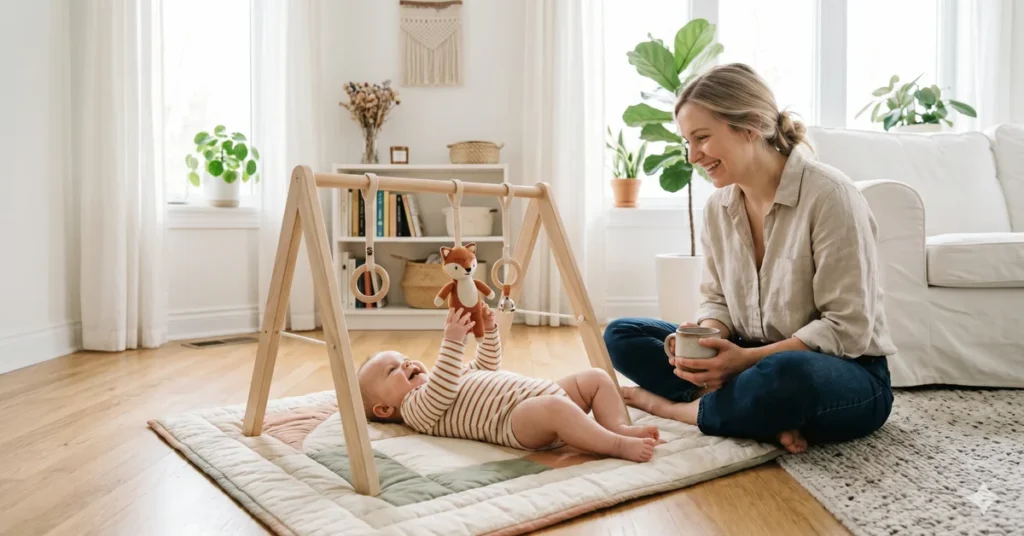
My daughter hated tummy time. I mean full-on, red-faced, screaming-into-the-carpet hated it. For the first two weeks, I dreaded every session — I’d set her on a blanket, she’d cry, I’d pick her up, and we’d both feel defeated.
Then we got a proper play gym, and everything shifted. She still fussed sometimes, but those dangling toys and that crinkly mirror gave her something to focus on. Three minutes became five, then ten. By three months, she was batting at toys on her back like a tiny boxer and actually lifting her head during tummy time to peek at herself in the mirror.
Since then — three kids and a decade of baby-gear obsession later — I’ve spent weeks deep-researching the current play gym market: cross-referencing independent reviews from Babylist, Wirecutter, and BabyGearLab, verified Amazon owner feedback, brand spec sheets, and CPSC recall databases. Here are the five I’d actually recommend, plus everything you need to know about choosing the right one.
Play Mat vs. Play Gym — What’s the Difference?
Before we dive in, a quick clarification because these terms get used interchangeably everywhere:
A play mat is simply a padded surface — it protects your baby from the hard floor and gives them a comfortable spot for tummy time, rolling, and eventually crawling. Think of it as a really nice blanket with cushioning.
A play gym (or activity gym) is a play mat plus overhead arches with dangling toys. The arches give your baby something to look at, bat at, and eventually grab while lying on their back. Most of the products in this guide are play gyms, though a couple work beautifully as standalone mats too.
If your baby is a newborn, I’d go with a gym — those overhead toys are incredibly engaging for the back-lying stage. If your baby is already rolling and crawling, a thick play mat might be all you need.
Why Your Baby Actually Needs One
Play gyms aren’t just convenient places to park your baby while you finish your coffee (though let’s be honest, that matters too). The American Academy of Pediatrics recommends supervised tummy time from the first day home from the hospital, using the phrase “back to sleep, tummy to play.” A play gym makes that daily practice significantly easier.
Here’s what’s actually happening developmentally when your baby plays on a gym:
- Muscle building. Tummy time strengthens neck, back, shoulder, and arm muscles — the same muscles needed for rolling, sitting, and eventually crawling.
- Flat head prevention. Since babies sleep on their backs (as they should), tummy time on a play mat counteracts the pressure that can lead to plagiocephaly.
- Visual tracking. Dangling toys teach babies to follow objects with their eyes, a foundational skill for reading later on.
- Cause and effect. When your baby kicks a piano key or bats a rattle and it makes a sound, they’re learning that their actions produce results. This is huge for cognitive development.
- Reaching and grasping. Those overhead toys aren’t just decoration — they’re target practice for developing hand-eye coordination.
How I Picked These 5
After cross-referencing more than 20 play mats and gyms across independent reviewers (Babylist, Wirecutter, BabyGearLab, Mother&Baby), Consumer Reports guidance, AAP infant play recommendations, and thousands of verified Amazon owner reviews, I narrowed it down based on what actually matters day-to-day:
- Washability. Babies spit up. A lot. If the mat isn’t machine washable, it needs to be really easy to wipe clean.
- Cushioning. A thin mat on a hardwood floor defeats the purpose. Thickness and padding quality varied wildly.
- Toy quality. Are the toys actually engaging? Can they be repositioned as baby grows? Are they safe to mouth?
- Materials safety. BPA-free, no flame retardants, and ideally third-party certified (OEKO-TEX, ASTM, etc.).
- Longevity. Some gyms are outgrown by 4 months. The best ones adapt as baby develops.
- Real-world practicality. How fast is setup? Can you fold it? Does it take over your entire living room?
- Verified ratings. Every gym I included has consistently strong Amazon reviews with substantial review counts. Several popular picks didn’t clear my bar.
The 5 Best Baby Play Gyms (2026)
Top Pick Lovevery The Play Gym
Around $150 · Ages 0-12 months+ · No batteries · Machine washable · OEKO-TEX 100 certified
If you can swing the price, this is the one that consistently rises to the top of every serious independent roundup — and the design philosophy explains why. It was created by child development experts, and five developmental zones unfold to reveal different activities as your baby grows, so a two-week-old isn’t bombarded with the same stimulation meant for a six-month-old.
It comes with five detachable toys (a Montessori-style high-contrast ball, a wooden batting ring with bell and castanet sounds, an organic cotton teether, silicone teething rings, and crinkly sound squares) plus three sets of interchangeable cards for visual development. The black-and-white cards target exactly the visual range newborns can actually see (more on that science below), and parent reviews consistently mention babies returning to this gym for far longer than to flashier, battery-powered alternatives.
The included Play Space Cover transforms the whole thing into a fort for toddlers, so you actually get a year of use out of it. Setup takes about two minutes with no tools, and the mat is machine washable.
Why it stands out
- Five developmental zones prevent overstimulation
- Grows with baby from newborn through toddlerhood
- Beautiful design that doesn’t clash with your living room
- Sustainable materials: FSC-certified wood, organic cotton, OEKO-TEX certified
- No batteries — blissfully quiet
Worth knowing
- Most expensive gym on this list at $150
- Doesn’t fold flat — you have to disassemble the legs to store it
- Takes up significant floor space (~50 inches wide when zones are open)
- Mat must be air-dried, not tumble dried
Best Budget Fisher-Price Deluxe Kick & Play Piano Gym
Around $30–40 · Ages 0 months+ · 3 AA batteries required · Machine washable mat
There’s a reason this is Amazon’s best-selling play gym with thousands upon thousands of reviews — the kick piano nails one of the earliest cause-and-effect lessons a baby can grasp. Independent reviewers from Babylist to BabyGearLab consistently flag the moment babies discover they can make the piano light up by kicking as a developmental “aha” worth the price alone.
The gym grows through four modes: lay and play (newborn kicks the piano on their back), tummy time (reposition toys to encourage pushing up), sit and play (flip the piano upright for seated play), and take-along (detach the keyboard for the car). Smart Stages technology adjusts the learning content across three levels, introducing animals, colors, shapes, and numbers with dozens of songs and sounds.
Five linkable toys dangle from the repositionable arch: a mirror, a BPA-free elephant teether, a crinkly panda, a rattle lion, and monkey cymbal clackers. The bundle version also includes two soft rattle maracas.
Why it stands out
- The kick piano — the most-praised feature on any budget gym
- Incredible value for the price
- Detachable piano becomes a standalone toy for toddlers
- Machine washable, thick playmat
- Smart Stages grows with baby
Worth knowing
- Actual play area feels small once the piano and arches are set up
- Bright, colorful design isn’t the most living-room-friendly aesthetic
- Requires batteries (3 AA, not included)
- The mat could use more padding on hard floors
Best for Small Spaces — Skip Hop Farmstand Grow & Play Activity Gym
Around $65–90 · Ages 0–2 years · Battery included (non-replaceable in bunny) · Spot clean only
If your apartment is already drowning in baby gear, the Farmstand’s fold-up sides are a game-changer — reviewers consistently call them out as the feature that finally made the play space feel contained. They snap into place to create a little enclosed play area that keeps toys from rolling under the couch and gives your baby a cozy boundary. When playtime is over, you can roll the whole mat up with the built-in carry handle.
The farm theme is adorable without being obnoxious — cheerful avocados, beets, and carrots hang from the arches alongside a musical bunny. A watermelon-shaped wedge pillow makes tummy time more comfortable. The detail that earns the most praise in parent reviews: the arches detach and convert into a growth chart you can hang on the wall. It’s the kind of thoughtful touch that makes Skip Hop products feel like they were designed by parents.
Five hanging toys include an avocado rattle, a beet squeaker, and a musical bunny with a carrot teether, plus additional sensory plush characters. The mat features a crinkle peek-a-boo leaf, a pocket where your baby can “pick” a carrot, and various textures for tactile exploration.
Why it stands out
- Fold-up sides create a contained play space
- Beautiful, non-overstimulating design
- Growth chart arch is brilliant
- Thick, spacious mat with good padding
- Carter’s/Skip Hop brand reliability
Worth knowing
- Spot clean only — no machine washing
- Musical bunny’s battery is not replaceable
- Arches bend but don’t fold, so storage isn’t completely flat
- Price is mid-to-high but feature set doesn’t match Lovevery
Best Musical — Baby Einstein 4-in-1 Kickin’ Tunes Music & Language Discovery Gym
Around $30–50 · Ages 0–36 months · 3 AA batteries required · Machine washable mat
If you want your baby bilingual by college, might as well start now, right? Kidding (sort of), but the Baby Einstein’s multi-language feature is legitimately useful — the kick piano teaches colors, shapes, and numbers in English, Spanish, French, and German. With dozens of melodies, sounds, and phrases, plus an extended continuous-play melody mode, owner reviews consistently note this gym holds attention longer than most competitors in its price range.
The Magic Touch piano surface responds to even gentle kicks and taps, so even very young babies can trigger the sounds. It transitions through four modes just like the Fisher-Price, but the addition of flash cards and a tummy time prop pillow gives it a slight edge in the learning department. Seven detachable sensory toys — a crinkle medallion, triangle rattle, BPA-free textured music note, flash cards, self-discovery mirror, plus the piano and pillow — keep curious hands busy.
It’s one of the most widely-owned play gyms in the category, with parent reviews running into the thousands across Amazon and major retailers.
Why it stands out
- Multi-language piano is a unique and actually useful feature
- Extended continuous music mode for when you need a break
- Most toys of any gym on this list (7 detachable)
- Machine washable mat
- Good price-to-feature ratio
Worth knowing
- Mat surface can be slippery during tummy time
- Only the bottom half of piano keys is fully responsive in many reports
- Design is functional but not particularly stylish
- Requires batteries
Best Design-Forward Newborn Pick — Tiny Love Luxe Developmental Gymini (Black & White Décor)
Around $130 · Ages 0 months+ · Stand-alone wooden arch · Machine washable mat · 12 milestone cards included
Here’s something most new parents don’t realize: newborns can only see about 8–12 inches in front of them, and they see high-contrast black-and-white patterns best. Colorful toys? Basically invisible to a two-week-old. The Tiny Love Luxe Developmental Gymini leans hard into this science — paired with a stand-alone wooden arch and timeless black-and-white décor that holds up beautifully in a styled living room.
It packs 20 engaging activities into a compact footprint. A responsive musical lion plays gentle melodies and reinforces cause-and-effect when tapped. The high-contrast cloth book targets exactly the visual range newborns can resolve, and reviewers note that babies who reject other gyms often stay engaged with these bold patterns. A self-discovery mirror, a crinkly geometric mobile, and a giant rainbow kicker round out the play. The adjustable arches can be configured multiple ways or removed entirely for open floor play.
Tiny Love includes 12 development milestone cards plus a guide based on their “6 Development Wonders” system — it’s legitimately helpful for first-time parents who want to understand what’s happening at each stage and how to make the most of gym time.
Why it stands out
- High-contrast design is scientifically optimized for newborn vision
- Stand-alone wooden arch — sturdier and more aesthetic than plastic alternatives
- 20 engaging activities plus 12 milestone cards make it a strong developmental tool
- Adjustable arches adapt to different developmental stages
- Mat is foldable and machine washable
Worth knowing
- Priced just below the Lovevery tier — premium pick, not budget newborn option
- Black-and-white theme may feel limiting as baby gets older and sees more color
- Doesn’t include Lovevery’s developmental-zone unfolding system
- Compact footprint means less crawling room than the Skip Hop Farmstand
When to Start Using a Play Gym (and When to Stop)
You can put your baby on a play gym from day one — the AAP recommends tummy time for healthy, full-term babies starting as soon as the first day home from the hospital. In the early days, many newborns prefer tummy time on a parent’s chest before transitioning to the floor mat. Here’s roughly what to expect at each stage:
0–2 months: Your baby will mostly lie on their back and gaze at high-contrast patterns or overhead toys. Tummy time sessions will be short — start with 2–3 minutes a few times a day. Don’t be discouraged if they cry. Many newborns prefer tummy time on your chest before transitioning to the floor mat.
2–4 months: This is the golden era of play gyms. Your baby starts batting at dangling toys intentionally, tracking objects with their eyes, and pushing up during tummy time. Those overhead toys suddenly make sense to them — you’ll see genuine excitement and focus.
4–6 months: Reaching and grasping become more precise. Your baby might start rolling from tummy to back (or vice versa) on the mat. They’ll grab toys and bring them to their mouth. This is when toys with different textures really shine.
6+ months: Most babies outgrow the overhead arches as they become mobile. Remove the arches and use the mat for seated play, or transition to a larger foam play mat for crawling. Gyms with conversion features — like Lovevery’s fort cover or Skip Hop’s growth-chart arches — extend the useful life significantly.
5 Ways to Make Tummy Time Easier
If your baby screams during tummy time, you’re not alone — and you’re not doing anything wrong. Here are the strategies that actually helped us:
Start on your chest. Especially for newborns. Lie back on the couch or bed and place your baby belly-down on your chest. They get the benefits of tummy time plus the comfort of hearing your heartbeat.
Use a mirror or high-contrast cards. Place them directly in front of your baby’s face during tummy time. My daughter would tolerate an extra three minutes just staring at herself. Babies are vain — use it.
Try the football hold. Carry your baby belly-down along your forearm throughout the day. It’s technically tummy time, it soothes fussy babies, and it counts toward their daily total. My husband figured this one out first, and it became our go-to move for fussy evenings.
Keep sessions short and frequent. Three minutes five times a day beats one miserable fifteen-minute session. Your baby needs a cumulative 30 minutes of tummy time per day — but nobody said it has to happen all at once.
Time it right. After a diaper change or nap when your baby is alert and content — never right after a feeding. A full belly on the floor is a recipe for spit-up and tears.
Quick-Pick Guide
Best overall and worth the investment: Lovevery The Play Gym — unmatched developmental design, a full year of use, beautiful and battery-free.
Best if you’re on a budget: Fisher-Price Kick & Play Piano Gym — the kick piano alone is worth the $30. The best value in baby gear.
Best for tiny apartments: Skip Hop Farmstand — fold-up sides, roll-up portability, and that genius growth chart arch.
Best for music-loving families: Baby Einstein Kickin’ Tunes — songs in four languages and the most toys of any gym here.
Best design-forward newborn pick: Tiny Love Luxe Developmental Gymini (Black & White Décor) — wooden arch, 20 developmental activities, designed for how newborns actually see.
FAQ
Do I need both a play mat and a play gym?
Not at first. A play gym includes a mat, so it covers both bases. As your baby becomes mobile (around 6 months), you might want a separate large foam play mat for crawling and cruising — but that’s a different product entirely. For the newborn-to-six-month stage, a single play gym is all you need.
Are expensive play gyms worth it?
It depends on what you value. The Lovevery at $150 gives you a year of developmentally staged activities, sustainable materials, and a fort conversion — amortized over daily use, that’s under 50 cents a day. The Fisher-Price at $30 gives you the single most engaging feature (the kick piano) at a fraction of the price. Both are “worth it” — just for different reasons.
How long will my baby use a play gym?
Most babies actively use the overhead arch setup from about 1 to 6 months. After that, they’re too mobile to stay put under the arches. However, gyms with conversion features — forts, ball pits, growth charts — can extend well into the toddler years. The mat itself remains useful for floor play long after the arches come off.
Can I use a play gym on carpet?
Absolutely, and you won’t need as much padding underneath. On hardwood or tile, you might want to put a yoga mat or folded blanket under thinner play mats (the Fisher-Price especially benefits from this). The Lovevery and Skip Hop have enough built-in padding for most hard surfaces.
Looking for the full rundown on what newborns need to play with? Check out our Best Toys for 0–3 Month Old Babies — a play gym is just one piece of the puzzle.
This article is for informational purposes only and is not a substitute for personalized medical advice from your pediatrician. Product prices and availability are accurate as of May 2026 and may change.
