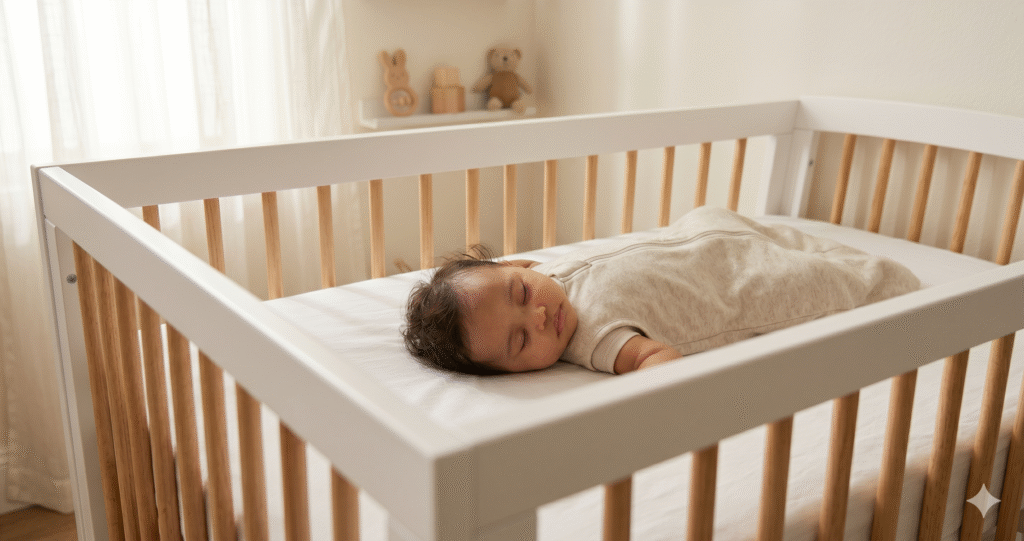
A sleep sack can replace a loose blanket, but the products sold under that name do not all work the same way. Fit, warmth, arm position, and whether the garment adds weight or compression all matter.
This guide focuses on unweighted wearable blankets and checks current manufacturer instructions, fit ranges, care requirements, and safe-sleep guidance. Start with your baby’s current weight, height, and developmental stage rather than buying a larger size for growth or choosing by fabric marketing alone.
What “sleep sack” means in this guide: an unweighted wearable blanket made for sleep, with no weighted pad, beads, pellets, insert, or added pressure on the chest, back, or body. It should meet the current manufacturer’s size limits, stay below the chin without covering the head, and leave the hips and legs free to bend and move. The AAP lists a properly sized wearable blanket as an alternative to loose blankets; it does not endorse a particular brand.
Quick Picks: Best Sleep Sacks at a Glance
Short on time? Start with these three unweighted options, then choose the linked size only if your baby meets its current fit limits:
| Category | Pick | Price | Why |
|---|---|---|---|
| Best Simple Cotton Pick | HALO SleepSack | $30–$40 | 100% cotton and a bottom-opening zipper |
| Best for Soft Fabric | Kyte Baby Sleep Bag | $50–$60 | Rayon-from-bamboo shell and J-shaped double zipper; air-dry care |
| Best Budget 2-Pack | KeaBabies Soothe Sleep Sacks | $20–$30 for two | Unweighted 0.5 TOG organic cotton with adjustable shoulder snaps |
Coverage note: The linked versions begin at 14–16 lb. They do not cover newborn sizing, a warmer 1.5 TOG option, or a footed toddler walker. Do not stretch these size ranges or use an arms-in swaddle to fill that gap; use only an unweighted, arms-free garment with a current fit guide that matches your child.
What Is a TOG Rating? (And Why It Actually Matters)
TOG, or Thermal Overall Grade, compares how much insulation a garment provides. A higher TOG generally means a warmer sleep sack, but TOG does not tell you that a complete outfit is safe at one particular room temperature. Pajamas, the sleep sack, its material and fit, and your baby all affect how much heat is retained.
The AAP does not prescribe a universal room-temperature-to-TOG schedule, and dressing charts from different brands are not interchangeable. Use the current guide for the product you buy as a starting point, and count the pajamas and sleep sack together. In general, dress your baby in no more than one layer more than an adult would wear comfortably in the same room.
The 3 Best Baby Sleep Sacks in 2026
1. HALO SleepSack Wearable Blanket — Best Simple Cotton Pick
The linked HALO SleepSack is a straightforward cotton wearable blanket with a bottom-opening inverted zipper. HALO markets the wider brand as widely used by hospitals, but that claim is brand context rather than independent proof that this version is right for every baby.
This Sage Woodland version is 100% cotton at 0.5 TOG. The zipper opens from the bottom for diaper changes, and the sack leaves room for the hips and knees to bend and the legs to move apart. HALO currently places its 0.5 TOG cotton model around 75–77°F; treat that product-specific guide as a starting point, count every clothing layer, and check your baby for signs of overheating.
HALO sells other materials, warmth levels, and sizes, but those are separate products or versions. Do not transfer their TOG, fit range, or care instructions to this linked cotton Medium.
Best for: families who want a simple cotton sack with a bottom-opening zipper and routine machine care.
Skip it if: your baby does not meet this version’s current size guidance, the neck or arm openings are not secure, or you specifically want a two-way zipper. Wash it before first use as directed; return it rather than using it if an odor persists, and stop using it if the zipper or seams become damaged.
Choose from HALO’s current size guidance and confirm the neck, armhole, and overall fit; do not buy a larger size for growth.
2. Kyte Baby Sleep Bag — Best for Soft Fabric
Kyte Baby’s sleep-bag line uses a soft 97% rayon-from-bamboo shell with 3% spandex. The fabric feel is the main reason families compare it with lower-cost cotton options, but softness alone does not determine fit, warmth, or skin tolerance.
The linked 1.0 TOG model has a J-shaped double zipper that runs along the side and bottom, plus a fabric zipper garage at the top. The shell is 97% rayon made from bamboo and 3% spandex, with polyester fill. Kyte currently places this warmth level around 69–73°F; use that model-specific range as a starting point rather than a universal rule.
Current Kyte sleep bags are sold in multiple sizes and TOG levels, but each version has its own fit and dressing guidance. No fiber is universally hypoallergenic or an eczema treatment. Choose a fabric your baby tolerates and follow the care instructions for the model you buy.
Best for: families who prioritize a soft fabric and a J-shaped double zipper and are comfortable following more delicate wash care.
Skip it if: you want a lower-cost cotton option or need something that can routinely go through a heated dryer. Kyte’s current care guidance calls for a cold gentle wash and hang or flat drying rather than machine drying.
Use the current dressing guide for the TOG and size you buy, count every clothing layer, and check your baby for signs of overheating.
3. KeaBabies Soothe Sleep Sacks — Best Budget 2-Pack
This Soothe set is an unweighted, sleeveless, arms-free wearable blanket rather than an arms-in swaddle. The two-pack is the lowest per-sack cost among the current picks, but price does not replace the need to confirm the fit.
The Soothe design uses adjustable shoulder snaps and one all-around single zipper. It is not the two-way-zipper KeaBabies Snooze model. The wider lower section leaves room for the hips and knees to bend, while the linked Medium still requires both the current weight and height range—not the age label alone—to fit.
Best for: families who want two lightweight organic-cotton sacks with routine machine wash and dryer-friendly care.
Skip it if: you prefer a two-way zipper, the shoulder snaps or zipper show damage, or the neck and arm openings are not secure on your baby.
Use this Medium only when your baby meets both 15–26 lb and 26–30 in. Inspect the shoulder snaps and zipper before each use, and stop using the sack if any fastener becomes loose or damaged.
Compare the Three Picks
The linked versions differ in fit range, fabric, warmth, closure, price, and care. Compare their listed specifications rather than assuming the whole brand uses the same ones:
| Feature | HALO SleepSack | Kyte Baby Sleep Bag | KeaBabies Soothe |
|---|---|---|---|
| Linked fit | 16–24 lb and 26–30 in | 14–20 lb and 22–27 in | 15–26 lb and 26–30 in |
| Linked warmth | 0.5 TOG | 1.0 TOG | 0.5 TOG |
| Linked fabric | 100% cotton | 97% rayon from bamboo + 3% spandex shell | 100% organic cotton |
| Closure | Inverted, bottom-opening zipper | J-shaped double zipper | Shoulder snaps + all-around single zipper |
| Care | Cold gentle machine wash; tumble dry low | Cold gentle wash; hang or lay flat to dry | Machine wash; dryer-friendly |
| Price position | Mid | Highest | Lowest per sack |
| Best for | Simple cotton construction | Softer fabric and double zipper | Two lightweight sacks on a lower budget |
Bottom line: HALO is the simple single cotton sack, Kyte Baby costs more and needs gentler care in exchange for a softer shell and double zipper, and KeaBabies lowers the per-sack cost with a two-pack. The current size and fit matter more than the brand name or category label.
How to Choose: A Quick Buying Guide by Scenario
Building a registry? Choose an unweighted sleep sack only after checking the model’s current weight limit and, when the manufacturer provides one, height limit. Register for the size your baby is expected to fit at first use, not a larger size for growth.
Baby has eczema or sensitive skin? No fabric is universally hypoallergenic or an eczema treatment. Choose a soft fabric your baby tolerates, wash it according to the label with a fragrance- and dye-free detergent, and ask your pediatrician or dermatologist about persistent eczema rather than relying on a fiber claim.
Room temperature changes through the year? Compare the current dressing guide for the sack you buy with your usual pajamas. A merino or bamboo fabric does not remove the need to count layers and check for sweating, flushed skin, or a hot chest.
On a tighter budget? Compare current prices for the HALO single sack and KeaBabies two-pack that fit your baby. Do not choose a larger size for longer use, and do not assume a sale price applies across every color or size.
Planning a swaddle transition? Begin before any sign of trying to roll. If you already use a removable-wing product, complete the transition to both arms free before that milestone. At the first sign of trying to roll, stop every arms-in or body-compressing swaddle immediately; do not continue a multi-night one-arm transition.
A note on washing
Care instructions vary by model. The linked cotton HALO and KeaBabies versions use routine machine care, while Kyte Baby currently calls for a cold gentle wash and hang or flat drying. Check the current label before buying if separate wash or air-drying would be difficult for your household.
Sleep Sack Safety: What Every Parent Needs to Know
• Place your baby on their back for every sleep
• Use a firm, flat, level, noninclined infant sleep surface with only a fitted sheet
• Keep blankets, pillows, bumpers, toys, and other soft or loose items out of the sleep space
• Use only an unweighted wearable blanket in the correct size, and make sure it cannot cover the head
• Stop every arms-in or body-compressing swaddle at the first sign of trying to roll
• Avoid overbundling and check for sweating, flushed skin, or a hot chest
• Room-share without bed-sharing, ideally for at least the first 6 months
Weighted sleep products: Do not use a weighted sleeper, swaddle, sleep sack, blanket, or removable weighted pad for an infant. “Light,” “targeted,” and “reversible” designs are not exceptions. Do not place a weighted pad on the chest, back, or anywhere else on a sleeping baby.
Choose by fit, not room to grow: Follow the current manufacturer’s weight limit and, when provided, height limit rather than age alone. Your baby’s head must not slip through the neck opening, the fabric must stay below the chin and away from the face, the arm openings should be secure without binding, and the hips and legs should move freely. Do not size up early for longer use. If the neckline, fasteners, or fabric have stretched or become damaged, stop using the sack and replace it rather than automatically moving to a larger size. Move up only when your baby meets the next size range and the current size no longer fits as the manufacturer intends.
For our complete guide to creating a safe sleep space, including bassinet recommendations, room temperature monitoring, and white noise machines, check out our Baby Sleep Essentials List. And if you are still putting together your nursery, our Newborn Must-Haves Checklist covers everything you need beyond sleep gear.
FAQs
How many sleep sacks do I need?
There is no safety-based minimum. Many families keep two correctly fitted sacks in the warmth level they currently use so one can be washed, but buy only after confirming the size and dressing guidance. Recheck fit as your baby grows rather than stocking up on a larger size.
When should my baby start using a sleep sack?
An unweighted, correctly sized, arms-free wearable blanket can be used from birth. A swaddle or wearable product that restricts the arms, chest, or body must stop at the first sign that your baby is trying to roll; do not wait for a particular age or begin a multi-night transition at that point. After that milestone, use only an unweighted, arms-free sleep sack that fits correctly and allows free movement.
When do babies stop using sleep sacks?
There is no single age cutoff. Stop using a sack when it no longer fits, is damaged, restricts movement, or interferes with safe use of the sleep space. If a child is trying to climb out of the crib, reassess the crib setup and follow the crib manufacturer’s height and developmental limits rather than treating a sleep sack as a restraint.
Can my baby wear a sleep sack in a car seat?
Do not thread a car-seat harness through an aftermarket sleep sack or sleeping-bag insert. Harness slots in a sleep sack do not prove that it was crash-tested with your seat. Dress your baby in thin layers, buckle the harness snugly, and place a blanket over—not under—the secured straps if extra warmth is needed, keeping the face uncovered. Always follow your specific car-seat manual. If your baby falls asleep in a car seat or stroller, move them to a firm, flat, noninclined infant sleep surface on their back as soon as possible after travel.