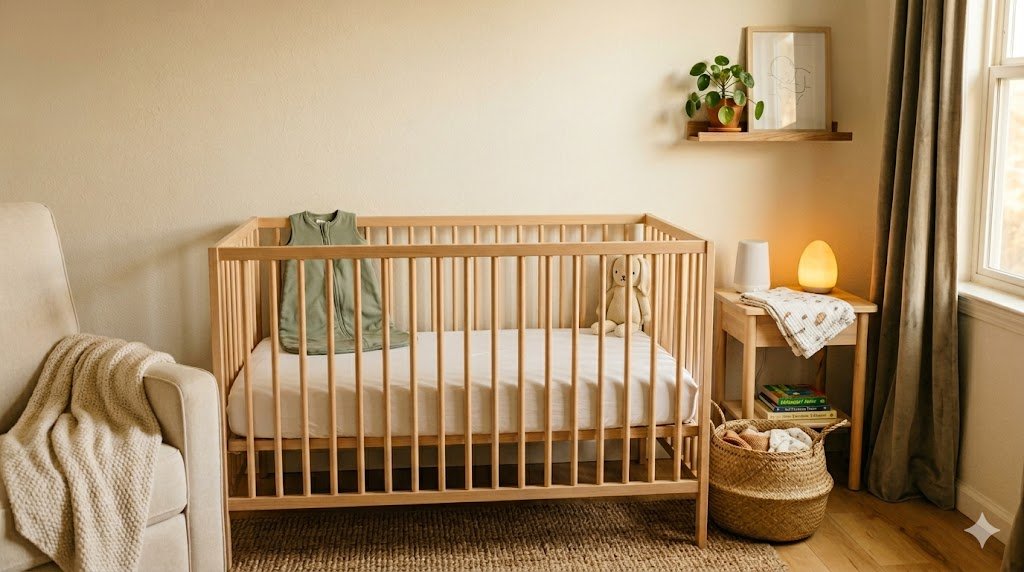
Research-based comparison updated for 2026. Product fit and sleep outcomes vary, and no item replaces current safe-sleep guidance.
This baby sleep essentials list compares ten products by current safe-sleep guidance, product instructions, care requirements, and practical tradeoffs. No product can guarantee longer or safer sleep.
- Best Swaddle: Halo SleepSack Swaddle – $28
- Best Sound Machine: Yogasleep Dohm Classic – ~$45-55
- Best Budget Night Light: G Keni Nursery Night Light – $15
Important – Safe Sleep First: Follow current AAP safe-sleep guidance for every sleep: place baby on their back on a firm, flat, noninclined sleep surface that meets current safety standards, and keep pillows, blankets, bumpers, stuffed toys, and positioners out. Room-share without bed-sharing, ideally for at least the first 6 months. Check each product’s exact instructions and stop-use limits; inclusion here is not a safety guarantee.
1. Halo SleepSack Swaddle – Best Swaddle on Our Baby Sleep Essentials List
Price: $28 | Top Pick | Use only within the exact size and weight range; stop at the first sign of trying to roll
The Halo SleepSack Swaddle has a 3-in-1 design for arms in, hands to face, or arms out. Follow the exact size and use instructions, always place a swaddled baby on their back, and switch to a correctly sized arms-free wearable blanket as soon as the baby shows signs of trying to roll.
For the current Halo SleepSack Swaddle, confirm the closure, zipper direction, fabric, care instructions, size range, and stop-use warning on the exact product page or label before buying; features can vary by model and size.
Current features: Foolproof at 3 AM. Three swaddle configurations in one product. The zipper opens from the bottom for diaper changes without unwrapping. Machine washable.
Trade-offs: Fit and closure preferences vary. Choose only from the current exact weight-and-length chart, check the fit each time, and stop swaddling at the first sign of trying to roll.
Best for: Families considering a swaddle after confirming that their baby is within the exact size range and is not showing signs of trying to roll. Swaddling is optional and not every baby accepts it.
How to choose: Check the exact size and weight range, closure design, hip room, care instructions, and stop-use warning. Fit and acceptance vary by baby.
2. Yogasleep Dohm Classic – Best Sound Machine for Baby Sleep
Price: ~$45-55 | Top Pick | Ages: Newborn through toddler (and beyond)
The Yogasleep Dohm Classic uses an internal fan to create adjustable rushing-air sound rather than a recorded sound track. Confirm the current controls, power requirements, warranty, and care instructions for the exact model.
The mechanical sound design differs from digital machines that play recorded tracks. It does not guarantee fewer wakings or better sleep. Keep any sound machine away from the sleep surface, use the lowest useful volume, and follow current manufacturer and pediatric guidance.
Current features: Mechanical fan-based sound, two speed settings, and an adjustable cap. Confirm the exact model’s current specifications and country-of-origin statement before relying on them.
Trade-offs: It requires outlet power and focuses on fan-based sound rather than app controls or a large sound library. Choose a different current model if battery operation or travel use is essential.
Best for: Families who prefer steady fan-based sound and can place the unit away from the sleep surface at a low volume. Recheck placement, cord access, and volume as the child becomes mobile.
Want to compare more options? We rounded up the best white noise machines for baby — 6 picks across every budget from $20 to $70, including portable and nursery options.
3. Kyte Baby Sleep Sack 1.0 TOG – Best Premium Sleep Sack
Price: ~$55 | Premium Pick | Ages: 3 months to toddler
Stop swaddling as soon as a baby shows signs of trying to roll, which can happen before 3-4 months. An unweighted, correctly sized sleep sack may be used for warmth after swaddling; for the Kyte Baby 1.0 TOG, check the current size chart, TOG guidance, fabric, and care instructions.
Kyte Baby lists a rayon-from-bamboo fabric and publishes size and TOG guidance for this sleep sack. Those descriptions do not guarantee temperature control, prevent overheating, or treat sensitive skin or eczema. Choose the exact size and clothing layers from current instructions, and check the baby for signs of overheating.
Current features: A J-shaped double zipper and multiple sizes and TOG options are listed for the line. Verify the exact product page, fabric, size chart, TOG guidance, and care instructions because options can change.
Trade-offs: This is a premium-priced option, and the exact care and fit may not suit every family. Buy only the quantity your laundry routine requires after confirming fit and current return terms.
Best for: Families comparing an unweighted sleep sack after swaddling ends and after confirming the exact size, TOG guidance, fabric, and care instructions. See our Best Baby Sleep Sacks 2026 roundup for broader options.
4. Love to Dream Swaddle Up – Best Alternative Swaddle
Price: ~$30-35 | Alternative Pick | Use only within the exact weight range; stop at the first sign of trying to roll
The Love to Dream Swaddle Up uses an arms-up design. It cannot guarantee longer sleep; follow the exact weight-based sizing and stop the Stage 1 swaddle as soon as the baby shows signs of trying to roll.
The key difference is the arms-up design. Instead of wrapping arms at the sides, this swaddle lets babies sleep with their hands near their face in a natural position. This means they can self-soothe by touching their mouth or cheeks, which some babies need to settle. It is certified hip-healthy by the International Hip Dysplasia Institute, so the legs stay free to move naturally.
Current features: Arms-up design for babies who hate traditional swaddles. Stretchy, snug fit calms startle reflex without restricting hands. Simple zip-on design. The Transition version has zip-off wings for gradual arm freedom.
Trade-offs: Only one swaddle style – arms up. No adjustability like the Halo. Sizing is weight-based and runs tight. If you are between sizes, go up.
Best for: Babies who fight traditional swaddles, break out of wraps, or seem to need their hands near their face to settle. Try the Halo first – if that does not work, this is your answer.
Which swaddle should you start with? Start with the Halo SleepSack Swaddle (#1). If your baby consistently fights having their arms pinned, switch to the Love to Dream. You do not need both upfront.
5. Chicco Close to You SE – Best Bedside Bassinet for Baby Sleep
Price: ~$200 | Top Pick | Use only until the earliest stop-use condition in the exact current manual
When comparing a bedside bassinet, check whether the exact model’s approved height settings, footprint, wheels or locks, sleep surface, and stop-use criteria fit your room and routine. Convenience features never replace the manual’s assembly and safe-use instructions.
The Chicco Close to You SE checks all three boxes at a price that does not require a second mortgage. Its standout feature is the height-adjustable frame (21.5” to 30.5”) that glides over your mattress, so baby sleeps right beside you at the same level. You can reach in and soothe your baby without getting out of bed. Four rubberized swivel wheels with locks let you roll it between rooms during the day.
Current features: Height adjustable to glide over most beds – baby is right beside you. Wheels for room-to-room movement. Breathable mesh on all sides for airflow and visibility. Zip-off, machine-washable fabrics and waterproof mattress. Fitted sheet included.
Trade-offs: The fixed side requires reaching over it, and the footprint may not fit a small bedroom or travel use. Stop using bassinet mode at the earliest weight, age, height, or movement limit stated in the exact current model’s manual; do not rely on rolling or pushing up as the only trigger.
Best for: Parents who want baby within arm’s reach at night without bed-sharing. The glide-over design works especially well with taller beds. If you specifically want a side that folds down for easier access after a C-section, look at the Halo BassiNest Swivel Sleeper instead (~$250-350).
Bassinet to crib timeline: Stop using a bassinet as soon as any limit in its exact manual is reached, such as a weight limit or a movement milestone. Do not rely on a typical age or rolling alone; prepare the crib before the earliest stop-use condition.
6. Nanit Smart Baby Monitor – Video Monitor With Breathing-Motion Tracking
Price: ~$290 | Splurge Pick | Ages: Newborn to toddler
A baby monitor is optional. If you use one, choose it for video or audio convenience; no monitor makes an unsafe sleep setup safe or reduces SIDS risk.
Nanit Breathing Wear uses a printed pattern that the camera analyzes to estimate breathing motion. Nanit states that the system is not a medical device and may produce false positive or false negative readings. It cannot replace adult supervision, medical care, or AAP safe-sleep practices.
Current features: 1080p HD video with overhead bird’s-eye view. Breathing motion tracking without wearables. Sleep analytics showing sleep patterns over time. Two-way audio. Temperature and humidity monitoring. No subscription required for core features (live view, alerts, two-way audio).
Trade-offs: Expensive. Paid Insights plans (starting around $100+/year) unlock the most useful sleep analytics and video history. Requires wall mounting for best results (floor stand available but less ideal). Overkill for experienced parents who are less anxious.
Best for: Families who want overhead video and optional sleep analytics after checking current mounting, Breathing Wear, account, and subscription requirements. An audio-only monitor may be enough if you only need to hear the baby.
7. Blackout Curtains – The Most Underrated Baby Sleep Essential
Price: $20-30 | Budget Pick | Ages: Newborn through childhood
Blackout curtains can reduce room light, which may make a consistent sleep environment easier to maintain. They do not guarantee longer naps. In a nursery, choose cordless window coverings and keep the crib away from windows and any cords.
You do not need expensive brand-name curtains. Any decent blackout curtain from Amazon that blocks 95%+ of light will do. The key is making sure light does not leak around the edges – use curtain rods that are wider than your window frame, or add Velcro strips to seal the sides.
Current features: Cheap. Effective immediately. Works for naps and nighttime. Lasts for years. Helps the whole family sleep later in summer when sunrise is at 5:30 AM.
Trade-offs: Most cheap curtains let some light leak around the edges. You may need to add Velcro strips, binder clips, or a travel blackout shade to get true darkness. Also, your baby may become dependent on complete darkness for naps, which can be tricky when traveling.
Best for: Every nursery and every bedroom where a baby sleeps. No exceptions.
8. G Keni Nursery Night Light – Best Budget Baby Sleep Essential
Price: ~$15 | Budget Pick | Ages: Newborn through toddler
A night light is optional. If you use one for feeds or diaper changes, choose the lowest brightness that lets the adult work safely, avoid shining it toward the baby, and keep the device and charging cord outside the sleep space.
Treat the G Keni entry as a category-level warm, adjustable night-light pick. Before buying, verify the exact current listing, controls, charging method, battery warnings, certifications, and seller; the earlier storefront link did not identify one exact current SKU.
Current features to verify: Warm-color output, dimming range, one-hand controls, charging method, battery warnings, and current price.
Trade-offs: The exact current SKU and feature set must be verified. A simple light may lack sound, scheduling, or app controls; compare those functions only if your routine needs them.
Best for: Families who want a dim light for adult visibility during nighttime care after verifying the exact product. A night light is optional and should stay outside the sleep space.
9. Graco Premium Foam Crib Mattress – Best Budget Crib Mattress
Price: ~$100 | Budget Pick | Ages: Newborn through toddler
The Graco Premium Foam is a lower-priced crib-mattress option. Before buying, confirm the exact current model, dimensions, firmness, crib fit, cover care, certifications, and instructions; use it only when it fits the crib without gaps.
The current listing names GREENGUARD Gold, OEKO-TEX Standard 100, and CertiPUR-US credentials for this model. Verify each current mark on the exact listing and label, and follow the manufacturer’s current unpacking, expansion, care, and replacement instructions rather than a generic timeline.
Current features: Affordable. Multiple safety certifications. Machine-washable waterproof cover. Fits both cribs and toddler beds so you do not buy twice. Lightweight at 7 lbs – makes sheet changes easier.
Trade-offs: This foam mattress arrives compressed. Follow the exact current manufacturer instructions for unpacking, expansion, ventilation, inspection, care, and replacement; do not invent an airing period or continue using a mattress with damage, sagging, or an unsafe gap.
Best for: Families comparing a lower-priced crib mattress after confirming the exact model, current certifications, crib fit, firmness, and care instructions.
10. Newton Essential Crib Mattress – Best Premium Baby Sleep Essential
Price: ~$250 | Premium Pick | Ages: Newborn through toddler
Newton describes the Essential’s Wovenaire core as breathable and washable. Those features do not make the mattress a SIDS-prevention product or change safe-sleep practice: use a firm, flat, noninclined mattress made for the crib with only a fitted sheet, and place baby on their back at the start of every sleep.
If a baby rolls from back to stomach and from stomach to back independently, keep placing them on their back at the start of every sleep; you do not need to turn them back after they roll. Keep the sleep space bare and do not add a positioner.
Newton describes both the cover and core as washable. Follow the exact model’s current rinsing, drying, and reassembly instructions; washability does not change safe-sleep requirements.
Product features: Newton currently lists a washable cover and core, Wovenaire core, and GREENGUARD Gold certification for the Essential. Confirm the exact model, dimensions, firmness, and care instructions before buying. None of these features replaces safe-sleep rules.
Trade-offs: Expensive at $250. It is lighter and feels different from traditional mattresses – some parents find the texture unfamiliar. Only one firmness level (Newton says it is engineered to work for both infant and toddler stages).
Best for: Families who prioritize washability and have confirmed that the exact model fits the crib and meets current requirements. Do not use “breathability” as a reason to change sleep position or add bedding.
Budget vs. premium mattress: Verify the current certification, dimensions, firmness, fit, and instructions for the exact model. A higher price, a “breathable” design, or regulatory compliance does not guarantee safety or change AAP safe-sleep practice.
Bonus: Zipper Footed Sleepers
Price: $15-25 per 3-4 pack | Carter’s / Simple Joys by Carter’s
This is not technically sleep gear, but it will change your 3 AM experience. Zipper sleepers versus snap sleepers is a hill I will die on. When your baby needs a diaper change at 2:47 AM and you are operating on three hours of sleep, the difference between one zipper and fourteen snaps is the difference between a 90-second change and a 5-minute fumbling session that wakes everyone up.
Buy footed sleepers with two-way zippers that open from the bottom. You unzip from the feet up, change the diaper, zip back down. Baby barely wakes up. Get them in newborn AND 0-3 month sizes because you do not know how big your baby will be.
Baby Sleep Essentials Comparison
| Product | Price | Ages | Category | Tag |
|---|---|---|---|---|
| Halo SleepSack Swaddle | $28 | Exact size/weight; stop at trying to roll | Swaddle | Top Pick |
| Yogasleep Dohm Classic | $45-55 | 0-toddler+ | Sound Machine | Top Pick |
| Kyte Baby Sleep Sack 1.0 TOG | $55 | 3 months-toddler | Sleep Sack | Premium |
| Love to Dream Swaddle Up | $30-35 | Exact weight; stop at trying to roll | Swaddle | Alternative |
| Chicco Close to You SE | $200 | 0-5 months | Bassinet | Top Pick |
| Nanit Smart Monitor | $290 | 0-toddler | Monitor | Splurge |
| Blackout Curtains | $20-30 | All ages | Environment | Budget |
| G Keni Night Light | $15 | 0-toddler | Night Light | Budget |
| Graco Premium Foam Mattress | $100 | 0-toddler | Crib Mattress | Budget |
| Newton Essential Mattress | $250 | 0-toddler | Crib Mattress | Premium |
Budget route (skip Nanit, Newton, and Kyte): ~$360 total
Full list: ~$1,070 total
Baby Sleep Essentials FAQ
What are the absolute must-haves for baby sleep?
The essential item is a safety-standards-compliant, firm, flat, noninclined sleep surface used exactly as directed, with no pillows, blankets, bumpers, toys, or positioners. Swaddles, sleep sacks, sound machines, monitors, and night lights are optional and must be used within their own instructions.
When should I stop swaddling?
Stop swaddling as soon as your baby shows signs of trying to roll; this can happen before 3-4 months. Always place a swaddled baby on their back. After swaddling, use a correctly sized, unweighted sleep sack if desired.
Is a baby monitor really necessary?
No. Babies do not need a monitor to sleep safely. Monitors are for parent peace of mind. If you room-share (which the AAP recommends for at least the first 6 months), you can hear your baby without any monitor. A monitor becomes more useful when baby moves to their own room.
How many sleep sacks do I need?
Two to three in the same size. One on the baby, one in the wash, one as backup. You will also want different TOG ratings if you live in a climate with significant temperature variation – 0.5 TOG for summer, 1.0 for spring/fall, 2.5 for winter.
What room temperature is best for baby sleep?
AAP guidance advises avoiding overheating rather than using one universal room-temperature target. Keep the room comfortable, dress baby in no more than one extra layer than you would wear, and check for sweating, a hot chest, or flushed skin. Use a correctly sized wearable blanket instead of loose bedding if extra warmth is needed.
A Note on Sleep Approaches
This list is about creating the right environment for sleep, not about sleep training methods. Every family makes their own choices about how to handle night wakings – there is no one right answer. What I do believe is that a dark room, white noise, and the right sleepwear make everything easier, regardless of your approach.
Frequent waking around 3-4 months can have several causes. Our 4-month sleep regression guide discusses common sleep-pattern changes, practical routines, and reasons to contact your pediatrician.
The Bottom Line on Baby Sleep Essentials
The only universal sleep-gear requirement is an appropriate, standards-compliant sleep surface used according to current safe-sleep guidance. The other products in this baby sleep essentials list are optional tools to compare by exact instructions, room setup, budget, and family routine.
For wake windows, bedtime routines, and solutions to common sleep problems, see our Baby Sleep Essentials: A Gentle Newborn Sleep Guide.
Getting ready for baby? Check our Newborn Must-Haves Checklist.
Packing for the hospital? See Hospital Bag Checklist 2026.
Recovering after delivery? Our Postpartum Recovery Products covers everything you need.
Looking for first toys? See Best Toys for 0-3 Month Babies.
Worried about dry winter air or nighttime congestion? See our Best Baby Humidifier for Nursery 2026 — 6 honest picks for cold and flu season.
This research-based comparison uses current manufacturer information and safe-sleep guidance; it does not claim hands-on use of every named product. Prices and features may change. This article is for informational purposes and does not replace personalized medical advice. Follow the exact instructions and current AAP safe-sleep guidance, and consult your pediatrician about your baby.