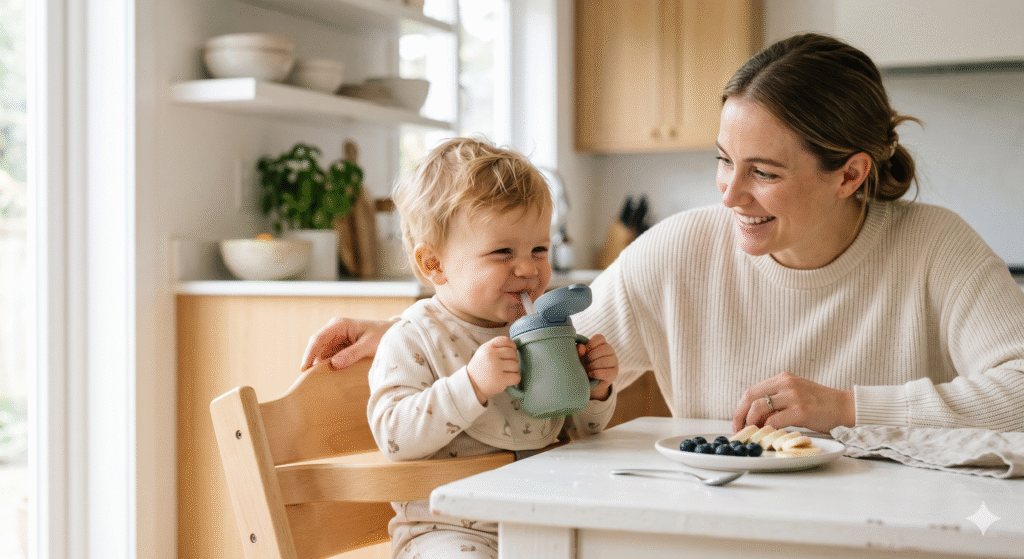
Toddler boy happily drinking from a straw sippy cup at a bright kitchen table while his mother smiles at him

Best Toddler Sippy Cups & Transition Cups 2026 (Tested by a Mom of Three)

This post contains affiliate links. As an Amazon Associate, I earn from qualifying purchases. If you buy through our links, we may earn a small commission at no extra cost to you. All products are independently researched and recommended based on real parent needs — never sponsored.

Ages: 6 months – 3 years  |  Last updated: April 2026

I have a cabinet full of cups that didn’t work out. Some leaked all over the diaper bag. Some had straws that turned into science experiments after two weeks. One particularly fancy cup had so many parts that I gave up cleaning it and just… threw it away. (No judgment, please.)

With three kids, I’ve been through the cup transition gauntlet more times than I care to admit. (If you’re still in the baby bottle stage, we have a guide for that too.) My youngest son is smack in the middle of it right now at 1, and let me tell you, watching him try to figure out a new cup is both hilarious and deeply stressful. My older son, on the other hand, happily takes his Thermos Funtainer to daycare like he’s heading to the office with a travel mug.

So after years of trial and error (and way too much money spent), I put together this guide of the cups that actually work. Not just the ones with great marketing, but the ones that survived real life in our house.

Quick Note: Sippy Cup vs. Straw Cup — Does It Matter?

Before we get to the picks, let’s clear something up, because this confused me for the longest time.

The American Academy of Pediatrics recommends weaning off bottles between 12 and 24 months. But what you transition to matters more than you might think. Speech-language pathologists and pediatric dentists increasingly recommend straw cups and open cups over traditional spouted sippy cups, because straw drinking encourages a more mature swallowing pattern and supports oral motor development.

That doesn’t mean spouted sippies are terrible. It just means if you can go straight to a straw cup, that’s the preferred route. Most of the cups on this list are straw cups for exactly this reason.

What about 360 cups? This is where it gets interesting. Dentists love 360 cups because they mimic real cup drinking. But some speech-language pathologists have raised concerns that 360 cups require a forceful sucking action that doesn’t match how we naturally drink. I’ve included one 360 option below because it works well for many families, but I want you to have the full picture so you can decide for yourself.

What to Look For in a Toddler Cup

After going through dozens of cups, here’s what actually matters day-to-day:

Leak-proof design. Because you will find this cup upside down under the couch. Or in your purse. Or launched across the car.

Easy to clean. If a cup has more than four parts, hidden valves, or requires a tiny brush you’ll inevitably lose, it’s going to sit in your cabinet unused. Trust me on this.

Safe materials. All of the cups on this list are BPA-free. I also looked at the overall material safety, including whether stainless steel options have any lead concerns (more on that below, because it’s important).

Age-appropriate design. A 7-month-old learning to drink needs handles and a soft straw. A 2-year-old heading to daycare needs something insulated and durable. Different stage, different cup.

The 9 Best Toddler Sippy Cups & Transition Cups

🏆 Overall Best

1. b.box Sippy Cup with Weighted Straw

Ages: 6 months+  |  Capacity: 8 oz  |  Price: ~$10  |  Material: BPA-free plastic

This is the cup I hand to every new parent friend. The weighted straw follows the liquid to the bottom of the cup, so your little one can drink from literally any angle — sitting, standing, lying on the floor refusing to get dressed (just our house?).

My youngest son took to this cup almost immediately. The handles are just the right size for small hands, and the flip-top lid keeps the straw clean when it inevitably ends up on the floor. It’s dishwasher safe, sterilizer safe, and comes in a rainbow of gorgeous colors.

Fair warning, though: the straw has a two-way valve that requires your baby to place their lips over the entire straw top and press down. Some babies figure this out right away; others need a few tries. And the straw valves wear out over time (especially if your teething toddler treats it as a chew toy), so budget for replacement straws (~$6 for a pack of two plus a cleaning brush).

Check price on Amazon

🍼 Best for Bottle Transition

2. Grosmimi PPSU Straw Cup

Ages: 6 months+  |  Capacity: 6 oz or 10 oz  |  Price: ~$15–19  |  Material: PPSU (medical-grade polymer)

If your baby is having a hard time letting go of the bottle, this is your secret weapon. The straw is made from the same silicone material as baby nipples, so it feels familiar in their mouth. The cross-cut (+) valve prevents leaks even when shaken or dropped, and the rotating handles protect little wrists.

What makes this cup special is the PPSU material. It’s a medical-grade polymer used in hospital equipment. It doesn’t absorb odors or stains, handles repeated high-temperature sterilization without warping, and is BPA and phthalate free. Think of it as having the safety benefits of glass without the shatter risk.

Bonus: you can use it two ways. With the tube, it’s a straw cup. Without the tube, it’s a spout cup for lying-down drinking. Grosmimi is Korea’s #1 baby cup brand, and it’s been blowing up on social media for good reason.

What I wish I’d known first: It’s pricier than basic plastic cups. The Stage 1 straw is very soft, which is great for beginners but can collapse if an older toddler sucks too hard. You’ll need to switch to the firmer Stage 2 straw once that starts happening (sold separately). The weighted straw extension is also a separate purchase.

Important: I specifically recommend the PPSU version of Grosmimi, not the stainless steel insulated version. Some consumers have reported finding lead at the solder point on the bottom of the stainless steel model after the base plaque came off. The PPSU version doesn’t have any metal solder points, so this concern doesn’t apply.

Check price on Amazon (10 oz)  |  6 oz version

🦷 Best for Oral Development

3. OXO Tot Transitions Straw Cup

Ages: 6 months+  |  Capacity: 6 oz (with handles) or 9 oz  |  Price: ~$10–12  |  Material: BPA-free plastic

If you care about supporting your baby’s oral development (and after reading all the SLP recommendations, I definitely do), this cup is a standout. The almond-shaped straw conforms to your child’s mouth, and the valve opens the moment their lips touch it — no forceful sucking or biting required. That’s exactly the kind of natural drinking pattern speech therapists want to see.

The removable handles are a nice touch. Start with them on for younger babies, then pop them off as your toddler gains confidence. The hinged cap creates a leakproof seal, and the whole thing comes apart in seconds for cleaning. Reviewed.com ranked it their #1 straw cup for toddlers after nearly 30 days of testing.

One heads-up: some babies need a moment to figure out how to activate the straw valve (it’s lip-activated, not suction-based). Once they get it, though, it clicks. A few color options may be out of stock depending on when you shop.

Check price on Amazon (6 oz with handles)

🥤 Best 360 Cup

4. Munchkin Miracle 360 Trainer Cup

Ages: 6 months+  |  Capacity: 7 oz (with handles) or 10 oz  |  Price: ~$8–10 for a 2-pack  |  Material: BPA-free plastic

One of the top-selling toddler cups on Amazon, and for good reason. No spout, no straw. Your child drinks from anywhere around the 360-degree rim, just like a regular cup. The silicone valve seals automatically when they stop sipping, which keeps things (mostly) mess-free. It’s also absurdly easy to clean because there are no tiny parts to disassemble.

My older son used this cup for months and loved it. It made him feel like he was drinking from a “real cup” like mom and dad, which was a huge motivator.

The honest truth about 360 cups: This is the most debated cup style in the parenting world right now. Dentists recommend it because it mimics open-cup drinking. But some speech-language pathologists, including feeding specialist Melanie Potock (writing for the American Speech-Language-Hearing Association), have cautioned that 360 cups can interfere with proper swallow pattern development because they require a sucking action that doesn’t match natural drinking. Pediatric dietitian Mama Knows Nutrition doesn’t recommend 360 cups at all.

My take? For occasional use, it’s fine. If it’s the only cup your toddler will accept, don’t stress. But I wouldn’t use it as the only cup — mix in straw cups and open cups for practice.

Also worth knowing: it will leak if thrown hard or shaken vigorously (every toddler’s favorite activity). The silicone valve gets chewed up during teething and needs replacing (~$4 for a 2-pack of replacement valves).

Check price on Amazon (7 oz 2-pack with handles)

💰 Best Value

5. NUK Learner Straw Cup

Ages: 6 months+  |  Capacity: 5 oz or 10 oz  |  Price: ~$7–10 for a 2-pack  |  Material: BPA-free plastic

At under $5 per cup, this is the most budget-friendly option on the list, and it doesn’t feel cheap. The 100% soft silicone weighted straw reaches the liquid at any angle, and it’s super gentle on gums. The built-in air vent is a nice touch that helps reduce the amount of air your baby swallows (which means less gas and fussiness afterward).

The handles are removable, so the cup grows with your child. NUK has been making baby products for over 70 years, and they also make a super cute Ms. Rachel collaboration version that my kids would lose their minds over.

A few downsides: the 5 oz version is quite small and gets outgrown fast. The straw is very soft, which is great for beginners but can collapse if an older toddler sucks too hard. You’ll need a small brush to clean inside the straw properly.

Check price on Amazon (5 oz)  |  10 oz version

🧹 Easiest to Clean

6. Munchkin Simple Clean Straw Cup

Ages: 12 months+  |  Capacity: 10 oz  |  Price: ~$8–10 for a 2-pack  |  Material: BPA-free plastic

If you’ve ever rage-cleaned a sippy cup at 10 PM while wondering why it has seven parts and a hidden valve designed by someone who clearly doesn’t have children — this cup is for you. The entire point of the Simple Clean is right there in the name: minimal parts, no hidden crevices, no mystery mold.

The one-piece straw design means there’s nowhere for milk residue or bacteria to hide. Pop the lid off, pull out the straw, rinse, done. The flip-top lid keeps things spill-proof, and it’s fully dishwasher safe.

The trade-off? No handles (designed for 12 months+, when most kids can grip a cup without them). No insulation. The design is functional but plain, with no cute colors or patterns. But honestly? At this point I’ll take “easy to clean” over “Instagram-worthy” every single time.

Check price on Amazon

🧊 Best for On-the-Go

7. Thermos Funtainer Straw Bottle (12 oz)

Ages: 10 months+  |  Capacity: 12 oz  |  Price: ~$15–18  |  Material: 18/8 stainless steel

This is the cup that goes to daycare, the park, the car, the grocery store. Thermos vacuum insulation keeps drinks cold for up to 12 hours (tested and confirmed — I’ve pulled my older son’s water bottle out of his daycare bag at 6 PM and it was still cold). The push-button lid pops up the straw with one hand, and the integrated carry handle makes it easy for little hands to tote around.

The straw is thinner than most, which actually works in your favor — it slows the flow rate so younger toddlers are less likely to choke or gag. Speech-language pathologist blog EatPlaySay calls it their “favorite travel cup for littles 10 months and older.”

Also, can we talk about the character options? Bluey, Paw Patrol, Disney Princesses, Spider-Man. My older son picked the Cars one and treats it like a prized possession.

A couple of things to know: the straw is narrow and needs a thin brush to clean properly (Thermos doesn’t include one). The stainless steel body should be hand-washed, not put in the dishwasher. And it’s cold drinks only, not designed for hot liquids.

A note on stainless steel cups and lead: Over the past few years, several brands of insulated stainless steel children’s cups have been recalled by the CPSC because the bottom seal can come off and expose a lead solder dot used in the vacuum-sealing process. Thermos Funtainer has not been subject to any recalls, and their current products use 18/8 stainless steel construction. As a general practice, I recommend periodically checking the bottom of any insulated stainless steel cup to make sure the base seal is firmly in place. If it loosens or comes off, stop using the cup immediately.

Check price on Amazon

🌿 Best Eco / Plastic-Free

8. Pura Kiki Stainless Steel Sippy

Ages: 6 months+  |  Capacity: 9 oz  |  Price: ~$25–28  |  Material: 100% plastic-free (medical-grade stainless steel + silicone)

For parents who want to eliminate plastic entirely from their child’s drinkware, Pura Kiki is one of the few truly plastic-free options. The liquid only ever touches stainless steel and medical-grade silicone, nothing else. The interchangeable top system is the real selling point: buy one bottle body, then swap between a nipple, sippy spout, straw top, or sport cap as your child grows. One bottle, multiple years of use.

The silicone sleeve prevents condensation and protects against dents, and there are measurement markings inside the bottle. BabyGearLab ranked it their #1 overall sippy cup pick.

The downside is cost. It’s the most expensive option on this list, and each interchangeable top is sold separately (~$6–8 each), which adds up. The silicone sleeve fits tightly and can be tricky to remove for cleaning.

Important safety note: I want to be transparent about something most blogs don’t mention. Consumer safety advocate Lead Safe Mama found that Pura Kiki’s insulated bottles manufactured before 2017 contained lead solder at the bottom sealing point. Pura states they switched to lead-free solder in 2017, and their current products carry MADE SAFE certification. However, the company was criticized for continuing to sell older inventory and never issuing a formal recall. Their non-insulated bottles have never had this issue (no solder points). If you choose Pura Kiki, I recommend either the non-insulated version, or making sure any insulated bottle is a current-production model. And as with any stainless steel insulated product, periodically check that the bottom seal is intact.

Check price on Amazon

🥛 Best Glass Option

9. Elk and Friends Glass Mason Jar Cups (4-pack)

Ages: 12 months+  |  Capacity: 8 oz  |  Price: ~$25–28 for 4 cups  |  Material: Glass + food-grade silicone sleeves

For at-home use, especially for milk and smoothies, these glass mason jar cups are a fan favorite. The liquid never touches plastic, only glass and silicone. The straws have built-in stoppers so your toddler can’t pull them out (genius), and they’re wide enough for thicker drinks like smoothies. Each cup comes with two lids: a straw lid for drinking and a leak-proof storage lid that turns it into a snack container or food storage jar.

At about $6 per cup in the 4-pack, the value is surprisingly good for a glass product. Measurement markings help with portion control, and everything except the lids is microwave and dishwasher safe.

Let me be upfront about one thing: these are not spill-proof. If your toddler tips the cup over or throws it, expect a mess. The silicone sleeve adds protection, but glass can still break if dropped on a hard surface. This is a supervised-use, at-home cup, not one for the car or the diaper bag.

Safety reminder: Glass cups should always be used under adult supervision with toddlers. While the silicone sleeves provide good protection, glass can break. These are best for mealtimes at the table, not for walking around or unsupervised play.

Check price on Amazon (4-pack)

Quick Comparison

Cup Best For Price Leak-Proof? Dishwasher Safe?
b.box Overall pick ~$10 Yes Yes
Grosmimi PPSU Bottle transition ~$16 Yes Yes
OXO Tot Transitions Oral development ~$11 Yes Yes
Munchkin 360 360 cup fans ~$9/2pk Mostly Yes
NUK Learner Budget pick ~$8/2pk Yes Yes
Munchkin Simple Clean Easy cleaning ~$9/2pk Yes Yes
Thermos Funtainer On-the-go / daycare ~$16 Yes (closed) Lid only
Pura Kiki Eco / plastic-free ~$26 Mostly Silicone parts
Elk and Friends Glass / at home ~$26/4pk No Yes

Cup Transition Timeline: What to Use When

6–9 months: Introduce an open cup with a small amount of water at mealtimes (just for practice — expect spills). Start with a beginner straw cup like the b.box, NUK Learner, or Grosmimi alongside the open cup.

9–12 months: Your baby should be getting more comfortable with straw cups. Start offering water in a cup more regularly. The OXO Tot Transitions is great for this stage because the valve is so easy to activate.

12–18 months: Time to start weaning off bottles. This is where the Grosmimi really shines for bottle-resistant babies, since the straw feels familiar. Introduce cups without handles (like the Munchkin Simple Clean) to build grip skills.

18–24 months: The AAP says bottles should be fully phased out by now. Your toddler should be primarily using straw cups and open cups. Add an insulated option like the Thermos Funtainer for outings and daycare, and once they’re confidently sipping from straws, check out our best toddler water bottles for the next stage.

2+ years: Focus on open cup skills at home. Use spill-proof cups mainly for on-the-go and bedtime. The Elk and Friends glass cups are perfect for at-home practice since they look and feel like “real” cups.

Tips for a Smooth Transition

Start early, go slow. You can introduce a cup as early as 6 months. Don’t wait until you need to ditch the bottle. Give your baby time to explore and practice without pressure.

Get everyone on the same page. Make sure your partner, grandparents, and daycare providers know which cups your child is using and how they work. My husband kept putting the b.box straw in wrong for the first week, which meant it leaked everywhere, which meant he declared it “broken.” (It was not broken.)

Offer the cup at meals first. Pair it with food so your baby associates drinking from a cup with mealtimes, not comfort (that’s the bottle’s job, for now).

Try different types. Some kids take to straw cups immediately. Others prefer 360 cups. My youngest son rejected every cup with handles for two weeks before randomly deciding the b.box was acceptable. Toddlers are nothing if not unpredictable.

Don’t give up after one try. Research suggests it can take babies several weeks of exposure before they get comfortable with a new cup. Keep offering it without forcing it.

Model it. Drink from your own cup in front of your toddler. They’re little copycats, and seeing you drink from a cup is surprisingly motivating.

Frequently Asked Questions

When should I stop using sippy cups?

Most pediatricians recommend transitioning away from traditional spouted sippy cups between 18 and 24 months. Straw cups and open cups are preferred for long-term use since they support better oral motor development. There’s no hard cutoff for straw cups — plenty of adults drink from straws, after all.

Are 360 cups bad for my toddler?

Not “bad,” but there are differing expert opinions. Dentists generally approve of them because they mimic open cup drinking. Some speech-language pathologists have concerns about the sucking pattern they require. Using a 360 cup as one option alongside straw cups and open cups is a reasonable middle ground.

Is stainless steel safe for sippy cups?

Stainless steel itself is considered very safe for food and drinks. The concern is specifically with insulated stainless steel products that use lead-based solder to create the vacuum seal. Several brands have been recalled for this reason. Look for cups from established brands, check that the bottom seal is intact, and avoid any cup where the base has come loose. Non-insulated stainless steel cups don’t have solder points and don’t carry this risk.

How many cups does my toddler need?

I’d say two to three is the sweet spot: one straw cup for home, one insulated cup for outings, and an open cup for mealtimes. You don’t need a different cup for every day of the week (though it might feel that way when you’re standing in the baby aisle).

My toddler refuses every cup. Help?

Been there. Try letting them pick the cup (the character options on the Thermos Funtainer work wonders). Offer their favorite drink in the cup instead of water. Use a straw cup in the bath so they can practice without any mess pressure. And sometimes, honestly, it just takes time. My youngest son refused cups for three weeks straight and then one day just started drinking from one like he’d been doing it forever.

Found This Helpful?

I share practical, research-backed tips for raising little ones every week. Join our community of parents who are figuring it out together!

Planning your toddler’s full mealtime setup? See our picks for the best toddler plates, bowls & utensils, and when they’re ready for the next step, our best toddler water bottles.