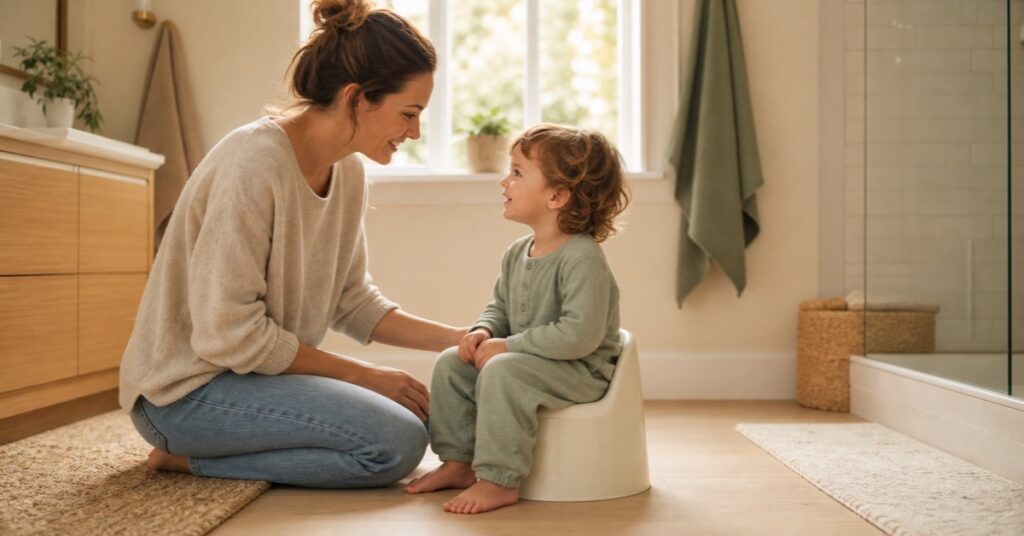
A wobbly toilet-seat reducer once slid under my older son and made him avoid the bathroom for weeks. Potty seats are simple products, but the wrong type can make a ready toddler feel unsteady.
Start with your child’s stage and your toilet shape. A floor potty gives the easiest foot support. A toilet reducer needs a stable step stool. I am not naming a ladder-seat winner in this update because the current options I reviewed did not give me enough confidence in their stability and fastening to recommend one.
Quick Picks
Best realistic mini toilet: Ingenuity My Size Potty Pro
Best adjustable reducer: BabyBjörn Toilet Training Seat
Best reducer with handles: Jool Baby
Best built-in seat: Mayfair NextStep2
Best folding travel seat: Frida Baby Fold-and-Go
Editor’s note: This is a research-led guide. I checked each model’s current instructions and fit limits, then looked for repeated fit and cleaning problems in recent buyer feedback.
Which Potty Seat Type Should You Choose?
| Your situation | Best type | Why it helps | Main compromise |
|---|---|---|---|
| New to training or nervous about the big toilet | Floor potty chair | Feet stay on the floor; no climbing | You empty and clean the bowl |
| Wants a potty that looks like yours | Realistic floor potty | Familiar shape can make the routine appealing | More seams and parts to clean |
| Ready for the family toilet | Reducer plus stool | No potty bowl to empty | Fit must be checked; feet still need support |
| Considering a ladder-and-seat combination | No current pick | Every setup needs a stable toilet fit and secure foot support | More parts and joints need fitting, inspection, and adult help |
| Several people share one bathroom | Built-in child/adult seat | No loose reducer to store | Requires installation and exact bowl fit |
| Mainly needs help in public restrooms | Folding reducer | Packs into a diaper bag | Not a standalone potty; may not fit every toilet |
If your child is hesitant, start with a floor potty. Moving directly to a ladder or adult toilet does not make training more advanced. A child who feels secure is more likely to relax and learn.
The Five-Minute Fit and Safety Check
- Identify the toilet shape. Look at the bowl from above. Most are round or elongated, while square and other nonstandard shapes need extra care. The Mayfair model linked below is elongated.
- Test for movement before your child sits. Press the front, back, and both sides. A reducer should not rock, lift, or slide. A ladder should sit evenly on the floor and toilet with every fastener secured. If it will not stay stable, return it instead of improvising with towels, foam, or tape.
- Support both feet. The American Academy of Pediatrics guidance on HealthyChildren.org says feet should reach the floor on a potty chair and recommends a stool for bracing at the big toilet. Handles can help confidence, but they do not replace foot support.
- Watch the whole transfer. Help until your child can get on, turn, sit, and get off with control. Do not let a child stand on the toilet seat, swing from handles, or treat a ladder as climbing equipment.
- Inspect and clean. Check for cracks, loose hardware, worn nonslip pads, and pinch points. Clean the underside, hinges, splash guard, and removable cushions—not only the visible top.
Safety baseline: Use a floor potty only on a flat floor, never on an elevated surface. Keep the bathroom floor dry and stay close enough to help, especially with reducers and ladders.
Best Floor Potty Chairs
Floor potties keep the first setup low, simple, and easy to reach.
1. BabyBjörn Potty Chair
Best for: A cautious beginner who needs a stable, simple first potty with full foot contact.
Skip it if: You have very little floor space or want to move directly to the family toilet.
The BabyBjörn keeps the job simple. Its high back and molded armrests help a small child feel secure rather than perched on a low, shallow potty. A rubber strip underneath helps it stay in place, while the removable inner bowl lifts out for emptying and rinsing.
This is the option I would choose for a toddler who looks worried about the height or opening of an adult toilet. There are no sounds or pretend plumbing to distract from the routine, and the smooth design leaves fewer awkward corners to scrub.
Watch-outs: It takes permanent floor space, and the bowl needs cleaning after each use. It has no lid, storage compartment, or entertainment features.
2. Ingenuity My Size Potty Pro
Best for: A toddler eager to copy adults and motivated by a toilet-like design.
Skip it if: Fast, crevice-free cleaning matters more than sounds and pretend play.
The My Size Potty Pro looks more like a small household toilet than a basic potty bowl. Its flush handle makes a sound, and the inner bowl lifts out for emptying and rinsing. That familiar appearance can help a child who rejects anything that looks like baby gear.
The current manual sets a 50-pound maximum and says to use the potty only on a flat surface. It also warns that the tank is not a backrest. The sound module requires two AAA batteries; plan to supply them.
Watch-outs: The realistic shape creates more seams to wipe. The sound may encourage some children to play instead of sit. The bowl is for emptying; only use the separate conversion ring on an adult toilet as shown in this model’s manual.
Best Toilet-Seat Reducers
Reducers avoid a bowl to empty, but they need an exact fit and stable foot support.
3. BabyBjörn Toilet Training Seat
Best for: A child ready for the family toilet when you want an adjustable reducer.
Skip it if: Your child depends on side handles or you do not have room for a separate stool.
An adjustment dial underneath is the reason to choose this seat. You set it for your toilet, and the rubber edge helps hold it in place. The seat also has a front splash guard and a rear handle for hanging it between uses.
Its light weight lets many toddlers help place and remove it after an adult has adjusted the fit correctly. That can support independence without asking the child to climb a full ladder.
Watch-outs: It has no side handles. Add a stable stool so both feet are supported, and help your child get on and off until the transfer is safe. BabyBjörn says it adjusts to most standard toilets—not every toilet—so test it carefully on unusually shaped or heavily contoured seats.
4. Jool Baby Potty Training Seat with Handles
Best for: A child who wants something to hold on to while sitting on a standard round or elongated toilet.
Skip it if: Your toilet has an unusual shape or you want an adjustable locking fit.
The built-in side handles give a nervous toddler a clear place to put both hands instead of gripping the adult seat. The underside is slip-resistant, and the front splash guard helps contain forward spray.
Jool says the seat fits most standard round and elongated toilets and includes a hook for hanging it when adults need the toilet. Pair it with a stool: a child can hold the handles and still feel insecure if both feet dangle.
Watch-outs: There is no adjustment dial, so compatibility depends on the contour of your adult seat. The handles are for balance while sitting—not for pulling the reducer off the toilet or lifting it with a child on it. Recheck the fit whenever it moves between bathrooms.
Why There Is No Ladder-Seat Pick
Current note: I am not naming a ladder-and-seat winner in this update. The exact-model evidence I reviewed did not give me enough confidence in stability and fastening to recommend one, so I am not substituting another model just to keep this category filled.
If you use an adult toilet, choose a reducer that stays still on your toilet, add secure foot support, keep the floor dry, and stay close enough to help with every transfer. Follow the exact instructions for both pieces rather than treating handles or steps as permission for unsupervised climbing.
Best Built-In Training Seat
5. Mayfair NextStep2 Elongated
Best for: A shared bathroom with an elongated toilet and no room to store a loose reducer.
Skip it if: Your toilet is round, you cannot replace the existing seat, or your child needs handles.
The Mayfair NextStep2 replaces the entire adult seat. A smaller child ring is built in and stores magnetically inside the lid when adults use the toilet. When training is over, the child ring can be removed while the adult seat remains installed.
The adult seat closes slowly, while the STA-TITE fastening system is designed to keep the installed seat from shifting. The link below is for the elongated version, not the round one. Measure your bowl and make sure the page still says “elongated” before ordering.
Watch-outs: Installation is required. The child insert has no side handles and does not remove the need for a stable step stool. Check the hinge area for trapped residue and small-finger pinch points.
Best Folding Travel Seat
6. Frida Baby Fold-and-Go
Best for: Errands, airports, hotels, and other places where an adult toilet is available.
Skip it if: You need a standalone potty for the car, roadside stops, or places without a usable toilet.
The Frida Fold-and-Go reduces the opening of many adult toilets and folds small enough for a diaper bag. The silicone handles give you a place to grip the reducer without touching the toilet, and the solid panels are easy to wipe down.
The included storage bag keeps the folded seat separate from the rest of your bag. It fits many round and oval toilets, but public toilets vary, so press all sides and confirm the fit before your child sits.
Watch-outs: There is no prominent front splash guard. Wipe both sides and folds, then let the seat dry before storing it. Treat the storage bag as spot-clean only; the brand does not say it can go in the washer. This reducer cannot be used as a floor potty.
For standalone road-trip and emergency options, see my travel potty guide.
Readiness Matters More Than a Birthday
Look for several signals together: longer dry stretches, noticing that pee or poop is coming, interest in the toilet, and being able to walk to the bathroom, follow a simple direction, and help move clothing. You do not need every sign on the same day. Practice is easier when your child can notice the urge, reach the bathroom, understand the routine, and feel ready to try.
Keep the potty visible, offer predictable low-pressure chances to sit, and let your child choose between two safe setups. If fear or strong resistance appears, pause. Painful bowel movements, ongoing stool holding, or persistent concerns are reasons to call your pediatrician. See my gentle potty-training guide and toddler potty-training basics for the full routine.
Final Verdict
If you are unsure where to begin, choose a simple floor potty such as the BabyBjörn Potty Chair. Move on only when the whole setup fits your toilet, keeps both feet supported, stays still, and lets your child get on and off safely.