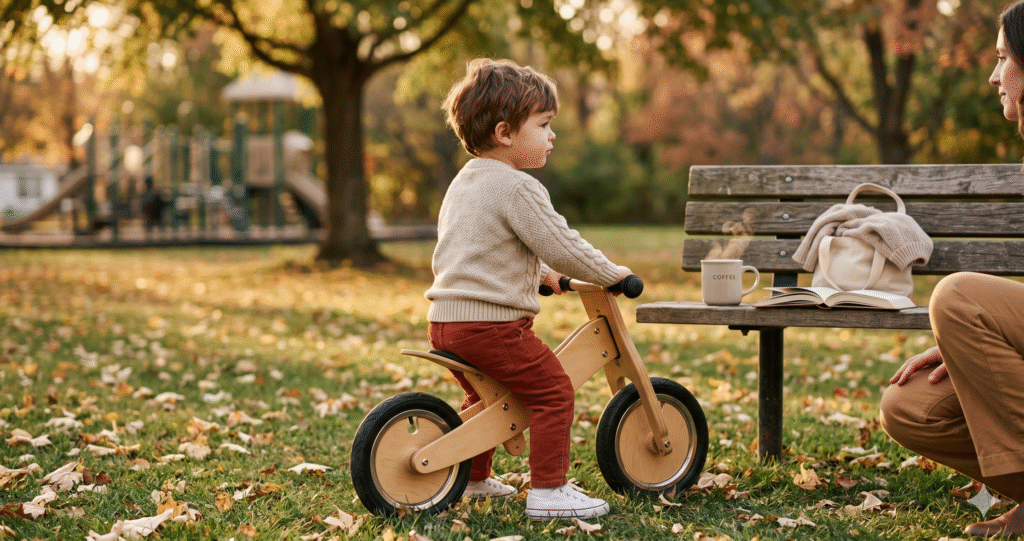
My youngest just turned 19 months and finally walks steadily on his own. Which means the balance bike window is opening soon — but not yet.
After raising three kids, I track motor milestones differently than I used to. Less about the chart at the pediatrician’s office, more about what their body is actually doing. A 19-month-old and a 2.5-year-old need completely different bikes, even when manufacturers slap the same age range on the box.
That’s the part most balance bike roundups skip. They list the same five bikes everyone lists, sort by price, paste the manufacturer’s “ages 18 months to 5 years” line, and call it a day. None of that tells you whether a specific bike fits your specific kid this month. A two-year-old can have an inseam anywhere from 11 to 15 inches. The same bike that fits one toddler perfectly is physically wrong for another.
So I did this differently. As a mom of three watching kids cycle from cruising furniture, to walking, to running, to two-foot jumping — I grouped these 4 bikes by motor skills stage, not age. Each pick below corresponds to what your child is actually doing right now: brand-new wobbly walker vs. confident runner.
A few notes on how I picked. Every bike here passed my two filters: as a mom of three, would I buy this for my own kid, and would I confidently recommend it to my best friend? Each holds at least 4.4 stars on Amazon — and for the two industry-standard Striders, I explain exactly where the data comes from. The 1-star reviews got read individually so the real failure modes are listed alongside the wins in each review.
Before we get to the bikes: a quick look at what’s actually happening in a child’s body when they learn balance. Once you see balance bikes through the lens of motor development, picking the right one gets a lot clearer.
Why Balance Bikes Beat Training Wheels (Every Time)
I learned to ride a bike the way most of our generation did: someone put me on a bike with training wheels, and one day — terrifyingly — yanked them off and ran behind me. We learned to pedal eventually, but most of us never really learned to balance. Training wheels did that part for us.
Balance bikes flip the order. They teach the harder skill first.
When a child pushes themselves along on two wheels with their feet, here’s what’s actually happening in their body:
Bilateral coordination develops. Each foot pushes off in alternating rhythm, training both brain hemispheres to communicate in sync. This is the same neural pathway used for walking, running, swimming, and eventually pedaling a real bike. Tricycles don’t do this — both feet push forward together. Training wheels don’t either — there’s no opposing force to coordinate against.
The vestibular system gets a workout. This is the inner-ear network responsible for sensing tilt and gravity. When a child wobbles slightly and catches themselves with a foot, the vestibular system is logging data: this much tilt = this much correction. Training wheels actively block that learning by preventing the wobble before it starts.
Core strength gets activated. Without a backrest and without pedals to push against, a child on a balance bike has to actively engage their abs and lower back to stay upright. The 2.5-year-old who’s been riding a balance bike for six months has visibly stronger trunk control than the one who hasn’t.
Pediatric physical therapy literature has long supported the “balance before pedals” developmental sequence. Early intervention therapists use balance-style ride-on toys as a standard tool when designing motor programs for kids who need extra support.
One safety note: the American Academy of Pediatrics recommends helmets for any bike, and child safety industry guidance extends that to balance bikes, scooters, and other wheeled toys. We’ll come back to this in the safety section.
So that’s the science. Now for the part most roundups miss: not every kid needs the same bike at the same time. Motor skills come in stages.
The Motor Skills Stage Framework
This is the framework that drives the whole article. Before you pick a bike, figure out which stage your kid is in. The stage decides which specs matter — minimum seat height, bike weight, tire type, whether brakes belong on this bike at all.
| Stage | Typical Age | What your kid can do | What to look for |
|---|---|---|---|
| 1. New walker | 12–18 months | Walks steadily for 5+ minutes, turns without falling | Seat ≤11.5″, weight ≤8 lbs, optional 3-wheel transition |
| 2. Confident runner | 18–30 months | Runs, stands on one foot 2 sec, climbs stairs | Seat 11–15″, lightweight, foam or air tires, brakes optional |
| 3. Pedal-ready | 2.5–4 years | Two-foot jumping, multitasks while walking, kicks ball without falling | Seat 12–17″, 12–14″ wheels, hand brake recommended |
This framework catches a few things that age-based guides miss:
Inseam matters more than birthday. Two 18-month-olds can have a 3-inch difference in inseam — long-leg kid vs short-leg kid need entirely different bikes. To measure: stand your child barefoot against a wall and place a hardcover book firmly up between their thighs where leg meets body. Measure from floor to top of book. That number is everything. The bike’s minimum seat height must be ≤ that inseam — never higher.
The 30% rule of thumb. A bike that weighs more than 30% of your kid’s body weight feels like work to ride. A 25-pound toddler on a 7.5-pound bike is right at the line; heavier than that and the riding becomes the chore instead of the fun. This is a guideline used in cycling and pediatric PT communities — not a published medical standard, but a useful heuristic.
Stages don’t map cleanly to ages. In my own three kids, they each hit Stage 2 at different times — some earlier, some later. Your child gets there when they get there. Buying for the “next stage” and waiting for them to grow into the bike usually backfires — a bike that doesn’t fit makes them frustrated and they refuse to ride.
Now let’s get to the bikes. Each is grouped by which stage it actually fits, not by what’s printed on the box.
The 4 Best Balance Bikes for 2026 — Quick Comparison
| # | Bike | Stage | Price | Weight | Min Seat | Tires | Brakes | Best For |
|---|---|---|---|---|---|---|---|---|
| 1 | Yvolution Y Velo Junior | 1 | $50–90 | <8 lbs | 11″ | 9″ rubber | None | Smallest wobblers |
| 2 | Strider 12 Classic | 1 | $89–99 | 6.7 lbs | 11″ | 12″ foam | None | Strider entry point |
| 3 | Strider 12 Sport | 1+2 | $129–149 | 6.7 lbs | 11″ | 12″ foam | Brake mount only | One bike for 3 years |
| 4 | Banana Bike LT | 2 | $59–79 | 6.4 lbs | 12.2″ | 11″ EVA foam | None | Tightest budget |
A note on what’s not on this list. Schwinn Skip 3 has a seatpost clamp that doesn’t actually grip — Two Wheeling Tots, the leading independent test site for kids’ bikes, has flagged this; it functionally turns it into a fixed-height bike. Chillafish BMXie 2 has an integrated foot brake / footrest design that can confuse kids — when braking, both feet are occupied, which removes their ability to catch themselves with their feet. Cruzee UltraLite is genuinely excellent — at 4.4 lbs it’s the lightest 12″ balance bike on the market — but its $199 price puts it outside the price band I set for this guide. Retrospec Cub Plus has solid spec-sheet specs and good independent reviews, but as a relatively newer product, the consumer review volume on Amazon isn’t yet deep enough for me to confidently recommend — let it build a review base first.
What’s missing from this list: I considered including a Stage 3 (pedal-ready) bike for 2.5–4-year-olds who’ve outgrown 12″ but aren’t on a pedal bike yet. Honest answer: within the $60–150 price band I set for this guide, no bike has the Amazon review volume I’d want to confidently recommend. The Strider 14x is the category benchmark there, but it starts at $249 — well above most families’ balance-bike budget. I mention it in the bottom-line picks below, but it isn’t a main pick. That said, when a child outgrows a 12″ balance bike, the smart move is usually straight to a pedal bike anyway.
Yvolution Y Velo Junior (4.7 stars / 2,160 Amazon reviews) and Banana Bike LT (4.6 stars / 5,313 Amazon reviews) — those numbers come straight from Amazon, the same ratings you’d see at checkout.
Strider 12 Classic and Strider 12 Sport — Amazon ratings on these are fragmented across many color and version SKUs, so a single aggregated star count isn’t directly visible at the listing level. That said, as the category-defining brand with over 4 million bikes sold globally and a top recommendation from Two Wheeling Tots after testing 100+ balance bikes, the credibility comes from BikeRide’s multi-platform aggregated rating data (2,880 user reviews) plus the global sales volume plus independent industry testing.
I’m putting this here because you deserve to know how the data behind a product recommendation was sourced.
All 4 bikes here passed my two-filter test and the rating threshold above, with their real 1-star failure modes written into each review honestly.
The 4 Reviews
Stage 1: For New Walkers
#1 — Yvolution Y Velo Junior · Best for the smallest wobblers
The Yvolution Y Velo Junior has one clever design move. In 3-wheel mode it’s technically a tricycle, but when your kid is ready, you snap the two rear wheels together and it becomes a real balance bike. Same bike, two developmental stages.
For a 12–18-month-old still figuring out forward motion, this is genuinely useful. Forward motion is one skill. Lateral balance is another. The Y Velo lets a kid master the first before adding the second — exactly the sequencing pediatric occupational therapists use for motor learning.
Best for: Stage 1, 18 months to about 2.5 years, inseam 11–14″. Especially good for petite or cautious kids.
Pros:
- 11″ minimum seat — actually fits a brand-new walker
- Under 8 lbs — passes the 30% rule for kids 25 lbs and up
- Dual-rear-wheel converts to single-wheel when confidence grows
- Puncture-proof rubber tires — no maintenance
- 2,160 Amazon reviews, 4.7 stars
What you should know:
- 9″ wheels are smaller than the rest of this list — slower roll, harder over uneven ground, and your kid will outgrow the wheel size before the seat size
- Top 1-star complaint: rear axle is close to the seat, and some kids hit their ankles on the frame at higher speeds. By age 2.5, most kids have aged out of this bike anyway, so the ankle issue is a signal it’s time to upgrade — not a reason to push through
- No hand brake (and at this stage, you don’t need one)
#2 — Strider 12 Classic · The cheapest Strider
Strider is to balance bikes what Kleenex is to tissues — the brand name has basically become the category name. They’ve sold over 4 million bikes globally and effectively defined what a balance bike is. The Classic is the entry point — same proven geometry as the Sport, just with a shorter seatpost and fewer color options.
If you’re buying your first balance bike and you want a brand-name bike without paying for the Sport, this is it. The 11″ minimum seat height matches the Sport and Cruzee for the lowest in the industry.
Best for: Stage 1 to early Stage 2, 18 months to about 3 years, inseam 12–15″. Kids who’ll move to a pedal bike before age 4 — this is “the early years bike,” not a 4-year bike.
Pros:
- 11″ min seat fits the smallest kids
- 6.7 lbs — among the lightest steel-frame bikes
- Tool-free quick-release seatpost clamp
- Strider’s customer service is genuinely good (parts available years after you buy)
- Strong resale value (Strider brand recognition makes used resale relatively easy)
What you should know:
- Top 1-star complaint: occasional headtube issues out of the box — only some bikes, but inspect on arrival
- Older batches of the rubber grips were tested and found to potentially contain carcinogenic compounds (PAH chemicals). Strider hasn’t publicly stated whether the materials have been updated — if it concerns you, a few-dollar pair of aftermarket grips solves it
- Foam tires can slip on hardwood floors and smooth concrete — fine on sidewalks
- No brake mount (the Sport adds a foot brake mount)
Stage 2: For Confident Runners
#3 — Strider 12 Sport · Best overall pick
If you only have time to read one review on this page, read this one. The Strider 12 Sport is the category benchmark — over 4 million units sold globally, a top recommendation from Two Wheeling Tots after testing 100+ balance bikes, and BikeRide’s multi-platform aggregator shows 2,880 user reviews (see the data note above for full sourcing). That kind of market feedback tells you something about how many families this bike works for.
Why it earns “best overall”: the seat adjusts from 11″ to 17″. Six inches of adjustment range — among the widest in the category. Fits an 18-month-old, still fits a 5-year-old. One bike, three years of riding, then handed down to a sibling — the math works.
The trade-off, honestly: foam tires. They never go flat, never need air, never strand you mid-ride — but they slip on hardwood floors and have less grip than air tires on loose dirt or wet pavement. If your kid mostly rides sidewalks and packed trails, foam is plenty. If you’re planning trail riding, or you live somewhere very wet, look at air-tire models (none made my main list because the review base didn’t clear my threshold).
Best for: Stage 1 through Stage 3, 18 months to 5 years, inseam 12–18″. Families who want one bike that lasts.
Pros:
- 11–17″ seat range — genuinely a 3-year bike, hand-down ready
- 6.7 lbs — your kid can pick it up themselves
- Built-in footrest is positioned correctly under the seat (many competitors get this wrong)
- Mini-sized handlebar grips designed for toddler hands
- Foot brake mount included so you can add a brake when your kid is ready
- 4 million-bike sales track record
What you should know:
- Same foam tire compromise as the Classic — slippery on smooth indoor surfaces and on wet ground
- Same older-batch grip chemical concern — swap for aftermarket grips if it bothers you ($10 fix)
- Bolts near the rear axle stick out slightly from the frame — some users have reported kids’ ankles brushing against them at higher speeds
- No brakes included (the foot brake mount is sold separately)
#4 — Banana Bike LT · Best on a tight budget
The Banana Bike LT is the bike I’d recommend without hesitation to a friend on a tight budget. $59–79, 5,313 Amazon reviews at 4.6 stars — the value-to-quality ratio is genuinely hard to beat.
It’s not the lightest. It’s not the prettiest. The headtube uses a simple clamp instead of proper bearings, which means after some crashes you’ll need to realign the handlebars back to straight every now and then. But at this price, you’re getting a real bike, not a toy.
Best for: Stage 2, 2–5 years, inseam 13–17″. Tight-budget families, a backup bike for daycare/grandparent’s house, or families who want to see if their kid will actually ride before investing in a pricier bike.
Pros:
- Starts at $59 — cheapest on this list
- 6.4 lbs total — light for the price
- Distinctive curved frame design with low center of gravity (genuinely helps stability)
- 5,000+ Amazon reviews at 4.6 stars
- 4-inch seat range gives reasonable longevity
What you should know:
- Top 1-star complaint: bolts and bearings can loosen with use — keep a hex key in the kitchen drawer and tighten every couple months
- Listing descriptions have been inconsistent (some say aluminum frame, some say steel) — current version 4 reportedly aluminum, but check the listing before buying
- Same foam-tire indoor-slippage issue
- No hand brake (and no foot brake mount either)
- 12.2″ minimum seat is too tall for most 12–18-month-olds — this is a Stage 2 bike, not a Stage 1 bike
What to Look for When Buying
If you’ve read this far and still haven’t decided, here’s how I’d think through the decision. These are the variables that actually matter, roughly in order of importance.
Inseam first, age last. The single most important number in this whole article: the bike’s minimum seat height vs your kid’s inseam. If the bike’s minimum seat is taller than the kid’s inseam, the bike doesn’t fit, full stop. Manufacturer “ages 18 months to 5 years” labels won’t save you. A bike too tall = feet can’t plant flat = can’t push off = full frustration meltdown within a week. Measure first, buy second.
Bike-weight to kid-weight ratio. A bike heavier than 30% of the kid’s body weight makes riding feel like work. A 22-pound toddler shouldn’t be wrestling a 9-pound bike — that’s 41%. The lightest bikes on this list are around 6.4 lbs, which suits kids 22 lbs and up.
Tire type matters more than the marketing makes it seem. All 4 bikes on this list have foam or EVA foam tires — they never go flat, never need pumping. They also slip on hardwood and don’t grip as well on wet ground or loose dirt. If you’re planning trail riding or live somewhere rainy, an air-tire balance bike is worth considering (none on the main list this round) — though you’ll occasionally need to pump them up.
Whether brakes belong here. This is a developmental-readiness question, not a “which is better” question. Most kids under 2.5 don’t have the hand-eye coordination to use a hand brake yet. So at Stage 1, brakes are pointless. By late Stage 2 and into Stage 3, hand brakes become the bridge skill that transfers to pedal-bike braking. Of the 4 main picks here, only the Strider 12 Sport reserves a foot-brake mount for an upgrade — the others are no-brake by design.
Frame material affects longevity more than ride feel. Steel (Strider Classic, Strider Sport) is durable and slightly cheaper, but rusts if stored outdoors in damp climates. Aluminum (current Banana Bike LT, Yvolution) doesn’t rust, rides slightly more refined. If your bike lives in a garage, either works.
Seat range determines longevity. A 3″ seat range will get you through about a year of growth. A 6″ seat range — like the Strider Sport’s 11–17″ — really does last 3+ years.
Safety Checklist
A few more safety basics:
Closed-toe shoes only. Sandals or bare feet are a common cause of toe scrapes. Sneakers every ride.
Stay close for the first month. Driveways, sidewalks, parking lots — proximity rule is arm’s length until your kid demonstrates clear, predictable steering control. Then you can gradually back off.
Avoid hills until your kid has brakes. None of the 4 bikes here have hand brakes. Feet can stop the bike on flat ground. On any kind of slope, gravity is faster than a kid’s feet.
Watch foam tires on indoor surfaces. All 4 bikes have foam or EVA foam tires that slip on hardwood and tile. If you let your kid ride indoors, do it on carpet or just take it outside.
Check CPSC recalls on used bikes. If you’re buying secondhand or accepting a hand-me-down, search the model on CPSC.gov before letting your kid ride. Children’s product recalls happen more quietly than they should, and parents often don’t hear about them.
FAQ
How young can a child start using a balance bike?
Most kids can start between 18 months and 2 years, but inseam matters more than birthday. If your child can flat-foot the ground sitting on the lowest seat setting, they can start. Both the Yvolution Y Velo Junior and Strider 12 Classic have 11″ minimum seat heights, fitting the smallest riders.
Are balance bikes really better than tricycles?
For learning to ride a real bike, yes. Tricycles teach pedaling but not balance. Kids who use balance bikes typically skip training wheels entirely and go straight to pedal bikes — often years earlier than tricycle kids.
What’s actually different between Strider Classic and Strider Sport?
$30 and a longer seatpost. The Classic comes with one short seatpost (good for 18 months to 3 years). The Sport comes with both a short and a long seatpost, extending the use range to about 5 years. Same frame, same wheels, same weight. If you want a bike that lasts 3–4 years, get the Sport. If you know your kid will be on a pedal bike before 4, the Classic saves you $30.
How long does a balance bike actually last?
Most families get 2–3 years out of one, depending on the seat range. A 3-inch range covers about a year; a 6-inch range — like the Strider Sport’s 11–17″ — really does cover 3+ years. Hand-down to a younger sibling adds another 2–3 years.
Foam tires or air tires — which should I choose?
Mostly sidewalks, indoor riding, zero maintenance? Foam (all 4 picks here are foam). Trails, packed dirt, wet pavement, or you care about cushioning over bumps? Air. Air tires need pumping roughly once a month — most standard pumps with Schrader valves work.
When does a child transition from balance bike to pedal bike?
Most kids around 3–4, but it’s a developmental-readiness signal, not an age. Watch for these three signs: feet up and gliding for 10+ seconds, turning without putting feet down, curiosity about big-kid pedal bikes. All three — they’re ready.
Do balance bikes really need brakes?
Not in Stage 1 and early Stage 2. Yes in late Stage 2 and Stage 3, especially if you live somewhere hilly. Hand-brake muscle memory transfers directly to pedal bikes, so introducing a hand brake around age 2.5 makes the eventual pedal-bike transition smoother.
Bottom Line
If you only need one answer for one situation:
- Starting from scratch with a 12–18-month-old? Yvolution Y Velo Junior. The dual-rear-wheel transition lets the smallest kids master “forward motion” before adding “lateral balance.”
- Want one bike that lasts 3 years? Strider 12 Sport. The 6″ seat range is the longest in the category, backed by 4 million units sold globally.
- Tight on budget? Banana Bike LT. $59–79, 5,000+ Amazon reviews at 4.6 stars — just expect to tighten the bolts every couple months.
- Want a Strider but on a budget? Strider 12 Classic, $30 less than the Sport, fully sufficient for the first 3 years.
What about Stage 3 — that 2.5–4-year-old who’s almost ready for pedals? Honest answer: at this size, the smartest next move is usually straight to a pedal bike. If your kid is showing the readiness signs (feet up gliding 10+ seconds, turning without feet down, curiosity about pedal bikes), buy a pedal bike, not a bigger balance bike. If they’re not there yet but have outgrown a 12″ balance bike, the Strider 14x is the category benchmark — $249, and currently the only Strider that converts from balance bike to pedal bike with an add-on pedal kit. It’s well above the $60–150 band I set for this guide, but for the specific use case of “one bike to bridge balance to pedals,” it has no real competitor right now.
As a mom of three, my core advice for this whole category is simple: wait until the inseam is there, then don’t drag your feet. The window is shorter than you think — a well-fitting balance bike has about 2–3 years of useful life before it’s outgrown. Yvolution for the smallest kids, Strider for the longest-lasting bike, Banana Bike for the tightest budget. Pick one, stop overthinking, and start riding.
Want 30 screen-free activities on printable cards?
Grab the free Screen-Free Activity Cards PDF — sorted by mess level, setup time, and age. Print, cut, and grab one whenever you need an idea.