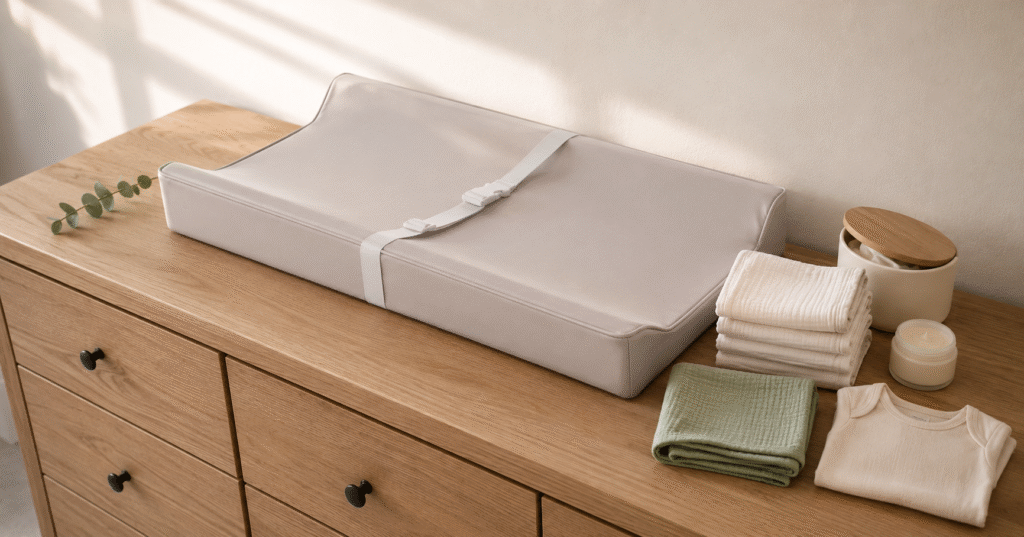
I want to start with a confession that goes against every nursery checklist you’ve probably read: across three babies, I have never once owned a changing table.
My daughter (now six, and very offended whenever I bring this up) got changed on a folded towel laid across our bed for the first year. By the time my older son arrived, I’d at least figured out that a real changing pad on top of a regular dresser beats the bedsheet improv. By the time my youngest son came along eighteen months ago, I’d cycled through enough setups across mom-group friends, baby showers, and my own three rounds of nesting to actually know what I was looking at. Three babies in, I finally had it figured out.
Here’s what those three rounds taught me: the changing pad is the piece that actually matters. The changing table is optional, swappable, and often overpriced for what it does. A good pad lives with you through blowouts at 3am, projectile pee, and the moment you realize the clean diapers are across the room — and baby’s coming with you to get them. The pad is where safety, cleanability, and your sanity meet.
So I spent the past several weeks doing what I do whenever I’m writing one of these guides: cross-referencing Babylist, The Bump, BabyGearLab, and Mommyhood101’s reviews, digging through CPSC recall records, reading hundreds of one-star and three-star reviews to find what actually breaks, and pulling current Amazon sales data to see which products parents are buying right now versus which ones are coasting on dated recommendations.
The result is below: five changing pads I’d put on any baby registry today, plus one changing table for the parents who want a dedicated furniture piece. None of these are sponsored. None of them are the most expensive or the prettiest options I could have picked — they’re the ones that kept showing up across independent reviews, in the nurseries of friends whose judgment I trust, and in the long-term ratings that hold up after a thousand diaper changes.
Quick Picks at a Glance
- Best Overall: Keekaroo Peanut Changer — the wipe-clean splurge worth every penny
- Best Budget: Munchkin Secure Grip — the bestseller for a reason
- Most Popular Choice: Skip Hop Nursery Style — the one with the toy bar
- Best for Safety-Conscious Parents: Graco Premium Contoured — triple-certified for chemicals
- Best Portable: Skip Hop Pronto Signature — the diaper bag’s best friend
- Best Stand-Alone Table: Delta Children Eclipse — pad included, four-sided safety
Before We Get Into Picks: The Safety Stuff That Actually Matters
If you skim nothing else in this guide, please read this section.
Pediatricians from the American Academy of Pediatrics and across the medical community agree on one thing: babies should never be left unattended on a raised changing surface, even for a moment. Falls are the leading cause of nonfatal injuries for infants under one year old, and elevated surfaces like changing tables, beds, and sofas are among the most common scenes. The standard ASTM safety test (F2388) for changing pads exists precisely because babies wiggle, roll, and arch backward at the worst possible moments.
A few non-negotiables when shopping:
- Look for a contoured shape with raised sides. Flat pads are essentially a slippery mat with no rolling barrier.
- The pad needs a safety strap. Use it every single change, even the 30-second ones.
- The pad needs to attach to your changing surface. Whether through a non-skid bottom, screw-in fabric straps, or hook-and-loop tabs — something has to keep the pad from sliding when your baby starts kicking.
- Check the CPSC database before buying. The U.S. Consumer Product Safety Commission maintains a recall search you can run on any baby product in about 30 seconds. I run it on every product I recommend here.
One more thing that doesn’t get talked about enough: certifications. GREENGUARD Gold means a product has been independently tested for over 10,000 chemicals and VOCs. JPMA (now operating as Baby Safety Alliance) means an accredited lab has sample-tested for safety and performance. These aren’t marketing — they’re verifiable third-party testing. I’ll flag which products have which throughout this guide.
The cover trap I see new moms fall into: Beautiful organic cotton changing pad covers look gorgeous in nursery photos. They also soak up pee instantly and need a wash after almost every change. The first-time moms in my circle who started with cotton-only setups all ended up adding a wipe-clean pad within the first month. If you do nothing else after reading this guide, please consider that the convenience of wipe-clean beats the aesthetics of cotton every single time.
1. Keekaroo Peanut Changer — Best Overall
If money were no object and someone said “pick one changing pad for all three of your future babies,” the Keekaroo Peanut would be the answer every time.
It’s been on my radar for years through three rounds of nesting research. The story I keep hearing from friends who own one is some version of “I watched my mom-group friend wipe one down in five seconds during a playdate blowout and ordered mine that night.” That’s the thing about the Peanut: Keekaroo bills it as the only changing pad on the market with a true shell-over-foam construction, and independent reviewers largely back that up. The outer skin is a proprietary material called Dura-Soft (essentially a soft synthetic rubber), and it’s bonded directly over a foam core. There’s no cover. There’s no cotton anywhere. There’s just a single piece you wipe down and walk away.
Here’s what makes it the gold standard in this category:
- Five-year warranty. Most pads come with one year, if any. Five years means the manufacturer is genuinely standing behind durability.
- Made in the USA — the only pad on this list manufactured domestically.
- Independently tested non-toxic. Free from BPA, PVC, latex, phthalates, formamide, and PBDE flame retardants. JPMA-certified to ASTM F2388.
- Genuinely impermeable. The kind of blowouts that would ruin a fabric cover in a single change wipe off the Peanut in under ten seconds, based on consistent long-term review reports.
- It pays for itself. Cotton covers cost $15-25 each, and you typically need three to four to keep up with laundry. The math closes the gap fast.
That said, there are real trade-offs.
The Vanilla (cream) color can stain from beets, blueberries, and major blowouts if you don’t wipe it down immediately — a frequent point in three-star reviews. If staining stresses you out, choose the Slate or Grey version; same product, just darker. The surface can also feel cool to the touch in winter. Not cold enough to upset most babies, but if your nursery runs chilly, a burp cloth across the top half does the trick. And yes, it’s expensive. There’s no way around that.
Despite all of that, it’s the changing pad I’d point any new mom toward when she’s building her registry. Check the current price on Amazon →
Best for: Parents who want one changing pad that lasts through multiple children with zero cover laundry.
Heads-up: The Vanilla color stains; choose Grey or Slate if you have a clumsy older sibling around.
2. Munchkin Secure Grip — Best Budget
If the Keekaroo represents the splurge end of the spectrum, the Munchkin Secure Grip is its honest, hardworking opposite. It’s the pad I’d buy if I were starting over with a tight budget — and based on how aggressively it dominates the bestseller charts in this category, it’s clearly the pad most parents are buying.
The reason is simple: it does the basics very well. Contoured cushioned foam shape, easy-wipe waterproof surface, and a clever bottom design with rubber “Xtra Grip” dots that genuinely keep the pad from sliding on a smooth dresser. It also ships with two fabric attachment straps and screws to anchor the pad to the back of your changing furniture, which is something I wish every pad came with.
The brand has Baby Safety Alliance certification (the new name for JPMA), which means an independent laboratory has sample-tested the product against ASTM standards. That’s the same certification you’ll see on the Keekaroo and Graco picks, just at a fraction of the price.
What you’re trading off at this price point:
- No GREENGUARD Gold certification (the Graco Premium below adds it at a similar price).
- The foam surface feels colder in winter than a wipe-clean rubber pad like the Keekaroo — most parents pair it with a cotton or fleece cover, which adds a small ongoing laundry burden.
- The pad itself is waterproof, but if you buy a separate cover (recommended), the cover is not.
None of these are deal-breakers for a budget pick. The Munchkin has been on the market for over a decade with a near-perfect star rating across tens of thousands of buyers, and that kind of track record is hard to fake. View on Amazon →
Best for: First-time parents on a budget who want a reliable, basic pad without compromising safety.
Heads-up: Plan to buy a cotton cover or two for warmth; the bare pad surface can feel cool against baby skin.
3. Skip Hop Nursery Style — Most Popular Choice
The Skip Hop Nursery Style is the changing pad I see in more than half of my mom-group friends’ nurseries. There’s a reason — and it’s mostly the toy bar.
The structural pitch is familiar: contoured cushioned foam, wipe-clean surface, safety belt, non-skid base with tabletop attachment. What makes it different is the tuck-away toy bar with a baby-safe mirror that arches over the head end. For babies aged roughly three to nine months (the peak “fight every diaper change” window), that toy bar has saved many, many parents from full meltdowns mid-change.
It’s also extra-wide at 18.25 inches versus the standard 16, which gives squirmy babies more room before they hit a side. PVC-free and phthalate-free, in case those are deal-breakers for you — they’re the kind of certifications new moms in nursery review groups consistently flag.
Two heads-ups before you buy:
The metal frame underneath the toy bar can scratch wooden dressers. This shows up repeatedly in three-star Amazon reviews and across nursery furniture forums. If you’re planning to put this on a wood surface you care about, slip a felt furniture pad underneath.
When the toy bar is tucked down, it sits slightly above the head end of the pad. Some babies’ heads naturally tilt or arch backward against it, and a small but real minority of parents report it makes their baby look uncomfortable. My take: try keeping the toy bar fully tucked away when your baby’s lying down, and only deploy it when they’re actively distracted and looking up.
If those caveats don’t faze you, this is the pad with the highest “kept us sane during the screaming-baby phase” testimonial volume of anything on this list. Check it out on Amazon →
Best for: Parents of older babies who turn diaper changes into a wrestling match.
Heads-up: Slip a felt pad underneath if you’re using it on a nice wooden dresser.
4. Graco Premium Contoured — Best for Safety-Conscious Parents
This is the pad I’d recommend if you’re the kind of parent who reads ingredient labels and certification stamps before adding anything to your cart. Which — let’s be honest — describes a lot of us once we start nesting.
The Graco Premium Contoured is the only changing pad in this guide that holds three independent third-party certifications: GREENGUARD Gold (screened against more than 10,000 chemicals and VOCs), JPMA / Baby Safety Alliance (sample-tested against ASTM safety standards), and UL Formaldehyde-Free certification (independently lab-tested in environmental chambers). To my knowledge, no other pad in this price range hits that trifecta.
The pad itself is made from PEVA (a PVC-free vinyl alternative), which means none of the off-gassing concerns parents sometimes raise with traditional vinyl changing pads. It has the standard contoured walls, plush buckle cover designed to avoid pinching baby’s skin, two safety straps for anchoring to a dresser, and a non-skid bottom. Standard 16 × 32 inch sizing fits any standard changing topper.
The trade-off versus the Munchkin — its closest competitor at a similar price point — is genuinely just about certification depth. The Munchkin will likely perform similarly in your day-to-day life. But if you care about verified chemical screening for the surface your baby spends multiple hours a week lying on, the Graco is the stronger pick.
The one knock on this product is the one-year warranty, which is short compared to the Keekaroo’s five years, though within industry norm. View on Amazon →
Best for: Parents who prioritize verified non-toxic certifications without paying premium-pad prices.
Heads-up: The plush buckle cover is comfortable but not waterproof — the pad itself is what wipes clean.
5. Skip Hop Pronto Signature — Best Portable
You need a portable changing pad. I promise. Even if you have a dedicated nursery setup, the moment you start leaving the house with a baby, you’ll find yourself changing diapers in airport bathrooms, in the back of your car, on a friend’s living room floor, at the pediatrician’s office on top of that thin tissue paper they put down, and in the rare gas station that has a fold-down changing table you don’t fully trust. (If your baby starts daycare, you’ll also want one to send along — most daycares supply their own pads but a backup is gold for outings.)
The Skip Hop Pronto Signature is the portable changer that comes up most consistently in long-time mom recommendations and across editorial picks. It folds down into a compact clutch about the size of a paperback book, with a wrist strap and a stroller clip. Unfolded, it gives you a 23.5 × 21.75 inch padded changing surface with a built-in pillow at the head end — the “Pronto pillow,” which reviewers consistently call out as the standout feature because it gives baby’s head a soft landing on hard public surfaces.
Inside the clutch portion: a mesh pocket that holds about four diapers plus a tube of diaper cream, a front zipper pocket for keys and your phone, and a translucent wipes case. The whole thing weighs about 12 ounces empty.
Here’s what to know before you buy:
- It’s not a replacement for a diaper bag. The capacity is enough for one outing’s worth of supplies, not a whole day’s. Think of it as the thing you grab when you’re going for a 90-minute coffee with a friend, not the thing you take on a six-hour drive.
- The included wipes case doesn’t seal as tightly as some parents would like — a recurring note in long-term reviews. If you’re doing long days out, the wipes inside can dry out. Many parents pair the Pronto with a separate wipes pack in their main diaper bag and use the Pronto’s case for shorter outings.
- The changing pad itself has minimal cushioning outside the head pillow. It’s fine on a regular surface, less great if you’re changing baby directly on hard tile.
None of those caveats matter for what this actually is: a stylish, lightweight portable changer for short outings. Check it on Amazon →
Best for: Anyone who leaves the house with a baby (so, all of us).
Heads-up: Plan to refill the wipes case before each major outing.
What About a Dedicated Changing Table?
Time to push back on the standard nursery checklist a bit. You don’t actually need a dedicated changing table. Plenty of parents (including me, three times over) use a regular dresser with a changing pad strapped to the top. It’s actually the setup most pediatricians recommend, because it gives you long-term furniture you’ll use for years, plus storage you’d want anyway.
That said, dedicated changing tables have two real advantages: (1) the four-sided safety rails on most stand-alone tables provide more rolling protection than a pad alone, and (2) the open-shelf storage style is easier to grab from one-handed than dresser drawers, especially in those early months when you have a wiggly baby in the other hand.
If you want a dedicated piece of furniture, here’s the one I’d actually recommend after researching the entire category.
6. Delta Children Eclipse Changing Table — Best Stand-Alone Changing Table
If you’ve weighed the dresser-top route and decided a dedicated changing table earns its floor space in your nursery, the Delta Children Eclipse is the one I’d point you toward.
At a mid-range price point, it includes everything you actually need: a sturdy solid-wood-and-composite frame, four-sided safety rails built right into the table (most dresser-top setups rely on the contoured walls of whichever changing pad you add on top), a water-resistant changing pad with a safety strap built in, and two open storage shelves below for diapers, wipes, lotion, and outfit changes. Open shelving in particular makes one-handed grabs much easier when you have a wiggly baby on top — there’s no drawer to fumble open.
Certified by the Baby Safety Alliance (formerly JPMA), tested for lead and other toxic elements, and includes an anti-tip device that meets current ASTM safety standards. The Delta Children brand has been making nursery furniture since 1968 — they’re not a flashy direct-to-consumer brand, but they’re one of the most established names in the category, and the Eclipse has held up across thousands of long-term reviews.
Honest trade-offs:
- The included changing pad is on the thinner side — this is consistent feedback across reviews. If you want more cushion, the Munchkin Secure Grip or Graco Premium pad fits perfectly on top.
- The warranty is 90 days — short by industry standards. That said, after digging through long-term reviews from parents who’ve owned the Eclipse for three to five years, it consistently holds up well past that window.
- It’s not convertible. Once your baby ages out of diaper changes, the Eclipse becomes either a low-priority storage piece or something to donate — unlike a dresser-top setup, where the furniture keeps earning its place for years.
For the price point and the safety features, it’s hard to beat. Check current pricing on Amazon →
Best for: Budget-conscious parents who want a real changing table without the price tag of premium nursery furniture.
Heads-up: Plan to swap out the included pad if you want more cushioning.
How to Set Up Your Changing Station (Whichever Pad You Choose)
A few things I wish someone had told me before my first baby arrived:
Anchor your changing pad to whatever it sits on. Most pads ship with fabric straps and screws for exactly this. Use them. The non-skid bottom alone is not enough once your baby starts kicking and arching.
Keep absolutely everything within arm’s reach before you start. Diapers, wipes, diaper cream, a clean outfit, a spare burp cloth. The cardinal sin of diaper changes is turning your back for “just one second” to grab something across the room. According to the CDC’s Injury Center, falls are the leading cause of nonfatal injuries treated in U.S. emergency rooms for young children — and elevated surfaces are where most of them happen.
Don’t put your changing setup near a window with cords. Blind cords are a strangulation hazard that gets overlooked because the changing surface itself feels safe. The AAP and CPSC both recommend moving cribs, changing tables, and other nursery furniture away from windows with corded blinds entirely — and going cordless wherever possible.
Frequently Asked Questions
Do I need both a changing pad and a changing pad cover?
It depends on which pad you buy. For wipe-clean rubber pads like the Keekaroo Peanut, you don’t need a cover — that’s the whole point. For foam contoured pads like the Munchkin Secure Grip or Skip Hop Nursery Style, most parents add a cotton cover for warmth and softness against baby skin. If you go the cover route, plan to buy three or four so you always have a clean one during laundry cycles.
When can I stop using a changing pad?
Most pads are rated for babies up to 30 pounds, which usually means you’ll outgrow them somewhere between 18 and 24 months — or earlier if you have an early walker who refuses to lie still. Once changing on the floor with a thick towel becomes safer than trying to wrestle a toddler on a raised surface, that’s your sign.
Are wipe-clean pads better than foam pads with covers?
“Better” depends on your priorities. Wipe-clean pads (Keekaroo) win on cleanup speed, laundry load, and hygiene during illness. Foam pads with cotton covers (Munchkin, Skip Hop) win on price, warmth, and that soft “real bedding” feel some parents prefer. Both work safely if used with the strap and properly anchored to your changing surface.
What’s the difference between GREENGUARD Gold and JPMA certification?
They test for different things. GREENGUARD Gold specifically certifies that a product has been screened for chemical emissions and VOCs (volatile organic compounds) — the stuff that off-gasses into your nursery air. JPMA / Baby Safety Alliance certifies that a product has been sample-tested against the structural safety standards set by ASTM. The Graco Premium Contoured pad on this list has both, plus UL Formaldehyde-Free certification — that’s about as comprehensive as it gets.
How do I clean a changing pad after a major blowout?
For wipe-clean pads: a damp cloth with mild soap, followed by a sanitizing wipe. Don’t submerge them in water, and don’t use harsh bleach which can degrade the surface material over time. For foam pads with covers: remove the cover and machine wash on warm, wipe the pad itself down with a sanitizing wipe, and let everything air-dry completely before re-assembling.
All product details current as of publication. Prices and availability may change — always confirm on the retailer’s site before purchasing. As an Amazon Associate, I earn from qualifying purchases at no additional cost to you.