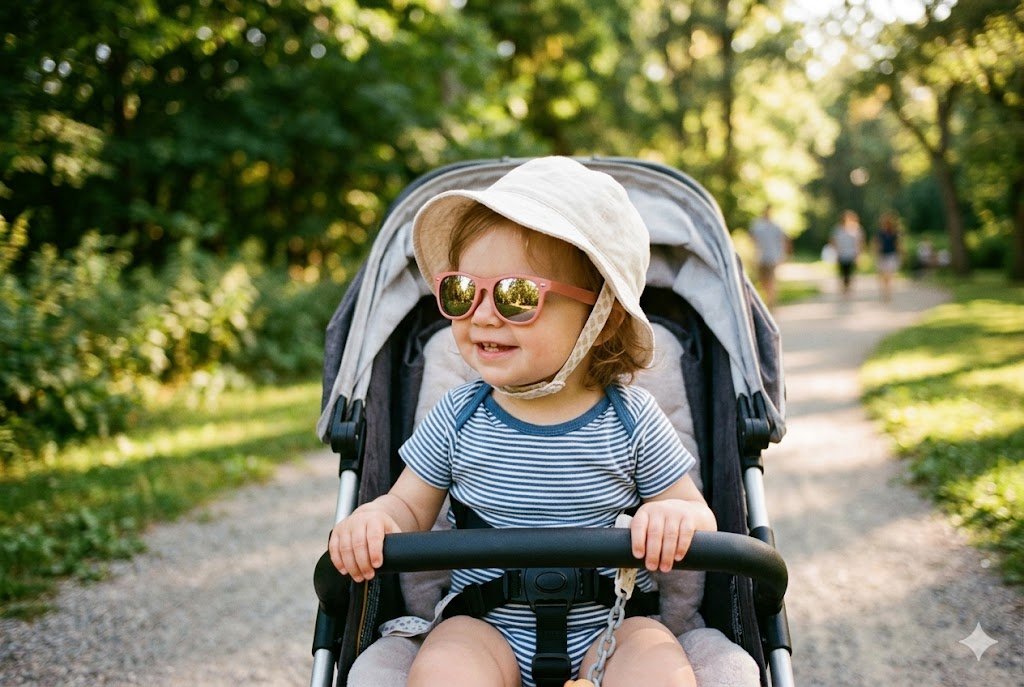
By the time you’ve got a third baby, you stop pretending you’ll find the “perfect” anything, and you start ruthlessly testing what actually survives stroller naps, beach sand, and a 19-month-old who treats every accessory as a chew toy. Sunglasses for babies are no exception. After a decade of pushing strollers through high-UV summers, snow-day errands, and far too many afternoon park trips with three kids in tow, I’ve seen dozens of pairs come and go in our household.
So when I sat down to research the best baby sunglasses for 2026, I didn’t want to give you another “10 cute picks” list. I wanted to know: which pairs are actually being bought by tens of thousands of parents this season, which ones hold up to a wiggly toddler’s grip strength, and which ones pediatric optometrists genuinely back. I spent weeks cross-referencing the American Academy of Pediatrics sun-safety guidance, American Academy of Ophthalmology recommendations on UV exposure in childhood, independent reviewer roundups from Babylist’s 2026 update, WonderBaby, and MomJunction, plus thousands of one- and two-star reviews on Amazon to find the actual failure points.
These six pairs are what’s left standing. Every one is in stock as of this writing, every one has thousands of verified parent reviews, and every one earned its spot through a different strength: budget, polarized lenses, newborn fit, durability, or the Babiators warranty that pays for itself the first time a toddler launches them out of the stroller.
Do Babies Really Need Sunglasses?
Yes, and earlier than most parents realize. The piece most parents don’t know: children’s eyes transmit significantly more UV light to the retina than adult eyes do, because the lens is clearer and less developed. The AAP’s policy statement on ultraviolet radiation in children emphasizes that UV damage to the eyes is cumulative over a lifetime, and that early protection meaningfully reduces the risk of later eye disease like cataracts and macular degeneration.
The good news is that sun protection for babies isn’t complicated. It’s a three-piece system: a UPF sun hat, mineral baby sunscreen on exposed skin from 6 months onward, and a snug-fitting pair of UV400 sunglasses anytime they’re in direct sunlight. We covered the sunscreen piece in detail in our best baby sunscreen 2026 guide. Sunglasses are the third leg of the same stool.
What to Look For in Baby Sunglasses
Before we get to the picks, here’s the short list I use to vet any pair:
- 100% UV400 protection. This is non-negotiable. Anything less is a fashion accessory, not eye protection. Look for “UV400” or “100% UVA/UVB” explicitly on the listing.
- Polarized lenses (bonus, not required). Polarization cuts glare from water, snow, and pavement. The AAO says it’s especially helpful for kids who spend time on water, snow, or in bright sun, though non-polarized sunglasses with full UV protection are still completely fine.
- Flexible, shatter-resistant frames. TPE or rubberized frames bend instead of snapping. This matters more than you think, because babies will absolutely bend, twist, chew, and step on these.
- Adjustable strap. The difference between sunglasses you actually use and a $25 donation to the bottom of your diaper bag. Especially under age 2, the strap is what keeps them on long enough to do any good.
- Snug fit without pressure marks. Too tight and you’ll see angry red lines on the bridge of the nose after a 20-minute walk. Soft silicone nose pads help.
- BPA-free, non-toxic materials. Assume they’re going in baby’s mouth at some point.
With that framework, here are the six pairs I’d actually recommend in 2026.
6 Best Baby Sunglasses 2026
1. Baby Solo Babyfarer — Best Budget (Optometrist-Designed)
If I had to start a parent at one pair, it would be this one, and not just because of the price. Baby Solo is a small Miami family business whose sunglasses are designed by US optometrists, which is a credential almost no other sub-$10 pair on Amazon can claim. They sit consistently at the top of Amazon’s baby girls’ sunglasses bestseller list, and the value-to-quality ratio is honestly hard to argue with.
The Babyfarer is a classic mini-Wayfarer shape in BPA-free polycarbonate, with 100% UV protection, an anti-scratch coating, and an adjustable soft strap. It’s not polarized (that’s the trade-off at this price), but for daily stroller walks, errands, and casual outdoor time from 6 months through about age 3, polarization isn’t required as long as UV400 is.
Best for: First-time sunglasses purchase, twin families, parents who want a “lose-it and don’t cry” backup pair, or anyone testing whether their 6-month-old will actually tolerate sunglasses before investing in a premium pair.
2. COASION Baby’s First with Strap — Best Heart Shape
The heart shape isn’t a safety upgrade, and I won’t pretend it is. But it photographs incredibly well, and that matters when you’re trying to bribe a toddler to keep sunglasses on long enough for the actual UV protection to do its job. (Whatever works, right?) This pair is the #2 bestseller in the category for a reason.
What makes COASION’s heart frame worth recommending isn’t the cute factor. It’s that they didn’t compromise on the specs. You get true UV400 polarized lenses, a flexible rubber frame that survives bending and twisting, and an adjustable strap that goes from newborn to about 2 years. Lens width is 41mm, frame width 106mm, and the whole pair weighs just 13.4 grams, light enough that babies forget they’re wearing them.
Best for: First birthday photos, beach trips, daycare sun-time, and any parent who wants polarized protection without the premium price tag. Boys, fair warning: the heart shape will read as “girl coded” to most observers.
3. COASION CA8042 — Best Polarized Newborn Wayfarer
The CA8042 is the pair I’d point to for a brand-new parent shopping for shower gifts or a 3-month-old’s first beach trip. They’re sized specifically for the 0-12 month range, with a narrower bridge and smaller lens diameter, which sounds obvious but is rarer than you’d think. Most “newborn” sunglasses on Amazon are actually 0-24 month listings with strap adjustments doing all the work.
What sets the CA8042 apart in research: COASION markets the polarization claim front and center, and parent reviews back it up. Thousands of verified buyers repeatedly mention the strap stays put, the frame bends without breaking, and the mirrored lenses (offered in black/green, black/blue, pink, and others) survive teething. WonderBaby tagged this exact pair as their “Best Polarized” pick.
Best for: Newborns through 12 months, high-UV climates, first-baby-shower gifts, parents who want polarization specifically for water or snow glare. After 12 months, sizing up to the COCOSAND or Babiators is the natural next step.
4. COCOSAND Flexible with Strap — Best Overall (Amazon Sales King)
If you only buy one pair, make it this one. COCOSAND’s flexible Wayfarer is, by some distance, the most-purchased baby sunglasses listing on Amazon. It occupies multiple slots in the top 15 bestsellers simultaneously because the parent listing has so many color variants. Tens of thousands of parents have reviewed it, and the rating has held remarkably steady. Babylist, WonderBaby, and MomJunction have all featured COCOSAND in their roundups over multiple update cycles.
The engineering is what earns the volume. The frame is TPE (the same food-grade plastic used in baby bottles), bends 360 degrees without breaking, and uses one-piece silicone nose pads that genuinely solve the red-mark-on-the-nose problem so common in this category. The strap is 95% polyester / 5% neoprene, adjustable from 110mm to 195mm, so the same pair grows with baby from about 4 months through the second birthday. Lenses are polarized with 100% UV blocking, and the hex socket screws don’t loosen the way standard kid-sunglasses screws do.
Best for: The safe default. If you’re overwhelmed by choices, want one pair that works across most situations from 6 months to 2 years, and don’t mind the slightly-higher price tag, this is it. The 15+ color variants also mean it doubles well as a baby shower gift.
5. JAN & JUL Urban Xplorer — Best for Active Toddler 2-6Y
By the time your toddler is running, climbing, throwing things at the dog, and generally giving zero thoughts to your shopping cart, somewhere around 2 to 3 years, the baby-sized pairs start losing their grip, both literally and figuratively. JAN & JUL is what I’d recommend for that transition. Babylist named these their “Best Polarized and Super Durable” pick in their January 2026 update, and the durability claim isn’t hype. Babylist’s gear editor specifically referenced a video of the frames being run over by a car and surviving.
The Urban Xplorer line uses TPEE (a softer, more elastic relative of TPE) for the frame, shatter-resistant polarized TAC lenses, and a low-profile adjustable elastic strap. Materials are BPA, phthalate, and PVC-free, and they’re CPSIA compliant, which matters if you’re handing them down between siblings. The brand is Vancouver-based (Twinklebelle Design Inc), and they pair well with JAN & JUL’s UPF sun hats if you want a coordinated sun-protection setup.
Best for: Active toddlers age 2-6, older siblings who’ve outgrown infant pairs, hiking and bike-riding families, anyone who’s already lost three pairs of cheaper sunglasses to “I don’t know where they went, Mommy.”
6. Babiators Original Navigator — Best Premium with Warranty
Babiators has been the gold-standard baby sunglasses brand since 2009, Atlanta-based, with a cult following among parents who don’t want to keep replacing $10 pairs every six months. Babylist included Babiators as their top pick for “Best Toddler Aviator” in their 2026 update. What you’re paying the premium for, honestly, is the Lost & Found Guarantee: if your toddler loses or breaks them within one year, Babiators will replace them. You do have to register the pair on Babiators’ own website within 30 days of purchase, a step a lot of Amazon buyers miss. Don’t be one of them.
Beyond the warranty, the build quality genuinely is a step up. The Original Navigator uses 100% recycled rubber for the frame, impact- and shatter-resistant lenses with full UV400 protection, and the classic navigator shape that doesn’t go out of style. The 0-2Y “Junior” size fits roughly 0 to 24 months; the 3-5Y “Classic” size carries through to kindergarten. Even the storage pouch is made from 100% recycled microfiber.
My husband and I disagree about whether the Lost & Found Guarantee is worth the premium. He’s pro, I’m skeptical, and the answer probably depends on how often your toddler “redecorates” the car floor.
Best for: Premium-tier shoppers, gift-givers (these make excellent baby shower gifts because the brand recognition is high), parents of “hands-on” toddlers where the warranty pays for itself within a year. If the Babiators logo on the temple bothers you, the Keyhole or Aviator silhouettes from the same brand offer lower-profile branding.
When Do Babies Need Sunglasses?
The American Academy of Pediatrics recommends sunglasses for babies starting at 6 months of age, in any season where they’re spending time outdoors. That includes winter, because snow reflects up to 80% of the sun’s rays, which is why “snow blindness” is a thing skiers worry about. Babies and toddlers are at higher risk than adults because their pupils are larger and their lenses transmit more UV light.
Under 6 months, the AAP guidance is different and clearer: no sunscreen, no sunglasses, just shade. Use the stroller canopy, a wide-brim sun hat, breathable long sleeves, or stay indoors during peak UV hours (roughly 10 AM to 4 PM). The skin and eyes are simply too sensitive to add products at that age.
Are Baby Sunglasses with Strap Worth It?
Under age 2, absolutely yes. Toddlers do not understand that sunglasses protect them. They understand that there’s a thing on their face and the thing must come off. A strap means you put them on once, they stay put for the duration of the stroller walk, and the UV protection actually has a chance to work. Five of the six pairs above (all but the Babiators Navigator) include an adjustable strap for exactly this reason.
From about age 3 or 4 onward, most kids will keep sunglasses on without a strap. Partly because they’ve learned that the world looks better with them on, and partly because by then they’ve figured out that yanking them off and throwing them isn’t the social win they thought it was at 18 months.
Safety Tips for Real-Life Use
- Stroller walks: Combine sunglasses with the stroller canopy fully extended. Sunglasses alone aren’t enough on a south-facing afternoon walk. If you’re still shopping for a stroller, our best travel strollers 2026 guide covers canopy coverage in detail.
- Car seat / rear-facing: Direct sun through a car window is one of the highest-UV exposures babies get. Sunglasses plus a window shade is the right combo. Never leave sunglasses on a sleeping baby; they can slip down over the nose and mouth. The AAP also reminds parents that car seats are for travel, not for prolonged sleep.
- Beach trips: Polarized matters here. The reflection off sand and water doubles the UV dose. Pair with a wide-brim hat and our recommended mineral baby sunscreen.
- Summer outdoors generally: Sunglasses are one piece. If you’re heading anywhere with mosquitoes (parks, lakes, dusk walks), our safe mosquito repellent guide by age rounds out the kit.
- Cleaning: Warm water and the included microfiber cloth. No chemical lens cleaner, since toddlers will absolutely put the lens back in their mouth.
- Replace when scratched: Deeply scratched lenses can scatter UV light unpredictably. If the lens shows visible scratches across the visual axis, retire the pair.
The Bottom Line
If you want the short version: start with the COCOSAND Flexible if you can only buy one pair and your baby is 6-24 months. Drop down to the Baby Solo Babyfarer if budget is tight. Go up to Babiators if you want the warranty cushion or you’re buying a gift. Add the COASION CA8042 specifically for newborns under a year, and graduate to JAN & JUL once your kid is running marathons through the playground.
All six pairs hit the AAP’s 99%+ UV protection threshold, all six are in stock and currently shipping, and all six have enough parent reviews behind them that you’re not buying a fashion experiment. Whichever you pick, the most important thing is that you pick something and start the habit early. Those little eyes have a lot more sun ahead of them, and ten bucks now is cheaper than the cataract surgery later. (Mostly joking. Mostly.)