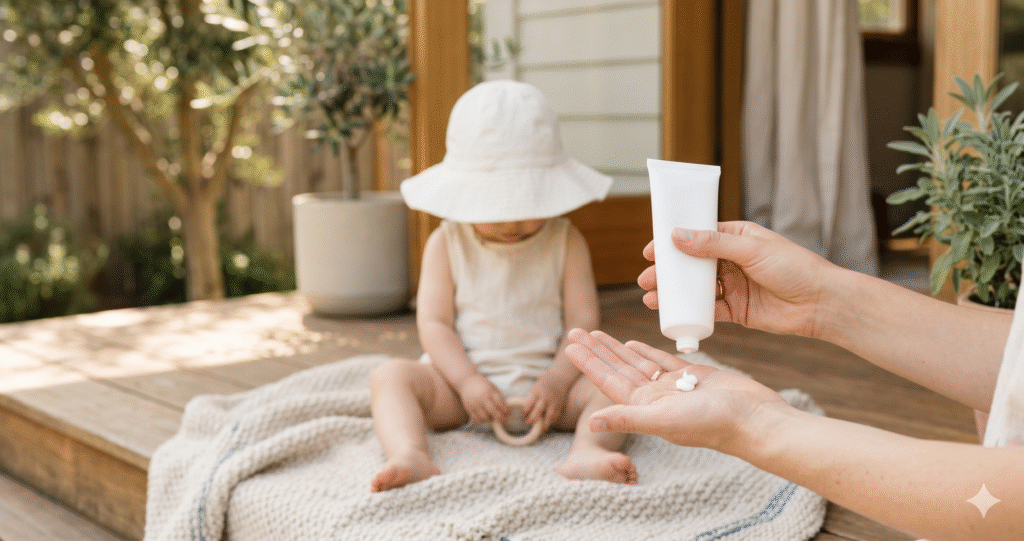
My youngest son is nineteen months old, and last May I spent a sweaty hour at the beach watching him refuse to keep his sun hat on for more than about thirty seconds at a time. I had brought three different sunscreens with me, two recommended by well-meaning friends and one I’d panic-grabbed at Costco the week before, and every single one had something buried in the ingredient list that made me second-guess whether I should actually be putting it on his face.
I’ve spent the six years since my daughter was born reading ingredient labels like they personally owe me money. And if there’s one category where the labels lie hardest, it’s sunscreen, especially the ones marketed to babies. The word “natural” means nothing on a U.S. sunscreen label; Thinkbaby is currently facing a class action lawsuit over exactly that claim. “Mineral” can still mean a hybrid formula with chemical filters tucked in. “Baby-safe” doesn’t protect you from benzene contamination when the parent company is big enough to get recalled, as happened with Neutrogena and Aveeno in 2021. And separately, Babyganics was recalled in March 2025 after independent testing found its SPF 50+ label didn’t match actual efficacy.
So this year I tossed the sunscreens I had and set one rule: if a baby sunscreen isn’t EWG Verified or rated green in EWG’s Skin Deep database, it doesn’t go on any of my three kids. These six are what survived the cut.
Under 6 Months: Shade First, Sunscreen Second
Before we talk about products, let’s cover the most important rule, because a shocking number of baby sunscreen guides skip it: the American Academy of Pediatrics recommends that babies under 6 months should be kept out of direct sunlight as much as possible. Not “use baby sunscreen carefully.” Keep them in shade.
Why? Newborn skin is thinner and more permeable than older-baby skin, which means the active ingredients in sunscreen (even the mineral ones) absorb more readily. A baby’s surface-area-to-body-weight ratio is also much higher than an adult’s, so the per-pound dose of any topical product ends up higher than you might expect.
For water time specifically, I default to UPF 50 swim shirts (stuff like iPlay or RuffleButts) plus a wide-brim hat with a chin strap, because my kids will take a regular hat off within about eight seconds. My daughter was born in October, so I mostly dodged the summer-baby sunscreen question with her. My older son was a summer baby though, and I still remember the stretch of weeks where my husband and I basically planned our entire outdoor life around the stroller canopy. Tedious. Safest.
Mineral vs. Chemical Sunscreen: What Baby Skin Actually Needs
Every sunscreen on the U.S. market falls into one of two camps based on its active ingredient.
Mineral (also called physical) sunscreens use zinc oxide or titanium dioxide as the active ingredient. These sit on top of the skin and reflect UV rays rather than absorbing them. Zinc oxide alone gives you the broadest UVA/UVB coverage of any FDA-approved active ingredient, which is why most pediatric dermatologists recommend zinc-based formulas for babies and toddlers.
Chemical sunscreens use active ingredients like oxybenzone, octinoxate, avobenzone, octocrylene, and homosalate. These absorb into the skin and convert UV radiation into heat. The FDA has been asking chemical-sunscreen manufacturers for additional safety data since 2019, because multiple studies have found that these compounds show up in users’ bloodstream within hours of application. Oxybenzone and octinoxate specifically have been linked to hormone disruption in animal studies, and are banned in Hawaii and Key West for the damage they cause to coral reefs.
For babies and young kids, every pediatric dermatology guideline I’ve read (and I’ve read a lot of them) recommends sticking with mineral. No hybrid “mineral-based” formulas that sneak in a chemical filter or two. I’ve seen too many brands do that. All six picks below are zinc-primary, mineral-only.
What “EWG Verified” Actually Means (And Why I Only Feature It)
The Environmental Working Group’s sunscreen guide rates every sunscreen on a 1–10 hazard scale, and a subset of those products earn the separate EWG Verified® mark — a stricter certification that requires the product to avoid every ingredient on EWG’s Unacceptable List, provide full transparency (including what’s in fragrance), and be reviewed by EWG’s scientists.
It matters because it’s the single most rigorous independent standard currently applied to sunscreen in the U.S. market. Of the 2,200+ sunscreens EWG screened in 2025, only about 63 earned the Verified mark. Most drugstore “baby mineral” options, including Babyganics, are rated Moderate Hazard by EWG rather than green. That’s why you won’t find them on this list.
6 Best Baby Sunscreens 2026
1. Babo Botanicals Sensitive Baby Mineral Sunscreen Lotion SPF 50 — Best Overall
Babo Botanicals is EWG Verified, and it’s been my go-to ever since I audited our sunscreen stash last fall. The active ingredient is 20% zinc oxide (nothing else), and the inactive ingredients list reads like a cold-pressed salad: sunflower oil, coconut oil, shea butter, chamomile extract, calendula. No silicones, no phenoxyethanol, no ambiguity.
On my youngest son’s skin it goes on thicker than a chemical lotion would, which is the nature of a 20% zinc formula, but it rubs in to a matte finish within a couple of minutes. I’ll be honest: on my husband’s darker skin you can see a faint white cast for the first five minutes or so. For pale toddler legs, it vanishes. The 3 oz tube is small for a family of five, so I keep two in rotation. (In my experience one tube lasts about three pool trips before it’s empty and I’m cursing at the recycling bin.) If you want to see it in person first, Whole Foods stocks it in bigger cities.
2. Blue Lizard Baby Mineral Sunscreen SPF 50+ — Best Smart Bottle
Blue Lizard is the one pick on this list that isn’t EWG Verified. It’s rated green in EWG’s guide but uses some inactive ingredients (dimethicone, phenoxyethanol, aluminum stearate) that the Verified program screens against. I still think it’s worth including because its Smart Cap Technology is legitimately useful: the bottle lid turns pink in UV light, which is a surprisingly effective reminder that you’re actually exposed. It’s saved me from forgetting reapplications more than once.
The formula uses both zinc oxide and titanium dioxide as active ingredients (a “dual mineral” approach), which means it rubs in a bit more easily than a zinc-only formula. It’s also water-resistant for the full 80 minutes, the FDA maximum, which matters if you’re planning any pool or beach time. The 5 oz tube lasts noticeably longer than the 3 oz bottles from other brands on this list, and it’s widely stocked at Target and CVS if you don’t want to wait for an Amazon delivery.
3. Badger Baby Mineral Sunscreen Cream SPF 40 — Best Minimalist Ingredients
Badger’s baby formula has seven base ingredients plus a touch of sea buckthorn for antioxidants. Seven. Zinc oxide, sunflower oil, beeswax, jojoba oil, vitamin E, chamomile, calendula. If you want a sunscreen that reads like a balm recipe rather than a chemistry set, this is it. Badger is a B Corp, the New Hampshire facility runs on solar power, and the tube is 50% post-consumer recycled plastic.
The trade-off is real though: water resistance is 40 minutes, half the FDA maximum. For stroller walks or playground afternoons it’s the cleanest option here. For a pool day, you’ll be reapplying twice as often. The cream is also thicker than the lotions, so I warm it between my palms first, otherwise it’s a wrestling match with my youngest. Target carries it.
4. Earth Mama Kids Uber-Sensitive Mineral Sunscreen SPF 40 — Best for Eczema
This is the one I reach for when any of my three kids has a patch of eczema that’s about to meet the sun. Earth Mama’s Uber-Sensitive formula carries the National Eczema Association Seal of Acceptance, which means its ingredients have been reviewed for suitability on eczema-prone skin. It contains more organic colloidal oatmeal than the FDA actually requires to label a product as an eczema cream, plus organic shea butter. Which is a clever trick: sunscreen and barrier moisturizer in one pass.
Earth Mama rebranded this from “Baby” to “Kids” a couple of years ago, which confused me the first time I tried to reorder (same formula, just the label). Water resistance here is 40 minutes, same limitation as Badger, so plan reapplications accordingly.
5. Attitude Baby Mineral Sunscreen Lotion SPF 50 — Best Budget EWG Verified
If budget matters (and for a product you’re going to be reapplying every two hours all summer, it absolutely does), Attitude is the cheapest EWG Verified baby sunscreen I’ve found. It’s a Canadian clean-beauty brand (made in Quebec) with a short ingredient list, roughly fourteen inactives total, and genuine Verified status. The 3 oz lotion typically runs several dollars less than Babo Botanicals or Mustela.
Two caveats worth naming. First, the glycerin is soy-derived, which matters if there’s a soy allergy in your family. Second, this SPF 50 baby-specific formula is newer to the U.S. market than the other picks here, so the long review track record isn’t quite there yet. EWG Verified does a lot of the heavy lifting on ingredient safety, and Attitude has been making cleaner-than-average personal care products for over a decade.
6. Mustela Mineral Sunscreen Stick Face & Body SPF 50 — Best Face Stick
Every parent hits the moment where their toddler will not, will not, hold still long enough for a lotion application to the face. Enter the stick. Mustela’s mineral stick is EWG Verified, accepted by the National Eczema Association, and small enough to live in the side pocket of a diaper bag indefinitely. My youngest son, who treats facial sunscreen application like a personal attack, will tolerate a quick swipe of this because it’s fast.
My husband keeps one in his car for the weekend park trips I don’t always join, and I keep one in my purse for “we’re already halfway to the playground and I forgot” moments. At 0.6 oz it’s roughly the size of a chapstick, which catches some reviewers off guard. This is a face and touch-up tool, not a whole-body solution. Buy it to supplement the lotion in your bag.
Mustela is also one of the few baby skincare brands actually recommended by pediatricians in both European and U.S. hospital settings, which is part of why I keep coming back to their products. (Their Stelatopia line basically saved us during my older son’s eczema phase when he was two; I’m a fan.)
How to Apply Baby Sunscreen Safely
Timing: Apply the first layer 15 minutes before going outside. Mineral sunscreens technically start working immediately (they sit on top of skin rather than absorbing), but giving them a few minutes to set means you’re not rubbing half of it off on a onesie the moment you walk out the door.
Amount: For a baby or toddler’s body, you want a rough quarter-sized dollop of lotion per limb. Most sunscreens are lab-tested at 2 mg per cm² of skin, which is more product than most people actually apply. If you find yourself finishing a 3 oz bottle over the course of a summer, you’re in the right ballpark.
Reapply: Every two hours, full stop. And immediately after swimming, sweating heavily, or toweling off, regardless of what the “80 minutes water resistant” claim on the bottle says. “Water resistant” is not the same as “waterproof” (no sunscreen can be labeled waterproof in the U.S. since 2011).
For daycare or camp: Hand the teacher or counselor a labeled bottle with your kiddo’s name on it, plus a sticky note that says “reapply at 11 am and 2 pm.” This has saved me from a few “we forgot” sunburns.
After a day in the sun, a gentle bath and follow-up with a fragrance-free moisturizer helps replenish skin. I’ve written more about my favorite clean baby lotions if you’re looking for a post-sun routine, and our full baby bath essentials guide covers everything you need for the nightly cool-down.
Frequently Asked Questions
Can I use a spray sunscreen on my baby?
Short answer: the American Academy of Pediatrics specifically recommends against spray sunscreens for young children, because of inhalation risk. Aerosolized particles get into little lungs too easily. The FDA has also raised concerns about spray sunscreens more broadly, both for inhalation and for flammability near open flames. If you like the convenience of a spray for yourself, that’s fine. For babies and toddlers, stick with lotions and sticks. The 2021 benzene recall also disproportionately hit spray formulations, which is worth knowing.
What’s the difference between SPF 30 and SPF 50 for babies?
Smaller than most people assume. SPF 30 blocks about 97% of UVB rays; SPF 50 blocks about 98%. The real-world protection gap depends far more on whether you’re applying enough product and reapplying on schedule than on which number you picked. Anything SPF 30+ is appropriate for babies 6 months and older, per the AAP.
Do I need to wash mineral sunscreen off at the end of the day?
Yeah, absolutely. Zinc oxide is a physical barrier and is genuinely difficult to scrub off with water alone. A mild soap and washcloth, or the normal bedtime bath routine, takes care of it. Leaving it on overnight can contribute to clogged pores and minor skin irritation, especially on faces.
Can I bring these in my carry-on?
Yep, all six picks are 3 oz or smaller (the Mustela stick is 0.6 oz, basically a rounding error), so they’re TSA-compliant for flights. I usually stash the Mustela stick in my purse and pack one 3 oz lotion per kid in our carry-on.
Is Neutrogena Pure & Free Baby safe since it wasn’t part of the 2021 recall?
The specific Pure & Free Baby lotion wasn’t part of Johnson & Johnson’s benzene recall; that hit five of their aerosol sprays. But the parent-company issue is why I personally opted not to include any J&J sunscreen brand on this list. If you already have it at home and feel comfortable using it, it’s a zinc-oxide formula and rated green by EWG. That call is yours to make.
Want my full printable sun + heat safety checklist?
I made a one-page checklist after I panic-googled “toddler heatstroke symptoms” at 4 pm on vacation last June. It covers reapplication timing, heat-stroke warning signs by age, and the hat-plus-UPF-clothing-plus-shade stack. Grab it free below.