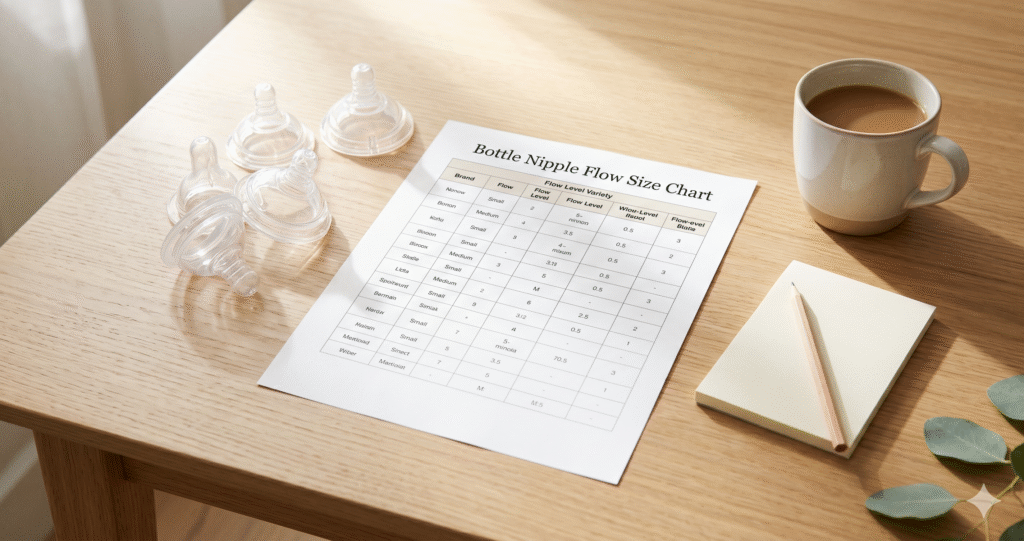
Bottle Nipple Size Chart by Brand
| Brand | Lower / Newborn Flow | Middle Flow | Faster Flow | Important Note |
|---|---|---|---|---|
| Dr. Brown’s Options+ | Ultra-Preemie, Preemie, Level 1 (0+) | Level 2 (3+) | Level 3 (6+), Level 4 (9+) | Y-Cut is labeled 9+ for clinician-directed thicker feeds. |
| Philips Avent Natural Response | Flow 1–2 | Flow 3 | Flow 4–5 in the US and Canada | Choose by drinking style, not age. Natural Response differs from the older Natural line. |
| Comotomo Gen 1 | Slow, 1 hole (0–3 months) | Medium, 2 holes (3+) | Fast, 3 holes (6+) | Original chart: Variable Y-cut (6+); no Preemie flow listed. Match the bottle generation. |
| Comotomo Gen 2 | Preemie (0 months); Slow (0–3 months) | Medium (3–6 months) | Fast (6+); Variable (6+) | Gen 2 nipples do not fit Gen 1 bottles. A Preemie label does not replace an individualized feeding plan. |
| MAM | Size 0 (newborn), Size 1 (0+) | Size 2 (2+) | Size 3 (4+) | Size X is labeled 6+ for thick liquids. |
| Tommee Tippee Natural Start | Extra Slow / Slow (0+) | Medium (3+) | Fast (6+) | US and UK special-flow labels differ; check the exact package and bottle line. |
| Evenflo Balance+ | Slow (0+) | Medium (3+) | Fast / X-Cut (8+) | Standard-neck and wide-neck nipples are not interchangeable. |
| Lansinoh NaturalWave | Extra Slow (XS), Slow (2S) | Medium (3M) | Fast (4L) | Age labels vary by market; Lansinoh advises following feeding cues. |
How to Use This Chart Without Chasing the Calendar
Package ages are useful for finding the right box on a store shelf. They are not a schedule your baby has to graduate through. Nationwide Children’s Hospital notes that a healthy baby who is growing and enjoying bottles may stay on the same nipple level for the entire bottle-feeding period. That is completely okay.
When my daughter was about four weeks old, she sometimes cried and pulled away halfway through a bottle. After checking the bottle assembly, vent, position, and feeding cues, a different flow helped. The useful lesson was not “four weeks means size up.” It was that the whole feed matters more than the number on the package.
This guide gives you the labels for seven common bottle brands, but your baby’s suck-swallow-breathe rhythm is the final check. If feeding suddenly changes, also consider a clogged or damaged nipple, a vent assembled incorrectly, illness, temperature, positioning, or a change in appetite before assuming the flow is wrong.
Bottle Nipple Flow Levels by Brand
Dr. Brown’s Options+
Dr. Brown’s lists Preemie and Ultra-Preemie options below Level 1, followed by Level 1 (0+), Level 2 (3+), Level 3 (6+), and Level 4 (9+). Those ages are manufacturer starting points. The brand recommends considering a change in the context of how feeding is going, not age alone.
The Y-Cut is labeled 9+ and accommodates thicker liquids. Dr. Brown’s specifically ties thickening to a pediatrician’s recommendation. If a clinician has not prescribed a thickened feed, use the appropriate standard nipple rather than choosing Y-Cut simply because your baby is older. See the current Dr. Brown’s nipple guide.
Philips Avent Natural Response
Natural Response needs its own rules. In the US and Canada, the current range is Flow 1 through 5, but Philips tells parents to choose by drinking style rather than age. An enthusiastic drinker who creates strong suction may need a lower number; a slower, steady drinker may need a higher number. If your baby is comfortable, getting enough milk, and growing as expected, Philips says there is usually no need to change.
Try a higher Natural Response flow when your baby repeatedly gets too little milk, takes unusually long to finish, falls asleep before finishing, seems frustrated, or plays with the nipple instead of drinking. Try a lower flow for gulping, coughing, or milk leaking from the mouth.
The older Philips Avent Natural nipple and the newer Natural Response nipple behave differently, so their numbers are not direct equivalents. Philips also gives a specific troubleshooting step for a newborn who takes longer than 20 minutes to drink 50 mL with Natural Response: it suggests the original 2 oz Natural bottle with the Natural T0 nipple, followed by professional help if feeding difficulties continue. That is a product-specific instruction—not a universal 20-minute rule for every bottle. Read Philips’ current flow guidance.
Comotomo
Check the generation before buying a replacement. Comotomo’s original nipple chart lists Slow (one hole, 0–3 months), Medium (two holes, 3+), Fast (three holes, 6+), and Variable (Y-shaped opening, 6+). Its Gen 2 chart also lists Preemie (0 months), alongside Slow (0–3 months), Medium (3–6 months), Fast (6+), and Variable (6+).
Gen 2 replacement nipples are labeled for Gen 2 bottles only; they do not fit Gen 1 bottles. Match the generation as well as the flow on the package. For a premature baby or a baby with feeding or swallowing difficulties, ask the baby’s care team to choose the nipple and flow. The word “Preemie” on a package is not a medical assessment. Use thickened feeds only with professional guidance.
Correction, October 9, 2026: The earlier version said Comotomo had no Preemie nipple. The table and this section now distinguish the original range from Gen 2.
MAM
MAM’s current guide lists Size 0 for newborns, Size 1 from birth, Size 2 from 2 months, Size 3 from 4 months, and Size X from 6 months for thick liquids. The sizes fit MAM bottles, but the age labels remain approximate. If Size 1 is still calm and efficient at four months, there is no prize for moving up. See MAM’s current size guide.
Tommee Tippee Natural Start
Tommee Tippee Natural Start nipples are available in Extra Slow, Slow, Medium, and Fast in the US. Slow is intended for newborns, Medium is labeled 3+, and Fast is labeled 6+. Special-flow naming differs by market—the US product page currently uses “Cereal,” while some other markets use “Variable.” Check the exact regional package rather than assuming those labels are identical.
Natural Start nipples fit Natural Start (formerly Closer to Nature) bottles; they are not interchangeable with every Tommee Tippee line. Follow professional instructions for any thickened feed. See the US Natural Start nipple page.
Evenflo Balance+
Evenflo Balance+ offers Slow (0+), Medium (3+), and Fast/X-Cut (8+) flows. Turn the nipple over to find the flow marking on the bottom rim: S, M, or X. Balance+ Standard and Wide nipples do not fit each other’s bottles, so match the replacement to the bottle neck as well as the flow. See Evenflo’s flow markings.
Lansinoh NaturalWave
Lansinoh marks Slow as 2S, Medium as 3M, and Fast as 4L on the bottom rim. Extra Slow (XS) is also available in some markets. Published age guides vary by region, which is another reason to follow the package in your market and your baby’s feeding behavior. Treat “clinically proven to reduce nipple confusion” as Lansinoh’s manufacturer claim, not a guarantee that every breastfed baby will accept the nipple. See Lansinoh’s NaturalWave FAQ.
Signs the Current Flow May Be Too Slow
Look for a repeated pattern across feeds rather than using a homemade rule such as “two signs for two days.” A faster flow may be worth a carefully watched trial when:
- Feeds are taking noticeably longer than they used to.
- Your baby sucks quickly but you see or hear few swallows.
- The nipple repeatedly collapses despite correct assembly and an open vent.
- Your baby becomes consistently fussy or frustrated while trying to drink.
- Your baby tires or falls asleep before taking enough, after other causes have been considered.
Those cues come from pediatric hospital and manufacturer guidance, but none proves that flow is the only problem. A sudden feeding change, poor intake, pain, dehydration signs, or poor weight gain deserves a call to your pediatrician.
Signs the Flow May Be Too Fast
- Gulping or hard, noisy swallowing
- Coughing or choking during the feed
- Milk leaking from the corners of the mouth
- More drooling, pulling away, or refusing to continue
- Difficulty coordinating sucking, swallowing, and breathing
Pause the feed if your baby coughs or chokes, bring them upright, and return to a slower, comfortable flow. Repeated coughing or choking is not something to solve by waiting a fixed number of weeks. Contact your pediatrician or a feeding/swallowing professional, especially for a premature baby or if you notice wet or gurgly breathing, increased work of breathing, color change, recurrent chest illness, or poor growth. Seek urgent help for breathing difficulty or blue/gray color.
For babies who also nurse, Nationwide Children’s notes that a slower-flow bottle nipple may help match feeding at the breast. Paced bottle feeding can also make it easier to pause and respond to fullness cues.
How to Try a New Flow Safely
- Check the bottle first. Confirm that the nipple is not clogged, torn, sticky, swollen, or collapsed and that the vent and collar are assembled correctly.
- Buy one small pack. You do not need to replace every nipple before you know the new flow is comfortable.
- Test during a calm daytime feed. Hold your baby semi-upright, keep the bottle more horizontal, and allow pauses.
- Watch the whole feed. A suitable flow looks calm: coordinated suck-swallow-breathe rhythm, little leaking, and no repeated coughing, gulping, or distress.
- Use one clearly labeled plan across caregivers. Grandma, daycare, and parents should know which nipple is being used. Avoid choosing a different flow simply because one adult feeds faster or slower.
- Step back if the new flow causes stress. There is no fixed waiting period before another trial; the timing depends on why the first trial failed and whether feeding concerns need professional assessment.
Changing Flow vs. Replacing a Worn Nipple
Moving to a faster flow and replacing a damaged nipple are different decisions. Inspect nipples before every use and replace one immediately if it is cracked, torn, thinning, sticky, swollen, discolored, or no longer returns to its original shape. A weak nipple can tear and become a choking hazard.
Routine replacement schedules vary: Philips currently recommends replacing feeding nipples every three months for hygiene, while Tommee Tippee recommends every two months or at the first sign of damage. Follow the instructions for your exact bottle system rather than applying one brand’s schedule to another.
FAQ: Bottle Nipple Sizes and Flow
Can I skip from Level 1 to Level 3?
Level numbers are not standardized, and even neighboring levels can feel very different. The goal is not to complete every number; it is to find the lowest flow that supports a calm, efficient feed. If a large jump seems necessary, feeding has become difficult, or your baby needs thickened liquids, ask your pediatrician or feeding specialist for help choosing the flow.
My baby coughs on the new flow. Should I try again in a few weeks?
Stop that trial and return to the previously comfortable flow. There is no universal 2–4 week schedule. If coughing or choking repeats, arrange a feeding assessment instead of repeatedly testing faster nipples at home.
Is it okay to mix flow levels between caregivers?
Consistency is safer and easier to interpret. During a brief, supervised trial you may still own both levels, but label them clearly and make sure every caregiver follows the same plan. Do not assign a different flow to daycare or a grandparent simply because their feeding pace differs.
Does every baby eventually need a faster nipple?
No. A healthy baby may remain on Slow or Level 1 throughout bottle feeding if feeds stay comfortable and growth is on track. Age alone is not a reason to change.
So, when should you change bottle nipple size? When a repeated feeding pattern—not a birthday—shows that the current flow no longer supports calm, coordinated drinking. Start with the lowest comfortable flow, make one careful change at a time, and ask for help when coughing, choking, fatigue, or poor growth keeps showing up.
Sources and Current Product Guidance
- Nationwide Children’s Hospital: Choosing a Bottle Flow Rate
- Philips Avent: Which Natural Response Nipple Suits My Baby Best?
- Dr. Brown’s Nipple Level Guide
- American Academy of Pediatrics / HealthyChildren: Cereal in a Bottle
- Pados et al. (2016): Milk Flow Rates From Bottle Nipples Used After Hospital Discharge
- Comotomo Replacement Nipple Flow Chart
- Comotomo Gen 2 Nipple Flow Chart
- Comotomo Gen 2 replacement nipple listing: generation compatibility
- MAM Bottle Nipple Size Guide
- Tommee Tippee US Natural Start Nipples
- Evenflo: How to Identify Bottle Nipple Flow
- Lansinoh NaturalWave Nipple FAQ