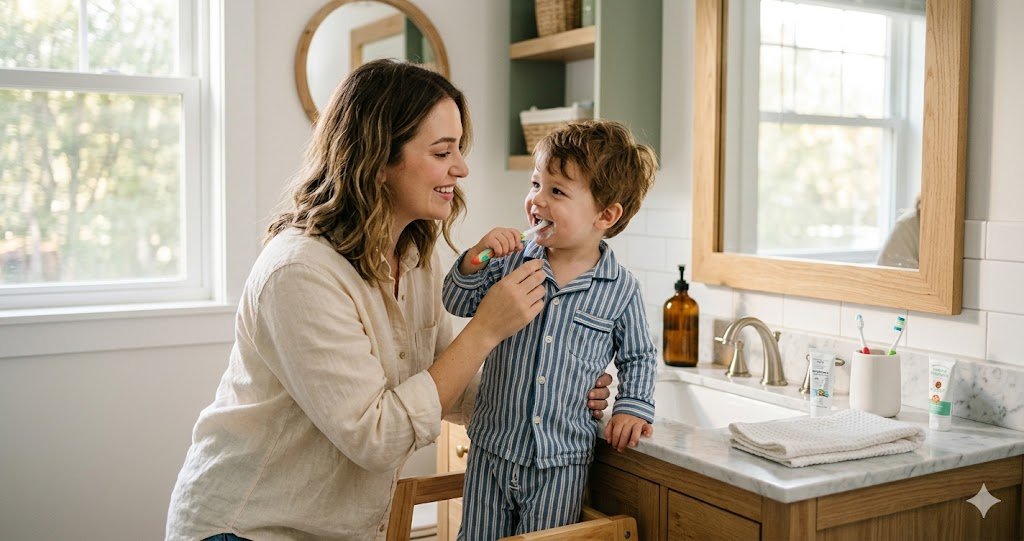
Toothbrushing with a toddler is one of those parenting moments nobody warns you about. One night they will open wide like a tiny dental student. The next night the toothbrush is somewhere under the couch and your kiddo is dramatically dying on the bathroom rug. If you have Googled “best toddler toothbrush” at 9 PM with a wiggly child wedged between your knees, you are not alone.
This guide compares six toothbrush options and the age labels and features families need to check. The product discussion is research-based; it is not a record of hands-on testing.
This guide covers four age stages (6–12 months, 12–24 months, 2–3 years, 3–4 years), explains when an electric brush starts to make sense, and walks through each of the six recommended brushes one by one.
At a Glance: Our 6 Top Picks
| Brush | Age | Type | Best For |
|---|---|---|---|
| Frida Baby Grow-with-Me Set | 6–18m | Manual silicone | First teeth + early independence |
| Dr. Brown’s Giraffe | 0–3y | Manual | Best overall manual |
| brush-baby BabySonic | 0–3y | Electric (battery) | First electric brush |
| Frida Baby Triple-Angle Toothhugger | 2y+ | Manual (3-sided) | Reluctant brushers |
| Philips Sonicare for Kids | 3y+ | Electric (rechargeable) | Premium tech pick |
| Burst Kids Sonic | 3y+ | Electric (rechargeable, sonic) | Dentist-designed, character-free |
About This Comparison
This is a research-based comparison, not a hands-on product test. The product comparison dates from May 2026. The October corrections address care guidance, author wording and stale prices; they do not represent a new check of every product specification, review or recall record. Check the exact model and age label before buying.
By Age: Which Type Belongs in Your Toddler’s Mouth Right Now
Toddler oral care changes fast. A six-month-old gnawing on a silicone nub and a three-year-old asking to brush “just like Mama” need totally different tools.
6–12 months: The first tooth(s)
The American Academy of Pediatrics recommends starting tooth cleaning as soon as the first tooth appears. If you’re not sure when to expect that first tooth, our teething timeline by age walks through which tooth typically erupts when. Once teeth emerge, use a child-sized toothbrush with soft bristles and a small head. A teething or training product should not be assumed to replace tooth cleaning. Once the first tooth appears, brush twice daily with a rice-sized smear of fluoride toothpaste, following AAPD guidance.
12–24 months: Independent attempts
This is the “I do it!” stage. Your toddler still cannot brush effectively on their own (fine motor skills are not there yet), but they want to try. The play-it-safe approach most pediatric dentists I read recommend: let them brush first for a minute, then you finish the job. A chunky-handle manual brush works well here. An electric brush designed for under-3 (like brush-baby BabySonic) is also reasonable if your kiddo is into it.
2–3 years: Real brushing begins
An adult still needs to perform or finish brushing at this age. A three-sided brush head is not a reason to shorten brushing time. Use a rice-sized smear of fluoride toothpaste until age three; from age three, use a pea-sized amount.
3–4 years: Ready for electric
Check the exact model’s age label and use a head sized for your child’s mouth. Turning three does not make every powered brush suitable. Continue adult help and follow your child’s dentist’s advice.
Electric vs. Manual: Honest Take
Here is what nobody tells you in the marketing: for kids who already brush properly, manual and electric brushes clean teeth about equally well. The ADA’s official position is that both can be effective when used correctly. The Wirecutter podcast on oral hygiene says the same thing.
A timer may help structure the routine, but a powered brush does not guarantee cooperation or thorough cleaning. An adult still needs to help a young child clean all tooth surfaces.
A few cases where manual is still the right answer:
- Your child has sensory sensitivities (vibration can be too intense)
- You travel a lot and don’t want one more thing to charge
- You prefer a simple brush without charging or batteries
- The specific powered brush is not labeled for your child’s age
The 6 Best Toddler Toothbrushes for 2026
1. Frida Baby Grow-with-Me Training Toothbrush Set — Best for First Teeth (6–18 months)
If you are buying a baby’s first-ever toothbrush and want one product that grows with them through the entire teething stage, this Frida Baby set is the easiest answer. It comes with two silicone brushes designed for two different developmental moments. The Baby brush, recommended starting at six months, has a loop handle that doubles as a teething surface and a removable stopper; follow the manufacturer’s instructions and supervise brushing. The Toddler brush, designed for 18 months and up, has a triple-angle bristle head that cleans three sides of a tooth at once.
What I appreciate about this set is that it acknowledges something most brands ignore — a six-month-old and an eighteen-month-old need totally different brushes. The Toddler brush’s bristles change from blue to white when it is time to replace, which is helpful when you cannot remember if you swapped it last month or three months ago. If your baby is also still chewing on everything in sight, pair this with the options in our best teething toys roundup.
- BPA-free and phthalate-free food-grade silicone
- Triple-angle bristles clean front, back, and biting surface at once
- Toss-time indicator on the toddler brush
- Easy-grip handles sized for tiny hands
- Silicone bristles are gentler than traditional toothbrush bristles — fine for training, but a separate brush is needed for true cleaning once teeth are in
- Choking-hazard warning for children under 3 (supervise closely)
- Does not include a finger brush despite some product descriptions implying it (those are sold separately)
2. Dr. Brown’s Infant-to-Toddler Toothbrush, Giraffe — Best Manual Overall (0–3 years)
If I had to recommend one manual toothbrush to a friend with a first baby, this would be it. The Dr. Brown’s giraffe brush is what BabyGearLab named its top manual baby toothbrush, and pediatric dentists from JustBabyTeeth Pediatric Dentistry to the Triangle Pediatric Dentistry group recommend it. There is nothing flashy about it — just a small head, super-soft bristles, and a comfort-grip handle. The giraffe-shape body has four stable legs so the brush stands upright on the counter without the head touching the surface.
This comparison does not provide first-hand durability evidence for this brush.
- Super-soft bristles safe for emerging teeth and tender gums
- Stands upright on its own legs — no contaminated countertop contact
- BPA-free
- Very affordable, very widely available
- Endorsed by multiple independent pediatric dentists
- The legs can tip over on a wet bathroom counter (small annoyance)
- Doesn’t include toothpaste — you’ll need to buy that separately
3. brush-baby BabySonic — Best Electric Brush for Under-Threes
Most “kids’ electric toothbrushes” are designed for ages 3 and up, so when a parent of a one-year-old asks for an electric option, the choices narrow fast. The brush-baby BabySonic is the rare brush actually built for the 0–3 window, and it is the one BabyGearLab named its top pick for that age group.
It delivers sonic vibration (the listing claims 16,000 strokes per minute), a built-in LED light that helps you actually see your toddler’s back molars in the dim hallway, and a smart two-minute timer with 30-second pulses to teach proper brushing duration. Two brush heads come in the box — one sized for ages 0–18 months and one for ages 18–36 months — so it grows through the whole baby/toddler phase. The suction base keeps it standing upright on the counter.
One important caveat: this is a battery-operated brush, not a rechargeable one. You will need to swap the AAA battery periodically. If you want a fully rechargeable model, skip ahead to Philips or Burst (but neither is rated for under-3 use).
- One of the few electric brushes designed for under-3 use
- Gentle sonic vibration, not the stronger oscillating rotation of older-kid brushes
- LED light helps with night brushing and seeing back teeth
- Two age-graded brush heads included
- Battery-powered (not rechargeable) — AAA needs replacing
- Some long-term reviews mention motors that fade after a few months
- Vibration may still be too much for very sensory-sensitive babies
4. Frida Baby Triple-Angle Toothhugger — Best for the 2-Year-Old Who Won’t Sit Still
Choosing a three-sided brush does not establish that shorter brushing is sufficient. The ADA recommends two minutes of brushing twice daily. An adult should help clean the inner, outer and chewing surfaces. If brushing is difficult, ask your child’s dentist for an approach suited to their needs.
The bristles are soft and rounded, the silicone handle has a suction base that keeps it standing up between uses, and — like the other Frida Baby brushes — the blue bristles fade to white when it is time to toss. The age rating starts at 2 years (the bristle head is large enough that it doesn’t fit comfortably in a much younger mouth).
- Color-changing toss-time indicator
- Suction cup base keeps the brush off the counter
- Soft, rounded bristles gentle on gums
- Brush head is too big for kids much younger than 2
- Suction cup grip is just okay — works better on smooth counters than textured ones
- Does not replace thorough brushing or adult help at any age
5. Philips Sonicare for Kids — Best Premium Electric (3+ years)
This is Wirecutter’s top pick for kids’ electric toothbrushes, BabyGearLab’s co-recommendation, and the brush Yahoo Wellness dental experts told their team they use on their own children. The Philips Sonicare for Kids HX6321/02 pairs sonic technology (over 500 brush strokes per second, per Philips) with a Bluetooth-enabled handle that syncs with a coaching app featuring a character named Sparkly who needs to be brushed alongside your child.
What sets it apart is the KidPacer feature: the brush pulses every 30 seconds, prompting kids to move to the next quadrant of their mouth, and gradually increases recommended brushing time up to two full minutes over weeks of use. The handle comes with eight interchangeable stickers so kids can personalize it. Two power modes (lower for younger kids, higher for older) let it grow with your child.
Consider whether an app fits your family’s routine. This guide has not measured long-term app engagement, and current prices should be checked with the retailer.
- Endorsed by Wirecutter, BabyGearLab, Yahoo Wellness
- Two power modes for different ages
- KidPacer 30-second pulse trains correct brushing technique
- Rechargeable lithium-ion battery (weeks of brushing per charge)
- Customizable stickers genuinely help reluctant kids buy in
- App-based coaching requires a compatible device and caregiver setup
- Charging base takes up bathroom counter space
- Not suitable for children under 3 (small parts; cited on the listing)
6. Burst Kids Sonic Toothbrush — Best Dentist-Designed, Character-Free Electric (3+ years)
If you’ve been searching for a kids’ electric toothbrush without Frozen, Stitch, Spiderman, or any other licensed character on the handle, Burst Kids is what you’ve been looking for. The brand was built by a community of 35,000+ dental hygienists and dentists who help design and refine the product. The independent review site My Dental Advocate named it their 2026 top pick for kids’ electric brushes, calling it “the clear winner.”
It’s a sonic brush at 31,000 vibrations per minute — on par with Philips Sonicare’s sonic technology. The 2-minute timer pauses every 30 seconds to prompt kids to move to a new quadrant, same coaching pattern as the Philips KidPacer. Two modes (standard + sensitive) cover ticklish gums. Charcoal-infused PBT bristles are feathered to slip below the gum line, and the back of each brush head has a small tongue scrubber. A single overnight charge lasts about four weeks, which is genuinely useful for travel.
How Burst differs from Philips Sonicare for Kids: no app, no character stickers, no Bluetooth gamification — just a clinically designed brush in a silicone handle, available in blue, pink, and purple. Burst sells replacement brush heads through a subscription model or as three-packs on Amazon, which removes one decision point for parents. If you’ve been bothered by the licensed-character aesthetic on every other kids’ electric on the shelf, this is the cleanest premium option.
- Designed with input from 35,000+ dental hygienists and dentists
- Named 2026 top pick by My Dental Advocate
- No licensed characters — cleaner aesthetic, gender-neutral
- Sonic technology at 31,000 vibrations/min, on par with Philips
- 2-minute timer with 30-second quadrant pulses (same as Philips KidPacer)
- 4-week battery life on a single charge
- Built-in tongue scrubber on the brush head
- No app or coaching gamification — reluctant brushers may need extra parental engagement
- Replacement brush heads work best through Burst’s subscription model (or three-pack on Amazon)
- No pressure sensor like some premium adult brushes
- Sonic vibration may be too intense for very sensory-sensitive kids
Brushing Tips That Actually Work for Toddlers
Picking the right brush is only step one. Here’s what I have learned from three kids, a lot of failed bedtime routines, and a lot of reading pediatric dentist blogs:
- Let them brush first, then you finish. Toddlers don’t have the fine motor control to do a thorough job until around age 6–7. Letting them try first gives them ownership; your follow-up pass actually cleans the teeth.
- Two minutes feels long. Use a song. Pick one toddler-approved song that runs about two minutes (the Daniel Tiger toothbrushing song is exactly the right length). When the song ends, brushing ends.
- Brush at the same two times every day. AAPD recommends morning and night. Linking brushing to existing routines (after breakfast, before pajamas) builds the habit faster than trying to enforce a new ritual. If you don’t have a visual routine yet, our daily routine chart for toddlers includes a free printable.
- Pea-sized toothpaste starting at age 3. Before age 3, use a rice-grain smear of fluoride toothpaste, per AAPD. After age 3, pea-sized is fine. Teach spitting from the start.
- Replace every 3 months. Or sooner if the bristles look bent or frayed. Color-changing bristles make this easier; otherwise, set a phone reminder.
- Tag-team with your partner on tough nights. One person holds the iPad with Sparkly (or sings the song). The other person actually brushes. This isn’t lazy parenting — divide-and-conquer is genuinely the only way some weeks.
- Bring the brush to the dentist visit. Your pediatric dentist will check technique and let you know if you need to upgrade or downgrade brush size.
Frequently Asked Questions
When should I start brushing my baby’s teeth?
As soon as the first tooth appears, per the American Academy of Pediatrics. Before teeth come in, you can clean baby’s gums with a soft damp cloth, but a toothbrush isn’t necessary yet.
Is fluoride toothpaste safe for toddlers?
Yes — both the AAPD and ADA recommend a smear of fluoride toothpaste (the size of a grain of rice) starting at the first tooth. After age 3, a pea-sized amount is recommended. Fluoride helps prevent early childhood cavities.
Can a 2-year-old use an electric toothbrush?
Most electric toothbrushes are rated for ages 3 and up. The brush-baby BabySonic is one of the few designed for 0–3 years. Avoid using a standard adult or 3+ children’s electric brush on a toddler younger than 3.
What’s the difference between sonic and oscillating-rotating brushes?
Sonic brushes (like Philips) vibrate at very high speeds. Oscillating-rotating brushes (like Oral-B) have a small round head that spins back and forth. The ADA considers both effective; the right choice often comes down to which sensation your child tolerates.
How often should I replace a toddler toothbrush?
Replace the brush about every three to four months, or sooner if bristles become worn or frayed, following ADA guidance. Ask your child’s clinician for advice if you have concerns after an illness.
Do I really need to brush my toddler’s teeth for two full minutes?
Aim for two minutes twice daily with fluoride toothpaste and adult help. A three-sided brush is not evidence that a shorter session cleans just as well. Help your child reach all tooth surfaces; ask their dentist for individualized advice if they struggle with brushing.
Final Thoughts
If you came here looking for one answer, here it is: the Dr. Brown’s Giraffe is the best manual toothbrush you can put in a 0–3 year old’s mouth, and the Philips Sonicare for Kids is the best electric option once your child turns three. Add the brush-baby BabySonic in between if you want an electric option before age three, and the Frida Baby Triple-Angle Toothhugger if your two-year-old has the wiggling skills of a small fish.
Whatever you choose, the real lesson from three kids and a lot of toothpaste on a lot of walls is this: the best toothbrush is the one your child actually lets near their mouth. Start where they are, replace it every three months, and let the dentist worry about the rest.
Want our complete toddler bedtime checklist?
Get our free printable PDF with the full toddler nighttime routine — including the exact two-minute brushing song lineup we use with our boys.
Join our weekly newsletter and get instant access. Plus weekly evidence-backed tips for the toddler years.