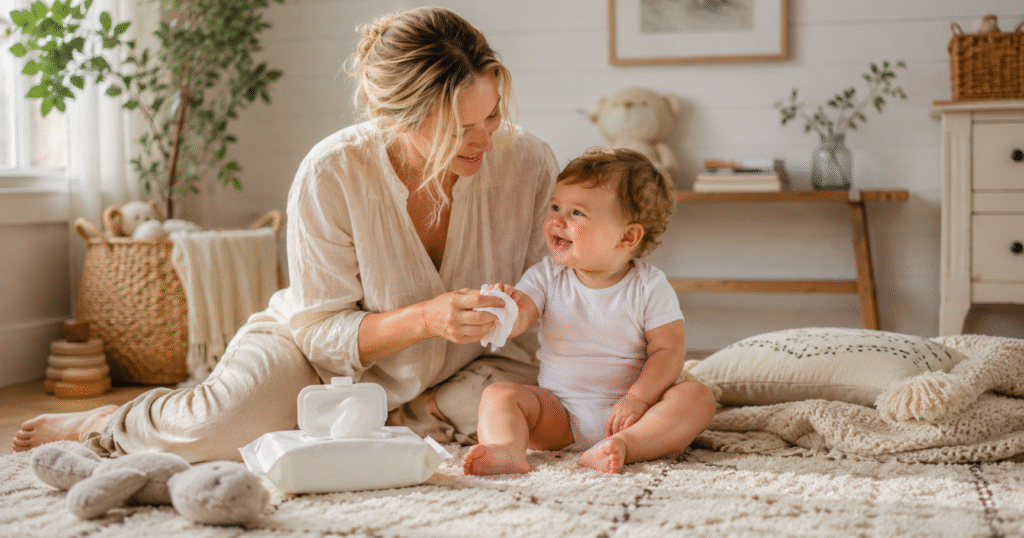
When my daughter was born almost six years ago, I had no idea that the average American baby goes through 10,000 to 12,000 wipes a year. That number isn’t mine — it came out of a class-action filing against Costco in the summer of 2024, and it has stuck with me ever since. Because if you do the math at our house — three kids, six-plus years of diapering, two still in the daily wipe lifestyle — we have personally been through a lot of baby wipes.
Over those years our family has tried a handful of brands, and the one I keep coming back to on the American grocery aisle is Huggies (I’ve written about how the major diaper brands compare across my three kids too). But over the same stretch I’ve watched the broader category shift in ways that have made me uneasy. Consumer Reports released PFAS testing in 2024 that put several major brands on a risk list. A class-action lawsuit against Costco’s Kirkland Signature wipes is currently moving through federal court. A clean-baby brand I almost switched to two years ago filed for bankruptcy and got reviewed into the ground after new owners changed the formula.
So when I sat down to put this guide together for 2026, I didn’t want to just rank brands by thickness and softness. I wanted to write what most “best baby wipes” lists skip: which products have ended up on Consumer Reports’ PFAS-risk list, which ones are facing active class-action lawsuits, and which ones still hold the National Eczema Association’s Seal of Acceptance after the latest round of independent ingredient review. Brands I’ve used across my own three kids, I’ll say so directly.
What I Look For in a Sensitive-Skin Wipe
I’m not a dermatologist, and after three kids I’m only barely qualified as my own household’s wipe quartermaster. But over six years of buying these things in every form factor known to American retail, the criteria I keep coming back to are:
- 99% or higher water. Not because the other 1% doesn’t matter — it does, a lot — but because shorter ingredient lists give fewer chances for something to react with sensitive skin.
- Fragrance-free. Including the words “natural fragrance,” which can legally hide a long list of undisclosed compounds.
- No ethoxylated ingredients. These are the ones Consumer Reports specifically warns about. The giveaways on a label are “PEG” followed by a number, “polysorbate” followed by a number, or any ingredient name ending in “-eth” (like laureth-9 or ceteareth). They aren’t dangerous in themselves, but the manufacturing process that creates them can leave behind trace amounts of 1,4-dioxane and ethylene oxide, both potential carcinogens.
- No MI or MCI. Methylisothiazolinone and methylchloroisothiazolinone were named the American Contact Dermatitis Society’s Allergen of the Year in 2013 for triggering a wave of contact dermatitis cases worldwide. Most major brands have phased them out, but it’s worth scanning the label.
- No Cocamidopropyl Betaine (sometimes labeled “Coco-Betaine”). The American Contact Dermatitis Society named this its Allergen of the Year in 2004 and it’s still on plenty of mainstream sensitive-skin wipes today.
- Third-party validation. The most reliable seals I look for are the National Eczema Association Seal of Acceptance (NEA), EWG Verified, and inclusion in Consumer Reports’ “Best” category. None of these is perfect on its own. Stacked together, they make me trust a product. If your baby is eczema-prone or has reactive skin, these seals carry extra weight.
- Brand stability. A brand that filed for bankruptcy last year, or had a quiet formula change, or has 600 recent reviews complaining their wipes “feel different now” — that’s a yellow flag, even if the certifications technically still hold.
My Top Picks for Sensitive Skin in 2026
I’ve ranked these by the strength of their third-party validation and the state of recent customer feedback. The first three are the ones I’d build a baby registry around today based on what the certifications and testing data show. The fourth is the brand I’ve reached for myself across three kids, with caveats I think parents should weigh.
1. WaterWipes Sensitive+ Newborn & Baby Wipes — Best Overall on Paper
If I were having a baby today and had the budget for premium wipes from a newborn’s first week home, this is the brand I’d reach for first. The ingredient list is two things: 99.9% purified water and a drop of grapefruit seed extract. There’s also a trace of benzalkonium chloride, which WaterWipes now discloses on the package — it comes in with the grapefruit seed extract and acts as the preservative system. The trace is reported at levels well below the limits set by cosmetic safety regulators for sensitive-skin products. Worth knowing about. Not, from what I’ve read, worth panicking about.
WaterWipes carries the NEA Seal of Acceptance on three different SKUs. Consumer Reports puts them in the “Best” category. They’re sold to NICUs across Ireland, the UK, and parts of Asia and Australasia. The Skin Health Alliance, the French Association for the Prevention of Allergies, and the Eczema Association of Australasia all endorse them. They show up on more Babylist baby registries than just about any other wipe.
What’s been going sideways in 2024 and 2025: WaterWipes updated their packaging and changed the wipe material to what they call a “2x stronger” regenerated cellulose. The brand frames this as an upgrade. A noticeable chunk of long-time customers on Trustpilot frame it as the opposite — smaller wipes, less moisture, and a faint chemical smell that wasn’t there before. If a long-time WaterWipes user told me they’d noticed a difference recently, I’d believe them. Whether the new formula still meets your standards is a personal call.
The other thing to know: WaterWipes have a pH closer to 8, which is essentially neutral water. Most other wipes are formulated to match babies’ slightly acidic skin pH of around 5.5. Whether this matters depends on whose research you read.
Best for: newborns, eczema-prone skin, parents who want the shortest possible ingredient list, anyone who has tried multiple brands and watched their baby react.
2. The Honest Company Sensitive Wipes — Best Plant-Based on the Certification Math
Honest Sensitive Wipes are seven ingredients long. Water. Trisodium ethylenediamine disuccinate, a chelating agent that keeps the formula stable. Sodium benzoate, a preservative with an EWG hazard score of 3 — middle of the pack, but cleaner than the benzalkonium chloride family and notably cleaner than phenoxyethanol. Sorbitan oleate decylglucoside crosspolymer, a plant-derived surfactant. Caprylyl glycol and ethylhexylglycerin, both preservative boosters that let the formula use less sodium benzoate overall. Citric acid for pH balancing.
The company says every ingredient is toxicologist-audited. The product carries the NEA Seal, EWG Verified status, and a spot in Consumer Reports’ “Best” category — the only brand on this list that holds all three. The wipes are compostable in eight weeks under the ISO 20200 testing standard, the cloth is plant-based with no plastic content, and the brand ran a clinical study with 35 babies aged 7 months to 3 years where 100% of parents agreed the wipes were durable, gentle, and helped keep skin looking healthy. They’re also a fixture on Babylist’s most-added registries year after year.
What I’d want you to know from the customer-side research: I went looking for a pattern of complaints across Amazon, TikTok, and parenting forums. The pattern I found is small but real — a scattering of reviews from 2024 and 2025 saying “they feel different lately” or “I got a bad batch, super rough and super thin.” A handful of individual rash reports. Not a brand-wide red flag. Probably worth knowing about if you’re committing to a 576-count Subscribe & Save and consistency matters to you.
The other honest disclosure: these are not the cheapest wipes on the shelf. At about $0.05 a wipe in the 864-count format, you’re paying a premium for the certifications. Whether that’s worth it is your call.
Best for: parents who want three-way third-party validation (NEA + EWG + CR) on a single product, families committed to compostable plant-based materials, anyone who’s reacted to mainstream wipes and wants a transparent ingredient list.
3. Amazon Brand Mama Bear 99% Water — Best Budget on the Independent Reviews
Mama Bear is Amazon’s own private-label brand for parenting products, and the 99% Water version is the one I’d keep in the car or at grandma’s house if I were starting over today. It’s 15 ingredients long, which is the trade-off you make for the price. Most of those ingredients are mild — purified water, a few plant extracts (cucumber, calendula, licorice root, chamomile, aloe), glycerin, vitamin E. The two preservatives are sodium benzoate (EWG hazard 3) and phenoxyethanol (EWG hazard 4), which has more debate around it, used at concentrations well below regulatory limits but worth flagging if you specifically avoid it.
One important thing to know: Amazon sells baby wipes under at least three different in-house brand names, and they are not the same products. Mama Bear is the one I’m pointing to here. Amazon Elements is a separate brand line, and Amazon Elements baby wipes were specifically named in Consumer Reports’ 2024 PFAS-risk list. Amazon Basics is a third, separate line. The labeling on Amazon’s site does not make the difference between these three obvious. Look for the words “Mama Bear” on the package — that’s the one with the cleaner track record.
What the third-party evaluators say: Babygearlab tested ten brands in 2025 and listed Mama Bear as their solid budget pick, noting it “strikes a nice balance between performance and cost.” Mommyhood101’s 2026 evaluation has it in their recommended cluster, alongside notes that Babygearlab, Forbes, and “hundreds of Redditors” all endorse the product.
The independent reviewer pattern that surprised me: across 21,000+ Amazon reviews and parenting forum threads, I couldn’t find a rash-complaint pattern, a formula-change controversy, or a third-party safety flag for this SKU. The most consistent criticism is that the moisture level is slightly lower than premium brands, and occasionally the wipes tear when you pull them out. These are real but small problems compared to the price — at $0.03 a wipe, this is the cheapest pick on this list by a notable margin.
Best for: families on a real budget, second and third babies after you’ve stopped being precious, anyone who wants a clean-enough ingredient list without paying premium-brand prices, the pack you keep in the car.
4. Huggies Natural Care Sensitive — The Mainstream Pick I’ve Reached For (With Caveats Worth Knowing)
This is the American brand I’ve reached for on and off across three kids. Not exclusively — like a lot of moms I know, my actual diaper-bag rotation has included whatever was on sale or on hand. But Huggies is the brand I keep returning to when I’m at Target without a plan. If you have ever stood in that aisle in the last five years, you have probably picked one of these up too. They are the number-one selling sensitive baby wipe in the entire category, with more than 122,000 Amazon reviews and the National Eczema Association’s Seal of Acceptance printed right on the package. For millions of American families, they are simply the baby wipe.
What I’ll say from using them myself: they’re thick enough that I don’t reach for two at a time. The moisture level is reasonable. None of my kids has had a sudden reaction I could trace back to the wipe itself. For day-to-day use across normal skin, they have been fine.
Here’s also what’s harder to say.
What I’d want a friend to know before subscribing:
- Consumer Reports flagged this product in their 2024 PFAS-risk list. The flag is based on ingredient-list analysis by the nonprofit Made Safe, not on detected chemical contamination in CR’s own testing. Specifically, the ingredients Butoxy PEG-4 PG-Amodimethicone and Polysorbate 20 are both ethoxylated compounds, which CR identifies as carrying a contamination risk for 1,4-dioxane during manufacturing.
- The formula contains Coco-Betaine (also called Cocamidopropyl Betaine, or CAPB). The American Contact Dermatitis Society named CAPB its Allergen of the Year in 2004. For most babies it’s fine. For some, it triggers contact dermatitis.
- Kimberly-Clark, the parent company, is currently facing a separate class-action lawsuit (filed October 2024) alleging PFAS contamination in their Huggies Simply Clean Fragrance Free product. That’s a different SKU from this one. Same company.
- Across 2024 and 2025, parenting forums have collected an unusual cluster of reports describing babies who suddenly developed rashes “after Huggies changed something.” Kimberly-Clark has not publicly confirmed a formula change.
After reading all of that, am I going to throw out the packs I have right now? No. My kids tolerate them fine and I’m not raising children inside a science experiment. But if I were starting from a brand-new newborn today, knowing what I now know, I’d start higher up this list — at WaterWipes or Honest — and only reach for Huggies as a backup or budget swap. And if a friend told me her eczema-prone baby was reacting to wipes, this is the first SKU I’d ask her to swap out.
Best for: families who want the most familiar option in the category, parents weighing affordability against the trade-offs above, anyone whose baby has already been using these without incident.
Currently Being Investigated — What Parents Should Know
These are wipes you will see on the shelf at Costco, Walmart, Target, and Amazon in 2026. None of them has been formally recalled. But each one is currently the subject of either a pending class-action lawsuit or an independent testing concern that I think parents shopping this year should know about — so you can read labels and make informed decisions.
Kirkland Signature Fragrance Free Baby Wipes (Costco). Active class-action lawsuit filed June 2024 (Bullard v. Costco Wholesale Corp., Case No. 4:24-cv-03714, Northern District of California). Independent testing by a Department of Defense ELAP-certified laboratory detected 3.7 parts per billion of PFAS. In 2025 the federal judge denied Costco’s motion to dismiss, and the case is moving forward. Costco’s public position is that the product meets current regulatory standards, and the wipes remain available for purchase.
Pampers Sensitive Baby Wipes. Named in Consumer Reports’ 2024 list of wipes “posing PFAS exposure risks,” based on ingredient analysis by Made Safe. This is the most-reviewed sensitive baby wipe on Amazon, with more than 238,000 reviews. The “Sensitive” label does not, in this case, mean the cleanest ingredient profile within the Pampers line.
Pampers Aqua Pure. Pampers’ “99% water plant-based” SKU, and also named in the same Consumer Reports risk list. This one matters because it’s a cautionary tale: the cleaner-sounding product within a brand line is not automatically PFAS-free. The two different concerns (short ingredient list versus PFAS contamination) are tested for differently and don’t predict each other.
Huggies Simply Clean Fragrance Free. Independent class-action lawsuit filed October 2024 alleging PFAS contamination. Different SKU from Huggies Natural Care Sensitive (covered above), but same parent company, Kimberly-Clark.
Amazon Elements Baby Wipes. Named in the CR risk list. Worth flagging again because Amazon Elements is easily confused with Mama Bear (the one I pointed to above) and Amazon Basics, which are separate Amazon brand lines with separate formulations.
Parent’s Choice Gentle Clean Fragrance Free (Walmart). Walmart’s value brand, named in the CR risk list.
Seventh Generation Sensitive Protection Cleansing Baby Wipes. Named in the CR risk list. Worth flagging because the brand’s positioning is built around clean ingredients.
Coterie The Wipe (for reference). Originally flagged by Consumer Reports in 2023. Coterie reformulated in August 2024, removing laureth-9, hydroxyacetophenone, and silicone quaternium-17 from the formula. CR re-classified them as “Best.” They are sold only direct-to-consumer by subscription, which is why they aren’t on this Amazon-focused list, but they’re worth knowing about if you’re willing to subscribe direct.
How to keep watching as new information surfaces: bookmark the CPSC recalls page, the FDA recalls page, and the Consumer Reports baby wipes guide. They update as testing data and litigation outcomes come in.
A Note on Hello Bello
You’ve probably seen Kristen Bell’s clean-baby brand in stores or social ads. Their Premium Fragrance-Free wipes carry the NEA Seal, and the ingredient list is genuinely cleaner than most mainstream brands. I considered them for this guide.
Two things gave me pause. First, Hello Bello filed for bankruptcy in October 2023 and was acquired by new owners shortly after — which I am not holding against them. Plenty of brands recover from bankruptcy and come out stronger. But the second thing is louder: their Trustpilot reviews from 2024 and 2025 are dense with reports of formula changes, packaging quality drops, customer service that doesn’t respond to email or voicemail, and the recurring “they used to be great, what happened?” story. The most common version of that story is a parent who bought a fresh case, noticed it felt and smelled different from previous orders, and reached out to the company without success.
If you have been using Hello Bello for years and your baby is doing fine with them, don’t switch on my account. But I can’t recommend them as a confident pick in 2026 until the brand stabilizes. Check back in 12 months.
When Wipes Cause a Skin Reaction
Even the cleanest wipe in the world can trigger a reaction in a specific baby. Skin is individual — what your friend’s baby tolerates fine might be the same wipe that turns your kid’s bottom into a topographic map of irritation. Here is the playbook that’s worked across my three kids:
- Stop using the wipe immediately. Don’t try to push through “maybe it’ll clear up if we keep going.” Switch to a plain warm-water washcloth for 24 to 48 hours.
- Take a clear photograph in good light. If the rash hasn’t started clearing within a couple of days, this is what you’ll show your pediatrician. Phone-camera evidence is genuinely useful at the appointment.
- Note when the reaction started in relation to opening a new pack. Bad-batch issues happen. If you opened a fresh package the same day the rash showed up, save the pack and the lot number.
- When you go back to wipes, try a different brand with a shorter ingredient list. Many parents I’ve talked to use WaterWipes or Honest Sensitive as the reset choice for this exact reason.
- If the skin is broken, oozing, hot to the touch, or accompanied by a fever, call your pediatrician same-day. Don’t wait it out.
Quick Answers
Are PFAS in baby wipes actually dangerous?
The science isn’t settled yet. PFAS are persistent in the body and the environment, and they’ve been linked to a range of health concerns including liver effects, thyroid changes, and certain cancers at higher exposure levels. But topical exposure through wipes is a different absorption pathway than drinking water containing PFAS, and there isn’t yet enough research to tell parents precisely how much risk a daily wipe routine represents. What we do know is that manufacturers don’t add PFAS deliberately. They get in as manufacturing contamination, and brands that actively test for them tend to come back cleaner. Knowing which brands have been flagged versus cleared is the most useful step parents can take right now.
Should I throw out my Kirkland wipes?
That’s your call. Costco hasn’t recalled the product and the case is still in court. If your baby has sensitive skin or eczema, switching to a CR-cleared brand (WaterWipes, Honest, Healthybaby, Caboo) makes sense. If your baby has been doing fine on Kirkland for months without skin issues, you may decide the convenience and price justify waiting to see how the litigation resolves. Costco’s return policy is generous if you change your mind.
Are bamboo wipes safer than regular wipes?
Not automatically. The material the wipe cloth is made of — bamboo versus plant viscose versus polyester — is a separate question from the cleaning solution that’s poured onto it. A bamboo wipe with phenoxyethanol and a long preservative list lands in roughly the same risk category as a plastic-based wipe with similar ingredients. Look at both layers.
Can I just use plain water and a washcloth?
For most newborns in the first few weeks at home, yes. Some hospitals do exactly this on the changing table — that’s how the postpartum nurse showed me to clean my daughter the first day home. It’s not as convenient as a pre-moistened wipe (there’s a lot of warm-water-to-the-bathroom-tap logistics involved at 3 a.m.), but it’s the cleanest possible option from an ingredient-exposure standpoint. The reason most parents stop is the inconvenience, not the safety.
Will my daycare let me bring my own brand?
Most will, especially if you bring them in the original packaging and label each pack with your child’s name and the date you opened it. It’s worth asking at enrollment so it doesn’t become a battle on day one. Some centers have a policy of using their own bulk supply for sanitary reasons; if so, ask which brand they use and check it against the watch list above.
What’s the simplest, lowest-risk option if I just want one wipe to use?
Based on the certifications and the testing data, WaterWipes Sensitive+ is the most defensible single choice for the diaper area, especially in the first few weeks home from the hospital. Pair it with a clean dry washcloth dipped in warm tap water when you have the bandwidth. That’s the closest you’ll come to the gentlest option without making it harder than your real life can support.