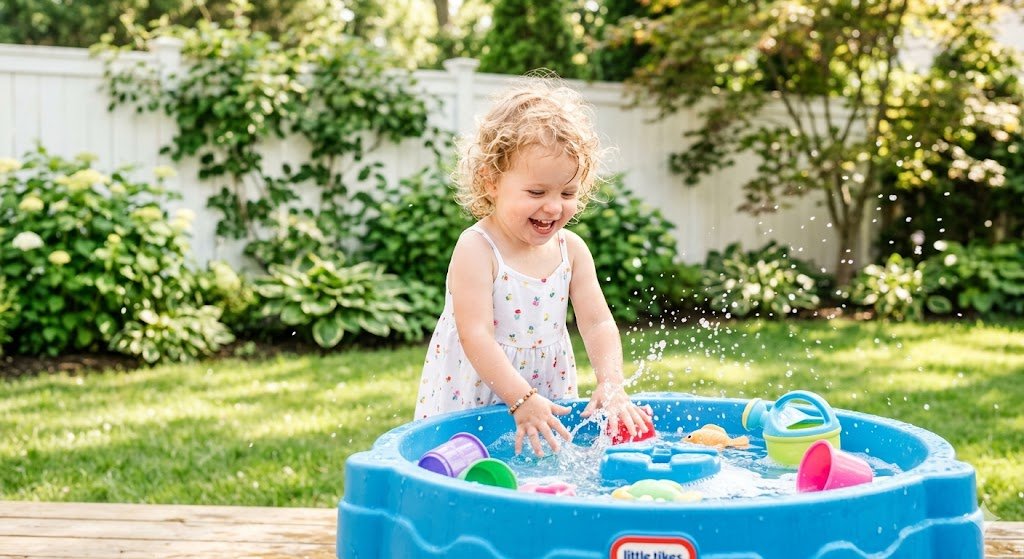
I have two little boys about eighteen months apart, and last spring I learned something that saved me a small fortune: they almost never agree on what to play with, but they both fall apart over a bucket of water and a couple of plastic cups.
That’s the honest starting point for any toddler backyard. You can spend four hundred dollars or you can spend nothing, and on the right afternoon the nothing version wins. What actually keeps a one-year-old and a three-year-old outside and happy isn’t a single big-ticket toy. It’s a yard with a few different kinds of play in it, sized for the stage each kid is in right now.
So this isn’t a “buy these twelve things” list. It’s a map of the four zones every toddler backyard needs, with a free option, a smart budget buy, and a splurge in each one, so you can build the version that fits your space, your kids, and your actual budget. I’ll also be straight about the famous toys that look great and quietly disappoint, and the safety stuff that’s easy to forget until it matters.
The four zones every toddler backyard needs
Before any shopping, it helps to think in zones instead of products. Toddlers cycle through moods fast, and a yard that can meet all of them buys you far more outdoor time than one expensive centerpiece ever will. The four that earn their keep:
- Water — the universal reset button. Cooling, calming, endlessly engaging, and the cheapest win in the whole yard.
- Sand and sensory — slow, focused, hands-deep play that stretches attention spans.
- Climbing and sliding — the gross-motor outlet that wears them out (the good kind of tired).
- Riding — balance, steering, and that intoxicating first taste of going fast on their own power.
You don’t need all four on day one. But knowing the map means every dollar you spend fills a real gap instead of duplicating one. Let’s go zone by zone.
Zone 1: Water play (start here, spend the least)
If you only set up one zone, make it water. It’s the rare category where the free version genuinely competes with the expensive one, and where a nervous new walker and a wild three-year-old can play side by side.
The $0 version: a bin, some cups, and a few frozen surprises
A shallow tub or storage bin, a stack of measuring cups, a turkey baster, and a couple of toys frozen into a block of ice will hold a toddler’s attention longer than most things you can buy. Pouring, scooping, and “rescuing” the frozen animals as they melt is pure sensory gold, and you already own all of it. This is also the lowest-risk way to find out whether your kiddo even likes water play before you spend a cent.
The budget buy: a splash pad
SplashEZ 3-in-1 Splash Pad
A 60-inch inflatable mat that’s part sprinkler, part shallow wading pool, with an alphabet-and-animals print across the bottom so there’s a little learning baked in. You connect a garden hose, the outer rim fills into a soft cushioned edge, then the center sprinklers kick on. No assembly, no batteries, and it folds away to nothing.
It’s the cheapest way to turn a hot afternoon around, and it works for a sitting one-year-old and a running preschooler at the same time. Two honest caveats from a deep read of owner feedback: the “non-slip” surface still gets slick the moment water pools, so it belongs on grass, never on a hard patio. And like most inflatable pads, it can develop mildew if it goes into storage even slightly damp, so dry it fully before folding.
The water table that earns its spot
Splash pads are great until your toddler wants to do something with the water. That’s where a water table earns its keep. Two are worth your money: a do-it-all best pick, and a bigger splurge if you want the showpiece.
Best overall: Step2 Rain Showers Splash Pond
If I had to point a friend at one water table, it’s this one. It’s one of the most consistently well-reviewed water tables out there for a reason: a two-tier design where kids scoop water up to the top and watch it “rain” down through spinners and ramps, a generous five-gallon basin big enough for two kids to crowd around, double-walled plastic that survives seasons of abuse, and (the unsung hero) a drain plug so you can empty it fast and skip the mosquito problem.
It ships with a thick stack of accessories, and assembly is the only real gripe: it goes much faster if you rope in your partner and an electric screwdriver. One nuance worth flagging for younger toddlers below.
Splurge pick: Step2 Pump & Splash Discovery Pond
The big one: a hand-activated pump, three areas of play, and an eleven-gallon ground-level pond kids can actually dip their toes into (with you right there). It’s genuinely impressive when it works. But I’d be doing you a disservice not to flag the catch: the pump, which is the whole selling point, is also this table’s known weak spot. A meaningful number of owners report the pump seal sticking and quitting within days, and the manufacturer’s replacement part hasn’t reliably fixed it. Buy it for the giant splash pond and treat a working pump as a bonus, not a guarantee.
Zone 2: Sand and sensory
Sand is the zone that buys you the longest stretches of quiet, focused play. It’s also the one where parents most often overspend on a name they remember from their own childhood. More on that in a minute.
The $0 version: a storage bin and a bag of play sand
A under-bed storage tote with a lid makes a perfectly good first sandbox, and the lid solves the single biggest sandbox problem before it starts: keeping neighborhood cats out (an uncovered sandbox is, to a cat, a luxury litter box). Fill it, add a few kitchen scoops, and you’ve got a sensory station for the cost of the sand.
The step-up: a real sandbox with a lid
Little Tikes Dirt Diggers Excavator Sandbox
This is the sandbox for the construction-obsessed stage my older son is in: a construction theme with a working excavator arm that really scoops and dumps, a set of digging tools, and a lid that flips over to become a truck ramp. It holds about a hundred pounds of sand (two standard bags), and the lid keeps rain and animals out between sessions.
Set expectations on two things. First, it’s compact: the basin is fairly shallow and on the smaller side, which is a plus for a small yard and a disappointment if you pictured something kids climb into. Second, the lid isn’t a quick flip-and-go cover. It has to be fully removed and reattached, and the closure takes a little wrangling. The excavator arm can also work loose over time. None of this is a dealbreaker, but it’s the difference between expectations and a return.
Zone 3: Climbing and sliding
This is the wear-them-out zone, and it splits cleanly by stage. A new walker wants something low and forgiving to clamber on. A confident three-year-old wants a real slide to bomb down a hundred times in a row.
The $0 version: a homemade obstacle course
Couch cushions, a sturdy cardboard box, a low step, a line of painter’s tape to balance along: a rotating obstacle course on the grass scratches the climbing itch for nothing, and it’s endlessly remixable. It won’t replace a slide, but for a one-year-old still building confidence, it’s often the better starting point anyway.
The mid-range slide: Babytronic 6-in-1 Toddler Slide
A freestanding indoor-outdoor slide that folds a climber, a slide, a basketball hoop, a little telescope, and under-step storage into one sturdy HDPE frame rated to a generous weight limit. It’s the kind of thing that gets used indoors on rainy days and dragged to the yard when the sun’s out, which is what makes it worth the money.
One honest note that applies to every freestanding plastic slide, this one included: the manufacturer itself recommends checking the screws and stability every week. Take that seriously. These slides can shift and tip if hardware loosens, and a sun-baked plastic slide can warp over a long hot summer if it lives outside permanently.
The splurge: Tiny Land Pikler Triangle Set
If you want one climbing investment that grows with your kid for years, a quality Pikler triangle is it. This wooden 7-in-1 set turns into a climbing triangle, a slide, a ramp, an arch, and a rocker, with anti-slip silicone feet and reinforced corners for stability, and it folds flat for storage. It’s open-ended, screen-free, beautiful enough to live in a play corner, and built for the long haul.
Because it’s wood, it’s happiest as an indoor-or-covered piece rather than something left out in the rain. And like all climbers, it needs a soft landing surface under it.
Zone 4: Riding
Nothing builds toddler confidence quite like rolling under their own power, and the riding zone is where matching the toy to the exact stage pays off most. Buy a year too advanced and it gathers dust in the garage.
The early stage: a four-wheel “first ride”
Budget pick: Gamfeiny Light-Up Baby Balance Bike
For the wobbliest stage, a four-wheel “baby balance bike” introduces the idea of sitting and pushing along with their feet way earlier than a true two-wheeler can. This one is feather-light at around four and a half pounds (so a tired toddler can drag it home), has fully enclosed wheels that won’t pinch little feet, light-up wheels that need no batteries, and a steering limiter so it doesn’t jackknife.
Set the right expectation, though: a four-wheel bike doesn’t actually teach balance. It’s a lovely first ride and confidence-builder for around 10–18 months, but plan to graduate to a true two-wheel balance bike once your little one is steady. That’s the next pick.
Best for the youngest: SEREED 4-Wheel Baby Balance Bike
This is the one I’d point a one-year-old’s parents toward. It’s one of the most popular first bikes for a reason: a stable four-wheel base, a tool-free adjustable seat, rubber grips, and a soft saddle, all on a light frame a toddler can manage. It nails the “walk while seated, then glide” progression that gets a new walker comfortable on wheels. This is my youngest son’s stage exactly.
Best for the two-to-three crowd: KRIDDO Toddler Balance Bike
Once a kid can truly balance, a real two-wheel balance bike is the single best bridge to a pedal bike, no training wheels ever required. This one fits the stage my older son is in: a carbon-steel frame, dual-bearing wheels for an easy glide, and a seat and handlebar that grow with them. My favorite detail is a genuine safety feature: the steering is limited to about 60 degrees in each direction, which stops a new rider from cranking the wheel too far and tipping over the front.
Splurge / grows-with-them: JMMD 6-in-1 Toddler Bike
If you’d rather buy once and convert, this one transforms through six modes, from a parent-push trike, to a tricycle with training wheels, to a balance bike, to a first pedal bike, on an aluminum frame with puncture-proof tires, a hand brake, and the same 60-degree steering limiter. It’s the priciest riding option here, but it’s really three or four bikes in one, spanning roughly a year and a half old to five.
The stuff I’d skip (and the famous toy that disappoints)
A roundup that only tells you what to buy isn’t being honest with you. So here are the two I’d steer around.
The classic turtle sandbox isn’t what it used to be. The iconic green turtle sandbox is the one a lot of us picture, and a lot of us reach for on nostalgia alone. But the current version is redesigned: instead of one solid molded piece, it now ships as roughly eight thin panels you snap together, and the feedback pattern is remarkably consistent. The panels can pop apart and leak sand from the bottom, and the four-piece lid doesn’t seal well enough to keep rain out, so the sand ends up perpetually wet. It’s also smaller than the one you remember. If you want a covered toddler sandbox, the Dirt Diggers above is the more reliable pick today.
Be a careful shopper with the generic 6-in-1 plastic slides. There’s a flood of nearly identical L-shaped toddler slide-climbers with basketball hoops and telescopes, sold under a rotating cast of brand names. They’re not all bad, but quality varies wildly, so let ratings and review volume do the sorting and don’t just grab the cheapest. Two specific things to inspect before you buy any of them: how tall the platform’s guard walls are relative to a basketball hoop mounted right there (kids have been documented putting their head through a deck-level hoop and leaning over a low wall, which is a genuine neck-and-strangulation risk), and how wide the climbing steps are (some are little more than narrow rungs that a wobbly toddler can’t get a full foot onto).
Build your backyard at three price points
This is how it all stacks up if you want to assemble a whole yard rather than pick one thing. Prices shift constantly, so treat these as ballparks and check current pricing before you buy.
| Tier | What’s in it | Rough total |
|---|---|---|
| The $0 yard | Water bin + cups + frozen toys, storage-bin sandbox, cushion obstacle course, loose parts | $0 |
| The ~$100 starter | SplashEZ splash pad + a light-up first ride + a bin sandbox + a few balls and bubbles | ~$100 |
| The ~$250 sweet spot | Step2 Rain Showers table + Dirt Diggers sandbox + a real balance bike (SEREED or KRIDDO) | ~$200–250 |
| The splurge dream | Step2 Pump & Splash + Tiny Land Pikler + JMMD convertible bike + covered sandbox | ~$450+ |
My honest take? The ~$250 sweet spot is where most families should land. It covers all four zones with pieces that genuinely last, and it leaves the splurge items as gifts grandparents can fight over.
One more thing: sun and heat
Want more no-screen, low-prep play ideas?
A great backyard is really just an invitation to unstructured, screen-free play. If you want a stack of simple activities for the days the weather (or the budget) won’t cooperate, grab our free Screen-Free Activity Cards: 30 low-prep ideas sorted by age, zero screens required.
Frequently asked questions
What age can a toddler start using a backyard setup?
Earlier than you’d think, with the right pieces. Water bins, a simple sandbox, and a four-wheel first ride all work from around the time a baby can sit and then walk (roughly 10–18 months). Slides and two-wheel balance bikes come a bit later, usually around two. The key is matching the toy to the stage rather than the calendar.
How do I do this if I have almost no yard (or just a balcony)?
Lean hard on the water and sensory zones, which need the least room. A splash pad rolls up, a bin sandbox tucks away, and a folding climber or Pikler triangle moves indoors. You can skip the riding zone outdoors entirely and let balance-bike practice happen at a nearby park.
What’s the single best first purchase on a tight budget?
A splash pad. It’s the lowest-cost item that reliably turns a cranky hot afternoon into a happy one, it works across a wide age range, and it stores flat. Everything else can come later.
How do I keep a sandbox clean?
A lid is non-negotiable, mostly to keep cats out. Beyond that, keep the sand a touch damp to reduce dust, rake out debris, and let it dry in the sun periodically. Replace the sand once a season if it gets grimy.
Where does all of this go in the off-season?
Plan for winter before you buy. Splash pads and inflatables fold flat into a bin (dry them fully first, or they mildew). Water and sand tables do best emptied, rinsed, and stored upside down in a garage or shed so they don’t collect water and crack in a freeze. The wooden Pikler and folding climbers come indoors and double as rainy-day gear, which is part of why they’re worth the splurge.