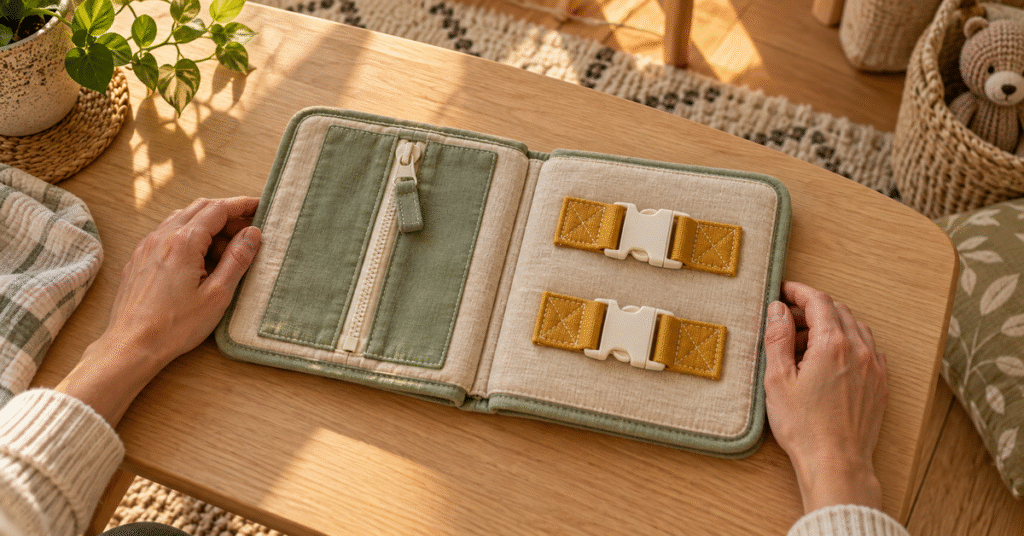
Toddler hands playing with a felt busy book showing fine motor activities on a sunlit table, best busy boards for toddlers

Best Busy Boards for Toddlers & 1-Year-Olds 2026: 8 Recall-Checked Picks

This post contains affiliate links. As an Amazon Associate, I earn from qualifying purchases. If you buy through our links, we may earn a small commission at no extra cost to you. All products are independently researched and recommended based on real parent needs — never sponsored.

My older son hit the busy board obsession somewhere around two and a half. Buckles on his car seat. Zippers on every jacket within reach. The little plastic clip on the diaper bag, undone and fastened and undone again, for thirty straight minutes on a drive across town. If you’ve watched a toddler discover fasteners, you know exactly what I mean.

That’s the stage when busy boards earn their keep. Used well, they turn the fasten-and-unfasten compulsion into fine motor practice and the kind of independent play that buys parents a quiet twenty minutes. Used badly, they end up shedding tiny pieces all over the back seat and gathering dust on a shelf within a month.

Below are the eight busy boards I’d recommend after cross-checking CPSC recall records, independent reviewer coverage, and the real-world complaints that bury themselves in 1-star reviews. I’ve also included a short section on sensory walls, because that search lands a lot of parents here, and the honest answer is more nuanced than Amazon’s results suggest.

Updated July 23, 2026: I rechecked all eight ASINs, current Amazon age and safety information, and the CPSC recall database. Where marketing copy conflicts with a formal age or small-parts warning, this guide follows the stricter safety information.

A quick note on age and small parts
Most felt busy books in this category carry a “3+ years, choking hazard, small parts” warning from the manufacturer. Those warnings are not marketing decoration. If you’re shopping for a child under 3, look for boards that explicitly state no loose components, or stick to wooden boards designed for younger toddlers. Two picks are listed from 12 months: the hahaland Farm book and the Hoarosall LED board. The HABA Town Maze is listed from age 2. The other five picks carry a 3+ minimum age; follow the manufacturer’s age label and small-parts warning rather than broader marketing language.

Quick Picks

  1. Best Overall: Esjay Toddler Busy Board (Blue Dinosaur)
  2. Best for Ages 1-2 / No-Assembly Pick: hahaland Farm Animals Busy Book
  3. Best Pink Theme: Exorany Pink Busy Board
  4. Best U.S.-Based Amazon Seller: SaFeli Space Busy Board
  5. Best Wooden with Lights: Hoarosall LED Switch Board
  6. Best Classic Montessori: Melissa & Doug Latches Activity Board
  7. Best Travel: HABA Town Magnetic Maze
  8. Best for Buckle Practice: WHITE DOLPHIN Toddler Buckle Backpack

How We Vet Every Busy Board: 4 CPSC Actions Worth Knowing

Before any product makes a roundup on this site, I check it against the U.S. Consumer Product Safety Commission’s recall database. For busy boards, the relevant history is more recent than most parents realize:

As of July 23, 2026, I found no active CPSC recall for the exact eight ASINs below. That is a database check, not a CPSC approval, certification, or endorsement. Beyond that baseline, I look for no small detachable mirrors or exposed magnets, secure stitching or hardware, a strong review history, and clear fulfillment and return information.


The 8 Best Busy Boards for Toddlers

Best Overall Esjay Toddler Busy Board (Blue Dinosaur)

Ages 3+ · Skills: fine motor, dressing self-help, alphabet, counting, shape matching

The Esjay Blue Dinosaur is the busy book that shows up in nearly every “best busy board” list for a reason. It’s accumulated thousands of verified Amazon reviews, currently ranks among Amazon’s top-selling felt playboards, and is available in a whole range of thematic variations (dinosaurs, unicorns, alphabet, fairies and more) covering nearly any toddler obsession.

The board itself is built around eight interactive pages of varying difficulty, ranging from simple velcro shape matching to genuinely tricky activities like shoe lacing, belt buckling, and zipper practice. Each page also includes a clock, a calendar, and a hook-and-loop alphabet set for early literacy. The fabric is reinforced at the seams, the corners are soft, and the whole thing folds down to a handled book that fits in a diaper bag.

One trade-off worth knowing about: this is not a tear-off-the-shrinkwrap toy. Most reviewers note that the initial setup takes roughly thirty minutes. You’ll need to apply velcro dots to the back of the puzzle pieces and animal shapes before the activities work. A meaningful minority of reviewers also report shipments missing one or two specific letter or number pieces (the letter Y and number 7 come up more than statistically likely). For a board designed to last several years of toddler use, the setup is a one-time cost. For a gift you’re handing over at a birthday party, pre-assemble it first.

Check Price on Amazon →

Best for 1-2yo hahaland Farm Animals Busy Book

Ages 1-3 · Skills: cause-and-effect, sensory exploration, finger puppet play, color and shape recognition

If you’re shopping for a child under three, this is the felt busy book I’d point you to first. Two specific design choices set it apart from the Esjay-style boards above. First, the current listing sets the manufacturer’s minimum age at 12 months and describes the accessories as integrated, with sewn-in hook-and-loop elements. Those are manufacturer listing claims, not a CPSC certification, so inspect every seam and attachment before use. Second, it ships fully assembled. There are no separate adhesive dots to apply or loose alphabet pieces to sort before play. You unzip the hook-and-loop closure and play.

The activity density is actually higher than Esjay’s, with twenty different mechanisms spread across ten pages: a spinning windmill, finger puppets for farmyard storytelling, button-pushing, lacing, seasonal changes on a tree, a small mouse-and-cheese matching game, vegetable identification, and several stick-and-move actions. The farm theme gives the whole thing a narrative coherence that the more activity-buffet boards lack, your toddler isn’t just doing exercises, she’s running a farm.

The catch: typically priced in the low-to-mid $30s, it’s the most expensive felt option here. The premium goes toward the no-assembly, integrated-activity design and Amazon fulfillment, both of which matter more for younger toddlers and gift-giving. If your child is over three and you want maximum activity variety per dollar, the Esjay is still the value pick.

Check Price on Amazon →

Best Pink Theme Exorany Pink Busy Board

Ages 3+ · Skills: same skill range as Esjay (fine motor, dressing, literacy, shape matching)

The Exorany Pink is functionally Esjay’s sister product, with the same general format and activity types, and the same caveat about needing initial velcro setup. The meaningful differences are the pink and unicorn-leaning theme set and review patterns that lean a touch more positive on fabric quality. Choose it for the theme rather than assuming it will be the cheaper option.

The board carries a multi-page felt book format with a handle, velcro closure, zipper pockets, lacing practice, button-and-snap pages, and a hook-and-loop alphabet for early literacy. The page count and activity variety are competitive with the Esjay, and the overall review consensus is strong.

For families whose kid has clear pink-everything preferences, this is the pick that won’t end up neglected on the shelf because the cover doesn’t match the child’s current aesthetic taste. If you’re choosing between this and the Esjay, color preference is genuinely the deciding factor, quality is comparable.

Check Price on Amazon →

Best U.S.-Based Amazon Seller SaFeli Space Busy Board

Ages 3+ · Small-parts warning · Skills: fine motor, sensory exploration, themed imaginative play

For parents who specifically prefer a U.S.-based Amazon seller for return and customer-service logistics, SaFeli is the strongest pick in this roundup. The space-themed board is twelve pages organized into roughly three zones: two pages of fine motor activities (buckles, zips, shoelaces, belts), eight pages of preschool learning (alphabet, shapes, colors, drawing), and two space-themed imagination pages. The seller states that the product has a Children’s Product Certificate and is tested to applicable ASTM/CPSIA requirements. A CPC is issued by the manufacturer or importer, ASTM F963 is a toy safety standard, and CPSIA is federal law; none of these means CPSC endorsement.

The twelve-page count is meaningfully higher than the eight-page format that dominates the category, and the space theme gives space-curious kids a coherent visual identity that can support pretend play beyond pure fine-motor practice. The brand also markets itself as preschool-classroom-tested, which lines up with the activity selection, most of the pages reinforce skills that show up on early childhood educator checklists.

Where this falls short: the review base is solid but smaller than Esjay’s. SellerSprite currently identifies the Amazon seller as U.S.-based, but that describes the seller account, not where the product was manufactured. Choose this one for its seller and return setup and its space theme, not as a Made in USA claim.

Check Price on Amazon →

Best Wooden + Lights Hoarosall LED Switch Board

Ages 1+ with supervision · Skills: cause-and-effect, fine motor, switch operation

This one is the wooden, light-up entry-level board for kids who haven’t yet aged into the felt-book complexity range. Eight different switches (toggle switches, rocker switches, slide switches) control eight corresponding LED lights mounted on a compact wooden plate roughly the size of a small clipboard (it takes 2 AAA batteries, sold separately). The board currently ranks among the stronger-selling electronic early-development toys on Amazon.

The educational depth is shallower than the felt books once your child masters cause-and-effect, which usually clicks around age two. It’s a phase-specific toy rather than something that grows with the child for three years, and that’s okay, because the phase it covers is the right one for it.

The appeal is the cause-and-effect feedback loop. Toddlers around twelve to twenty-four months are obsessed with the fact that switches make things happen. A board like this channels that obsession into eight different switch mechanisms rather than your actual light switches and TV remotes. The wooden frame is solid enough to survive being dropped repeatedly, and the compact size makes it genuinely portable.

Read before buying any wooden busy board with mirrors or lights
The Joyreal recall covered above involved this exact product category, a wooden LED-and-switch board with a small attached mirror. Hoarosall doesn’t include a detachable mirror in its current design, but the broader lesson stands: when you receive any wooden electronic board, check the mirror, the battery compartment, and any small attached components for secure attachment before handing it to a toddler. Adult supervision is essential for any toy in this format, especially under age 3.

Check Price on Amazon →

Best Classic Montessori Melissa & Doug Latches Activity Board

Ages 3+ · Skills: fine motor precision, problem-solving, counting, color recognition

The Melissa & Doug Latches Activity Board is a long-running classic with a focused design: six real-world latch mechanisms on one solid wooden board. It also appears across established toy roundups, including Babylist, The Bump, and Mother & Baby. Unlike the multi-page felt books, it does one specific type of fine-motor practice and does it clearly.

The format is simple: a solid wood board with six numbered doors, each secured by a different real-world latch type (hasps, slide bolts, hooks). Open each door and you find an animal picture and a number underneath. The skill demands are precise: your child needs to figure out how each latch works, manipulate it with the right finger movements, and remember which animal lives behind which door. It’s a single product that pulls together fine motor practice, problem-solving, counting, and animal identification.

Some parent reviews describe children becoming more comfortable with real-world latches after practicing on the board. That is anecdotal rather than a guaranteed developmental outcome. What the design clearly provides is repeated practice with six different latch movements, plus counting and animal matching behind the doors.

Worth flagging before you buy: it’s strictly 3+. The latches are real metal, and the finger movements would frustrate most younger toddlers. It’s also a static product, once your child has solved all six latches and remembers what’s behind each door, the replay value drops faster than a multi-page felt book. For a 3-to-4 window, it’s exceptional. After that, it tends to become a quietly retired toy.

Check Price on Amazon →

Best Travel HABA Town Magnetic Maze

Ages 2-5 · Skills: hand-eye coordination, fine motor pen control, focus

HABA is a German toy brand with an 80-year history and a reputation for design rigor that doesn’t really exist among the felt-book sellers. The Town Magnetic Maze is the most-reviewed and longest-listed product in this entire roundup. It’s been on Amazon for over a decade and has built one of the largest review bases of any toy in this roundup, and the design earns it.

The format is unusual for a “busy board” but solves a specific problem better than any felt book. A flat, sealed plastic case contains a magnetic maze underneath, and a small attached pen with a magnetic tip moves colored balls through the maze paths from one location to another (the theme is a small town map, with stops at parks, buses, and buildings). The entire thing is sealed. Nothing comes out, nothing gets lost, no batteries to worry about. The pen is attached by a cord.

For travel, it’s unmatched. A flat ten-inch case fits flat in any diaper bag or seat pocket, and there’s no setup and no loose play pieces to manage in a moving vehicle. The current listing starts at age 2, and the tethered wand and enclosure should still be checked before travel. Travel reviews repeat the same story: it goes into the seat-back pocket at takeoff and doesn’t come out until landing.

The thing to know going in: it’s a single-activity toy, not a multi-activity board. The pleasant surprise is the price — despite the big brand name, it typically sells in the $15-$20 range, right alongside the budget felt books. The trade-off is variety: one beautifully executed mechanic rather than ten. If you already own a felt busy book and want a travel companion that won’t shed pieces, this is the pick — and at this price it’s an easy add-on rather than an either-or decision. If you only have budget for one board, the multi-activity options still give more variety per dollar.

Check Price on Amazon →

Best for Buckles WHITE DOLPHIN Toddler Buckle Backpack

Ages 3+ · Small-parts warning · Skills: buckle and clip operation, zipper practice, learn-to-tie shoelaces

The most form-factor-distinctive pick on the list. Instead of a board or a book, this is a wearable backpack with the fasteners sewn directly onto the bag itself: side-release buckles, ladder buckles, snap closures, zippers, and a lace-up tie-shoe panel. A child who is currently obsessed with their car seat buckle gets to wear and operate the same mechanics on a toy.

The skill focus is narrow but deep. Where the felt books spread practice across alphabets, shapes, colors, and counting, this one product targets fastening-and-clipping practice directly for children who meet the manufacturer’s 3+ age guidance. The wearable format also adds a small pretend-play layer, kids treat it like an actual hiking pack.

What it doesn’t do: cover the multi-skill ground felt books cover. Once your child masters the buckles, the educational depth tapers off. It also doesn’t replace a multi-activity board for general fine motor variety. The current Amazon safety panel lists a minimum age of 3 and a small-parts warning, so I would not use it as a 2-year-old pick even though some marketing copy uses broader toddler language. For an age-appropriate child focused on buckles, it remains the most direct option here.

Check Price on Amazon →


Best Busy Boards for 1-Year-Olds: Age and Small-Parts Guidance

If you landed here searching for a busy board for a 1-year-old, here’s the short version: most of this category is not labeled for that age. Many felt busy books carry 3+ ratings because detachable hook-and-loop letters, puzzle shapes, and similar components may qualify as small parts. For a child under 3, follow the formal age guidance and safety warning on the current listing and packaging.

Two picks from this list have current listings that start at 12 months. The Hoarosall LED Switch Board is the strongest fit for the 12-24 month window: a solid wooden frame and a cause-and-effect switch mechanic that maps onto what one-year-olds are drawn to. Use it with direct supervision and check that the battery compartment remains screwed shut. The hahaland Farm Busy Book is the felt option listed from age one; it ships fully assembled with integrated, sewn-in activity elements. Inspect all attachments before each use.

Skip anything that requires velcro-dot assembly, includes an alphabet set, or shows small puzzle pieces in the listing photos, no matter what the title promises about “12 months+”. Age ratings in listing titles are marketing; the small-parts warning on the box is the law.

What About Sensory Walls?

Parents searching for a “sensory wall” often mean permanently mounted activity panels. Those are a different product category from the portable boards above and need their own installation, age, and hardware guidance. Many commercial panels are sold through specialty educational or therapy suppliers rather than ordinary toy listings.

For a home setup, use only a panel or toy that the manufacturer explicitly describes as wall-mountable, and follow its supplied hardware and installation instructions for your wall type. Do not drill into or modify a portable busy board, or attach one to furniture that was not designed to support it. A lower, stable activity surface is usually the simpler option. Our Montessori playroom setup guide covers placement ideas for small rooms.

If your child has specific sensory or therapy goals, ask their occupational therapist which equipment and placement fit those goals. A DIY activity wall is not equivalent to therapy-grade equipment, and ordinary portable toys should not be modified to imitate it.

How to Choose: Age, Skill Stage, and Travel Frequency

Three questions will narrow this list down to the right one or two boards for your family.

How old is your child? Under two, narrow the list to products whose current listings start at 12 months: the hahaland Farm book and Hoarosall LED board. At age two, the HABA Town Maze joins the list as a self-contained travel activity. From age three, the felt books (Esjay, Exorany, SaFeli), Melissa & Doug Latches Board, and WHITE DOLPHIN backpack become age-aligned choices.

What skill is most frustrating right now? If your kid is destroying every buckle in the house, the WHITE DOLPHIN backpack targets that obsession directly. If they’re climbing on every chair to reach light switches, the Hoarosall makes the LED-switch combo a toy. If they’re working through self-dressing (buttons, zippers, laces), the multi-page felt books distribute practice across all of those at once. If your child is in daycare or preschool, it’s worth asking the teacher which fine motor skills they’re focusing on this term; the answer is often weirdly specific and points to one of these boards over the others. Our low-prep fine motor activities guide pairs well with any of these boards as no-purchase complements.

How often do you travel? For frequent flyers and road-trippers, prioritize boards with handles and no loose pieces, the HABA Town Magnetic Maze and the hahaland Farm are the strongest travel picks. For mostly home use, the multi-activity felt books give more variety per session.

Frequently Asked Questions

When can babies start using a busy board?

There is no universal starting age for every busy board. Begin with the manufacturer’s minimum age; in this roundup, the earliest current listings start at 12 months and still call for close adult supervision. Many felt books are labeled 3+ because detachable components may qualify as small parts. The CPSC small-parts ban applies to toys intended for children under 3. Check the current listing and packaging rather than pushing a 3+ product younger.

Are felt busy books actually safe for toddlers under three?

Most aren’t, despite marketing language suggesting otherwise. The two picks in this list whose current listings start at 12 months are the hahaland Farm book (integrated, sewn-in activity elements) and the Hoarosall LED Switch Board (a wooden electronic format). Anything with detachable velcro alphabet pieces, removable puzzle shapes, or small magnetic components should be treated as a 3+ toy regardless of how the listing is titled.

Wooden busy boards or felt busy books, which lasts longer?

Wooden boards generally outlast felt books on durability; solid wood and metal latches tend to tolerate more wear. Felt books can offer more activity variety, although longevity depends on stitching, removable pieces, and how the toy is used. If you’re buying one board, a felt book may provide more activity types for the money. If your priority is handing it down, a well-constructed wooden board is usually the stronger durability choice.

Do busy boards actually help with development, or are they just quiet-time toys?

They can be both when matched to the child’s age and interests. Busy boards offer opportunities to practice fine-motor movements, hand-eye coordination, and simple problem-solving, while also functioning as quiet-time toys. They do not guarantee a milestone or replace therapy; the useful part is repeated, age-appropriate practice that the child willingly engages with.

Is it worth buying multiple busy boards, or just one?

For most families, one multi-activity felt board plus one travel-specific option covers the territory. A reasonable starter combination would be the Esjay or hahaland Farm for everyday home use plus the HABA Town Magnetic Maze for travel. Adding the Melissa & Doug Latches Board makes sense once your child crosses three and is ready for Montessori-style precision work, though it works alongside the felt book rather than replacing it, since the two cover pretty different ground.

For more ways to keep toddlers genuinely engaged without screens, my guide to screen-free activities covers the routines and small-purchase setups that have actually worked in our house. And if you’re looking for more open-ended toy ideas for this age group, our best toys for 2-3 year olds roundup covers picks beyond busy boards.