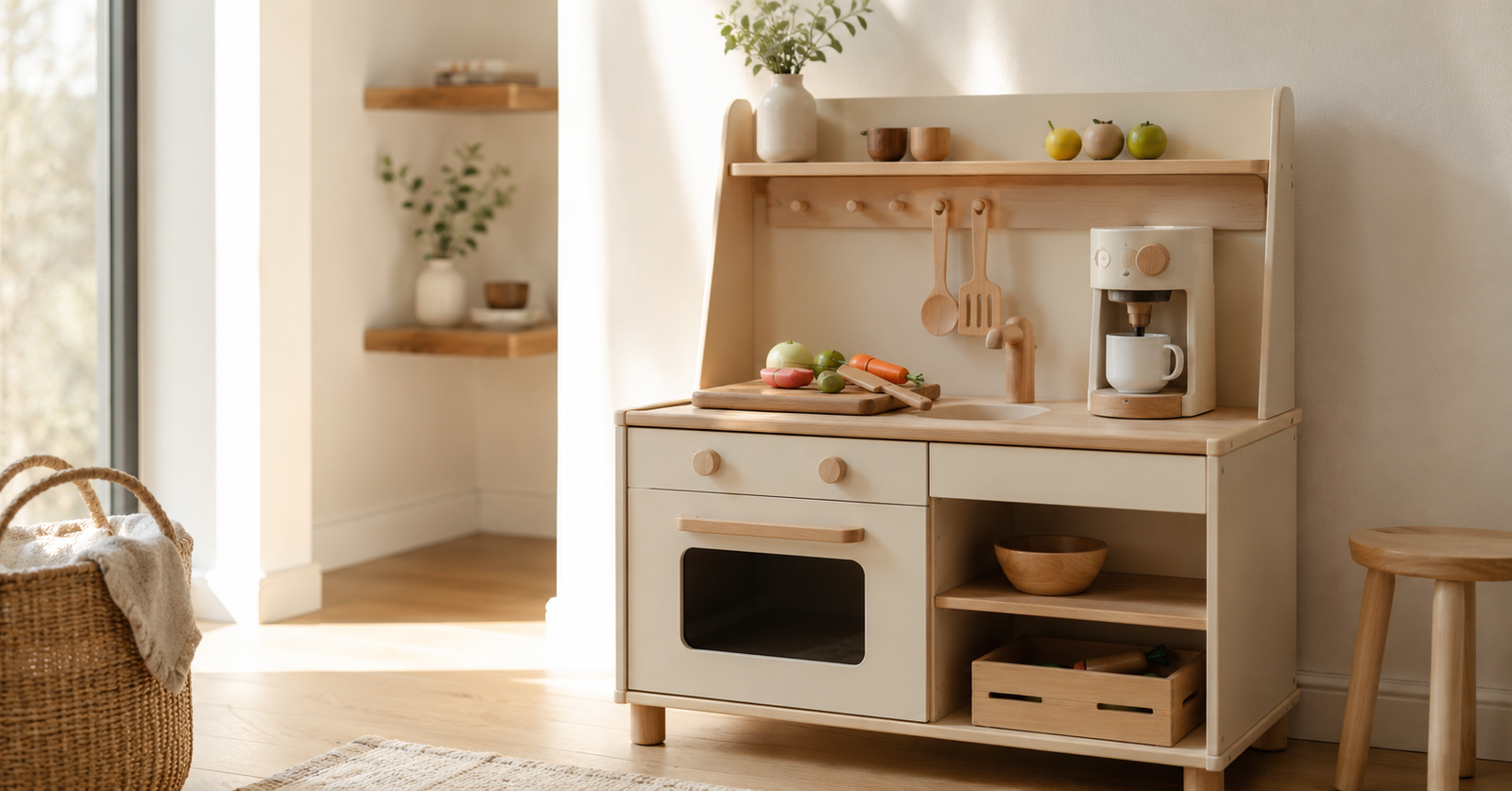
My older son hit a stretch around three where every spare moment was spent “making coffee” for whoever wandered into the living room. He’d hand me a wooden mug, watch my face like he was watching the news, and then ask if it needed more sugar. We didn’t have a real play kitchen at that point, just a row of cookware on the bottom shelf of the pantry. He made it work, but it was clear he was outgrowing the setup.
I’ve spent the last decade raising three kids through what I’d call the “pretend play years,” and a good play kitchen is one of the few toys that earns its footprint. The right one gets pulled out daily for a year or more, builds language and sequencing in ways flashcards never will, and quietly turns into a place where siblings cooperate instead of compete. The wrong one ends up shoved against a wall, missing knobs, and donated within six months.
I pulled this roundup together to save you that second outcome. Below are eight play kitchens I’d actually consider for a toddler today, covering wooden, plastic, indoor, outdoor, budget, and heirloom builds. All of them got vetted against the same quality bar I use for anything that takes up four square feet of my living room.
Follow the age label for the exact kitchen and its accessories. A 3+ label is not permission to use the kitchen with a younger child after removing a few small pieces or adding supervision. Step2 Best Chefs starts at age 2; the compact Tiny Land Honey Kitchenette is labeled 3+. Neither is a recommendation for an 18-month-old. See the CPSC’s toy-age guidance.
Quick Picks at a Glance
| Best For | Pick | Approx. Price | Why |
|---|---|---|---|
| Best Overall | Tiny Land Wooden Kitchen with Lights & Sounds | ~$150 | Height-adjustable counter grows with your child; includes 18 accessories and real button-activated lights and sounds |
| Best Plastic (Indoor/Outdoor) | Step2 Best Chefs Kitchen | ~$100 | Toddler-friendly from age 2, durable molded plastic, weather-resistant, 25 accessories included |
| Best for Small Spaces | Tiny Land Toddler Kitchen | ~$70 | Compact wood build under 23 inches wide, Montessori-style simplicity, lower counter height |
| Best Budget Cottage | Best Choice Products Toddler Cottage Kitchen | ~$85 | Wooden cottage charm with scalloped edges and real storage shelves; looks far more expensive than it is |
| Best Mid-Range with Most Appliances | ROBUD Wooden Play Kitchen | ~$130 | Six appliances (ice maker, fridge, coffee maker, oven, dishwasher, microwave), gold-accent design |
| Best Heirloom Wooden | Melissa & Doug Chef’s Kitchen | ~$140 | FSC-certified wood, working ice cube dispenser, the kind of build that survives three kids |
| Best Outdoor / Mud Kitchen | Hape Outdoor Kitchen | ~$190 | Real working water tap, weather-treated wood and bamboo, sensory play heaven for the backyard |
| Best Feature-Rich Corner | Best Choice Products Corner Kitchen | ~$150 | Light-up hood with sounds, L-shape design that fits an awkward corner, plus open storage across fridge, pantry, oven, and sink |
How I Chose These Eight
I started with a much longer list and cut hard. Anything with shaky stability complaints, a wave of recent one-star reviews about parts breaking, or a structural design that felt prone to tipping was out before it made the page. Same for anything labeled as a “kitchen set” that turned out to be a pile of accessories without a real kitchen unit. Useful, but a different category.
What I kept was filtered through four things I care about in a toddler kitchen:
- Stability. Follow the exact kitchen’s assembly and anti-tip instructions before use. A heavy or weighted base does not replace required anchoring, and anti-tip hardware does not make climbing safe. If the instructions do not explain how to secure your model, ask its manufacturer instead of improvising a weight or attachment.
- Real interactivity, not just decals. Doors that actually open, knobs that click, faucets that turn. Painted-on details photograph well but burn out a toddler’s interest in about a week.
- Honest accessory count. Some “playsets” include a single wooden spoon. I’ve flagged what each kitchen comes with so you know whether you’re also buying a $30 cookware set on top.
- Build quality at the price. A $70 kitchen and a $230 kitchen are different things. I’ve matched expectations to price tier so nobody feels misled.
I also gave weight to picks that work for more than one age. If you have a 2-year-old and a 4-year-old, you don’t want to buy twice. Most of these will carry a child from late toddlerhood through early elementary school.
The Eight Best Pretend Play Kitchens for Toddlers
1. Tiny Land Wooden Play Kitchen with Lights & Sounds: Best Overall
Best for: Families who want one kitchen to last from age 3 through early elementary. Approx. $150.
If I were buying one kitchen and one kitchen only for a household with toddlers and preschoolers under the same roof, this would be it. The standout feature is the three-stage height-adjustable counter. Most wooden kitchens lock in at one height and start to feel cramped by age five, but this one grows with your child. The range hood and stovetop have real button-activated lights and sound effects (auto shutoff, which I appreciate when it’s been the fourth round of “dinner” before lunch).
What sold me beyond the height adjustability: it ships with eighteen accessories, including a cutting-food set, a cookware set, a chef hat and apron. That’s a real “open and play” kit, not a stripped-down piece of furniture you then need to outfit. Build is eco-friendly wood, BPA-free, certified to ASTM-F963 and EN-71 toy safety standards.
- Height adjusts in three stages, growing with the child
- Real button lights and sounds, with auto shutoff
- Generous 18-piece accessory set included
- Removable sink for easier cleaning
- Assembly takes time and patience; block out an evening
- Some buyers report light intensity varies between bulbs
2. Step2 Best Chefs Kitchen: Best Plastic (Indoor / Outdoor)
Best for: Toddlers age 2+, families with active siblings, anyone wanting indoor-outdoor flexibility. Approx. $100.
The Step2 Best Chefs is labeled for ages 2 and up; its instructions require adult supervision and proper assembly. That age rating does not include an 18-month-old. The double-walled plastic is genuinely tough (Step2 makes this in the USA from US and imported parts), and it stands up to the kind of everyday play and sippy-cup spills that destroy wood finishes.
The feature list is dense for the price point: working oven and fridge doors, a pass-through window (which my kids loved for “drive-thru” play), a stovetop with lights and sounds (requires 2 AA batteries, not included), a coffee pot, a sink with faucet, a recycling bin, hooks, and shelves. It comes with 25 toy accessories. The molded-in colors mean no painted finish to chip.
It’s also one of the only options here you can move to a covered porch or playroom corner without worrying about humidity or scuffs.
- Manufacturer age guidance: 2+; adult supervision required
- Indoor/outdoor use; durable plastic shrugs off spills
- 25 accessories included; no chipping paint
- Pass-through window and working doors
- Batteries for lights and sounds sold separately
- Less of an “heirloom” look than wood; plastic is plastic
3. Tiny Land Toddler Kitchen: Best for Small Spaces
Best for: Apartments, second-child households, Montessori-leaning setups, children age 3 and up. Approx. $70.
This one is the apartment-friendly answer. The footprint is under 23 inches wide and the counter sits at just under 20 inches. Its low counter does not establish suitability for an 18-month-old: the Honey Kitchenette’s manufacturer age guidance is 3+. Choose for the labeled age first, then check whether the height suits your child.
The build is solid wood with water-based non-toxic paint. Where the bigger Tiny Land model is dense with appliances and lights, this one strips back to the essentials: stainless-steel pots and a pan, wooden cutting food with a knife and board, clicking knobs, an oven door, a sink. The aesthetic is cream with light wood and a small floral curtain. It looks more like a Montessori shelf piece than a toy aisle pickup.
This one is compact by design, which means fewer “rooms” to play with and a shorter ceiling on play length. If you have an older preschooler, you may outgrow it sooner. Its small size does not lower its 3+ age guidance, so do not choose it as a first kitchen for an 18-month-old.
- Compact toddler-scaled height (~20-inch counter)
- Solid wood with non-toxic water-based paint
- Montessori-friendly clean aesthetic
- Lower entry price than full-size options
- Few accessories, no lights or sounds
- May feel small by age 4
4. Best Choice Products Toddler Cottage Kitchen: Best Budget Cottage
Best for: Anyone who wants the “wood kitchen” look without the heirloom price. Approx. $85.
The cottage scalloped edges read as far more vintage than the price would suggest. It’s an under-$100 engineered wood and metal build from Best Choice Products, certified to ASTM and CPSIA toy safety standards, but it photographs like a much more expensive piece and slots nicely into a neutral playroom or living-room corner.
Features are real, not just decorative: a play microwave, a play oven, clicking knobs, and three open shelves for storage (pantry, oven, sink). It includes five accessories (three utensils, a play pot, a Dutch oven), which is honest for the price tier. You’ll likely want to add a basic food set if your child doesn’t already have one. The cream version is the most popular, but it also ships in sage, white, and black variants (different ASINs).
What you give up at this price: no lights or sounds, and the engineered wood doesn’t have the dense feel of solid-wood options three times the cost. For toddlers, neither has been a dealbreaker in my experience. But if you’re shopping for a child who’ll still be using this at age six, the wooden Melissa & Doug or the higher-end Tiny Land options below will outlast it.
- Cottage scalloped-edge styling looks far more expensive
- Real working doors and clicking knobs
- Open storage shelves for play food
- ASTM & CPSIA certified
- Only 5 accessories included; plan to add a food set
- No lights or sounds
- Engineered wood, not solid wood
5. ROBUD Wooden Play Kitchen: Best Mid-Range with the Most Appliances
Best for: Kids obsessed with watching adults make coffee, kitchens with serious appliance envy. Approx. $130.
If your toddler has noticed that real kitchens have more than a stove and a sink, this is the pick that delivers. ROBUD packs in six interactive appliances (a stove with range hood, a fridge with an ice-making function and separate freezer compartment, an oven with a see-through door, a coffee maker, a microwave, and a dishwasher), plus a sink with faucet. All five appliance doors actually open and close, knobs turn and click, and there are sound effects built into the design.
Aesthetically, this one leans modern: gold-accent handles, a marble-look countertop, available in white-and-gold or black-and-gold. It’s MDF wood construction, BPA-free, water-resistant, with an anti-tip safety device included, which is a detail I’m always glad to see on a 48-pound piece of furniture toddlers will pull on.
The catch: no play food is included. You’ll get pots, pans, dishes, and utensils, but if you want fake croissants and pretend eggs, that’s a separate purchase. Also, the small parts mean this is firmly a 3-and-up pick.
- Six interactive appliances; the most on this list
- All five appliance doors open and close
- Anti-tip safety device included
- Modern gold-accent design photographs well
- No play food included
- Small parts mean strict 3+ recommendation
- MDF rather than solid wood at this price point
6. Melissa & Doug Chef’s Kitchen: Best Heirloom Wooden
Best for: Families who want a piece that survives all the kids. Approx. $140.
Melissa & Doug has been making toys for over thirty-five years, and the Chef’s Kitchen is one of those pieces I’d genuinely call generational. New inventory is built on FSC-certified wood (FSC C156584), and the construction is dense. This thing weighs nearly 65 pounds. It’s not the kitchen you move every season; it’s the kitchen that sits in the playroom corner from your first child through your last.
The feature that pulls toddlers in is the working ice dispenser on the refrigerator. Two play ice cubes are included, and pressing the dispenser actually drops them. (Ice dispensers are the kind of detail a toddler can spend a solid week refilling on repeat without losing interest, which is a real testament to how well the feature is designed.) The dials turn, the microwave plate spins, the freezer opens, and there’s a grocery checklist clipped to the front for older kids to mark up.
The trade-off is accessories: it ships with just the two ice cubes. You’ll need to add pots, pans, food, and utensils separately, which can add another $30–50 to the total. For families who already have a play food set, this slots in beautifully. The default color is charcoal gray, but it also comes in cupcake pink/white and cloud white.
- FSC-certified wood, dense and built to last
- Working ice cube dispenser is a magnet for toddler play
- Five color/finish options available
- 35+ year brand with consistent quality
- Heavy (nearly 65 lb); adult assembly required
- Almost no accessories included beyond the ice cubes
7. Hape Outdoor Kitchen: Best Outdoor / Mud Kitchen
Best for: Backyard play, sensory-driven kids, families with covered outdoor space. Approx. $190.
Mud kitchens are the unsung hero of toddler play. You give a child a tap that produces real water, a small pile of dirt, and some flowerpots, and they will entertain themselves for an entire afternoon. That’s something no indoor toy I’ve ever owned can claim. My youngest son started showing interest in scooping and pouring around fifteen months, and that kind of sensory play maps almost perfectly onto outdoor kitchens.
Hape’s outdoor pick is the one I trust most for serious weather exposure. The wood is FSC-certified and pressure-treated for the outdoors; the plastic parts are bio-based green PE plastic; the body includes bamboo. It has a real working water tank with a tap feeding into a sink, a blackboard for “menus,” two flowerpots, clicking stovetop knobs, and an oven plate. The included accessories are practical: a pot, a ladle, two bowls, two flowerpots, a sieve, the water tank, sink and faucet, and an oven plate.
A couple of practical things to know before you buy. Hape recommends covering or storing it during harsh weather, even though the build is weather-resistant. You can’t actually cook real food on it or use real flame, so treat it as a sensory tool, not an outdoor appliance. For supervised backyard play, though, this is the closest thing to an outdoor experience that doesn’t require a real garden hose hookup.
- Real working water tank and tap
- FSC wood, bamboo, and bio-based plastic build
- Made for genuine outdoor use
- Excellent for sensory and water-play development
- Recommend covering in harsh weather
- Strict 3+ rating (small parts)
- Higher price point than indoor options
8. Best Choice Products Corner Kitchen: Best Feature-Rich Corner Design
Best for: Playrooms with awkward corners, families wanting maximum features per square foot. Approx. $150.
If you have a dead corner in a playroom or basement, this L-shape pick is built to fit it. The footprint runs nearly 57 inches along one wall and 24 inches along the other, which gives you much more usable kitchen “real estate” than a single-wall design at the same price tier. Build is engineered wood and metal, ASTM and CPSIA certified.
The feature density is what justifies the corner placement. Built-in play microwave and oven, clicking knobs, a light-up range hood with sound effects, a battery-powered ice dispenser at the stove, and open storage zones across the fridge, pantry, oven, and sink areas. It comes in a Farmhouse White as the headline color, with several other variants (pink, cream, sage, coastal blue, black, espresso) available as separate ASINs.
Honest caveat: this is the lowest-rated pick on my list, and it’s worth knowing why. The 4.4-star average reflects some assembly complaints and occasional reports of part-fit issues, both of which are common at this price for a kitchen this size. If you’re someone who loses patience with thirty-page IKEA-style instructions, factor that in. For families who can take their time with assembly and want the most appliances and the biggest footprint at $150, though, the trade is reasonable.
- L-shape corner design uses dead space
- Light-up range hood with sound effects
- Battery-powered ice dispenser
- Multiple color variants available
- Lowest-rated pick on this list (sits right at our 4.4 cutoff)
- Assembly is reported as time-intensive
- Large footprint; measure your corner before buying
How to Choose: A Quick Buying Guide
After you’ve narrowed to two or three picks above, these are the five questions I’d run through before clicking buy.
1. Wooden, plastic, or outdoor?
Wood lasts longer and photographs better but is heavier and intolerant of spilled juice and outdoor weather. Plastic (the Step2 pick) is dishwasher-resilient, lightweight, and can move indoor/outdoor, at the cost of an aesthetic you may or may not want in your living room. Outdoor mud kitchens are a different category entirely and best treated as a second kitchen for sensory play rather than a primary indoor toy.
2. How big is your space?
A full-size wooden kitchen runs about 35–40 inches tall and 30–40 inches wide. A corner unit (option 8) is the most space-efficient if you have an actual corner to fill. Apartment dwellers should look hard at the Tiny Land Toddler (option 3), which is genuinely compact. Measure your wall before ordering. If you also need a separate place for serving pretend meals or drawing menus, compare toddler table and chair sets by footprint before filling the rest of the room.
3. How old is your child today, and in two years?
Start with the exact model’s minimum age and safety instructions, then consider counter height and features. An 18-month-old is below Step2 Best Chefs’ 2+ guidance and the compact Tiny Land Honey Kitchenette’s 3+ guidance. Turning 3 does not automatically make every kitchen suitable: check its own label, accessories, and assembly requirements. If younger siblings share the room, keep age-restricted toys and small parts out of their reach.
4. Lights and sounds, or quiet play?
Lights and sounds are a fast hook for younger toddlers and great for kids who love feedback. They also burn through batteries and can grate on adult nerves on month six. The Tiny Land Lights & Sounds (option 1), Step2 (option 2), and Best Choice Corner (option 8) all include light/sound features. The Melissa & Doug, Tiny Land Toddler, and ROBUD picks lean more toward quiet wooden play.
5. What’s actually in the box?
Some kitchens come fully stocked (Tiny Land Lights & Sounds with 18 accessories, Step2 with 25). Others ship with just a couple of pieces and assume you’ll buy a separate cookware or food set (Melissa & Doug, ROBUD, Best Choice Cottage). Factor the cost of a starter food set ($20–40) into your decision if your child doesn’t already have play food. Our guide to the best toys for 2-3 year olds covers some excellent food-set add-ons.
Safety: What Actually Matters
Three things to check before assembly, regardless of which pick you choose:
- Anti-tip hardware. Follow the manufacturer’s instructions for your exact kitchen and any anti-tip device before play. Do not substitute added weight for required anchoring, or assume a generic strap fits every kitchen and wall. There is no verified 40-pound threshold in this guide that makes smaller kitchens exempt. Ask the manufacturer if the correct attachment is unclear, and do not let children climb on the kitchen. See the CPSC’s anchoring guidance.
- Choking-hazard small parts. Keep small parts away from children under three and from children who still mouth objects. Removing loose accessories does not lower the kitchen’s labeled minimum age; parts can also loosen or break off. Follow the exact product’s age guidance and inspect it for damage. The U.S. Consumer Product Safety Commission’s toy safety guidelines explain these requirements.
- Stable open/close mechanisms. Run your hand around door hinges and edges before letting a toddler loose on a freshly built kitchen. Most of these picks pass ASTM-F963 standards (the U.S. consumer toy safety standard), but assembly errors can introduce pinch points.
For broader context on why pretend play matters developmentally, and why a kitchen specifically punches above its weight, the American Academy of Pediatrics’ clinical report on the power of play is the gold-standard reference. The summary version: open-ended pretend play supports executive function, language, and social-emotional development in ways structured toys can’t replicate.
Frequently Asked Questions
What age is best for a play kitchen?
Interest in pretend cooking does not establish a play kitchen’s safe starting age. Follow the exact product’s label: Step2 Best Chefs is for ages 2 and up, while the compact Tiny Land Honey Kitchenette is labeled 3+. Do not use a 3+ kitchen with an under-3 child by removing accessories or relying on supervision. Check each model separately rather than assuming every pick is suitable once a child turns 3.
Wooden or plastic: which actually lasts longer?
For purely indoor use with reasonable care, wooden kitchens like the Melissa & Doug or Tiny Land picks will outlive plastic in terms of aesthetic durability. Paint and finish age well if the wood is solid. Plastic (the Step2) is more forgiving of spills, outdoor moisture, and rough handling but will eventually show scuffs and fading in sustained sunlight. If your kitchen will live in a finished playroom, wood. If it might wander out to the patio, plastic.
Do I need to buy separate play food?
It depends on the pick. The Tiny Land Lights & Sounds and the Step2 ship with full accessory sets (18 and 25 pieces respectively). The Best Choice Cottage and Tiny Land Toddler ship with a handful of pieces, enough to start. The Melissa & Doug and ROBUD picks expect you to add food separately. Budget another $20–40 for a basic wooden or felt food set. We cover food add-ons in our roundup of toys for 2-3 year olds.
Can an 18-month-old use a play kitchen?
Only choose a play kitchen whose manufacturer explicitly includes 18 months in the exact model’s age guidance. Step2 Best Chefs is 2+ and the compact Tiny Land Honey Kitchenette is 3+, so neither is an 18-month recommendation here. Supervision or removing small accessories does not override those limits. This guide has not verified an 18-month option.
How does pretend cooking help development?
It builds a surprising amount. Sequencing skills (first you turn on the stove, then you stir, then you serve), fine motor coordination (gripping utensils, opening doors), language (“more pasta, please”), social play (cooking for someone), and early symbolic thinking (a wooden block stands in for a sandwich). The National Association for the Education of Young Children (NAEYC) has good background reading if you want to go deeper.
What about safety for kids who climb on furniture?
Do not allow climbing on a play kitchen. Complete the exact model’s assembly and any required anti-tip installation before play, following the manufacturer’s directions for suitable hardware and attachment points. An anchor reduces tip-over risk; it does not make climbing safe or eliminate all injury risk. If the correct installation is unclear, keep the kitchen out of use until the manufacturer clarifies it.
Put the play kitchen somewhere visible from where you usually sit. The kitchens that get the most use in my house are the ones in the corner of the living room, where my kids can show me what they’re “cooking” without leaving my line of sight. The ones tucked into a basement or far bedroom get half the play time, no matter how nice they are.
Prices and availability are accurate as of publication and may shift. Specific feature sets are based on manufacturer listings and may vary slightly between batches or color variants, so always double-check the current Amazon listing before purchasing.