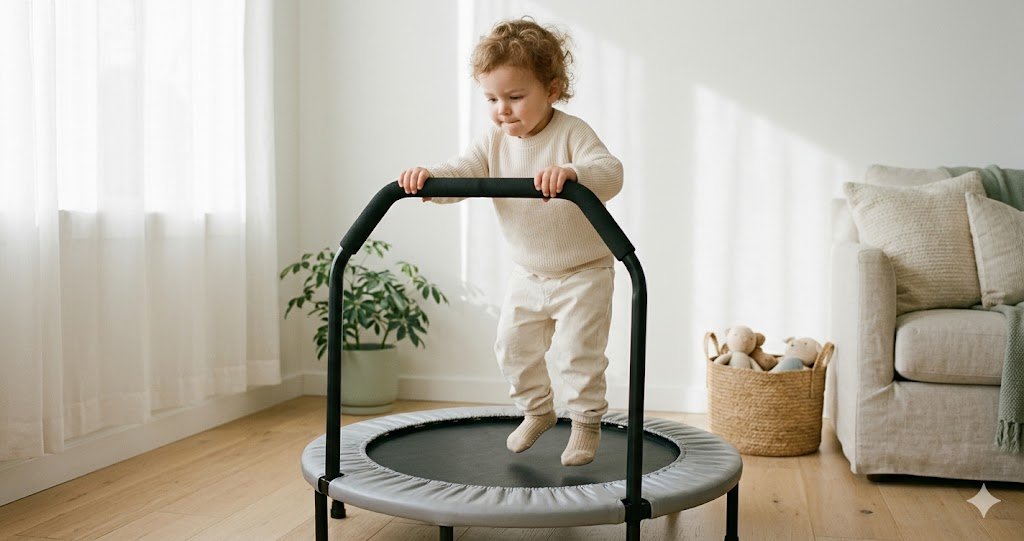
Search “toddler trampoline” on Amazon and you’ll get hundreds of results. Most parenting blogs will hand you a tidy list of ten links and let you click away. This isn’t that kind of article.
Before I show you any picks, I have to tell you something the affiliate-heavy roundups skip: the American Academy of Pediatrics does not recommend trampoline use for any child under six — including the small 36-inch mini trampolines you came here to research. That position has been on the books since 1977, most recently reaffirmed in 2012, and it applies whether the trampoline is in your backyard or your living room.
I’m raising three kids. My older son is past four and bounces with all the precision of a small tornado. My youngest is still finding his balance at nineteen months. So I understand both sides of this, the “AAP says no” side and the “but my kid has to move” side that any parent of an active toddler knows intimately. This article respects both.
If after reading the safety section you decide the risk-benefit math doesn’t work for your family, the most useful thing I can do is help you put the credit card back in the drawer. If you decide it does, I want to help you pick the model with the smallest realistic risk profile: proper ASTM certification, enclosed handle rail, single-jumper design, and a price you don’t have to rationalize.
📍 Before You Scroll: What AAP and CPSC Actually Say
The AAP’s parent-facing site HealthyChildren.org states plainly that “toddlers and preschoolers face the greatest risks for trampoline injuries” and that “kids under 6 should NEVER jump.” The 2012 AAP policy statement goes further: home trampoline use is “strongly discouraged” at any age.
The numbers behind that position: the U.S. Consumer Product Safety Commission estimates more than 100,000 trampoline-related ER visits per year in the United States, with twenty-two deaths in a ten-year span. Children under six are roughly fourteen times more likely to be injured on a trampoline than older kids. Three-quarters of injuries happen when more than one child is bouncing at once.
I’m not going to tell you the 36-inch mini trampoline category is exempt from any of this. It isn’t. The risk on a single-jumper foam-handled toddler model with elastic bands and a covered frame is meaningfully lower than on a 12-foot backyard spring trampoline with multiple kids on the mat — but “meaningfully lower” is not “safe.” If your child has a known balance disorder, joint hypermobility, or is under two, this isn’t the product category for your family. Talk to your pediatrician.
What We Used to Narrow This List From 300+ Listings to 7
The toddler trampoline category on Amazon is full of nearly identical 36-inch units from white-label sellers. Most of them have inflated review counts and zero brand history. To get from 300+ listings to seven defensible picks, I used a hard-gate filter — no exceptions, no “but this one looks pretty in pink” thinking.
Every pick on this list meets all of the following:
- 36-inch round design with a permanent, fully-enclosed handle or rail (no bare frames, no removable-only designs for the 1-3 age range).
- 4.4 stars or higher across at least 50 verified Amazon reviews.
- Active sales velocity. Meaning the listing is currently selling, not abandoned. White-label units that sat unsold for months get filtered out automatically.
- Spring-covered or spring-free design. Either elastic bands that don’t pinch, or traditional springs hidden under a continuous safety pad with no exposed gaps.
- Single-jumper rated. Three-quarters of trampoline injuries happen with two kids on the mat, so anything marketed as a “parent-child” or two-person trampoline is out.
- ASTM certification preferred. Required for top picks; noted explicitly for any pick that doesn’t carry it.
I also cross-checked each product’s age recommendation against the brand’s own website, not just the Amazon listing — Amazon copy is frequently stale or written by third-party listing optimizers, while brand-site spec pages are kept more current. Where the two disagreed, the brand site wins and I’ve flagged it in the spec block.
Quick Reference Table: Which Toddler Trampoline Fits Your Situation?
If you only have ninety seconds, scan this. Each row links to the longer write-up below.
| Pick | Best For | Age Range | Capacity | ASTM | Price Range |
|---|---|---|---|---|---|
| BCAN SP1 | Best Overall | 1–6 | Not published | ✅ Listed | ~$60 |
| BCAN BT1 | Premium, grows with child | 1–6 | Not published | ✅ Listed | ~$130 |
| Fisher-Price WonderJump | Most trusted brand name | 3+ | 55 lbs | Not on listing | ~$75 |
| ATIVAFIT 36″ | Best for storage and travel | 2–6 (brand site) | 55 lbs | Not on listing | ~$77 |
| JOY SPOT! 3FT | Quietest, spring-free | 1–6 | 100 lbs | Not on listing | ~$90 |
| Happin 36″ | U.S.-listed seller, dual-certified | 1–6 (brand site) | Not published | ✅ ASTM + CPC | ~$80 |
| SkyBound 36″ | Heaviest frame, deepest cert profile | 3+ | 200–300 lbs jumper | ✅ F963 / F381 / F2225 / AS4989 | ~$50 |
1. BCAN SP1 36″ Toddler Trampoline — Best Overall
BCAN SP1 — Best Overall Toddler Trampoline
Size: 36″ round, 30″ total height
Age: 1–6 (per BCAN listing and brand site)
Capacity: BCAN does not publish a maximum user weight for this model
Handle: Foam-wrapped, three-position handlebar (convex for 1–2 yr grip, concave for 3–5 yr more jump space, removable for older kids)
Certification: ASTM listed by manufacturer
Frame & mat: Steel frame, PVC safety pad covering elastic bands, anti-slip rubber feet, six-leg base
Setup: BCAN claims ten-minute tool-free assembly
Best for: Parents who want ASTM-listed safety credentials without paying a premium, and who want a trampoline that lasts from a child’s first cautious bounces through age six.
BCAN sits in a category of its own among the small-trampoline brands. They’re not a household name like Fisher-Price, but they’ve built their entire catalog around mini rebounders, both for kids and for adults, and they maintain U.S. parts warehouses for replacement parts — which matters more than people realize once a bungee snaps or a foam grip wears through.
The SP1 specifically wins “Best Overall” because of one design choice: the three-position handle. For a one-year-old just figuring out what their hands are for, the convex grip lets tiny fingers wrap securely. As your kiddo grows into the three-to-five window where they want more room to jump and less “in their way” hardware, you reconfigure the handle concave. By six, most kids want it gone entirely, and you simply remove it. One trampoline, three developmental stages.
It’s a small thing, but my older son was the kind of toddler who would deliberately ignore a handle if it didn’t fit his hand. Having the convex option meant he actually used the rail when he was small, instead of trying to bounce one-handed.
The trade-off, which the premium BT1 model addresses, is that the SP1 handle is not height-adjustable — only configurable. A tall four-year-old gets the same handle height as a small two-year-old. For most families that’s fine; the foam wrapping accommodates a fairly wide grip range. For families with a notably tall child, the BT1 is the upgrade path.
BCAN doesn’t publish a specific maximum user weight on this model, which I’d prefer they did. The brand’s adult fitness trampolines are rated to 330–550 pounds depending on size, so the frame engineering is in the family, but the official spec sheet for the SP1 doesn’t include a number. Treat this as a 1-to-6 trampoline by age, not by pounds, and stop using it when your child’s developmental stage outgrows it.
2. BCAN BT1 36″ Toddler Trampoline — Best Premium / Grows With Child
BCAN BT1 — Best Premium Toddler Trampoline
Size: 36″ round, 21.5″ total height
Age: 1–6
Capacity: Not published by BCAN for this model
Handle: Height-adjustable foam handlebar with safety locking pin
Certification: ASTM listed by manufacturer
Frame & mat: No-gap one-piece jumping mat with elastic-band system (no exposed springs), foldable legs with anti-slip rubber feet
Setup: BCAN claims five-minute tool-free assembly; folds for storage
Best for: Parents planning for a child to use the trampoline from one to six, who want a height-adjustable rail and don’t mind paying twice the budget-pick price for the upgrade.
The BT1 is BCAN’s “premium SKU” — same essential platform as the SP1, but with the two features parents reach for once they actually live with a toddler trampoline: a handle that grows with the child, and folding legs for when grandparents are visiting and the living room needs to be a living room again.
The height-adjustable rail is the bigger of the two upgrades. A one-year-old needs a low handle at chest level; a five-year-old who’s grown nine inches in three years needs that handle considerably higher or they’re hunching forward to use it, which both hurts their back and trains a bad bouncing posture. The BT1’s two-position pin system handles this; the SP1’s fixed handle does not.
The foldable legs are useful in a way that’s hard to appreciate until you’ve tried to vacuum around a trampoline. Folded, the BT1 fits behind a sofa or stands upright in a closet. Without that feature, even a 36-inch trampoline becomes a permanent fixture that you eventually start ignoring as it accumulates dust.
At roughly $130, the BT1 costs about twice what the SP1 does. That premium is reasonable if you’re committing to the trampoline for several years and have a tall child, or if your living space genuinely requires the fold-away footprint. If neither of those applies, the SP1 gets you 80% of the value at half the price.
3. Fisher-Price WonderJump 36″ — Best from a Trusted Brand
Fisher-Price WonderJump — Best Trusted Brand Name
Size: 36″ round
Age: 3+ (Fisher-Price explicitly recommends ages three and up, not below)
Capacity: 55 lbs maximum jumper weight
Handle: Soft foam-grip stabilizing handlebar, removable but not height-adjustable
Certification: ASTM not listed on Amazon page; product made under Mattel licensing by Bestway, both of which are subject to U.S. CPSIA regulation
Frame & mat: Powder-coated steel frame, six non-slip foot pads, full-cover spring pad
Setup: Tool-free assembly in minutes
Best for: Parents who weight brand reputation over spec sheets, families with a child age three or older, and anyone who wants a Mattel-backed customer service path if something breaks.
If the BCAN models feel anonymous to you, this is the antidote. Fisher-Price has been making toddler products since 1930. The WonderJump is licensed under the Fisher-Price brand and manufactured by Bestway, one of the largest outdoor-recreation and inflatable-products manufacturers in the world. That parentage means real CPSIA compliance, real recall infrastructure, and a name your relatives will recognize if they’re buying this as a gift.
What you give up for the brand premium: the WonderJump is rated for ages three and up, not one and up. The 55-pound weight limit is honest and explicit, where the BCAN models are vague. Both numbers matter — if your child is approaching five and trending tall, you’re going to outgrow the WonderJump before you outgrow either BCAN. And the handlebar isn’t height-adjustable, which limits the developmental window further.
One thing the WonderJump does notably well: the full-coverage spring pad. Reviewers consistently note that the springs are completely covered, with no gaps a foot could slip into. For the under-six population, where the most common trampoline injury after falls is contact with the frame or springs, that detail isn’t decorative — it’s the single most useful safety feature of the entire design.
4. ATIVAFIT 36″ Toddler Trampoline — Best Foldable for Travel
ATIVAFIT 36″ — Best Foldable for Travel
Size: 36″ round when assembled; folds to 28″ × 14″ × 5″ package
Age: 2–6 (per ATIVAFIT brand site)
Capacity: 55 lbs (per ATIVAFIT brand site)
Handle: Foam-wrapped fixed handle (not height-adjustable on this model)
Certification: Not listed on Amazon page; ATIVAFIT brand site does not display ASTM logo for this SKU
Frame & mat: Reinforced alloy steel frame, six-leg base with safety lock, waterproof Oxford-cloth mat, elastic-band suspension
Setup: Pre-assembled, folds flat for storage
Best for: Families who travel with toddlers, live in small apartments, or visit grandparents often enough that “the trampoline goes in the trunk” needs to be a real option.
ATIVAFIT has been making fitness equipment since the 1990s as an OEM partner for several Western brands you’d recognize. Their toddler trampoline isn’t trying to compete with BCAN on certifications. What it does instead is fold flat — really flat. The folded package is about the size of a yoga mat case and a third the width, and it slides into a car trunk or under a bed with no fight.
If you split time between two homes, drive to your in-laws’ for long weekends, or live somewhere your trampoline has to disappear when adult guests come over, that flatness matters more than another half-pound of frame steel. My sons have both used a similar ATIVAFIT model at the grandparents’ apartment because it tucks into a closet between visits.
The capacity number to pay attention to: 55 pounds. ATIVAFIT publishes this honestly on their brand site, which I appreciate. A five-year-old American boy is roughly 40 pounds at the 50th percentile, so you’ll likely make it through the recommended age window, but a heavier child will outgrow this model by four or five. If your kid is growing fast, the higher-capacity JOY SPOT! below or the SkyBound option is the smarter buy.
The notable absence: no ASTM mark on the listing or brand site for this particular SKU. ATIVAFIT does make ASTM-certified models in their larger 60-inch line, so the company has the testing infrastructure — they just didn’t apply it (or didn’t display it) for this one. For parents who treat ASTM as a non-negotiable, this means choosing one of the BCAN models or the SkyBound instead.
5. JOY SPOT! 3FT Toddler Trampoline — Quietest for Apartments
JOY SPOT! 3FT — Quietest (Spring-Free)
Size: 36″ round, 8.3″ folded height
Age: 1–6
Capacity: 100 lbs (highest among the 36-inch picks on this list)
Handle: Two-position adjustable foam handlebar (approximately 23″ to 32″ range), fully removable
Certification: Not displayed on this specific listing; JOY SPOT! does sell a separate “Premium” SKU with ASTM marking, but the sales velocity on that variant is significantly lower
Frame & mat: Spring-free elastic-band suspension (no metal springs anywhere in the design), rubber-tipped legs, anti-slip feet
Setup: Tool-free, five-minute assembly per manufacturer
Best for: Apartment dwellers, anyone with downstairs neighbors, families with a baby napping while the older kid bounces, and parents of kids with sensory sensitivity to the metallic “boing” of traditional spring trampolines.
The spring-free design is the entire pitch for this one. Traditional small trampolines use steel springs to provide bounce; JOY SPOT! uses thick elastic bands instead. The difference is immediate and significant: no metallic ringing, no high-frequency squeak, just a softer whump on each bounce.
If you live in an apartment, a townhouse, or a single-family home where the trampoline lives near a bedroom, this matters more than parents anticipate. Spring trampolines aren’t loud per se, but they make a distinctive sound that travels through floors and walls. Spring-free models are dramatically quieter — to the point that I’d choose this design even at a slight price premium for any indoor placement.
The 100-pound weight capacity is also worth noting — it’s the highest among the 36-inch models on this list, which gives you breathing room as your child grows. Combined with the two-position adjustable handle, you can plausibly stretch this trampoline from a toddler’s first jumps to a grade-schooler’s last ones.
The honest weakness: ASTM certification isn’t displayed for this particular SKU. JOY SPOT! does sell a separate “Premium” version that explicitly carries ASTM marking, but that variant moves at a fraction of this one’s sales volume, which makes me hesitant to recommend it — I’d rather you buy a proven-selling SKU with a known design history than a low-volume sibling product with a better certification claim but no real-world track record. If ASTM is a deal-breaker for you, the BCAN models or the SkyBound are the better answer here.
6. Happin 36″ Toddler Trampoline — Best U.S.-Listed Seller With Full Certification
Happin 36″ — Best U.S.-Listed Seller With Dual Certification
Size: 36″ round, 30″ total height
Age: 1–6 (per Happin brand site)
Capacity: Happin does not publish a maximum user weight for this specific SKU
Handle: Height-adjustable foam handlebar
Certification: ASTM and CPC dual-certified per brand site (CPC = U.S. Children’s Product Certificate)
Frame & mat: Steel frame with anti-slip legs, no-gap mat-to-pad junction, 1.5-inch thick spring cover padding
Setup: Tool-free
Best for: Parents who want documented U.S. children’s product compliance, a seller account based in the United States, and a height-adjustable rail — without going to the BT1’s premium price point.
Happin solves a specific problem that haunts the Amazon toddler-trampoline category: most of the listings are fulfilled by sellers based outside the U.S., and when something goes wrong, you’re dealing with overseas customer service through Amazon’s chat system. Happin operates through Valusa, a U.S.-based seller account, which means returns and replacements move at U.S. speeds.
The dual certification — ASTM plus CPC — is the other distinguishing feature. ASTM is the voluntary trampoline-safety standard; CPC is the mandatory U.S. children’s product compliance certificate. Many overseas listings claim ASTM but skip the CPC paperwork. Happin documents both on their brand site, which gives you stronger ground to stand on if a product issue ever needs to be escalated.
What Happin doesn’t publish: a specific maximum jumper weight for this exact SKU. The 1-to-6 age range is clear, the build quality is in line with the price, and the no-gap mat design is genuinely good — but if you’re the kind of buyer who needs a number to plan around, the Fisher-Price (55 lbs) or JOY SPOT! (100 lbs) gives you more clarity.
The trampoline is also one of the prettier ones in this list, with several genuinely tasteful color options on the brand site (the Purple and Coral colorway in particular is one my older son would have picked himself at four). For families who plan to keep the trampoline visible in a playroom or living area rather than hidden away, the design matters.
7. SkyBound 36″ Indoor Trampoline — Best Budget Heavy-Duty
SkyBound 36″ — Best Budget Heavy-Duty Frame
Size: 36″ round, 8.7″ folded height
Age: 3+ (per Amazon listing)
Capacity: Frame static-rated to 1500 lbs; SkyBound recommends a 200–300 lb single-jumper limit per their site
Handle: Foam-wrapped 2.0mm galvanized steel handlebar (notably thicker frame steel than competitors)
Certification: ASTM F963, F381, F2225, and AS4989 — the most comprehensive cert profile on this list
Frame & mat: Reinforced galvanized steel frame, thick PVC safety pad over springs
Setup: Tool-free
Best for: Parents on a tight budget who still want a real American brand and the deepest safety certification list available, families with a heavier or older preschooler, and anyone who’s broken a cheaper trampoline before.
SkyBound is the only pick on this list with a full backstory you can verify on a U.S. brand website. They make trampolines and trampoline parts at every size, from this 36-inch toddler model all the way up to fourteen-foot backyard units, and their site openly publishes recall information, warranty terms, and the actual ASTM standards they certify to.
What sets this model apart on paper is the frame thickness — 2.0mm galvanized steel where most 36-inch trampolines use thinner tubing. You can feel the difference when you assemble it; the bar doesn’t flex when an adult pushes on it. For a heavier four- or five-year-old who jumps hard, that matters. SkyBound is also the only pick that carries four separate ASTM certifications (toy safety, trampoline safety, full-size trampoline safety, and an Australian standard).
The honest limitation: like the Fisher-Price, this is rated for ages three and up, not one and up. If your child is a younger toddler still learning to stand steady, the BCAN SP1 or the BCAN BT1 is more appropriate. The SkyBound is built for the preschooler who’s already running, climbing, and ready to translate that energy into controlled bouncing.
One other note: SkyBound publishes weight capacity in the way fitness manufacturers do — static frame rating versus single-jumper rating. The 1500-pound static rating is what the empty frame can hold without deforming; the 200–300 pound jumper recommendation is what one person should weigh when actually bouncing. That’s overkill for a preschooler, which is exactly the point — the margin is enormous, which is part of why this frame holds up for years.
How to Choose: The Five Specs That Actually Matter
The product listings will throw a hundred specs at you. Most of them are noise. Here are the five that actually decide whether you’ll be happy with the trampoline six months in.
1. Your child’s developmental readiness, not just their age
Manufacturers list a minimum age, but the real question is whether your child can stand independently for a full minute, walk steadily without holding furniture, and follow a simple “stop” or “sit down” instruction reliably. A child who can do all three is ready to try a toddler trampoline under supervision. A child who can’t do any of them, regardless of birthday, isn’t, and the recommended age on the box is irrelevant.
My older son was ready at about two and a half. My youngest, at nineteen months, isn’t — he can stand, but his “stop” comprehension is still developing, and that combination is exactly the situation where a trampoline becomes a hazard rather than a tool. Same biological family, totally different readiness. Birthdays don’t decide this; whichever week your kid stops trying to bounce while holding a toy in each hand, that’s the week.
2. Handle type: fixed vs. height-adjustable vs. removable
This is the spec parents most often regret not researching. A fixed-height handle is fine for a single developmental window — say, eighteen months to three years. After that, your child either outgrows it (and stops using it because it’s in the way) or grows past it (and starts hunching). A height-adjustable handle, like the one on the BCAN BT1 or Happin or JOY SPOT! models, accommodates a wider range. A fully removable handle, like the BCAN SP1’s three-position design or the Fisher-Price WonderJump’s pull-off rail, gives you the option to graduate your kid from “needs the rail” to “doesn’t need the rail” without buying a new trampoline.
3. Spring vs. spring-free
Two practical differences. Spring-free elastic-band designs are noticeably quieter, which matters for apartment-dwelling families and anyone with a baby napping during older-sibling bounce time. Spring designs are typically louder but can offer slightly higher bounce on the same input — which is a feature for older preschoolers and a non-issue for younger toddlers, who you want bouncing low and controlled anyway.
The safety story is more complicated than the marketing suggests. Spring-free isn’t automatically safer — what matters is whether the design has gaps where a foot can slip. A well-designed spring trampoline with a continuous mat-to-pad cover (like the Happin, Fisher-Price, or BCAN SP1) is comparable in fall-related safety to a spring-free model. Spring-free is most clearly better on noise.
4. Weight capacity vs. your child’s growth trajectory
If a manufacturer publishes a 55-pound weight limit, take it seriously. Average American children reach 55 pounds somewhere between age six and seven, with significant individual variation — some kids will hit it sooner, some later. If you want one trampoline to last all the way through preschool and into early elementary, look at the JOY SPOT! (100 lbs) or the SkyBound (200+ lbs jumper rating). If you’re comfortable replacing or retiring earlier, the lighter-rated models will be fine for the first few years.
5. ASTM and CPC marks on the listing
Neither standard is legally required for a small recreational trampoline, but the presence of both is a strong signal that the manufacturer has invested in compliance infrastructure. ASTM F381 is the relevant trampoline-specific standard; F963 covers general toy safety; CPC is the U.S. children’s product compliance certificate. The BCAN models and Happin display ASTM clearly; SkyBound displays the deepest list of all. The other picks don’t — which doesn’t mean they’re unsafe, just that the documentation isn’t there to support a stronger safety claim.
The Safety Rules AAP Recommends If You Use One Anyway
If your family lands on the “we’re using one” side of this decision, the AAP and CPSC have published consistent guidance on how to make trampoline use as low-risk as possible. These are not my rules. They come directly from the AAP’s HealthyChildren.org parent guidance and the CPSC Safety Alert #085.
- One child on the mat at a time. This is the single biggest risk reduction available. About three-quarters of trampoline injuries happen with two or more jumpers, because a smaller child can be thrown by the bounce energy of a larger child. No exceptions, including siblings, including “just for a second.”
- An adult is always supervising. Not in the next room, not “checking on them every few minutes” — actually in the room, watching. Toddler trampolines are not a babysitter.
- No flips, somersaults, or attempted tricks. Cervical-spine injuries on trampolines almost universally involve attempted flips. A toddler isn’t going to plan one, but a four-year-old watching gymnastics on TV absolutely will try. Make the rule before they think of it.
- No jumping onto the trampoline from another surface. Couch-to-trampoline, chair-to-trampoline — this is how the worst home-trampoline injuries happen. The trampoline is for stepping onto, not landing onto.
- The trampoline is on a flat, hard floor. Not on carpet, not on grass, not on a rug. Soft surfaces under a small trampoline make the bounce response unpredictable — the legs sink unevenly and the mat tilts. Hardwood, tile, or laminate.
A few additional rules I follow at home that aren’t in the official AAP guidance:
House rules in our home (not AAP guidance — my own choices):
- Three-foot clearance on all sides — no toys, no furniture, no walls within arm’s reach of a jumping child.
- Socks off and onto the trampoline, or grippy socks with rubber dots — regular socks on the mat surface are slip hazards.
- “Stop bouncing before you get off” is its own enforced rule. Stepping off mid-bounce is how ankles roll.
- Maximum twenty minutes per session for younger toddlers. Coordination degrades with fatigue, and tired-toddler bouncing is when accidents happen.
Frequently Asked Questions
Are 36-inch mini trampolines safer than full-size backyard ones?
The AAP does not officially differentiate between sizes in its position statement, and from a strict policy standpoint, all home trampolines are discouraged for children under six. That said, the CPSC injury data points to two factors that drive most serious injuries: multiple simultaneous jumpers and falls from height. Mini trampolines with enclosed handle rails reduce both risks substantially compared to a 12-foot spring trampoline without netting — but “substantially reduced” is not zero, and the AAP’s under-six guidance still applies.
Can my 18-month-old use a toddler trampoline?
Most manufacturers list a minimum age of one or two years, but I’d push parents to think about developmental readiness rather than birthday. If your child is still learning to stand without holding furniture, the trampoline is not the right tool yet. If they’re a confident walker who can stop on command and balance for a full minute, the design intent of these products covers them — though AAP would still recommend waiting until six.
Indoor vs. outdoor placement?
Indoor placement is what these 36-inch units are designed for. Some manufacturers explicitly limit warranty coverage to indoor use, and outdoor exposure subjects the mat and elastic bands to UV degradation, temperature swings, and rain damage regardless. Check the specific brand’s warranty terms before placing one on a patio. If you want outdoor bouncing, that’s a different product category — a 6-foot or larger trampoline with proper netting, which has its own AAP cautions.
How long do toddler trampolines last in practice?
The frame outlasts everything else by years. The elastic bands or springs are the first thing to fatigue, typically at the one-to-three-year mark of regular use. The foam handle grip is second. Most of these brands sell replacement bungees and pad covers, which is one quiet reason BCAN’s U.S. parts warehouse matters — you can keep the trampoline going for a second child without buying a new one.
What if I rent or live in a small apartment?
Three considerations. Pick a spring-free model (JOY SPOT!) for noise reduction. Pick a foldable model (ATIVAFIT or BCAN BT1) for storage. And test your floor — put the unfolded trampoline in place, have your child bounce gently while you stand on the floor below or in an adjacent unit, and listen. A trampoline that’s silent on hardwood may be unacceptable on a suspended floor.
Is ASTM certification mandatory?
No. ASTM is a voluntary standard for recreational trampolines, not a federal requirement. CPC (Children’s Product Certificate) is mandatory for any children’s product sold in the U.S., but most importers handle CPC at the paperwork level without testing every SKU to ASTM. The presence of either mark on a listing is a positive signal; the absence isn’t proof of a problem. I weight ASTM-marked models slightly higher because it indicates the brand has invested in voluntary testing.
What should I do if my child does get hurt on the trampoline?
For visible injuries — a clearly swollen ankle, a wrist that won’t bear weight, any head impact — call your pediatrician’s after-hours line or head to urgent care. Take a photo of the trampoline setup and the injury site if you can; pediatricians often ask for mechanism-of-injury details, and photos beat verbal recall. For falls that seem minor but involve any neck or back complaint, lower your threshold for getting it checked — cervical injuries are the category AAP flags most strongly, and they can present subtly. Keep the trampoline’s model name and your child’s weight handy when you call; it helps the clinician calibrate the conversation.
The Bottom Line for Busy Parents
AAP guidance is what it is. If you’re treating that guidance as inviolable, the right answer is “no trampoline yet” and a different approach to burning toddler energy. An indoor obstacle course works remarkably well, and our screen-free activities guide covers thirty more I rotate through with my own kids.
If you’ve decided the risk-benefit math works for your family, here’s where I’d put each dollar:
- One defensible choice and you’re done thinking about this: BCAN SP1. ASTM-listed, three-position handle, priced where it should be.
- Tall kid, or want one trampoline from one to six: the BCAN BT1. Adjustable rail and folding legs justify the premium if you actually use both.
- You weight brand reputation over spec sheets: Fisher-Price WonderJump. Just understand it’s a three-and-up product with a 55-lb ceiling.
- Apartment, downstairs neighbors, baby napping: JOY SPOT! spring-free is the only one that solves the noise problem.
- Tight budget, real American brand: the SkyBound at sub-$50, with the deepest certification list on the page.
Whichever you pick — supervise actively, enforce the one-child rule like your kid’s spine depends on it (because it does), and have an honest conversation with your pediatrician at your next well-child visit. They’ve seen the injury data up close and their perspective is worth more than any blog roundup, including this one.
One more practical note: if you and your partner aren’t on the same page about whether to buy a trampoline at all, save yourselves an argument and read the AAP section above together first. It’s a lot easier to decide once both adults have the same information, and the conversation goes better than “I already ordered it.”
Toddler tantrums on top of toddler energy?
Grab our free Calm-Down Cheat Sheet — ten phrases that actually work mid-meltdown, written for parents who don’t have time for ten-step scripts.