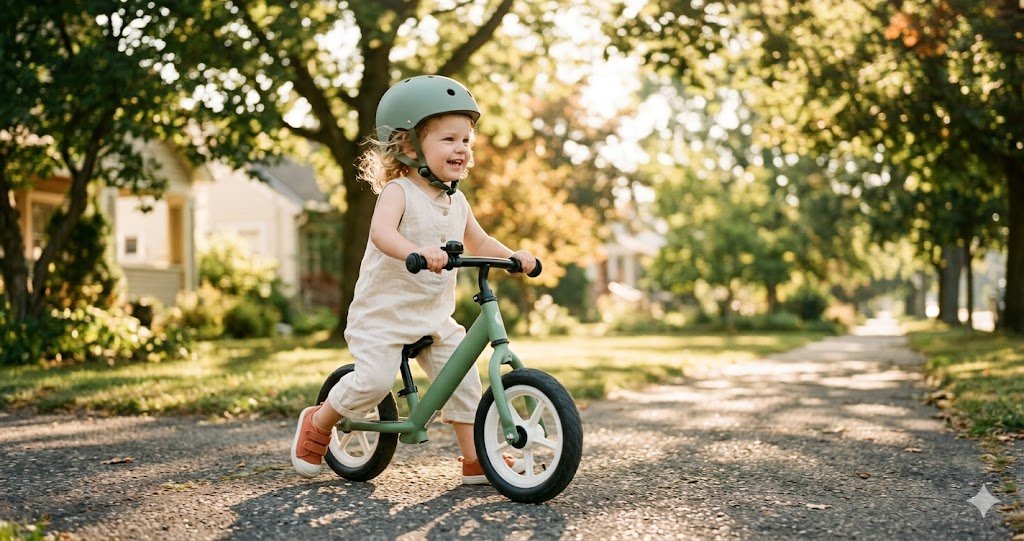
My older son started gliding on a balance bike around 2 years and 4 months. Within six weeks he was faster than I was comfortable jogging next to. My youngest son is 18 months old and currently still very much in the walking-the-bike-around-the-living-room phase. Same household, same parents, two completely different rides. That gap is exactly why “best balance bike for a 2 year old” is a harder question than most roundups admit.
If your kid is closer to 18 months and just got steady on their feet, you need a different bike than the kid who’s almost three and ready to chase older siblings. The Amazon search results lump these together, which is how so many parents end up with a $30 four-wheeled toy collecting dust by age 2.5, or a “real” balance bike their toddler is too small to mount.
This guide breaks the picks down by where your child actually is, not just by chronological age, and I’ve personally watched both my sons go through it. For the bigger-picture motor-skills framework behind these picks, my main balance bike guide for toddlers walks through the inseam math and stage-by-stage development.
Are balance bikes actually worth it?
Quick yes. The research is genuinely strong here, which is rare for parenting products. A study published in the Journal of Functional Morphology and Kinesiology surveyed over 2,000 families and found that kids who used a balance bike before transitioning to a pedal bike learned to ride independently almost two years earlier than kids who used training wheels. A follow-up biomechanics study using inertial sensors explained why: training wheels actually teach kids the wrong motor pattern, because the bike never tips, so the child never learns to manage instability.
The American Academy of Pediatrics doesn’t formally endorse a specific learning method, but their bike-sizing guidance emphasizes that a properly-sized first bike, where the child can stand straddling the bike with both feet flat on the ground, is the single most important fit factor. That’s the entire design philosophy of a balance bike.
What is not worth it: buying one too early. If your child isn’t steadily walking yet, a balance bike will mostly sit there. The pediatric PTs I’ve followed on this consistently say wait until independent walking is solid, plus the ability to briefly stand on one foot. Buying at 12 months because the box says “12 months+” is one of the most common ways parents end up with an expensive piece of nursery decor.
How I picked these (and what I cut)
I went through every balance bike with at least a few thousand Amazon reviews, cross-checked them against independent test sites like BabyGearLab, Two Wheeling Tots, Rascal Rides, and BikeRide, and pulled the CPSC recall database for every brand. A few popular Instagram-darling brands (the ones with the wicker baskets) got cut because their actual Amazon performance is poor: under 50 reviews and a 3.4 average. Pretty doesn’t equal usable.
I also separated four-wheeled “baby balance bikes” (12–24 months, essentially a ride-on toy) from true two-wheeled balance bikes (18 months and up, the kind that actually teaches the balance skill). Most roundups mix them. Don’t let anyone sell you a four-wheeler as the right answer for a confident two-year-old.
Brand transparency note: Retrospec voluntarily recalled about 72,000 of their Scout-model children’s bike helmets in January 2024 for not meeting CPSC’s positional stability standard. Their balance bikes were not part of the recall, and none of the other brands on this list have any CPSC recall history. I’m flagging it because if you’re buying a Retrospec bike and want a matching helmet from the same brand, skip the Scout line. They make other CPSC-compliant models.
The 5 picks at a glance
- KRIDDO Toddler Balance Bike — Best Overall for ages 2 and up
- Strider 12 Sport — Best Premium / longest hand-me-down life
- Retrospec Cub 2 — Best for the just-turned-two kid
- SEREED 4-Wheel Baby Balance Bike — Best for first birthdays (12–24 months)
- Retrospec Cricket — Best aesthetic + best for indoor use
1. KRIDDO Toddler Balance Bike — Best Overall
Best Overall (2-wheel)
Check the current price on Amazon →
If I were recommending a balance bike for a 2-year-old to a friend on a budget, this is the one I’d point them to. Around $50, with a customizable name plate (sticker sheets included; the reviews that make me smile most are the ones describing kids who spend their first week decorating it rather than riding), a steel frame rated to 110 pounds max rider weight, and puncture-proof tires.
Max rider: 110 lbs • Brake: No • Colors: 10 (incl. LED versions)
The thing that sells this bike for budget-conscious families is the 110-pound weight rating. Most balance bikes top out around 55–60 lbs, which means your kid is “done” with the bike around age 4. The KRIDDO will physically still hold a six-year-old. It’s been a top-ranking best-seller in Amazon’s Kids’ Balance Bikes category for a while now with several thousand verified reviews and a 4.6 average, which for a sub-$50 bike is genuinely remarkable.
What I’d want you to know: there’s no hand brake. If you live somewhere with hills, a sloped driveway, or your toddler is the type who has zero fear and goes full speed down everything, the foot-down stop is the only stop they have. For flat sidewalks, parks, and grass, totally fine. A few Amazon reviews mention the handlebar or seat clamp going wobbly after months of hard use, which seems to be a quality-control inconsistency rather than a universal flaw; KRIDDO’s customer service replaces parts quickly. Their Trustpilot is basically all 5-stars, mostly for “they fixed it fast” stories.
Best for: the kid who’s confidently walking, has flat-ish riding surfaces, and you want a bike that’ll last for three years and maybe a younger sibling.
2. Strider 12 Sport — Best Premium
Best Premium (2-wheel)
Check the current price on Amazon →
This is the bike used in the published balance bike learning studies I reviewed, including the one cited above, and it’s also the bike used by the All Kids Bike nonprofit that teaches kindergartners across the US how to ride. Strider has been making this exact design in Rapid City, South Dakota since 2007.
Max rider: 60 lbs • Brake: No • Colors: 7 • Warranty: 2-year limited
The Sport version (vs. the cheaper Classic) gets you the padded seat, mini-grips designed for tiny hands, and crucially the XL seatpost in the box, which extends the bike’s useful life by easily a year. The seat drops to 11 inches, one of the lowest on the market, which means even an 18-month-old can actually touch the ground. With the XL seatpost installed, the same frame can fit a child up to roughly age 5, which is why so many of the verified reviews mention passing it down to a younger sibling.
Strider’s official price is around $130, but it tends to run closer to $150 on Amazon through third-party sellers. Worth knowing: buying directly from Strider’s site is sometimes cheaper.
One thing to factor in: the foam tires are amazing for “never deal with a flat” peace of mind, but they have noticeably less grip than air tires on wet grass or any kind of dirt. If your kid is going to be doing more than driveway laps and pavement, Strider sells an air tire upgrade for around $80. By the time you add air tires and the foot brake accessory, you’re past $250, and at that price you might as well buy a woom 1 from the start.
Best for: families who want one bike that lasts through multiple siblings, parents who want the most-researched option, and anyone giving a balance bike as a hand-me-down gift.
3. Retrospec Cub 2 — Best for the Just-Turned-Two Kid
Best for 18 months–3 years
Check the current price on Amazon →
If your child is right at the front edge of the balance-bike window, just turned 2, just steady on their feet, the Cub 2’s geometry is genuinely better than the Strider for that specific size. The frame sits very low, the seat starts at 11 inches, and the step-through design means your kid doesn’t have to fully swing a leg over to mount.
Brake: No (Cub Plus has one) • Colors: 10 • Fulfillment: Amazon
It’s an Amazon’s Choice product fulfilled directly by Amazon, which in practice means it shows up the next day with no Prime drama. It also has the widest color selection on this list, ten options including some genuinely beautiful muted tones (powder blue, blush, eggshell) that don’t scream “Toys R Us.”
The weight tradeoff: the Cub 2 is the heaviest 2-wheel bike on this list at around 9.6 pounds, because it’s steel rather than aluminum. For a 22-month-old, that’s a noticeable difference compared to the 6.7-lb Strider. They’ll have a harder time picking it back up after a tip-over, and you’ll be the one carrying it home when they’re done. The footrest is also positioned awkwardly enough that independent reviewers have docked it for design. Most kids adapt; some just ignore the footrest entirely.
Best for: the freshly-2 kid, parents who order on Amazon and value next-day delivery, and anyone who wants a bike that looks like it belongs in a tasteful Instagram photo without paying $200.
4. SEREED 4-Wheel Baby Balance Bike — Best for First Birthdays
Best for 12–24 months (4-wheel)
Check the current price on Amazon →
This is the four-wheel category I’d point a grandparent toward if they asked what to send for a first birthday. It’s a popular grandparent-gift pick partly because it’s cheap enough to feel guilt-free and partly because Amazon Prime makes it arrive in 2 days. For the 12-to-15-month window, when a baby wants to copy older siblings on bikes but real two-wheel balance is still months away, this kind of low, four-wheeled ride-on does the job better than almost anything else. At 3.5 pounds, it’s light enough that a toddler can drag it around the apartment themselves, which matters more than parents realize. A “bike” your toddler can’t move on their own gets ignored.
Max rider: 55 lbs • Brake: No (not needed at this age) • Colors: 9
This is the all-time best-seller in Amazon’s Kids’ Balance Bikes category, with thousands of verified reviews and a 4.8 average. The aluminum frame is light, the 135° steering limiter prevents the dramatic over-rotation falls that scare kids off bikes for months, and the tires are quiet on hard floors. It’s also one of the few products in this category where the Chinese-brand quality concern isn’t really an issue. SEREED has been on Amazon for years now with consistent feedback.
Important to set expectations: this is technically a ride-on toy, not a “real” balance bike. It has four wheels, not two, so it doesn’t teach the actual balancing skill that helps with transitioning to a pedal bike. Your child will outgrow it by 2 to 2.5, and you’ll need to buy a real two-wheel balance bike next. It’s the bridge between “wobbly walker” and “ready for a Strider,” not the destination.
Best for: first-birthday gifts (especially from grandparents who want to give something Pinterest-worthy), the 12–18-month window when your kid wants to copy older siblings on bikes but isn’t ready for the real thing, and apartment families who want something light and quiet.
5. Retrospec Cricket — Best Aesthetic / Best Indoor
Best aesthetic (4-wheel)
Check the current price on Amazon →
Same age range and category as the SEREED above (12–24 months, four wheels), but pricier and built specifically with indoor and small-space use in mind. The wheels are explicitly designed not to scratch hardwood floors, a thing I would not have known to ask about before having three kids and one set of unscuffed floors I once cared about.
Max rider: 44 lbs • Brake: No • Colors: 8 (Eggshell, Matcha Bloom, etc.) • Fulfillment: Amazon
The Cricket’s signature is the muted Scandinavian-style colorways (Eggshell, Matcha Bloom, Blush) that look intentional in a living room rather than like a toddler explosion. Cascade Gear Reviews has named it the best baby balance bike on the market in their most recent annual roundup.
Same limitation as the SEREED: you’ll outgrow it fast. The 44-pound max rider weight is lower than SEREED’s, which functionally means you’ve got 15 months of use before your kid is too big. Worth the extra $20 over the SEREED only if (a) indoor use is your primary scenario, or (b) you’re going to photograph this thing for the baby’s first birthday cards.
Best for: apartment families, parents who want toys that don’t visually scream, and anyone gifting to a Pinterest-aesthetic mom.
A quick word on helmets
None of these bikes come with a helmet, and a balance bike without one is not a complete setup. The AAP recommends helmets from the very first ride, including the slow tip-overs on grass. Look for any CPSC-compliant toddler helmet (Joovy Noodle, Bell Sidetrack Toddler, and Nutcase Little Nutty all have solid track records). For the Retrospec brand specifically, their Scout helmet was recalled in January 2024 as noted above; their other current helmet models are fine, but the easy move is just to buy a helmet from a brand whose entire product line you don’t have to vet.
What to skip
A few things I’ve seen recommended elsewhere that I’d personally pass on:
- Balance bikes with push handles for parents. These defeat the entire point. The whole reason balance bikes work is that the kid feels the bike’s instability and learns to manage it themselves. A parent handle is a more expensive, more awkward stroller.
- “Convertible 3-in-1” tricycle-to-balance-bike combos. They’re mediocre at both jobs. A $35 tricycle and a separate $50 balance bike is a better setup than a $90 convertible that does neither well.
- Light-up wheels. Fun for two days, then the batteries die, then your kid keeps asking why their bike “doesn’t work.”
- Buying secondhand without checking the frame. Balance bikes get dropped, ridden into walls, and ridden down stairs. A used Strider for $40 sounds great until you find the hairline crack in the frame. Inspect carefully or buy new.
Final pick: how to actually choose
If your kid is 12–18 months: SEREED (or Cricket if indoor matters).
If your kid is 18 months–2 years and just steady-walking: Retrospec Cub 2, because of the very low seat.
If your kid is 2 to 5 and confident: KRIDDO for budget, Strider 12 Sport for longevity.
If you’re buying one bike for multiple kids (or planning to hand it down to grandkids in 15 years): Strider, no question. Their bikes outlast the children.
The right balance bike depends much more on where your specific kid is developmentally than on the brand. All five of these are well-built, CPSC-compliant, and backed by enough real parent feedback that you’re not going to make a disastrous choice. Match the bike to your kid, pair it with a helmet they’ll actually keep on, and the rest takes care of itself.