It’s the third straight day of rain, it’s 3:47 in the afternoon, and my older son has just attempted to scale the back of the sofa like it owes him money. If you’re reading this, you probably have your own version of that scene happening somewhere in the house right now.
Here’s the thing nobody tells you before you have a toddler: the energy doesn’t go away just because you can’t get outside. It has to come out somewhere. The only real choice you get is whether it comes out as structured movement you set up on purpose, or as climbing the bookshelf while you’re answering one email.
This is a guide to the first option. Most of it costs nothing and uses things you already own, which is the part I care about most. At the end I’ve added a short section on the small number of movement toys that are genuinely worth the money, with honest notes on which ones fit which age, because a few of them get recommended constantly online despite being wrong for an under-three. Let’s get the rain handled.
Why “Just Tire Them Out” Is Actually Good Parenting
A bored, under-moved toddler isn’t being difficult on purpose. Young children need a genuinely large amount of active play every day. The American Academy of Pediatrics describes running, dancing, and climbing as central to how preschoolers develop, and the CDC’s activity guidance is that children three to five should be active throughout the day, with a commonly cited target of roughly three hours of light, moderate, and vigorous play combined. Indoors counts. It all counts.
Occupational therapists have a useful phrase for the kind of movement that settles a wound-up kid fastest: “heavy work.” It’s any activity that makes muscles push, pull, carry, or climb against resistance, and it’s the reason a child who’s been crawling, jumping, and hauling cushions for twenty minutes is noticeably calmer afterward than one who watched twenty minutes of cartoons. You’re not just burning time. You’re giving their nervous system the input it’s actively looking for.
Two-minute setup before you start: Clear a landing zone. Push the coffee table back, move anything with a hard corner out of the main path, and put down a rug or a couple of cushions wherever a fall is likely. None of these activities need much space, but they all need a clear floor and your eyes in the room.
The Activities That Burn Energy Without Buying Anything
Start here. Genuinely, you can run a whole rainy afternoon on this section alone and never open a shopping tab. I’ve ordered these roughly from “wildest” to “winding down,” because the trick to a good indoor stretch is to spend the big energy first and then steer toward calm, not fight it the whole way.
1. Animal Walks
The simplest gross-motor game there is, and the one that buys you the most calm per minute of effort. You call out an animal, your kid moves like it across the room and back. Bear walk on hands and feet with a straight-ish back. Crab walk belly-up. Frog jumps from a deep squat. Bunny hops, penguin waddle, snake slither on the belly.
What makes this “heavy work” rather than just silly is the load it puts through little shoulders and hips. Bear and crab walks especially are the kind of pushing-against-gravity movement that drains the tank fast. My older son will do these until he flops, and the bonus is that he thinks he’s getting away with being ridiculous indoors when he’s actually doing the toddler equivalent of a gym session.
2. Freeze Dance
Put on music, everyone dances, you pause the song without warning, and everyone has to freeze exactly where they are until it starts again. That’s the entire game, and it never gets old at this age.
The freezing is the part that’s secretly working. Stopping a moving body on command takes balance and impulse control, two things toddlers are building hard right now, so you’re sneaking in real coordination practice under cover of a dance party. Make the freezes silly (one foot up, arms over your head) and lean into being the most committed dancer in the room. If you’re not a little embarrassed, you’re not selling it hard enough.
3. The Couch-Cushion Obstacle Course
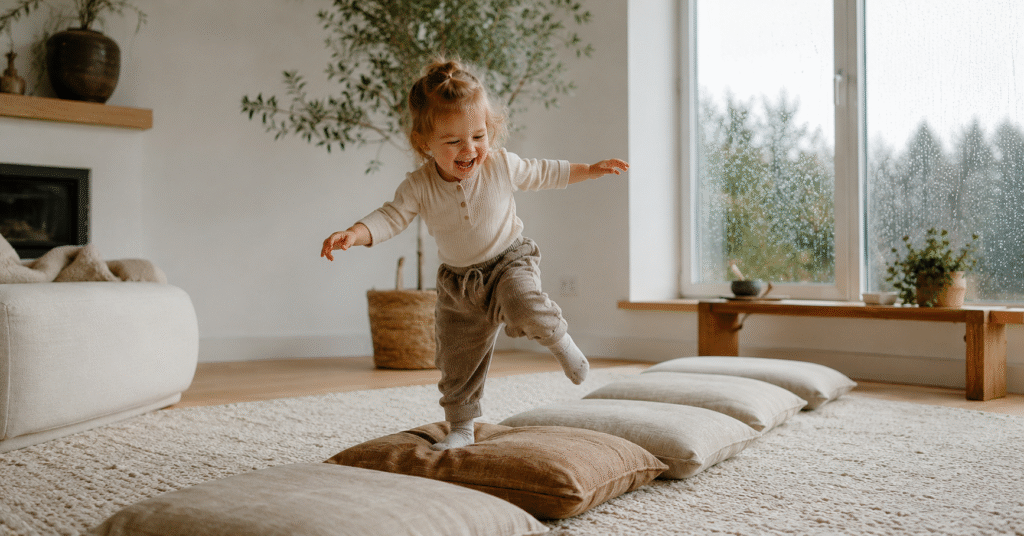
This is the heart of a rainy-day indoor setup, and it’s the one most worth your two minutes of effort. Pull the cushions off the sofa and turn the floor into something to be navigated. A row of cushions becomes stepping spots. A couch cushion leaned against an ottoman becomes a hill to scramble up. Add a “tunnel” by draping a blanket over two dining chairs, a “balance beam” with a line of painter’s tape on the floor, and a soft target to jump onto at the end.
Then give it a story, because a course is just furniture until it has stakes. The floor is lava and the cushions are the only safe rocks. The blanket tunnel is a cave. The tape line is a bridge over a river of crocodiles. Toddlers will run the same loop fifteen times if there’s a narrative pulling them through it, and every lap is climbing, jumping, balancing, and crawling stacked together.
Change one element each time they start to lose interest. Move a cushion, add a “don’t touch the walls” rule, make them carry a stuffed animal through to safety. Small changes reset the whole game for free.
4. Balloon Keep-It-Up
Blow up one balloon. The single rule: don’t let it touch the floor. That’s it, and it will absorb a startling amount of energy, because a balloon falls slowly enough that a toddler can actually keep up with it, which means constant jumping, reaching, and lunging without the frustration of a ball that moves too fast.
Balloon safety, read this first: Un-inflated and broken balloons are one of the most serious choking and suffocation hazards there is for children under three, and a popped balloon can be inhaled in a way that’s very hard to clear. Only play with balloons when you’re in the room and watching. The second a balloon pops, find every piece and throw it away immediately, before your child does the thing toddlers do and puts a scrap in their mouth. If you have a child under three who still mouths everything, skip this one and pick another game on the list.
5. Tape Games on the Floor
A roll of painter’s tape is the cheapest movement toy in the house and it peels up without marking the floor. Lay out a hopscotch grid, a long wiggly line to walk heel-to-toe like a tightrope, a “river” two tape-lines wide to jump across, or a grid of squares for jumping color-to-color (use a few sticky notes for color targets). Tape a big X on the wall at jump height and challenge your kid to slap it.
This is the lowest-effort, longest-lasting setup of the bunch. The tape stays down for days, so it becomes the thing they wander back to on their own between everything else.
6. The Wind-Down That Saves Bedtime
Here’s the part most “burn their energy” lists skip, and it’s the one that decides whether the afternoon ends well. You don’t want a kid going from full sprint straight into a tantrum because their body is still revved with nowhere to put it. Build a deliberate off-ramp.
After the big-energy games, shift to slow, weighted movement: have them push a laundry basket loaded with books across the room, do “wall pushes” pretending to hold the wall up, carry something genuinely heavy-for-them from one room to another, or roll up burrito-tight in a blanket. That same heavy-work input now reads as calming rather than activating. If things are still wound tight by evening, our calm-down phrases for mid-meltdown moments pick up exactly where the physical wind-down leaves off.
When You Want to Invest: Indoor Movement Gear Worth the Space
You do not need any of this. I want to be clear about that before a single product link, because the section above will carry most families through most rainy days for free. But if your kid is the type who burns through homemade obstacle courses by lunchtime, or you just want a dedicated movement station that’s always set up, a few things earn their footprint. I’ve researched these against what reviewers consistently report and the brands’ own specs, and flagged the catch on each, including the age traps that the glossier roundups skip.
One note before the picks: indoor movement toys live or die on whether they actually stay put on your floor. The single most common complaint across this whole category is “it slid out from under my kid,” so I’ve paid attention to non-slip bases and which surfaces each one is rated for.
National Geographic Stepping Stones — Best All-Rounder
What it is: A set of hard-plastic stepping stones in bright colors, plus a spinner for color-jump games
Age: 3 and up (small enough at the edges to keep away from a mouthing baby)
Capacity: Rated up to roughly 150 lbs, so it long outlasts the toddler years
Base: Non-slip rubber bottom plus a textured top surface, designed for indoor or outdoor use
The catch: Buy the hard-plastic version, not the soft-foam one. National Geographic sells a foam set under a nearly identical name that the maker says is for carpet or outdoors only and not for hard or slick floors. On a rainy indoor day on hardwood or tile, that’s the wrong one.
Best for: turning “the floor is lava” into a real, repeatable setup that stores in a stack and survives years of jumping.
If you only get one movement toy, this is the one I’d point a friend toward. It takes the single best free game on the list and gives it durable, predictable footing, which matters more than it sounds, because the homemade cushion version slides and collapses in ways that occasionally end in tears. The spinner adds just enough structure to turn aimless jumping into a game with a goal, and the hard-plastic stones grip an indoor floor the way the foam version can’t. This is solidly an over-three product, so in our house it belongs to my older son; the edges and the spinner pieces are not something I’d hand a younger toddler.
Playz Extra-Large Play Tunnel — Best for Crawlers and Younger Toddlers
What it is: A single oversized pop-up crawl tunnel with a roughly 21-inch opening, folds flat into a carry bag
Age: Tested as safe from 12 months and up, which is unusual; most tunnels start at 36 months
Material: Breathable, tear-resistant polyester
The catch: Like all spring pop-up tunnels, it takes a couple of tries to learn the fold-down-into-the-bag move, and the balls you see in some photos aren’t included. It’s a tunnel, not a ball pit.
Best for: the under-two crowd who burn energy by crawling, and households that need it to disappear into a closet between uses.
This is the one product on the list that fits a younger toddler, which is exactly why it’s here. My youngest is at the stage where crawling at speed is the workout, and an extra-large tunnel turns a hallway into a destination. The 12-month rating is the real differentiator; most crawl tunnels are built for older kids, so finding one tested for the crawling age is genuinely useful. It’s also the cheapest thing in this section by a wide margin, which makes it a low-risk first purchase if you’ve never bought a movement toy before.
National Geographic Stepping Stones & Balance Beams — Best Upgrade
What it is: A 12-piece set with four stepping stones plus four straight and four curved beams, with foam dice and game cards to drive the play
Age: 3 and up (small parts; choking-hazard rated, so not for under-threes)
Capacity: Hard plastic, non-slip rubber bases, supports up to about 150 lbs
The catch: The rubber bases grip well on a dry floor but the maker says not to use them on wet surfaces, which is a non-issue indoors as long as the floor’s dry.
Best for: the kid who’s already mastered plain stepping stones and is ready for connectable beams and a built-in dice game.
Think of this as the stepping stones with a second act. The added beams, straight and curved, let your child build an actual winding path to walk heel-to-toe rather than just hopping spot to spot, which is a real step up in balance difficulty. The foam dice and cards matter more than they look: they turn the set into a game with rules, and a game with rules holds a preschooler’s attention far longer than open-ended pieces do. Same trusted line as the basic stepping stones and the same over-three age fit, so this is older-son territory in our house too.
Tiny Land Foam Climbing Blocks — Optional Premium Pick
What it is: A 6-piece modular soft-foam set (stair block, ramps, wedges, a play mat) you reconfigure for climbing, crawling, and sliding
Age: Babies and toddlers; low and soft, designed for the pre-climbing-frame stage
Cover & base: Removable, machine-washable velvet cover over high-density foam, Velcro connections and a non-slip bottom rated for both hard floors and carpet
The catch: It’s the priciest thing here by a lot, it takes real floor space, and an active kid can outgrow the gentlest pieces fast. This is a playroom investment, not a rainy-day impulse buy.
Best for: families building a permanent soft-play corner, or with a young toddler who needs something safe to climb that isn’t the furniture.
I’ve put this last and labeled it optional on purpose, because at this price it’s a real decision rather than a casual add-to-cart. What it does well is give a younger toddler a sanctioned place to climb, which is the whole point if yours has decided the back of the couch is Everest. The washable cover is the feature parents end up most grateful for, and the non-slip base is genuinely rated for hard floors, unlike a lot of cheaper foam sets that slide around. If you want this category on more of a budget, the ECR4Kids SoftZone line is the one most often named as the benchmark, and worth a look before you commit.
One product I’d steer you to research carefully rather than recommend outright: the mini toddler trampoline. It’s the first thing most parents reach for to burn energy, but the American Academy of Pediatrics discourages home trampolines under age six, and that changes the math. I dug into where the actual risk lives and which models reduce it in our honest guide to toddler trampolines with safety rails before you buy one. For climbing specifically, a foldable Pikler triangle is the more pediatrician-friendly option, and once the rain clears, a balance bike takes all this gross-motor energy outside.
Building a Rainy-Day Rhythm That Actually Works
The mistake I made early on was treating a rainy day as one long block to fill, which is exhausting and doomed. What works far better is short, repeated bursts. Toddlers don’t do marathons; they do sprints. Fifteen to twenty minutes of real movement, then a quieter activity, then back to movement an hour or two later when the wiggles rebuild.
So a realistic afternoon looks less like “two-hour obstacle course” and more like: animal walks before lunch, tape games while you make food, a cushion course in the mid-afternoon slump, and a heavy-work wind-down before dinner. You’re rotating, not performing. And you do not have to be on the floor for all of it; plenty of these run while you supervise from the couch with a coffee, which on day three of rain is not nothing.
Quick Questions Parents Ask
How do I burn toddler energy in a small apartment?
Lean on the activities that go vertical and in-place rather than the ones that need a running start. Animal walks, balloon keep-it-up, freeze dance, and a tape X on the wall to jump and slap all work in a tiny footprint. Of the gear, the play tunnel and the stepping stones store flattest and need the least permanent floor space.
My toddler gets wild instead of tired. What am I doing wrong?
Usually nothing, except stopping at the fun part. Big, fast, exciting movement revs kids up first; the calming comes from the slow, heavy, pushing-and-carrying work that should come after. If your little one tips into over-excited rather than worn-out, you likely need more wind-down at the end and a slightly earlier off-ramp, not more high-energy play.
What age is this for?
The free activities scale from about one through the preschool years; you just dial the difficulty up or down. On the gear, watch the age ratings: the play tunnel suits the youngest crowd from around a year, while the stepping stones and balance beams are firmly over-three because of small parts. Match the toy to the kid, not the other way around.
Want a rainy-day plan you don’t have to invent on the spot?
Grab our free screen-free activity printable, a grab-and-go list of indoor movement games sorted by energy level, so the next gray afternoon is already handled.