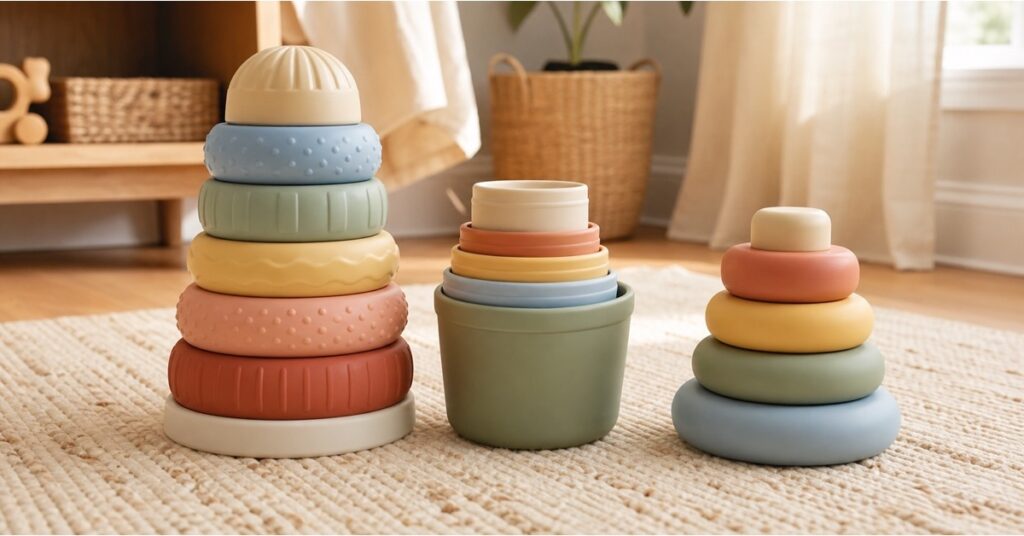
Short answer: The Sassy Stacks of Circles is the best all-around stacking toy for most babies starting at 6 months because its straight post accepts the rings in any order. For cups, choose The First Years Stack & Count if you want a low-cost set for floor and water play, or Moonkie Stacking Cups if soft silicone matters more than easy separation.
The best stacking toy is the one that matches what your baby can do now. A 6-month-old usually needs easy-to-grasp pieces for holding, mouthing, banging, and dropping. A baby closer to 10 months may be ready to nest cups with help. Spinning stackers make more sense around the first birthday, when a longer post and moving discs are less overwhelming.
For this update, I compared current exact listings, manufacturer details, age labels, safety records, current availability, independent market data, and recurring low-star feedback. Seven products made the final list; several popular-looking options were removed because they missed the age, demand, product-intent, or safety screen.
Best Stacking Toys for Babies: Quick List
| Best for | Pick | Starts | Price band | Main trade-off |
|---|---|---|---|---|
| Best overall | Sassy Stacks of Circles | 6 months | $ | Keep it out of the bath; some pieces can hold water |
| Budget cups | The First Years Stack & Count | 9 months | $ | Smaller and more precise to stack than photos suggest |
| Two-toy value | Fisher-Price Blocks & Rock-a-Stack | 6 months | $$ | Shape-sorter lid rests on the bucket instead of locking |
| Compact nesting cups | Mushie Stacking Cups | 10 months | $$ | Hard PP plastic, not silicone |
| Soft silicone cups | Moonkie Stacking Cups | 6 months | $$ | Cups can wedge together; inspect often for tears |
| Premium spinning stacker | Fat Brain Toys SpinAgain | 12 months | $$$ | Long removable post and a premium price |
| Lower-cost spinner | JUXUE Spinning Stacker | 12 months | $$ | Light base can tip during stacking |
Choose by Age and Play Stage
| Stage | What play often looks like | What to look for | Best match here |
|---|---|---|---|
| 6–9 months | Grasping, mouthing, banging, dropping, knocking down | Chunky pieces, forgiving openings, low base, easy inspection | Sassy, Fisher-Price, Moonkie |
| 9–12 months | Putting objects in and out, early nesting, deliberate release | Clear size differences, cups that separate without a struggle | The First Years, Mushie |
| 12 months+ | Repeating cause and effect, taller towers, more accurate placement | Stable floor setup, moving parts that reward repetition | SpinAgain, JUXUE |
The current CDC 18-month milestone guidance includes simple toy play and putting objects in and out of containers, but it does not use a specific block count as a formal milestone. If stacking is not happening yet, model one action at a time—take off, put on, drop in—then let your baby decide what comes next.
Rings, Cups, or a Spinning Stacker?
| Type | Choose it when… | Skip it when… |
|---|---|---|
| Stacking rings | You want the clearest grasp-and-release task and an easy first tower | Your baby is frustrated by order-dependent pieces or narrow posts |
| Nesting cups | You want one compact toy for stacking, hiding, pouring, and bath or sand play | You want a tower that stands easily without careful alignment |
| Spinning stacker | Your child is 12 months+ and loves repeating a visible cause-and-effect action | Your child swings long pieces or gets upset when a base comes apart |
7 Best Stacking and Nesting Toys for Babies
1. Best Overall: Sassy Stacks of Circles
Sassy solves the most common first-stacker problem: the center openings are the same size, so a baby can place the rings in any order. There is no tapered post that silently turns the activity into a size-sequencing puzzle before a baby is ready. The rings are chunky, varied in texture and weight, and one clear ring contains beads for a visual-and-sound response.
That forgiving design is why this is the strongest all-around starting point. At first, the play may be nothing more than taking rings off and mouthing the textures. Later, the same set supports deliberate placement and simple size comparison. It is also colorful enough to be easy to track on the floor without relying on a noisy electronic reward.
The trade-offs are real. The smaller rings can look very similar in size, and the empty base is lightweight. Low-star feedback also includes occasional fit, finish, and water-entry complaints. Treat it as a dry floor toy rather than a bath stacker, and inspect the edges and hollow pieces when it arrives.
Best for: a forgiving first ring stacker from 6 months.
Skip if: you specifically want silicone or a toy for water play.
Main trade-off: easy any-order stacking, but less useful for teaching a precise largest-to-smallest sequence.
2. Best Budget Cups: The First Years Stack & Count Cups
If you want one inexpensive set that can move from the play mat to the bathtub, start here. The eight graduated cups stack into a tower, nest for storage, hide small objects underneath, and use different bottom openings to change the way water pours. Large numbers on the bases add a counting prompt later without interfering with the basic play now.
The holes are useful, but they do not make cleanup automatic. Empty every cup, rinse it, and let the pieces dry completely after water play. The cups are also smaller than many parents expect from the photos, and the tower needs more precise alignment than a wide ring stacker. A baby may spend months happily nesting, scooping, and knocking the cups down before building the full tower.
If your baby tries to push every small object deeply into their mouth, stay close and judge the smallest cup carefully before handing over the complete set. The manufacturer’s minimum age is 9 months. For a broader bathroom setup, see our baby bath essentials guide.
Best for: families who want the most play patterns for the lowest price.
Skip if: you want large cups or a tower that balances with very little precision.
Main trade-off: excellent versatility and storage, but the compact size surprises some buyers.
3. Best Two-Toy Set: Fisher-Price Baby’s First Blocks & Rock-a-Stack
This bundle is the most practical gift pick because it covers two different actions without asking a baby to master either one immediately. The Rock-a-Stack has five rings and a rounded base that rocks when batted. The block bucket adds ten chunky shapes for holding, dumping, filling, and—later—matching through the sorter lid.
For a younger baby, the value is in taking pieces out and watching an adult put them back. By the end of the first year, rings can go onto the post and blocks can go into the bucket. Shape matching usually becomes interesting later, so the set has more runway than a single-purpose tower. The handle also gives the pieces a storage home.
The lid is the biggest design compromise: it sits on the bucket rather than clicking firmly into place. A baby can simply lift it off instead of using the shape holes, which is convenient for fill-and-dump play but less satisfying if you expected a locked sorter. Check the package on arrival, too; some low-star complaints focus on fulfillment condition rather than the design itself.
Best for: a baby-shower or first-birthday gift that spans several play stages.
Skip if: you want a shape-sorter lid that locks onto the bucket.
Main trade-off: more long-term variety, but also more loose plastic pieces to store.
4. Best Compact Nesting Cups: Mushie Stacking Cups
Mushie’s cups are the tidy, quiet option for a small play space or diaper bag. The eight cups collapse into a compact stack and use subdued colors and embossed bottom patterns instead of bright rainbow plastic. Mushie’s current product page lists food-grade polypropylene plastic—not silicone—and a starting age of 10 months. It also says the set is free of BPA, BPS, PVC, and phthalates and tested to CPSIA, ASTM, and Prop 65 requirements.
The material distinction matters. These cups are lightweight and rigid. They do not flex like silicone, and they are not meant to double as a soft teether. Recurring low-star comments describe the tower as easier to knock over than expected and the rims as less forgiving than rounded silicone. On the positive side, PP plastic does not grip itself, so the nested cups are easier to separate than soft silicone cups that wedge together.
The official care guidance allows warm soapy water or the top rack of the dishwasher. Dry the pieces before nesting them for storage. If muted colors are the main appeal, this set earns its place; if you want the easiest tower for a brand-new stacker, Sassy is more forgiving.
Best for: compact storage, quieter colors, and easy cup separation.
Skip if: you expect soft silicone or want a chewable stacker.
Main trade-off: neat and lightweight, but the rigid cups need careful alignment.
5. Best Soft Cups: Moonkie Stacking Cups
Moonkie is the soft alternative in this list. The seven cups flex when squeezed, make less noise when dropped, and have raised textures plus different openings for pour-and-drain play. The current listing describes the material as food-grade silicone and says it is free of BPA, PVC, and phthalates. That makes the set appealing during the stage when nearly every toy is explored with the mouth—but the condition of the material matters more than the marketing label.
Silicone has two predictable drawbacks. First, the cups can grip and wedge inside one another, making them surprisingly hard for a baby—and sometimes an adult—to pull apart. Second, low-star feedback includes repeated reports of cracking or tearing after use. Inspect the rims, textured areas, and openings before and after play. Remove and discard any damaged cup immediately; do not keep a torn piece in the rotation as a teether.
They are also not the best floating bath cups because silicone is heavier than thin plastic. Choose them for softness and quiet floor play, not because you expect them to behave exactly like The First Years set in the tub.
Best for: babies who benefit from soft, quiet pieces and varied textures.
Skip if: you want cups that separate effortlessly or float well.
Main trade-off: soft silicone is gentler when dropped, but it can stick to itself and needs frequent damage checks.
6. Best Premium Spinner: Fat Brain Toys SpinAgain
SpinAgain turns stacking into a visible cause-and-effect loop. Each shaped disc twists down the corkscrew-style post instead of simply dropping. When the post is lifted from the base, the discs can tumble off and the sequence starts again. The base can be flipped for a steadier or wobblier setup, so the same toy can feel different without adding more pieces.
This is the splurge pick because the movement is the point, not because it teaches a clinically special skill. It suits a child who already places objects deliberately and likes repeating the same action to see the same result. Fat Brain’s current listing starts at 12 months and describes coated ABS plastic.
The central post is long and removable. Low-star feedback repeatedly notes that the post and base separate when a child tries to carry the completed tower, and some children become more interested in the post than the discs. Set it up on the floor, keep an adult nearby, and put it away if your child is swinging the post. The finished tower is not meant to be carried as one unit.
Best for: 12-month-olds and toddlers who love repeated motion and visual cause and effect.
Skip if: your child swings long objects or gets frustrated when a base comes apart.
Main trade-off: the most satisfying spinning action here, at the highest price.
7. Best Lower-Cost Spinner: JUXUE Spinning Stacker
JUXUE offers the same basic spiral-down payoff at a lower price than SpinAgain. Six two-tone discs rotate down the threaded post, and the base can be flipped between a steadier and a wobbling orientation. It is a clear next step after ordinary rings for a child who wants more movement from the action.
The lower price comes with a less substantial feel. Recurring low-star comments describe the base as too light, the tower as easy to tip, and the post as coming away from the base under the weight of the discs. The 14-inch post is also long enough to become a wand in a toddler’s hands. Use it seated on the floor and within reach of an adult, especially during the first few sessions.
The listing uses phrases such as “Montessori” and “autism sensory toy.” Those are marketing terms here, not a clinical endorsement and not a reason by themselves to choose it. The practical reason to buy it is simpler: your child likes spinning cause-and-effect play, and the premium option costs more than you want to spend.
Best for: a lower-cost introduction to spiral spinning play at 12 months+.
Skip if: base stability or a firmly attached post is your top priority.
Main trade-off: strong play value for the price, but lighter construction than SpinAgain.
What I Left Out—and Why
A popular product does not automatically belong in a best-of list. I removed one soft ring stacker after finding a serious consumer incident tied to the exact ASIN. I also removed a multifunctional castle-cup set after a low-star report described a child’s finger becoming trapped in an opening. A fine-motor hedgehog from the previous version of this guide was cut because placing pegs into a shell is not the same shopping intent as stacking or nesting.
Several attractive wooden and minimalist options also missed the final cut because of age mismatch, weak current exact-child demand, or recurring complaints about sharp edges, splinters, paint wear, narrow posts, or small toppers. The goal is not to fill seven different aesthetic categories. It is to give you seven choices that answer the actual question.
Stacking Toy Safety and Care
- Use the current age label. Retail titles and old reviews can lag behind updated manufacturer guidance.
- Inspect before every mouthing session. Look for tears, cracks, rough seams, loose beads, warped openings, or a base that no longer holds as designed.
- Dry water toys completely. Drain, rinse, and air-dry cups separately before nesting them for storage.
- Keep long posts at floor level. Sit nearby for spinning stackers and stop the activity if the post is being swung, carried in the mouth, or used for hitting.
- Do not improvise a legal small-parts test. The CPSC uses a regulated small-parts cylinder; a household tube is only a rough conservative screen. See the CPSC small-parts guidance for the actual standard.
Frequently Asked Questions
When do babies start stacking toys?
Many babies first explore a stacker by removing pieces, mouthing them, banging them together, dropping them, or knocking down a tower an adult built. Deliberately placing pieces usually comes later and varies widely. Offer the toy at its labeled age, model one simple action, and let play—not a block count—guide the session.
Are stacking rings or cups better for a 6-month-old?
A forgiving ring set with chunky pieces is often easier for early grasp-and-release play. Cups offer more ways to play but may require better alignment to build a tower. For this age, Sassy is the easiest dry-floor choice; Moonkie is the soft-cup choice if you are willing to inspect silicone carefully.
Are silicone stacking cups safer than plastic?
Material alone does not make a toy safer. Soft silicone hurts less when dropped, but it can tear, grip other pieces, and collect debris. Rigid plastic can be easier to clean and separate, but edges and seams still need inspection. Follow the exact product’s age label, care instructions, and damage warnings.
Can stacking cups go in the bath?
Only if the current manufacturer instructions allow water play. Drain and dry every piece after use. Do not assume a ring stacker belongs in the tub just because some pieces look washable; hollow rattles and bases can trap water.
How many stacking toys does a baby need?
Usually one simple ring stacker or one cup set is enough to begin. Add a spinner later only if your child enjoys repeated cause-and-effect play. Different colors are not a different developmental category, so choose distinct play patterns instead of collecting near-duplicates.
The Bottom Line
Choose Sassy Stacks of Circles if you want the easiest first ring stacker, The First Years if you want the most play for the least money, and SpinAgain only when your child is ready for a longer post and a more complex spinning payoff. The right toy is not the one with the tallest tower or the most pieces. It is the one your baby can explore safely at the stage they are in now.