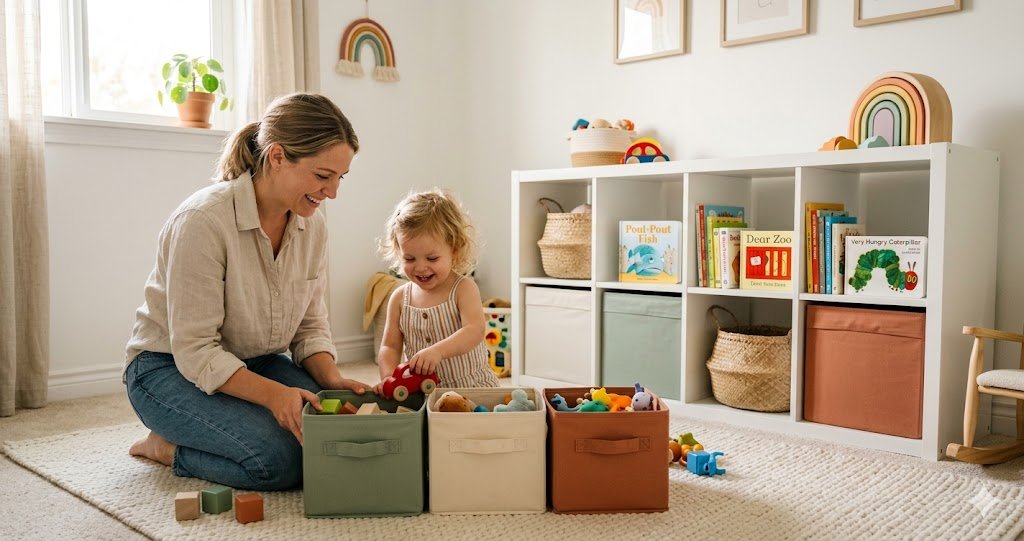
The Best Nursery Storage Bins & Toy Organizers, Sorted by How Kids Actually Play
Toy clutter is sneaky. It starts with a few rattles in a basket, and somewhere around the second birthday you look up and the living room floor is a minefield of blocks, board books, and one very loud xylophone. Across three kids and about a decade of stepping on stray Duplo at 6 a.m., I’ve assembled, filled, re-sorted, and ruthlessly downsized more bins, baskets, and cubbies than I can count.
This guide is the version I wish I’d had at the start. Instead of “here are ten products,” I’ve organized it around how kids in different stages actually use their stuff — because the right organizer for a crawling baby is almost never the right one for a block-obsessed three-year-old. Every pick below cleared a hard bar: solid ratings from a meaningful number of reviewers, a real track record on the shelf, and a design I’d actually trust in a room with small humans in it.
What actually matters when you’re buying toy storage
Before the picks, a few selection principles I’ve learned the messy way. These matter more than color or price.
Open bins beat deep boxes for little kids
One thing Montessori-minded parents and play experts tend to agree on: when toys are visible and reachable, kids play with them more intentionally and, the part you care about, put them away more readily. A deep toy chest swallows everything into one jumbled pile, so the bottom third never gets touched. Low, open bins let a toddler see the dinosaurs, grab the dinosaurs, and (eventually, with reminders) return the dinosaurs. That’s why most of my picks lean toward shelves-with-bins rather than one giant box. (It’s the same logic behind our Montessori playroom setup for small spaces, where visible, low storage does a lot of the heavy lifting.)
Anything tall has to go on the wall
This is non-negotiable. Furniture tip-overs are a leading cause of preventable injury and death for young children, and the U.S. Consumer Product Safety Commission’s Anchor It! campaign exists precisely because kids climb. Every freestanding shelf below ships with an anti-tip strap — but use a wall anchor screwed into a stud, and treat the included plastic tip kit as a starting point, not the final word. (CPSC has even recalled certain plastic tip-restraint kits whose ties became brittle and snapped.) Two minutes with a drill buys a lot of peace of mind. In our house, my husband and I keep a standing rule: nothing freestanding counts as set up until it’s screwed to a stud. (If you’re early in the baby-proofing process, our guide to the best baby gates covers the other half of a climb-proof room.)
Skip the heavy hinged lid
Traditional wooden toy chests with a heavy drop lid are exactly the category that shows up in finger-entrapment and suffocation recalls. If you want a “toss it in” box, choose a soft-sided or lidless design, or one with a safety-hinged lid that won’t slam. None of my box picks below use a heavy hard lid, and that’s on purpose.
The picks
Humble Crew Toy Storage Organizer (12-Bin, 4-Tier)
If you buy one thing, make it a classic bin-shelf like this. It’s one of the most-reviewed organizers in Amazon’s Toy Chests & Organizers category for a reason: the four angled tiers put bins at toddler eye level, the bins lift out so your kid can carry “the car bin” to the rug and back, and the whole thing reads neutral enough to live in a shared living room. The frame is engineered wood reinforced with steel rods, each level holds a sensible amount of weight, and the plastic bins are BPA- and phthalate-free.
Good to know: 4 tiers, 12 removable bins (standard + large) · engineered wood + steel dowels · rounded corners · anti-tip kit included. A 16-bin version exists if you need more room.
Where it falls short: reviewers consistently note two things. The bins aren’t locked in, so a determined toddler can pull a whole bin out and dump it (that’s the trade-off for easy access). And a few standard bins run shallow, so oversized trucks or large stuffies fit better in the large bins. Assembly is straightforward but not instant — budget 20 minutes.
SpaceAid Toy Storage Organizer (6 Shelves + 12 Bins)
This is the one I’d point a “we have toys and books and zero system” family toward. It combines open side shelves (great for board books face-out, which is how toddlers actually choose a book) with a bank of removable bins for everything else. It’s built from solid pine rather than the usual particleboard, and the front-extended base is designed to resist tipping before you even reach for the anchor.
Good to know: ~52″ wide · solid pine construction · rounded edges + front-extended stability base · comes in several color and bin-count variations (9, 16, 24 bins).
One catch: solid wood means it’s heavier and has more assembly steps than a lightweight unit, and it sits at the higher end of this list on price. It’s also a newer release, so the long-term review history is still building — though early feedback skews strongly positive.
SoftOwl Extra-Large Collapsible Toy Chest
Sometimes you just need somewhere to fast-dump the bulky stuff — ride-on toys, big plush, the foam blocks. This soft-sided chest is my pick for that job specifically because it isn’t a hard wooden box. The lid is soft, there are internal dividers if you want a little order, and the whole thing collapses flat when you’re between life stages. At roughly 37 inches long, it genuinely holds a lot.
Good to know: ~37″ × 16″ × 14″ · collapsible fabric · soft lid (no slam-down hinge) · internal dividers.
Just know: fabric boxes flex. Loaded with heavy toys, the sides can bow outward, and a soft lid won’t keep dust out the way a rigid one would. It’s a catch-all, not a precision organizer — pair it with bins for the small stuff. Stock on the exact colorway can also be limited, so grab it when you see it.
DECOMOMO Fabric Storage Cubes (6-Pack)
If you already own (or are eyeing) a cube shelf — the ubiquitous IKEA Kallax-style grid is in half the nurseries I’ve seen — these are the bins to fill it with. They’re a clean, neutral fabric cube with two side handles and, crucially, a little label holder on the front so “books” stays books. DECOMOMO is a Canada-based brand that’s been doing storage since 2017, and the fit in standard cube cubbies is reliably good.
Good to know: 6 cubes · ~10.5–11″ sizing (also sold in 11/12/13″) · side handles + front label pocket · fits IKEA Kallax/Expedit and similar grids.
The trade-off: this particular set is the lighter non-woven style, so empty cubes won’t stand perfectly rigid the way a metal-framed bin would. If you want them to hold shape under weight, DECOMOMO also makes a sturdier metal-frame version worth the small upcharge. Expect minor color variation between batches.
Sorbus Foldable Fabric Storage Cubes (6-Pack)
For a playroom where color is the point — or where you want to sort by kid or category at a glance — these bright, lightweight cubes are hard to beat on value. They pop into shape in seconds over a cardboard floor insert, have sewn-in handles small hands can grab, and come in cheerful multicolor sets that double as a sorting game (“red bin = cars, green bin = animals”).
Good to know: 6 cubes · ~10.5″ × 10.5″ × 11″ · non-woven polypropylene with cardboard base insert · multicolor options.
Where it’s lighter-duty: the cardboard floor is the weak link — keep these away from spills and bath-adjacent zones, because a soaked base loses its structure. They’re lighter-duty than the DECOMOMO or a framed bin, which is the honest cost of the lower price. Great for toys and books; not where I’d store anything heavy.
STARSIKO XL Toy Storage Organizer with Play Mat
This one solves a very specific, very real problem: the great Lego/Magna-Tiles explosion. It’s a single oversized fabric cube attached to a play mat — your kid builds on the mat, and at cleanup you scoop everything back into the bin. It fits a standard 13×13 cube slot when you want it on a shelf, holds around 10 gallons, and (a detail I appreciate) it’s designed without a drawstring or cords, which sidesteps a real strangulation concern with some competing “bag” organizers.
Good to know: ~13″ × 13″ × 15″ · ~10-gallon capacity · detachable play mat · reinforced soft walls · no drawstring/cords.
Worth knowing: the play-mat-bag category is crowded with near-identical no-name versions, so you’re partly paying for a U.S. seller with a real review base. The single big compartment is a catch-all, not a sorter, and the mat’s attachment holds up variably with hard daily use. Best as a dedicated brick station, not your whole system.
Which one is right for your stage?
Baby (0–12 months)
You need less than you think. When my daughter was a baby (she’s nearly six now, so I’m reaching back a bit), the winning setup was just two or three plain fabric cubes (no particular brand, nothing fancy), within arm’s reach of the play space: one for soft toys, one for board books, one for the rotating “toy of the week” (often one of our favorite stacking and nesting toys at that age). A full bin-shelf is overkill at this age and a tip hazard the moment they pull to stand. Start with a couple of Sorbus or DECOMOMO cubes and grow into a shelf later.
Toddler (1–2 years)
This is peak grab-and-dump season. My youngest son, who’s a year and a half right now, treats every container as a challenge to empty. The trick at this stage is fewer, bigger, lower bins — not a fussy 12-compartment system he can’t manage. A short open shelf with a handful of removable bins, plus one soft box for the bulky stuff, covers it. Whatever you choose, this is the age to anchor it to the wall yesterday.
Preschooler (2–4+ years)
Now sorting becomes a teachable skill, and a real bin-shelf earns its keep. My older sons are deep in the “everything has 200 tiny pieces” era, and what works at this stage is two things together: an open bin-shelf for categories (blocks, cars, art, figures), and some kind of dedicated catch-all for whatever’s mid-build. Labels — pictures for pre-readers, words for new readers — turn cleanup from a meltdown into a game. (For the bigger-ticket play gear that lives alongside all this, see our honest take on foldable Pikler triangles.)
How to make any organizer actually work
The hardware is maybe 40% of the battle. The rest is the system:
- Fewer toys, visible. A toy rotation — keeping a third of the toys out and the rest stored out of sight, then swapping monthly — reduces clutter and, genuinely, increases focused play. Less is more.
- One bin, one category. “Miscellaneous” bins become black holes. Give every bin a clear job and a label.
- Cleanup at the child’s level. If your kid can’t reach it or lift it, they can’t be responsible for it. That’s the whole case for low, open, light bins.
- Make it a routine, not a battle. A consistent cleanup cue (a song, “five things before bath”) beats nagging every time.
For the developmental side of all this — why open access and independence matter — the American Academy of Pediatrics has solid, readable guidance on the power of play that shaped how I think about our own playroom.
FAQ
Are fabric bins or plastic bins better for kids?
Fabric cubes are lighter, quieter, and softer if dropped — great for little kids and for cube shelves. Plastic bins wipe clean and hold shape under weight, which is handy for heavier or messier toys. Most homes end up with both, and that’s fine.
Do I really need to anchor a short toy shelf?
Yes. Kids climb and pull, and even a low, loaded shelf can come down. Anchor anything freestanding to a wall stud, and don’t rely solely on a plastic tip-strap.
What about a classic wooden toy chest?
I’d skip the heavy hard-lid versions — they’re the design behind multiple finger-entrapment and suffocation recalls. If you love the toy-chest look, choose a soft-sided box or one with a slow-close, safety-hinged lid and ventilation.
How many bins do we actually need?
Fewer than the internet suggests. For most toddlers, 6–9 well-labeled bins plus one big catch-all box is plenty. More compartments than your child can mentally manage just creates more places to lose things.