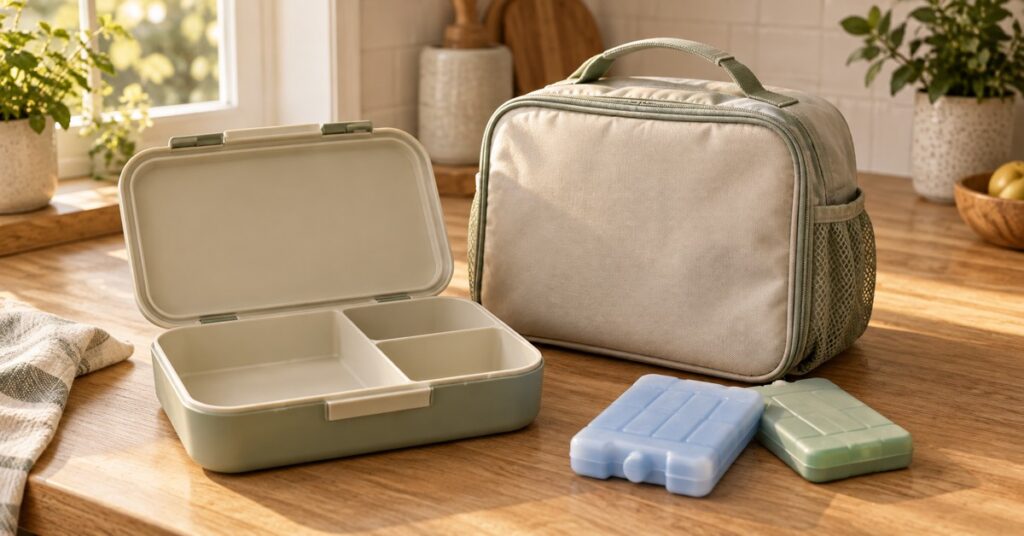
You cut the sandwich once, then cut it again to squeeze it into the lunch box. The fruit has nowhere to go. And tonight, the lid will need washing by hand before you can do this tomorrow.
I’d choose the box around the lunch you already pack. For a preschooler who eats several small portions, I’d start with Bentgo Kids. If a sandwich takes up most of the meal, I’d choose Yumbox Panino instead. You don’t need a bigger collection of containers to make lunch work. One suitable lunch box is enough unless your daycare asks for snacks packed separately.
Before buying, ask the center where food waits until lunchtime, whether staff help with lids, and whether they reheat meals. Those answers can change the purchase more than another compartment. Most of the Bentgo lunch options here and the b.box Mini are labeled for ages three and up; Munchkin’s Lunch Bento is labeled for eighteen months and up. A label doesn’t promise that your child can manage the latch or utensils alone. Follow the label on the box you buy and arrange help when needed.
| Your main need | Where I would start |
|---|---|
| Small, divided cold lunches | Bentgo Kids |
| A broad space for a sandwich | Yumbox Panino |
| More room and removable seals | b.box Mini |
| An ice pack kept below the tray | Bentgo Chill |
| A younger toddler needs utensils with the box | Munchkin Lunch Bento |
| One separately packed snack | Bentgo Kids Snack |
| Two snack times or two-box rotation | b.box Snack Box two-pack |
For small divided meals: Bentgo Kids
Bentgo Kids makes sense when lunch is a little of several things: small pieces of sandwich, soft cooked vegetables and some prepared fruit. Its five sections hold 2.4 cups altogether, but the largest section holds one cup. That main section is the number I’d pay attention to. It suits small divided meals; it isn’t the box I’d choose to stop squeezing in a larger sandwich.
The Dinosaur version is my starting point for that smaller meal, provided you can handwash the shell. The removable tray can go on the dishwasher’s top rack. Owner reports of sticking trays, worn latches and mold around seals are a reason to check those areas when washing, rather than assume a sturdy-looking case needs no attention. Let the box dry open. If handwashing a shell every evening already sounds unlikely, move on to the b.box Mini or Munchkin options below. Bentgo care details.
When a sandwich needs more room: Yumbox Panino
For sandwiches, the Yumbox Panino’s layout is more useful than simply adding more little compartments. Its main section holds two cups, alongside two smaller sections and a dip well. I would choose the Lavande Purple Unicorn Panino when you want room for the main part of lunch without rearranging everything around it. Bread sizes and fillings vary, so a tall roll still deserves a fit check.
Be careful with the name: Yumbox Original divides its tray into more small sections. It doesn’t give you the same broad sandwich space, and the two trays aren’t interchangeable. If your Original already fits what your child eats, keep it. Panino is a reason to change only when that layout is getting in the way.
Panino’s shell needs handwashing; only the tray belongs on the dishwasher’s top rack. It also cannot go in the microwave. Leave the tray and shell apart to dry before putting them away. I would buy it for the main compartment, not because I expect it to be the easiest box to clean. Use the sealed sections for suitable thicker foods, such as dips, rather than soup or other thin liquids. Yumbox use and care.
For a bigger meal and removable seals: b.box Mini
The b.box Mini is where I’d turn if you want more room and prefer seals you can remove for washing. Despite its name, it holds about one liter. A movable divider lets you adjust the main section instead of choosing a fixed layout every morning. That helps when lunch alternates between a wrap and several smaller foods.
The Ocean Breeze single box also avoids buying a second container before you know you need one. The compromise is that it is a deeper box: check your lunch bag with room left for cold sources. Only two sections are sealed for wet foods, and the divider doesn’t make every section liquid-tight. Keep thin liquids out.
You can take the seals out to reach the food underneath them. Wash the parts on the top rack at no more than 140°F (60°C), then dry and refit them. If a seal comes loose during lunch, a young child may need an adult to put it back. And the stretchy fruit section is a packing feature, not permission to send a whole apple to a toddler who needs fruit prepared differently. b.box care instructions.
If you want the ice pack under the tray: Bentgo Chill
Bentgo Chill is worth considering when you like having the ice pack tucked under the food tray. It stays with the box instead of floating loose in the bag. The Confetti Edition in Vivid Orchid has a larger, roughly three-and-a-third-cup tray than Bentgo Kids, with four compartments. Choose it for that cold-pack arrangement and meal size, not a promise that lunch will stay safe all day.
Perishable food still needs an insulated bag and two cold sources; the frozen built-in pack can be one. Refrigerate food on arrival if the center can. If you already have a bag and cold packs that work, you don’t need to replace the lunch box just to put one pack underneath it. The Chill’s shell and ice pack need handwashing, even though the removable tray can go on the top rack. FoodSafety.gov lunch guidance.
For utensils that stay with the box: Munchkin
For a younger toddler whose lunch needs a spoon or fork, Munchkin Lunch Bento is a practical alternative to a separate utensil pouch. The Green version includes a flat stainless steel fork and spoon that clip into the lid, plus five food compartments. Its eighteen-month label makes it relevant to families shopping before the usual preschool stage, but I would plan for adult help with opening and removing the utensils until the child can actually do both.
It is a substantial box, not my first choice for a child carrying everything independently. BabyGearLab also found weight to be a drawback. The included utensils are useful only if they are comfortable for your child; keeping a familiar spoon may matter more than having a matching set. BabyGearLab comparison.
Munchkin allows top-rack dishwasher washing, with an easily missed instruction: take out the silicone pad and wash the parts separately, then let them dry before reassembly. Do not microwave, boil or sterilize the box. I would use it for foods with little free liquid and keep wet food away from the utensil slots, following the manual. It isn’t my choice for soup or a loose, runny lunch. Munchkin Lunch Bento instructions.
Add a snack box only if you need one
If daycare asks for a snack separately, you have two sensible options here. Bentgo Kids Snack in Purple is the single-box choice. Its one-cup section and half-cup section are useful for two small foods without carrying a full lunch box. It is labeled for ages three and up. The tray can go on the top rack, while the shell needs handwashing. Owners have reported broken latches; check the closure before packing and stop using it if components are damaged.
Check Bentgo Kids Snack on Amazon
The b.box Snack Box two-pack, in Strawberry Shake and Lilac Pop, makes more sense when you need two snack times covered or want one box drying while the other is ready to pack. Each is a small, two-section snack container, about 350 milliliters. The silicone seals come out for washing. They also need to go back in correctly, so this doesn’t eliminate the evening reassembly.
I wouldn’t buy the pair just because it looks better value. If one snack box meets your needs, the spare may simply take up a cupboard. Neither of these small options should be treated as a full lunch box just because a toddler eats less than an adult. Pack the amount your child normally eats, without trying to fill every section. A small container you already own may be enough.
If lunch has to be hot, ask about storage first
I am not choosing OmieBox as the hot-food winner in this guide. Its integrated jar is appealing, but published results don’t give me enough confidence to recommend it as the default for a long wait until lunch. BabyGearLab reported an unsatisfactory four-hour hot-food result without identifying all the conditions needed to compare it with today’s model. That isn’t proof that every OmieBox performs poorly, and it doesn’t justify promising reliable lunchtime heat either. Read the test and its methods.
If a hot meal is essential, settle the storage and reheating arrangements with the center first. USDA advises keeping hot food at 140°F or above until mealtime. An adult should handle hot food and check that it is a safe temperature to eat before serving; holding temperature is not serving temperature. If meals can be refrigerated and reheated by staff, a cold-lunch container may be all you need. Follow its reheating instructions or have staff transfer the food to an appropriate dish. USDA packed-lunch guidance.
Whichever box you choose, prepare food for your child’s chewing skills and have an adult supervise eating while they sit upright. Avoid whole grapes, whole nuts, popcorn and hard raw carrot pieces for young children. An attractive product photo is not a toddler menu. Keep removable parts and damaged utensils out of a child’s mouth, and stop using a box with broken components. CDC choking-prevention guidance.
Try one ordinary packed lunch before daycare
Before sending a new box to daycare, pack one ordinary lunch in it. Put it in the actual bag with the cold sources. Then have your child try opening it at the table while you watch. Check whether the meal fits, the bag closes and an adult needs to help. If all three work for your day, you can stop shopping.